
IAE Academy

GATE 2018 EC Q.1: solution and answer

GATE 2018 · ECQ.1 · 1 mark · MCQ

Two identical nMOS transistors and are connected as shown below. The circuit is used as an amplifier with the input connected between G and S terminals and the output taken between D and S terminals. and are so adjusted that both transistors are in saturation. The transconductance of this combination is defined as while the output resistance is , where is the current flowing into the drain of . Let , be the transconductances and , be the output resistances of transistors and , respectively.

Which of the following statements about estimates for and is correct?
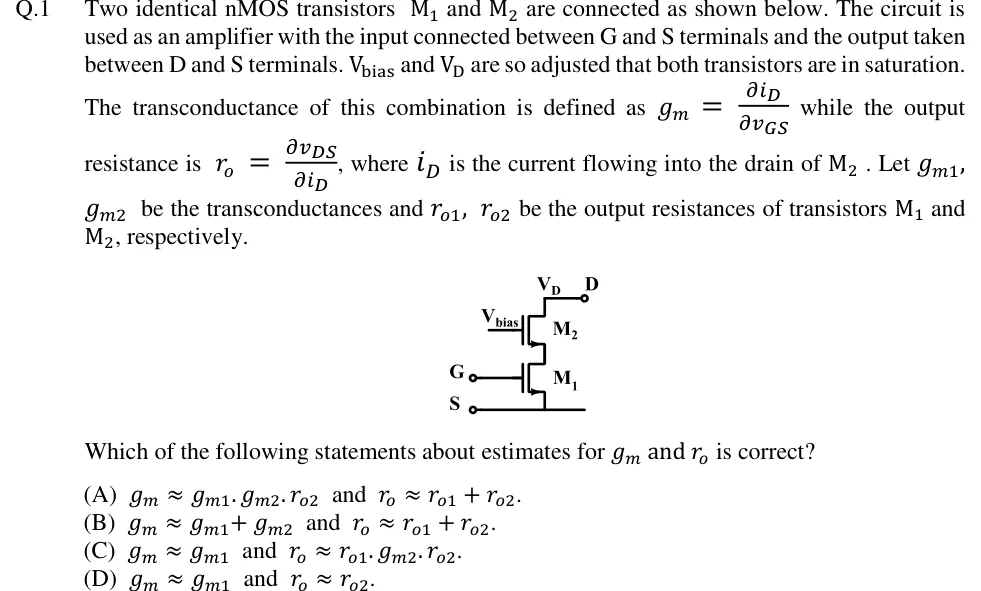
GATE 2018 EC question 1: Two nMOS transistors stacked in series (cascode).Tap to open full size
Figure from the GATE 2018 EC paper. It is part of the question.
Figure description

Two nMOS transistors stacked in series (cascode). Upper transistor M2: its gate is driven by a DC voltage labelled V_bias; its drain goes up to the output terminal labelled D, at voltage V_D. The source of M2 connects directly to the drain of lower transistor M1. Lower transistor M1: its gate connects to the input terminal G; its source connects to terminal S, which is the common (ground) rail running along the bottom. Input is applied between G and S; output is taken between D and S. Both transistors are drawn as enhancement nMOS with arrows on the source leads; the body connections are not drawn separately.

  1. (A)

    and .

  2. (B)

    and .

  3. (C)

    and .

  4. (D)

    and .

Answer and solution

ANSWER

(C) and .

Official answer: CSource: Official answer key, GATE 2018 EC (IIT Guwahati)

  1. Identify the circuit. is a common-source stage driven at G. has its gate at the DC voltage , which is an AC ground, so it is a common-gate stage stacked on top of . Together they form an nMOS cascode. Both devices are in saturation, so each one's small-signal model is a controlled current source (drain to source) in parallel with . Assumptions: body effect is neglected (no body terminals are drawn), and for each device.

  2. Let be the node joining the source of to the drain of , and let be its small-signal voltage. Since the gate of is at AC ground, . The current enters the drain of and flows down through and then to S. The same current flows in both devices.

  3. Transconductance (output shorted, ). The current through is so . This is small, because node looks into the source of and sees only about .

  4. The same current flows down through : . Substituting gives Almost none of 's signal current is lost in , so passes it through to the output.

  5. Output resistance (input shorted, ). With the controlled source of is off, so is just carrying : .

  6. Current through : , so . Substituting : The product term dominates because and .

  7. Result: and . This is option (C). A cascode keeps the transconductance of and multiplies its output resistance by the intrinsic gain of .

KEY IDEA

This is a cascode: is common-source and , with its gate at AC ground, is common-gate. Looking into the source of , node sees only about , so all of 's signal current reaches the output and . Looking down from the drain, is a transistor with source degeneration . That multiplies the resistance by 's intrinsic gain: .

WATCH OUT FOR

Adding the two output resistances in series (, as in (A) and (B)). That treats as a plain resistor. When rises, falls, and 's controlled source works against the change in current. That feedback produces the dominant term. Picking (D), , ignores altogether. Writing treats the devices as if they were in parallel, but they are stacked, carry the same current, and only is driven by the input.

From the GATE 2018 EC paper. Every question of this paper · Download the full paper · All 20 Amplifiers questions, with notes

More Amplifiers questions