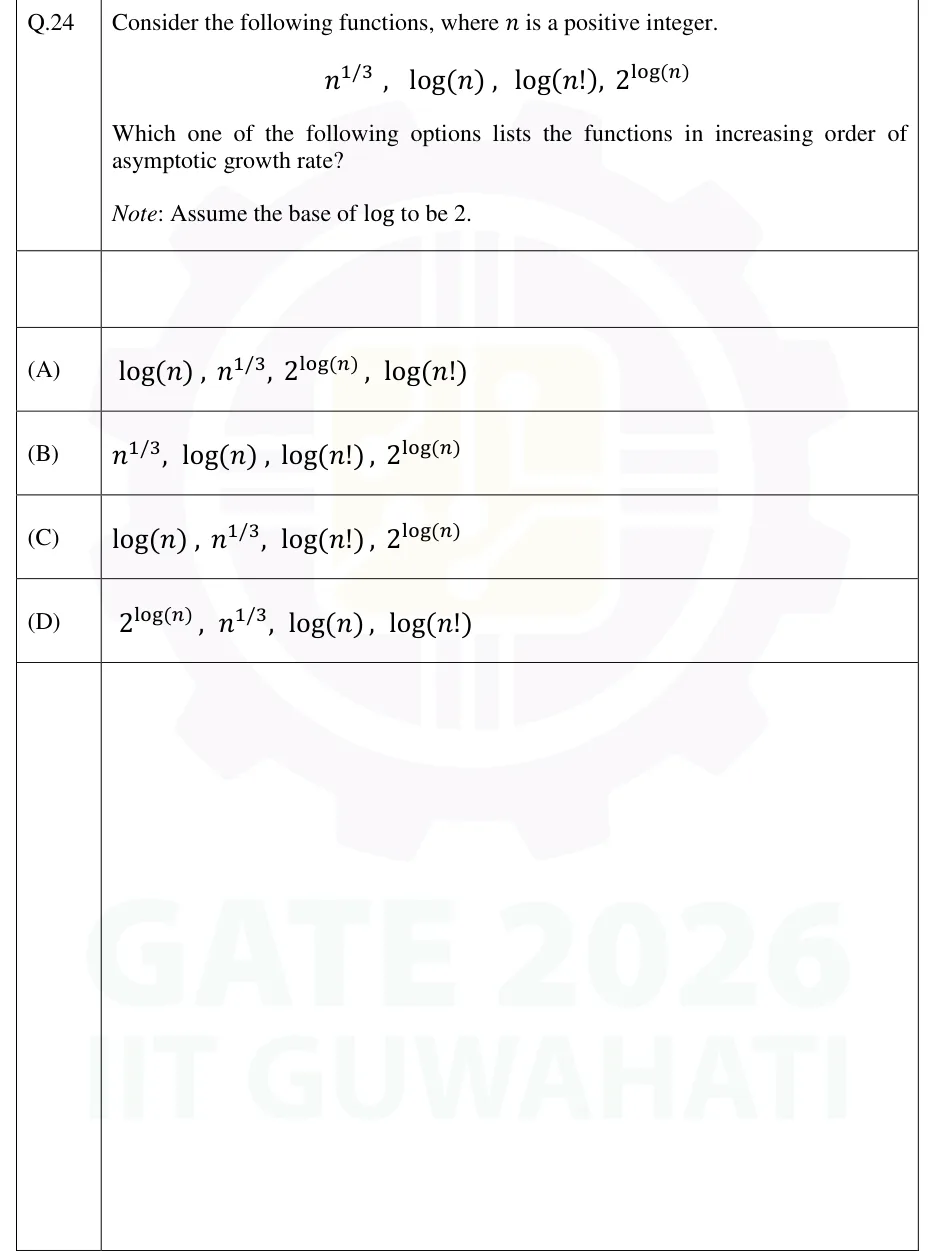
Consider the following functions, where is a positive integer.
Which one of the following options lists the functions in increasing order of asymptotic growth rate?
Note: Assume the base of log to be 2.
- (A)
, , ,
- (B)
, , ,
- (C)
, , ,
- (D)
, , ,

Consider the following functions, where is a positive integer.
Which one of the following options lists the functions in increasing order of asymptotic growth rate?
Note: Assume the base of log to be 2.
, , ,
, , ,
, , ,
, , ,
ANSWER
The correct answer is (A): log(n), n^{1/3}, 2^{log(n)}, log(n!) — in increasing order of asymptotic growth rate.
Official answer: ASource: Official answer key, GATE 2026 CS2 (IIT Guwahati)
Since the log base is given as 2 (per the note), by the definition of logarithm as the inverse of exponentiation.
grows slower than any positive power of (in particular slower than ), so it is the smallest of the four functions.
Since the exponent , . So grows more slowly than .
By Stirling's approximation, , which grows strictly faster than itself (since as ).
Combining all comparisons: .
This increasing-growth-rate order — — is exactly option (A).
KEY IDEA
Simplify each function to a standard growth class using and (Stirling), then order the resulting classes: .
WATCH OUT FOR
Forgetting that "log" here means log base 2 (as stated in the note) and mis-simplifying ; a common error is to treat as growing faster than (e.g., confusing it with or ), or to assume grows only like rather than by Stirling's approximation.
From the GATE 2026 CS2 paper. Every question of this paper · Download the full paper · All 14 Complexity questions, with notes