
IAE Academy

GATE 2020 EC Q.43: solution and answer

GATE 2020 · ECQ.43 · 2 marks · MCQ

For an infinitesimally small dipole in free space, the electric field in the far field is proportional to , where . A vertical infinitesimally small electric dipole () is placed at a distance () above an infinite ideal conducting plane, as shown in the figure. The minimum value of , for which one of the maxima in the far field radiation pattern occurs at , is
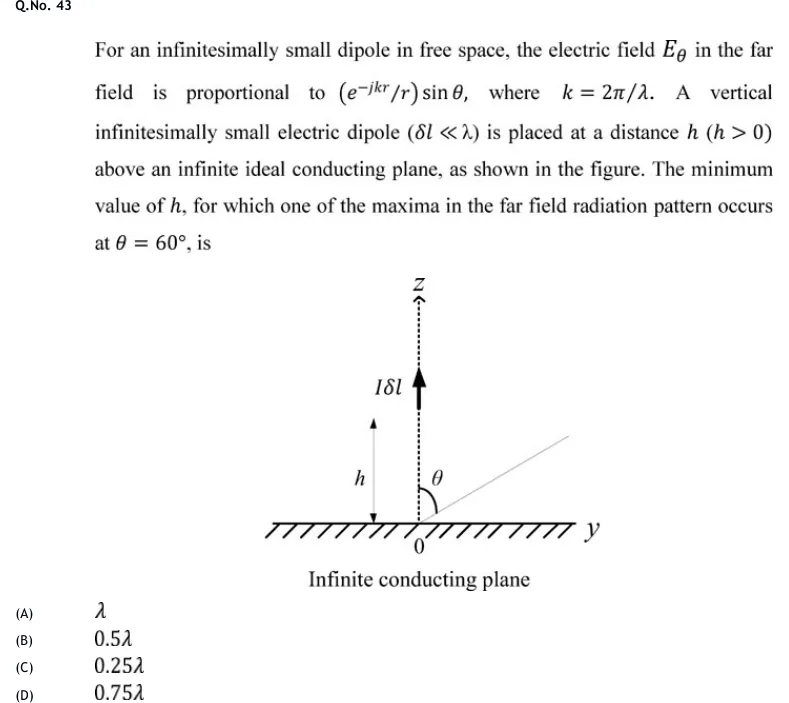
GATE 2020 EC question 43: A horizontal hatched line is the infinite conducting plane, labelled 'Infinite conducting plane' beneath it;Tap to open full size
Figure from the GATE 2020 EC paper. It is part of the question.
Figure description

A horizontal hatched line is the infinite conducting plane, labelled 'Infinite conducting plane' beneath it; the origin 0 is marked on it and the horizontal axis to the right is labelled y. A dotted vertical line rises from the origin and is labelled Z at the top, with an arrowhead. On this z-axis, at height h above the plane, sits a short upward arrow labelled I delta l (the vertical current element, pointing in +z). A double-headed vertical arrow to the left, running from the plane up to the dipole, is labelled h. A thin straight line leaves the origin up and to the right into the first quadrant (the observation direction), and the angle between it and the vertical z-axis is marked theta with a small arc.

  1. (A)

  2. (B)

  3. (C)

  4. (D)

Answer and solution

ANSWER

The minimum height is , option (A).

Official answer: ASource: Official answer key, GATE 2020 EC (IIT Delhi)

  1. Image theory. A perfectly conducting plane can be replaced by the image of the source. For a vertical electric current element, the image points the same way (current along ) and sits at . The problem becomes a two-element array in free space, with the elements at and in phase.

  2. Path difference. In the far field, looking along direction , the real dipole is closer to the observer than the origin is, and the image is farther away:

  3. Pattern multiplication. The pattern is the element factor times the array factor . It holds only in the upper half-space, . The array factor has maxima, , where

  4. does not help. gives , so (along the plane). That lobe is there for every . A maximum at therefore needs , and the smallest comes from .

  5. Solve for . With and :

    At the array-factor maxima fall at , that is . The one at is wiped out by the null of .

  6. Rule out the other options. At , . For this is , and for it is . Neither is a multiple of . For it is , and , so is a null, not a maximum.

  7. Check on the full pattern. The element factor shifts the peak of slightly. For the lobe between the nulls at and peaks at about . Differentiating,

    Setting this to zero at gives , that is , so . That is not one of the options. The nearest option is still , and is exactly what the standard array-factor condition gives. Hence the answer is (A), .

KEY IDEA

Above a perfect conductor, a vertical current element's image points the same way (in phase), at . So the pattern is . Array-factor maxima need . The lobe always sits at , so the first maximum that can land at is : , which gives .

WATCH OUT FOR

Giving the image the wrong sign. That is the rule for a horizontal element, whose image is reversed. It gives and the maxima condition , which leads to . At the correct pattern actually has a null at . A second mistake is using and forgetting that it only gives the lobe.

From the GATE 2020 EC paper. Every question of this paper · Download the full paper · All 2 Antennas questions, with notes