
IAE Academy

GATE 2026 EC Q.58: solution and answer

GATE 2026 · ECQ.58 · 2 marks · MSQ

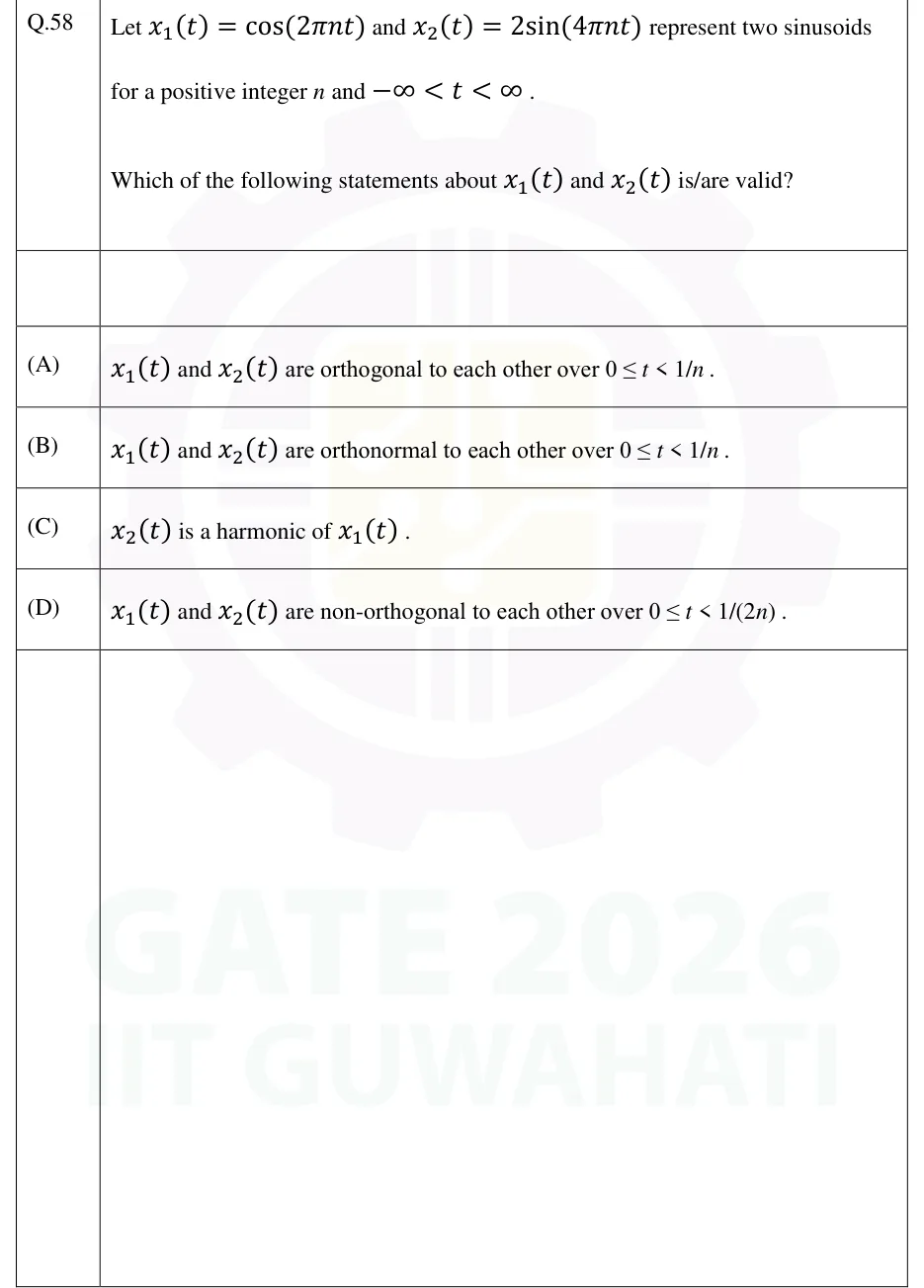
Let and represent two sinusoids for a positive integer and .

Which of the following statements about and is/are valid?

  1. (A)

    and are orthogonal to each other over .

  2. (B)

    and are orthonormal to each other over .

  3. (C)

    is a harmonic of .

  4. (D)

    and are non-orthogonal to each other over .
See the question in the paper

Answer and solution

ANSWER

(A), (C) and (D) are valid: the two sinusoids are orthogonal over one full period of but not over the half period , (frequency ) is the second harmonic of (frequency ), and they are not orthonormal because neither has unit energy over .

Official answer: A, C, DSource: Official answer key, GATE 2026 EC (IIT Guwahati)

  1. Frequencies. has frequency (period ). has frequency (period ). For real signals, two signals are orthogonal over an interval when their inner product over that interval is zero.

  2. Product-to-sum. Using with and :

  3. (A) Interval . Over this interval completes exactly 1 cycle and completes exactly 3 cycles, so each integrates to zero: The signals are orthogonal over this interval, so (A) is valid.

  4. (B) Orthonormal also needs unit energy. Both would have to equal 1, which needs for and for at the same time. No positive integer satisfies both (the first condition alone already fails for every positive integer), so (B) is not valid.

  5. (C) Harmonic relation. The frequency of is (the frequency of ), an integer multiple. So is the second harmonic of ; its amplitude (2) and its phase (sine rather than cosine) do not change that. (C) is valid.

  6. (D) Interval . This is only half a period of : completes half a cycle and completes one and a half cycles, so neither term integrates to zero:

  7. Adding the two terms gives The signals are not orthogonal over this interval, so (D) is valid.

  8. Answer: (A), (C) and (D) are valid.

KEY IDEA

Orthogonality depends on the interval. Harmonically related sinusoids are orthogonal over any whole period of the fundamental, because every product-to-sum term then completes a whole number of cycles. Over a fraction of that period the inner product is generally non-zero. Orthonormal is stricter still: each signal must also have unit energy over the interval.

WATCH OUT FOR

Assuming a sine and a cosine are always orthogonal and so rejecting (D). That is true only over a whole number of periods; over half a period of the inner product is . Other traps: marking (B) by treating orthogonal and orthonormal as the same thing (the energies are and , not 1), and rejecting (C) because is a sine with amplitude 2. A harmonic is defined by its frequency being an integer multiple of the fundamental, whatever its amplitude and phase.

From the GATE 2026 EC paper. Every question of this paper · Download the full paper · All 11 Fourier series questions, with notes

More Fourier series questions