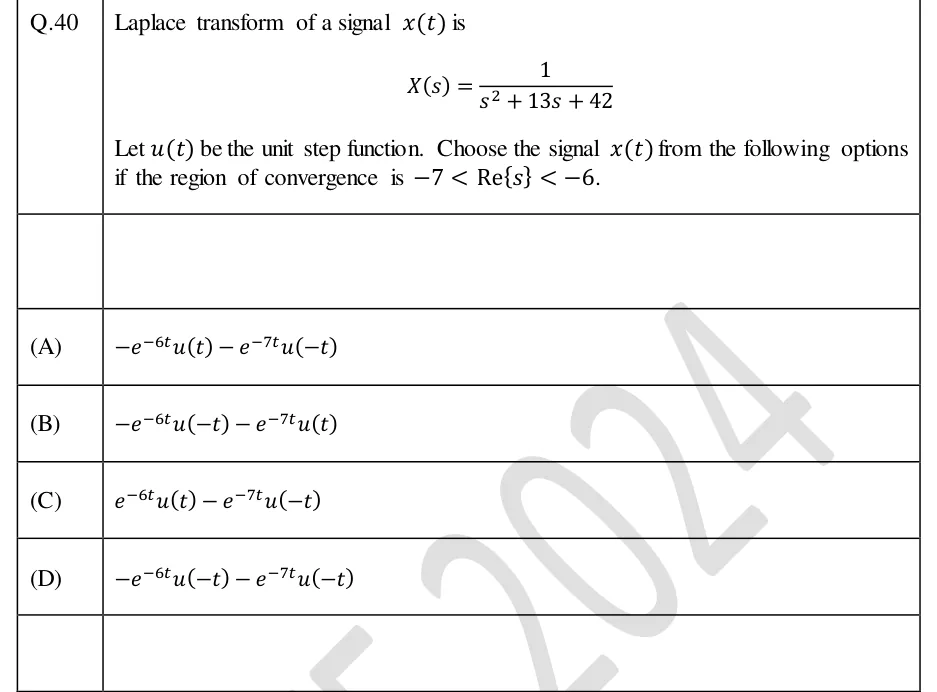
Laplace transform of a signal is
Let be the unit step function. Choose the signal from the following options if the region of convergence is .
- (A)
- (B)
- (C)
- (D)

Laplace transform of a signal is
Let be the unit step function. Choose the signal from the following options if the region of convergence is .
ANSWER
, option (B).
Official answer: BSource: Official answer key, GATE 2024 IN (IISc Bengaluru)
Factor the denominator: , so the poles are at and .
Partial fractions: Check: .
The ROC is a vertical strip between the two poles, so is two-sided. Each pole's term is right-sided or left-sided depending on which side of the strip the pole lies.
The pole lies to the RIGHT of the strip, so its term must have ROC (left-sided). Using the pair , :
The pole lies to the LEFT of the strip, so its term must have ROC (right-sided). Using the pair , :
Add the two terms: The intersection of the two ROCs, and , is exactly the given strip, which confirms it. This is option (B).
KEY IDEA
When the ROC is a strip between poles, a pole to the right of the strip gives a left-sided (anti-causal) term, , and a pole to the left gives a right-sided (causal) term, . The ROC of the whole signal is where the individual ROCs overlap.
WATCH OUT FOR
Treating every term as causal (the one-sided Laplace habit), or dropping the minus sign in the left-sided pair . Quick check on the other options: in (A) the term needs and needs , and no satisfies both. (C) has the same empty ROC. (D) is purely left-sided with ROC , and its transform is , which is not .
From the GATE 2024 IN paper. Every question of this paper · Download the full paper · All 8 Laplace questions, with notes