
IAE Academy

GATE 2026 EC Q.47: solution and answer

GATE 2026 · ECQ.47 · 2 marks · MCQ

Consider the discrete time system (S) with input and output as shown in the Figure. The two sub-systems represented by their impulse responses and are linear and time invariant.

Which of the following statements is necessarily TRUE?
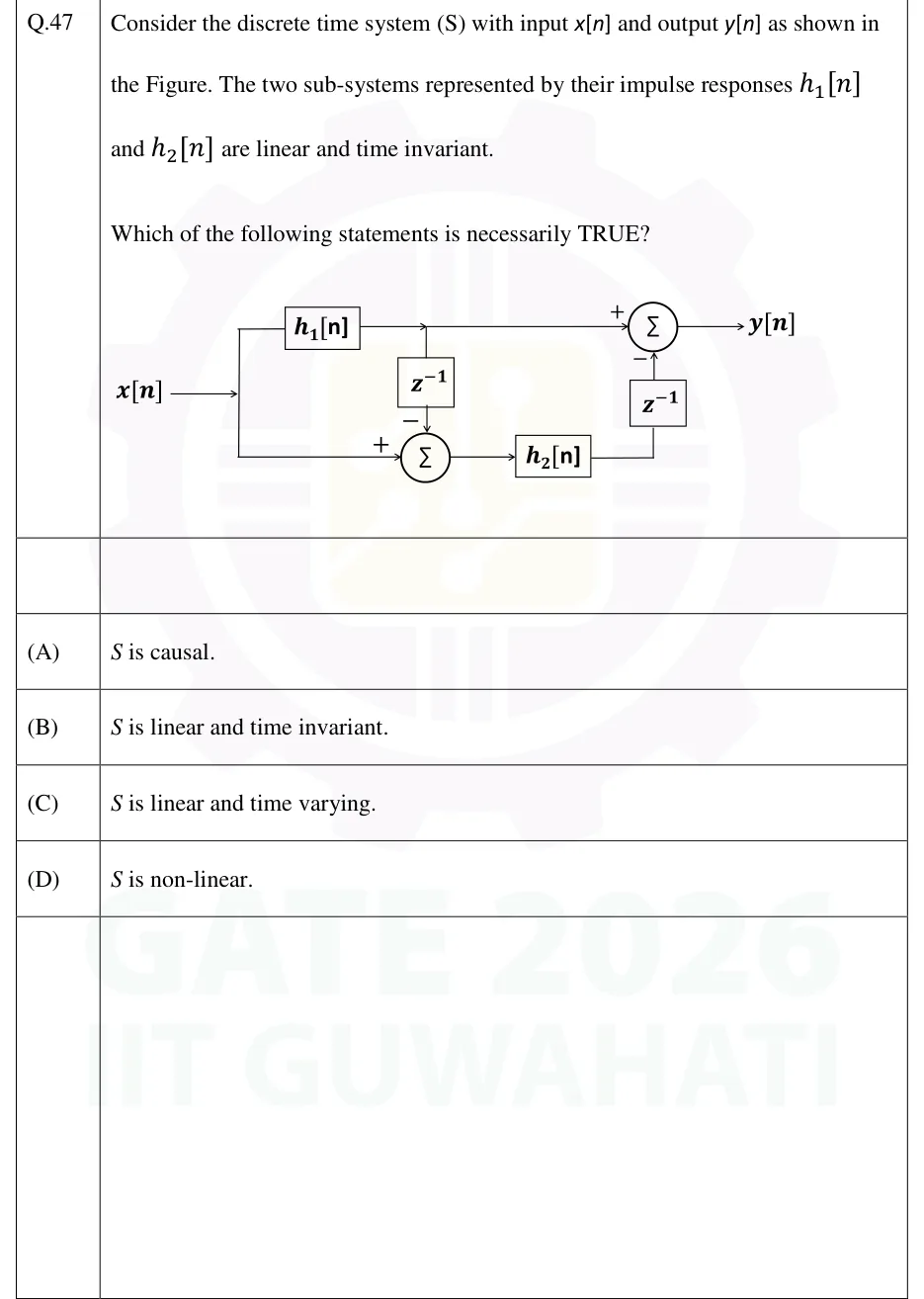
GATE 2026 EC question 47: Block diagram.Tap to open full size
Figure from the GATE 2026 EC paper. It is part of the question.
Figure description

Block diagram. The input x[n] splits into two paths. Upper path: x[n] feeds block h_1[n]. The output of h_1[n] runs right to the '+' input of an output summing junction, whose output is y[n]. A pick-off on the h_1[n] output line goes down through a z^-1 block into the '−' input of a lower summing junction. Lower path: x[n] also feeds the '+' input of that lower summing junction. The lower summer's output feeds block h_2[n]. The output of h_2[n] goes right and then up through a second z^-1 block into the '−' input of the output summing junction. So y[n] = (h_1 output) − (h_2 output delayed by one sample), and h_2 is driven by x[n] − (h_1 output delayed by one sample).

  1. (A)

    is causal.

  2. (B)

    is linear and time invariant.

  3. (C)

    is linear and time varying.

  4. (D)

    is non-linear.

Answer and solution

ANSWER

(B) S is linear and time invariant.

Official answer: BSource: Official answer key, GATE 2026 EC (IIT Guwahati)

  1. Name the internal signals. Let be the output of .

  2. Lower summing junction: its '+' input is and its '−' input is passed through . So . This drives , so .

  3. Output summing junction: its '+' input is and its '−' input is passed through . So .

  4. Every block (, , ) is LTI, and summing junctions and pick-offs are LTI too. There is no feedback loop: signals only flow forward from to . Series, parallel and summing connections of LTI systems give an LTI system. To see it directly, set : then , and . The overall impulse response is

  5. In the -domain (where the transforms exist), the same result is So is a convolution with one fixed impulse response. That makes linear and time invariant, which is option (B), and it rules out (C) and (D).

  6. Causality: nothing says or is zero for . For example, take , so . Then This holds for every , so , which is non-causal. is causal when both and are causal, but the question does not say they are. So (A) is not necessarily true.

  7. Only (B) holds for every LTI and .

KEY IDEA

Delays, adders, pick-offs and LTI blocks joined without a feedback loop always make an LTI system. Here the overall impulse response is fixed: , or . Whether the system is causal depends on whether and are causal, and the question does not tell us.

WATCH OUT FOR

Picking (A) because the diagram contains only unit delays , which makes it look causal. A delay after an anti-causal block does not remove its anti-causality: with the whole system reduces to for any . Another mistake is to read the cross-coupled branches as feedback that makes the system time-varying. There is no loop, and a fixed interconnection of LTI blocks stays LTI.

From the GATE 2026 EC paper. Every question of this paper · Download the full paper · All 31 LTI & convolution questions, with notes

More LTI & convolution questions