
IAE Academy

GATE 2023 EC Q.22: solution and answer

GATE 2023 · ECQ.22 · 1 mark · MCQ

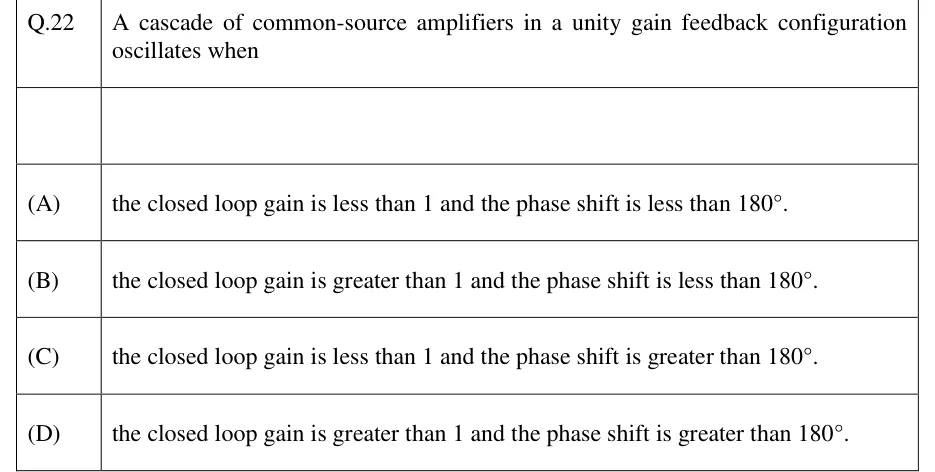
A cascade of common-source amplifiers in a unity gain feedback configuration oscillates when

  1. (A)

    the closed loop gain is less than 1 and the phase shift is less than 180°.

  2. (B)

    the closed loop gain is greater than 1 and the phase shift is less than 180°.

  3. (C)

    the closed loop gain is less than 1 and the phase shift is greater than 180°.
  4. (D)

    the closed loop gain is greater than 1 and the phase shift is greater than 180°.

See the question in the paper

Answer and solution

ANSWER

(D) is the intended answer if "closed loop gain" is read as the loop gain: the CS cascade oscillates when its loop gain is still greater than 1 at frequencies where the phase lag is more than 180°, i.e. when the phase margin is negative. The official key is MTA (marks to all candidates).

Official answer: marks to all candidatesSource: Official answer key, GATE 2023 EC (IIT Kanpur)

  1. What the options must mean. Connect the cascade so that the feedback is negative at low frequency. For an odd number of inverting CS stages, that means tying the output straight back to the input. With unity feedback (), the loop gain is and the closed-loop gain is . Oscillation is decided by the denominator: . At that point is unbounded, and a stable unity-feedback amplifier with large has . So the closed-loop gain is not the quantity any oscillation criterion uses. The options only make sense if "closed loop gain" is read as the loop gain , and "phase shift" as the phase lag of , on top of the inversion that makes the feedback negative. The official key awards marks to all candidates and gives no reason. The solution below answers the question as intended, under this reading.

  2. Model the cascade. Assume identical stages. Each CS stage has a low-frequency gain magnitude ( absorbed into ) and one pole from its output-node capacitance , at . and its zero are neglected. Then where is the phase lag of the loop. As rises, falls monotonically and rises monotonically from towards .

  3. How many stages can reach . At every finite frequency, each pole contributes . So reaches at a finite frequency only if . Call that frequency : . With , approaches only as , where . A two-stage loop of this kind therefore cannot oscillate.

  4. Oscillation criterion. A closed-loop pole on the axis needs , that is, and (Barkhausen). The extra of lag turns the negative feedback into positive feedback, and the signal comes back round the loop at its own amplitude. All open-loop poles are in the left half-plane and is monotonic, so the Nyquist plot of crosses the negative real axis once, at . If , the plot encircles . The closed loop then has poles in the right half-plane, and the oscillation builds up until the transistors' nonlinearity limits its amplitude. If , the loop is stable. The boundary case is the constant-amplitude Barkhausen condition.

  5. Restate it with the two crossover frequencies. Let be the gain crossover, where . Because falls and rises monotonically, . So the loop oscillates exactly when . In that case every frequency between the two has and , which is a negative phase margin: . The loop is stable exactly when . In that case every frequency between the two has and .

  6. (D): for and to hold at the same frequency, we need and . That is possible only when , which is exactly the oscillating case. Conversely, every oscillating loop has such a band of frequencies. So (D) is the oscillation condition.

  7. (A): together with needs . That is possible only when , so this loop is stable, with positive gain and phase margins.

  8. (B) and (C): with holds at low frequencies, below both and , in every amplifier, stable or not. It is just the ordinary amplifying region. with holds at high frequencies, above both crossovers, in every loop whose phase passes , stable or not. Neither pair tells an oscillating loop from a stable one. If (C) is read as describing the point, it says . That is a positive gain margin, so the loop is stable.

  9. Check with three stages (a ring oscillator). For , when each stage lags by : , so . At that frequency Sustained oscillation needs . With , the loop gain is still above 1 where the phase lag reaches , so the oscillation starts and builds up. This is the (D) condition.

  10. Answer: (D), read as "the loop gain is greater than 1 while the phase shift exceeds ". As printed, "closed loop gain" is the wrong quantity (see the first step), and the official key awarded marks to all candidates.

KEY IDEA

The loop gain decides oscillation, not the closed-loop gain. A negative-feedback loop oscillates when is still above 1 at the frequency where the phase lag reaches . Put another way, the phase crossover comes before the gain crossover, which is a negative phase margin. Each single-pole CS stage adds less than of lag, so at least three stages are needed. A three-stage ring oscillates at once each stage's gain exceeds 2.

WATCH OUT FOR

Taking "closed loop gain" literally. A stable unity-feedback amplifier has a closed-loop gain of about 1, and at oscillation that gain is unbounded, so it is not the test. Also: (1) choosing (C) on the idea that more than of phase shift is enough on its own, when the loop gain must still exceed 1 where the lag reaches ; (2) believing two single-pole stages can reach , when they only approach it as , where the gain has gone to zero; (3) confusing the start-up condition ( at ) with the Barkhausen condition for a steady amplitude ( at exactly ).

From the GATE 2023 EC paper. Every question of this paper · Download the full paper · All 4 Feedback & oscillators questions, with notes

More Feedback & oscillators questions