
IAE Academy

GATE 2020 EC Q.37: solution and answer

GATE 2020 · ECQ.37 · 2 marks · MCQ

Using the incremental low frequency small-signal model of the MOS device, the Norton equivalent resistance of the following circuit is
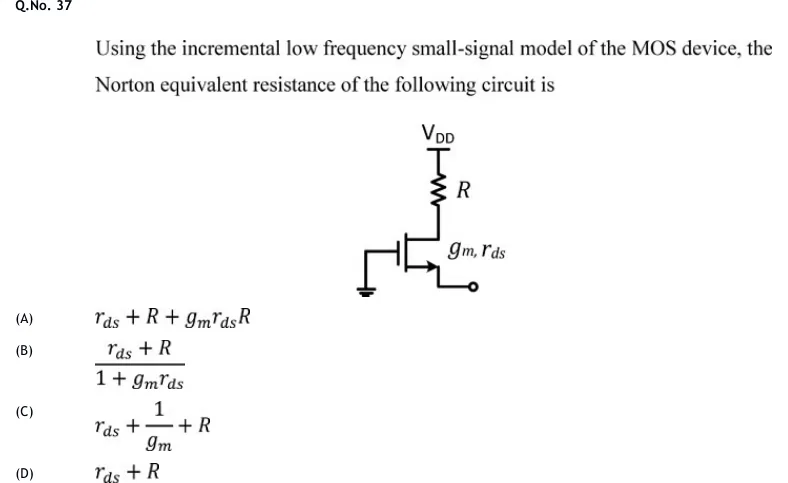
GATE 2020 EC question 37: One n-channel MOSFET, drawn as a three-terminal symbol with the arrow on the source pointing outward and labelled with its…Tap to open full size
Figure from the GATE 2020 EC paper. It is part of the question.
Figure description

One n-channel MOSFET, drawn as a three-terminal symbol with the arrow on the source pointing outward and labelled with its small-signal parameters g_m, r_ds. The gate lead runs left and is wired directly to ground. The drain (top) goes through a resistor R up to the supply V_DD. The source (bottom) is brought out to the right to an open terminal (small circle). The Norton equivalent is taken at this source terminal. There are no other components.

  1. (A)

  2. (B)

  3. (C)

  4. (D)

Answer and solution

ANSWER

The Norton equivalent resistance at the source terminal is , which is option (B).

Official answer: BSource: Official answer key, GATE 2020 EC (IIT Delhi)

  1. Small-signal circuit. To find the Norton resistance, set every independent source to zero. becomes AC ground, so runs from the drain to ground, and the gate is also at ground. Replace the MOSFET with its low-frequency model: a VCCS from drain to source in parallel with . No body-effect parameter is given, so the body effect is neglected. The Norton resistance is the resistance seen looking into the source terminal.

  2. Test source. Apply a test voltage at the source and let be the current it drives into the source terminal. Since the gate is at ground, .

  3. One path for the current. The only way can leave the source node is up through the transistor (VCCS and together) and then down through to ground. So the drain voltage is , and the current flowing from drain to source inside the device is .

  4. Drain-to-source current. The current from drain to source is the VCCS current plus the current:

  5. Solve. Multiply by :

  6. Result. This is option (B).

  7. Limit checks. As , , the familiar resistance looking into the source of a common-gate or source-follower stage. With , , which is correct for a gate-grounded device whose drain is at AC ground. Both limits agree.

KEY IDEA

Looking into the source of a MOSFET whose gate is at AC ground, the drain-side resistance is divided by , which is about the device's intrinsic gain. So the source is a low-resistance node, close to unless the drain load is comparable to times . This is the dual of looking into the drain, where the source-side resistance is multiplied up by the same factor.

WATCH OUT FOR

Picking (A), . That has the form of the resistance looking into the DRAIN of a source-degenerated MOSFET, where resistance is multiplied up. Here we look into the SOURCE, and resistance is divided down. Other slips: taking instead of , which gives , and ignoring the dependent source altogether, which gives (D), .

From the GATE 2020 EC paper. Every question of this paper · Download the full paper · All 20 Amplifiers questions, with notes

More Amplifiers questions