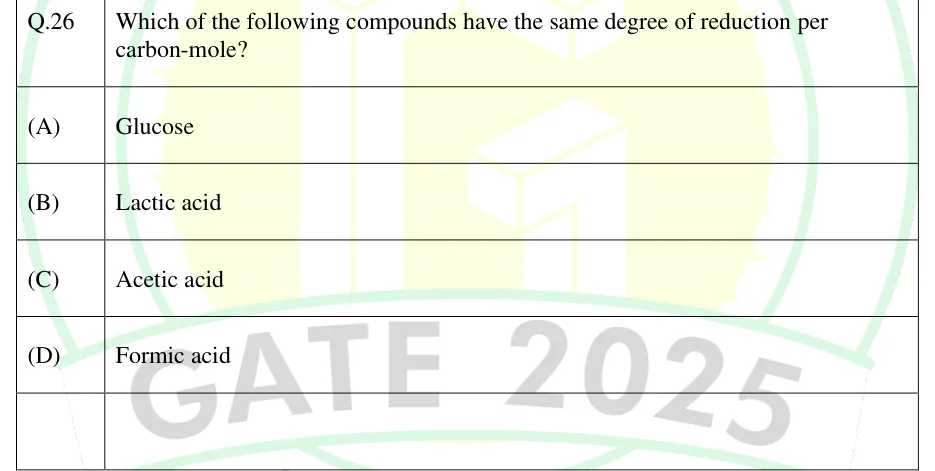
Which of the following compounds have the same degree of reduction per carbon-mole?
- (A)
Glucose
- (B)
Lactic acid
- (C)
Acetic acid
- (D)
Formic acid

Which of the following compounds have the same degree of reduction per carbon-mole?
Glucose
Lactic acid
Acetic acid
Formic acid
ANSWER
A, B and C. Glucose, lactic acid and acetic acid all reduce to the C-mole formula CH2O, so each has a degree of reduction of 4 per C-mole. Formic acid (CH2O2) has a degree of reduction of 2.
Official answer: A, B, CSource: Official answer key, GATE 2025 BT (IIT Roorkee)
The degree of reduction per C-mole, , of an organic compound whose C-mole formula is is . It uses the valences C = 4, H = 1, O = , N = , with , and as the reference state.
Write each compound per carbon atom by dividing its molecular formula by its number of carbon atoms. None of the four contains nitrogen, so .
Glucose: , so .
Lactic acid: , so .
Acetic acid: , so .
Formic acid: already has one carbon, so .
Glucose, lactic acid and acetic acid all have the same C-mole formula, , so all three have . Formic acid is more oxidised () and does not match them. Correct options: A, B and C.
KEY IDEA
The degree of reduction per C-mole depends only on the C-mole formula, for . So any compounds that divide down to the same C-mole formula (here ) must have the same .
WATCH OUT FOR
Working out the degree of reduction per mole instead of per C-mole (glucose 24, lactic acid 12, acetic acid 8) and deciding the three are different. A second slip is to treat formic acid like the others and miss that it carries two oxygens on its single carbon, which gives , not 4.
From the GATE 2025 BT paper. Every question of this paper · Download the full paper · All 24 Growth kinetics questions, with notes