
IAE Academy

GATE 2022 BT Q.48: solution and answer

GATE 2022 · BTQ.48 · 2 marks · MSQ

Which of the following statements are CORRECT for an enzyme entrapped in a spherical particle?

  1. (A)

    Effectiveness factor is ratio of the reaction rate with diffusion-limitation to the reaction rate without diffusion-limitation

  2. (B)

    Internal diffusion is rate-limiting at low values of Thiele modulus

  3. (C)

    Effectiveness factor increases with decrease in Thiele modulus

  4. (D)

    Internal diffusion-limitation can be reduced by decreasing the size of the particle
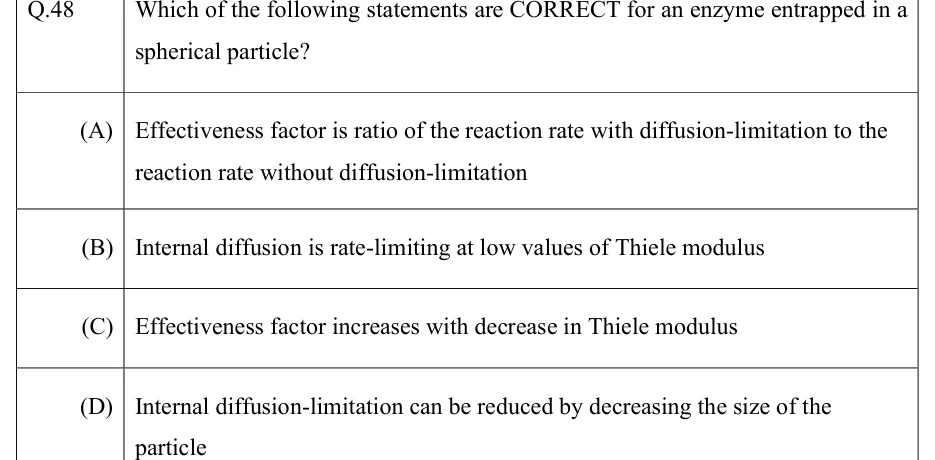
See the question in the paper

Answer and solution

ANSWER

Options A, C and D are correct. The effectiveness factor is the rate with diffusion limitation divided by the rate without it. It rises toward 1 as the Thiele modulus falls, and because the modulus is proportional to particle radius, a smaller particle reduces the internal diffusion limitation. B is wrong: diffusion limits the rate at HIGH Thiele modulus, not low.

Official answer: A, C, DSource: Official answer key, GATE 2022 BT (IIT Kharagpur)

  1. Definition of the internal effectiveness factor: , so . Statement (A) is exactly this definition, so (A) is correct.

  2. Thiele modulus for a sphere of radius (first-order limit of Michaelis-Menten kinetics, rate constant , where is the maximum reaction rate per unit particle volume, the Michaelis constant and the effective diffusivity of substrate inside the particle): It compares the intrinsic reaction rate with the rate of internal diffusion; a large means reaction is fast compared with diffusion.

  3. For a sphere with first-order kinetics: Limits: (reaction controls, substrate reaches the whole particle); (diffusion controls, only an outer shell of the particle works).

  4. So internal diffusion is rate-limiting at HIGH values of , not low ones. Statement (B) is incorrect.

  5. falls steadily as rises, so a decrease in raises toward 1. Statement (C) is correct.

  6. Since , a smaller particle gives a smaller and hence a larger : the internal diffusion limitation is reduced (the substrate has a shorter path to the enzyme at the centre). The same direction holds for general Michaelis-Menten kinetics, whose modulus is also proportional to . Statement (D) is correct.

  7. Correct options: A, C, D.

KEY IDEA

The Thiele modulus measures reaction speed against internal diffusion speed. The effectiveness factor (rate with diffusion limitation divided by rate without it) equals 1 when is small and falls roughly as when is large. Since , making the particle smaller raises .

WATCH OUT FOR

Getting the direction of the Thiele modulus backwards and marking B: a LOW means diffusion is fast compared with reaction (, reaction controls). A second slip is reading the effectiveness factor the other way up (rate without limitation over rate with it), which would give a value above 1.

From the GATE 2022 BT paper. Every question of this paper · Download the full paper · All 2 Immobilisation questions, with notes