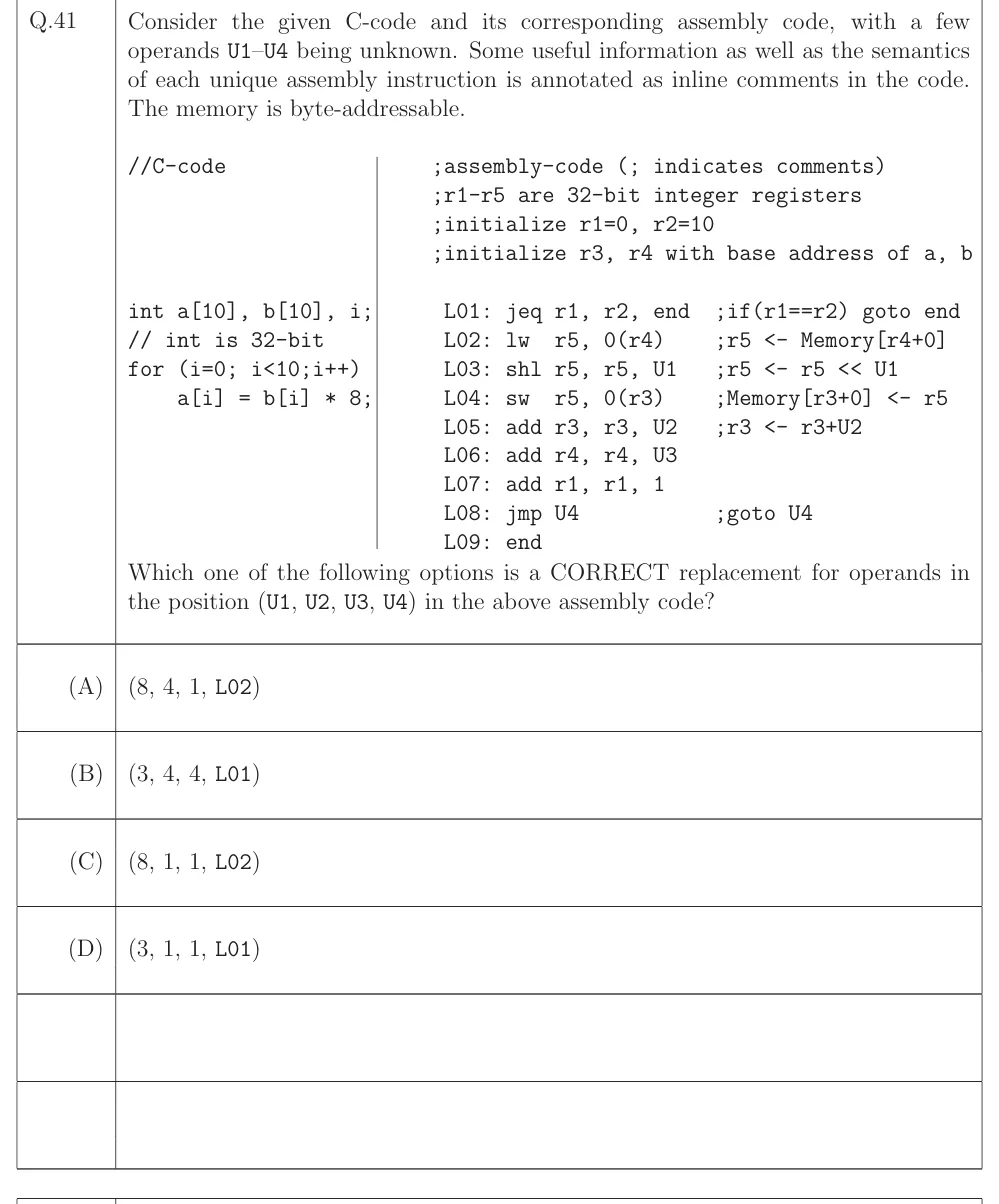
Consider the given C-code and its corresponding assembly code, with a few operands U1–U4 being unknown. Some useful information as well as the semantics of each unique assembly instruction is annotated as inline comments in the code. The memory is byte-addressable.
//C-code
int a[10], b[10], i;
// int is 32-bit
for (i=0; i<10;i++)
    a[i] = b[i] * 8;
;assembly-code (; indicates comments)
;r1-r5 are 32-bit integer registers
;initialize r1=0, r2=10
;initialize r3, r4 with base address of a, b
L01: jeq r1, r2, end ;if(r1==r2) goto end
L02: lw r5, 0(r4) ;r5 <- Memory[r4+0]
L03: shl r5, r5, U1 ;r5 <- r5 << U1
L04: sw r5, 0(r3) ;Memory[r3+0] <- r5
L05: add r3, r3, U2 ;r3 <- r3+U2
L06: add r4, r4, U3
L07: add r1, r1, 1
L08: jmp U4 ;goto U4
L09: endWhich one of the following options is a CORRECT replacement for operands in the position (U1, U2, U3, U4) in the above assembly code?
- (A)
(8, 4, 1, L02)
- (B)
(3, 4, 4, L01)
- (C)
(8, 1, 1, L02)
- (D)
(3, 1, 1, L01)