
IAE Academy

GATE 2022 IN Q.12: solution and answer

GATE 2022 · INQ.12 · 1 mark · MCQ

A pneumatic nozzle-flapper system is conventionally used to convert ________

  1. (A)

    Small changes in flapper's velocity to large changes in output temperature

  2. (B)

    Small changes in flapper's displacement to large changes in output temperature

  3. (C)

    Small changes in flapper's velocity to large changes in output pressure

  4. (D)

    Small changes in flapper's displacement to large changes in output pressure
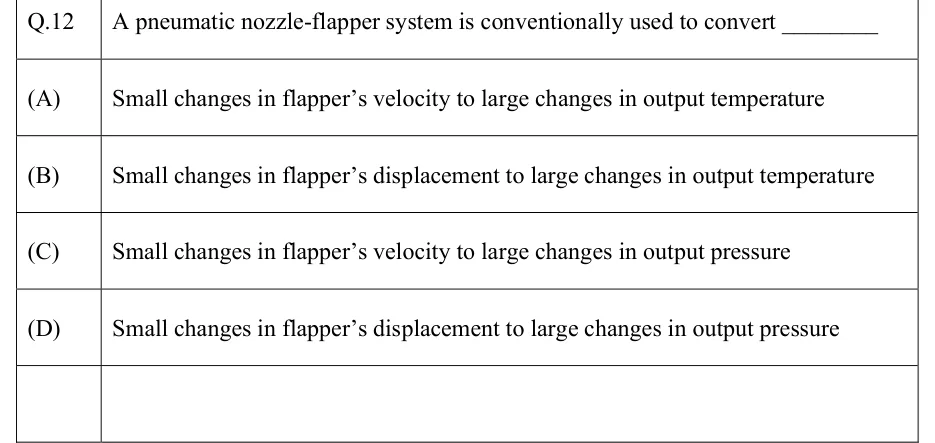
See the question in the paper

Answer and solution

ANSWER

(D) Small changes in flapper's displacement to large changes in output pressure.

Official answer: DSource: Official answer key, GATE 2022 IN (IIT Kharagpur)

  1. What goes in and what comes out. Air at supply pressure (typically about ) passes through a fixed restriction (the orifice) into a small chamber and then leaves through a nozzle. The flapper sits a small gap in front of the nozzle. The output is the chamber (back) pressure . Nothing in the device senses or produces temperature, so options (A) and (B) are out.

  2. Pressure-divider action. The orifice and the nozzle gap behave like two restrictions in series. As the flapper closes in (), the nozzle's escape (curtain) area shrinks and rises towards . As the flapper moves away, falls towards atmospheric pressure. So depends on the flapper's position .

  3. Static, position-sensing element. In the steady state, holds for any fixed gap, however long the flapper stays there. The output follows where the flapper is, not how fast it is moving. That rules out velocity, so (C) is out.

  4. Amplification. On the steep, nearly linear part of the versus curve, a flapper travel of only a few hundredths of a millimetre (roughly to in total) swings across nearly its whole range. Around the operating point, where the gain is very large and the minus sign means that a larger gap gives a lower back pressure. This is why the nozzle-flapper is the first-stage amplifier in pneumatic controllers and in I/P and P/I converters.

  5. Conclusion. The system turns small changes in flapper displacement into large changes in output pressure, which is option (D).

KEY IDEA

A nozzle-flapper is a pneumatic displacement-to-pressure transducer and amplifier. The fixed orifice and the variable nozzle gap form a pressure divider, so the back pressure is a steady-state function of the gap, . A travel of hundredths of a millimetre sweeps the full output pressure range, which gives a very large gain .

WATCH OUT FOR

Picking (C) by treating the flapper as a rate-sensitive element. The back pressure depends on the gap itself, not on how fast the gap changes: hold the flapper still and stays at a fixed value. Picking (A) or (B) is a separate slip. The medium is compressed air and the output is pressure, so temperature plays no part.

From the GATE 2022 IN paper. Every question of this paper · Download the full paper · All 2 Process control (IN) questions, with notes