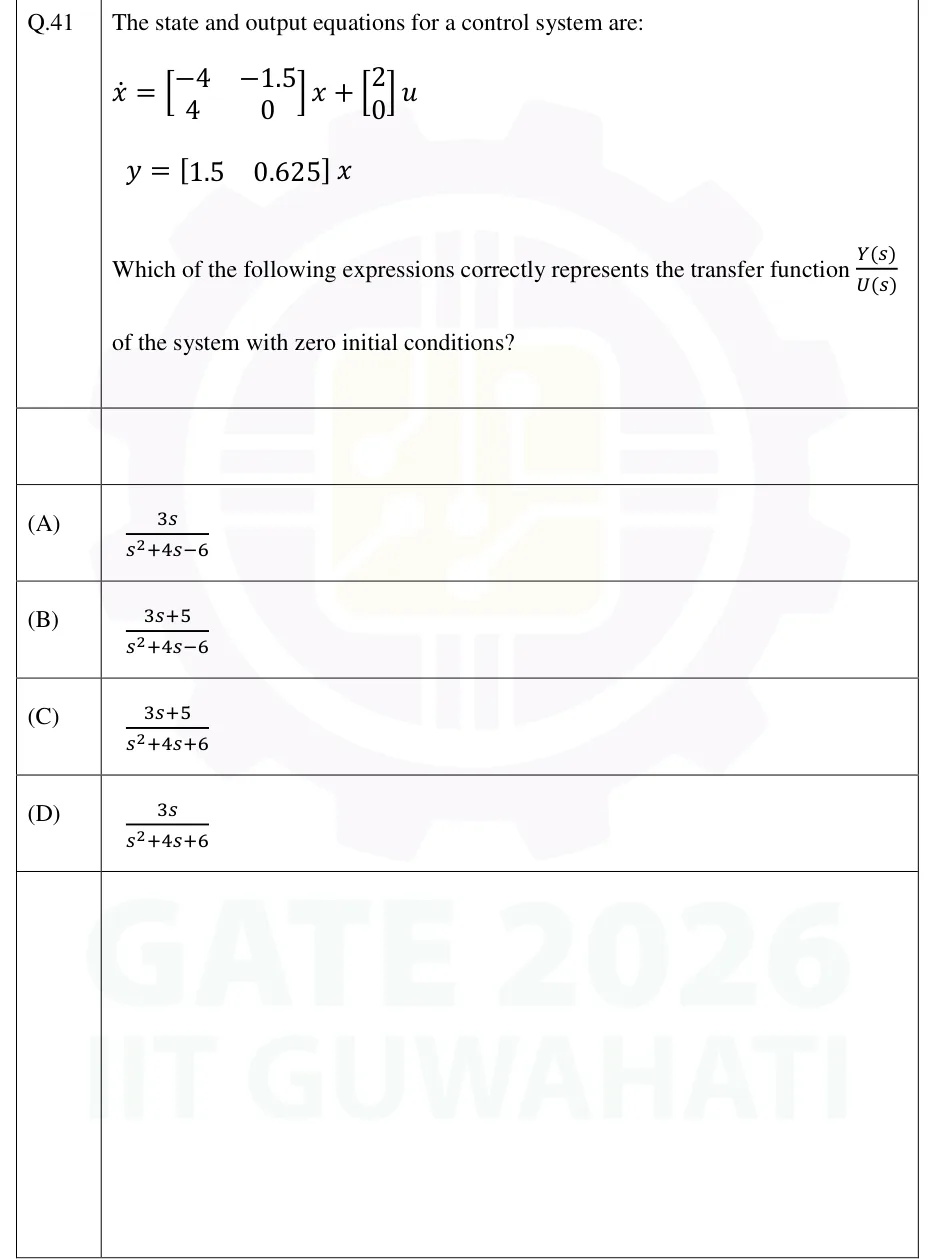
The state and output equations for a control system are:
Which of the following expressions correctly represents the transfer function of the system with zero initial conditions?
- (A)
- (B)
- (C)
- (D)

The state and output equations for a control system are:
Which of the following expressions correctly represents the transfer function of the system with zero initial conditions?
ANSWER
The transfer function is , which is option (C).
Official answer: CSource: Official answer key, GATE 2026 EC (IIT Guwahati)
With no direct feed-through term (), the transfer function of a state-space model is where , and .
Form :
Characteristic polynomial: The constant term is , which rules out options (A) and (B).
Adjugate of a matrix (swap the diagonal entries, negate the off-diagonal entries):
Multiply by :
Multiply by : The numerator has a constant term , which rules out option (D).
Therefore which is option (C). Quick check: the DC gain should equal . Here , so and , which agrees.
KEY IDEA
For a strictly proper state-space model, . The denominator is the characteristic polynomial of , and for a system you can read it off directly as . The numerator needs only one column of the adjugate, because has a single non-zero entry.
WATCH OUT FOR
Sign errors in . The off-diagonal product is , and subtracting it gives . Writing leads to option (B). The other common slip is dropping the term: the second state contributes to the output through even though does not drive it directly, and missing that term leads to option (D). Also watch the adjugate: swap the diagonal entries and negate the off-diagonal ones. Transposing without negating gives the wrong numerator.
From the GATE 2026 EC paper. Every question of this paper · Download the full paper · All 16 State space questions, with notes