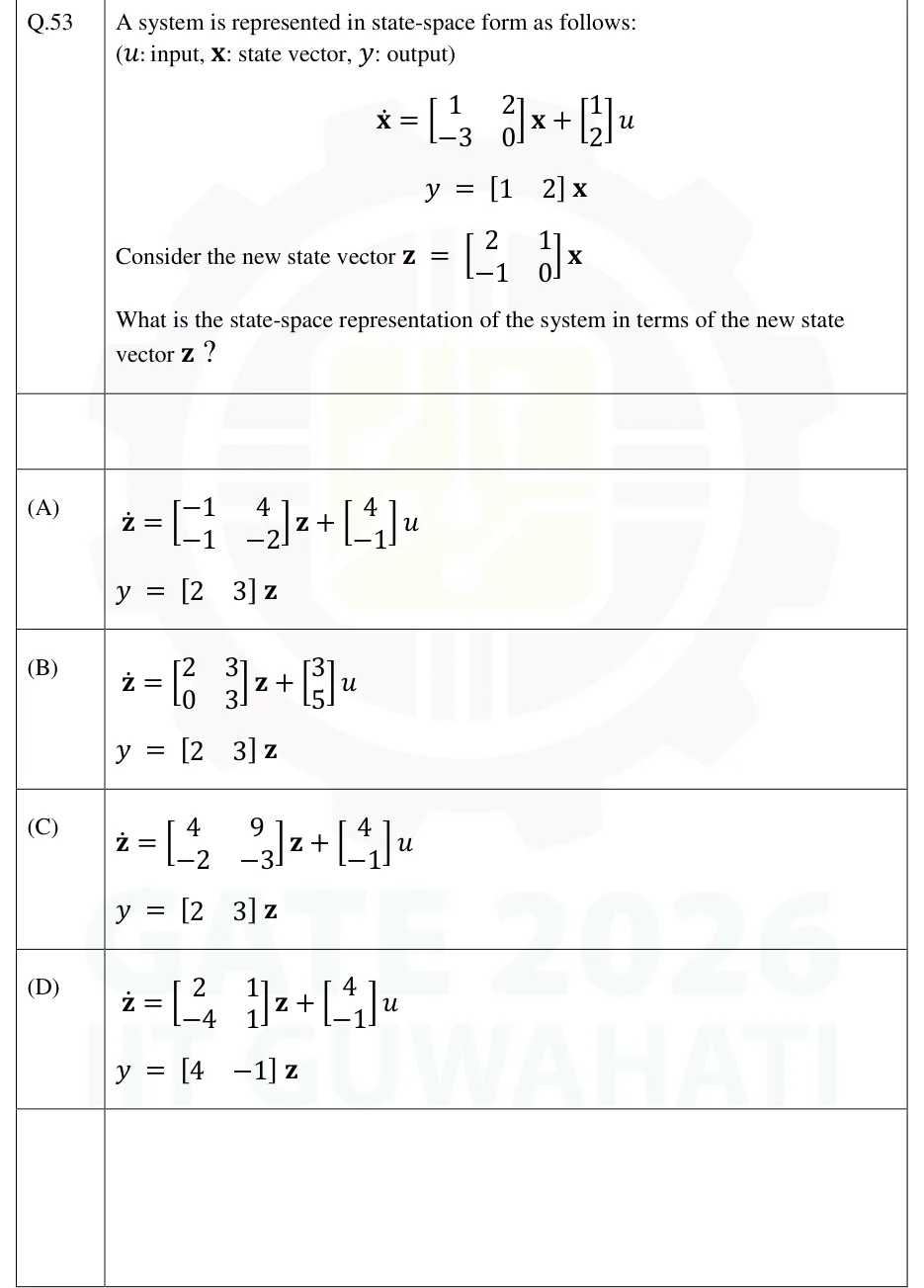
A system is represented in state-space form as follows: (: input, : state vector, : output)
Consider the new state vector
What is the state-space representation of the system in terms of the new state vector ?
- (A)
,
- (B)
,
- (C)
,
- (D)
,

A system is represented in state-space form as follows: (: input, : state vector, : output)
Consider the new state vector
What is the state-space representation of the system in terms of the new state vector ?
,
,
,
,
ANSWER
(C): ,
Official answer: CSource: Official answer key, GATE 2026 EE (IIT Guwahati)
Similarity transformation: with , , we have . Substituting into and pre-multiplying by gives , and .
Inverse of : , so . Check: .
Input matrix: . This rules out (B).
Output matrix: . This rules out (D).
System matrix: first , then
Invariance check: a similarity transform keeps the trace and the determinant. and . For the new matrix, and . Both match. The matrix in (A) has trace , (B) has trace and (D) has trace , so none of them can be similar to .
So , , which is option (C).
KEY IDEA
For a change of state , the new model is . The eigenvalues, and so the trace and determinant, of the system matrix do not change. That gives a quick check that removes wrong options without doing all the multiplication.
WATCH OUT FOR
Forgetting to pre-multiply by and stopping at gives the system matrix printed in (B). Mixing up the direction of the transform is the other trap. Because the question defines , the new matrix is , not . The two have the same trace and determinant, so the invariance check cannot catch this mistake. Only reading the definition carefully does. The same applies to the output matrix: it is , not .
From the GATE 2026 EE paper. Every question of this paper · Download the full paper · All 16 State space questions, with notes