IAE Academy

GATE 2022 EC Q.50: solution and answer

GATE 2022 · ECQ.50 · 2 marks · MSQ

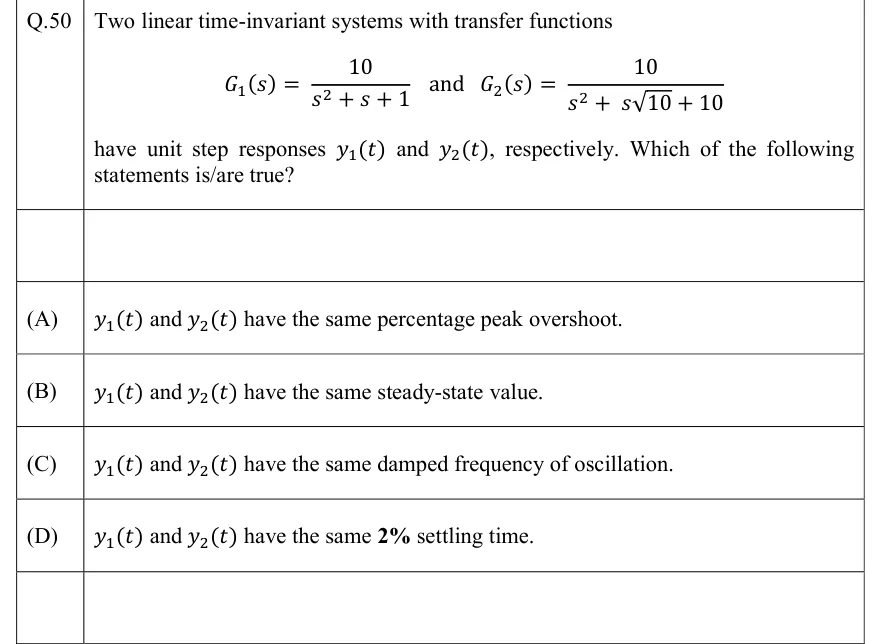
Two linear time-invariant systems with transfer functions

have unit step responses and , respectively. Which of the following statements is/are true?

  1. (A)

    and have the same percentage peak overshoot.

  2. (B)

    and have the same steady-state value.

  3. (C)

    and have the same damped frequency of oscillation.

  4. (D)

    and have the same settling time.

See the question in the paper

Answer and solution

ANSWER

Only (A) is true. Both systems have , so they share a percentage peak overshoot of about . Their steady-state values (10 and 1), damped frequencies (0.866 and 2.74 rad/s) and 2% settling times (8 s and about 2.53 s) are all different.

Official answer: ASource: Official answer key, GATE 2022 EC (IIT Kharagpur)

  1. Write each denominator in the standard form . For : , and .

  2. For : , and . Both systems are underdamped with the same damping ratio.

  3. Percentage peak overshoot is measured relative to the steady-state value, so it does not depend on the gain, and it depends only on : That is about for both. So (A) is true.

  4. Steady-state value of a unit-step response (final value theorem) equals the DC gain : , while . They differ, so (B) is false.

  5. Damped frequency : , while . They differ, so (C) is false.

  6. settling time : , while . The conclusion does not depend on the approximation: with the same , the second response is the first one time-compressed by the factor , so every time measure (exact settling time included) is times smaller. They differ, so (D) is false.

  7. Only (A) holds. The two systems share but have different and different DC gains.

KEY IDEA

For a standard second-order system, percentage overshoot depends only on . The time scale (, , ) is set by , and the steady-state value is set by the DC gain . Two systems with the same but different and gain therefore share only the percentage overshoot.

WATCH OUT FOR

Seeing the same numerator (10) in both transfer functions and assuming the steady-state values match, so marking (B). The steady-state value is , numerator divided by the constant term of the denominator: against . A second slip is thinking a different gain changes the percentage overshoot. It does not, because overshoot is measured relative to the final value.

From the GATE 2022 EC paper. Every question of this paper · Download the full paper · All 22 Time response questions, with notes

More Time response questions