
IAE Academy

GATE 2026 IN Q.56: solution and answer

GATE 2026 · INQ.56 · 2 marks · MSQ

A 16-bit processor has 16-bit wide instructions and a few internal registers. Every 16-bit instruction is encoded in a fixed format with one operation code of 7 bits and up to three operands. The operand can be an internal register and each operand is encoded by 3 bits. All the internal registers can be specified in an instruction using three bits.

The correct statement(s) for this processor is/are ______.

  1. (A)

    The processor has 16 internal registers.

  2. (B)

    The processor can support 128 unique operation codes (Opcodes).

  3. (C)

    The processor has up to 8 internal registers.

  4. (D)

    The processor can support 512 unique operation codes (Opcodes).
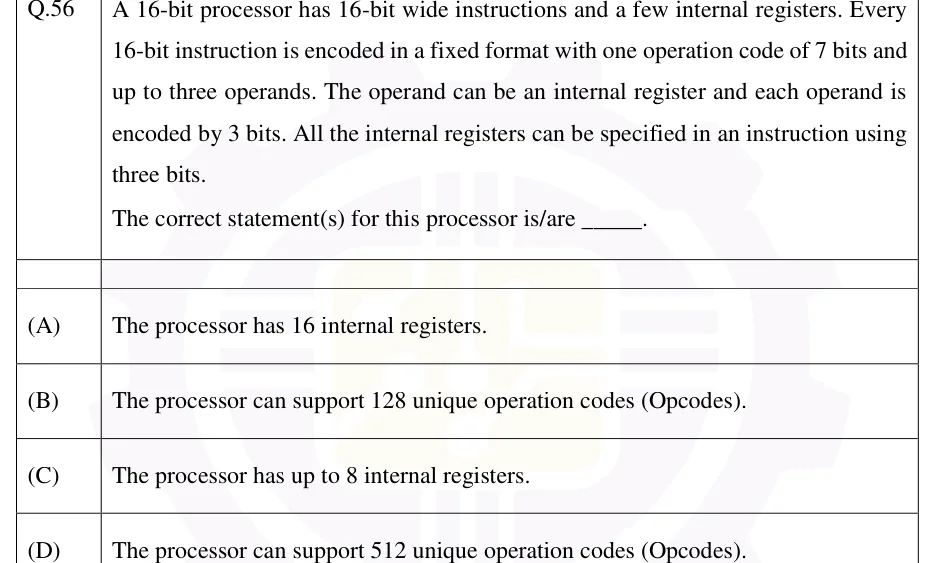
See the question in the paper

Answer and solution

ANSWER

The correct statements are (B) and (C). A 7-bit opcode field gives opcodes, and a 3-bit register field can name at most internal registers.

Official answer: B, CSource: Official answer key, GATE 2026 IN (IIT Guwahati)

  1. Check the instruction format. Opcode plus three operands takes bits, which is exactly the instruction width. The format is fixed, so the opcode field is always 7 bits and each operand field is always 3 bits.

  2. Count the opcodes. An -bit field has distinct codes. The opcode field has 7 bits, so the processor supports unique opcodes. Statement (B) is true.

  3. Count the registers. Each register is named by a 3-bit field, which gives distinct register addresses. The question says every internal register can be named with three bits, so there are at most 8 registers. Statement (C) is true.

  4. Reject (A). Naming 16 registers needs bits per operand, but the operand field has only 3 bits. With 3 bits, at least 8 of the 16 registers could not be named.

  5. Reject (D). 512 opcodes needs opcode bits. With three 3-bit operands that would make the instruction bits, more than the 16 available. The question also fixes the opcode field at 7 bits, which allows only 128 codes.

  6. Answer: (B) and (C).

KEY IDEA

An -bit field in a fixed instruction format can encode at most distinct values. So a 7-bit opcode gives 128 opcodes, a 3-bit register field gives 8 registers, and bits fills the instruction exactly.

WATCH OUT FOR

One mistake is to count the non-opcode bits and pick as the number of opcodes (D). Those 9 bits hold the three operand fields, not opcode bits. Another is to assume that a 16-bit processor must have 16 registers (A). The register count depends only on the width of the register field (3 bits), not on the processor's word length.

From the GATE 2026 IN paper. Every question of this paper · Download the full paper · All 9 Processors & memory questions, with notes

More Processors & memory questions