
IAE Academy

GATE 2018 EC Q.49: solution and answer

GATE 2018 · ECQ.49 · 2 marks · NAT

A uniform plane wave traveling in free space and having the electric field

is incident on a dielectric medium (relative permittivity > 1, relative permeability = 1) as shown in the figure and there is no reflected wave.

The relative permittivity (correct to two decimal places) of the dielectric medium is ________.
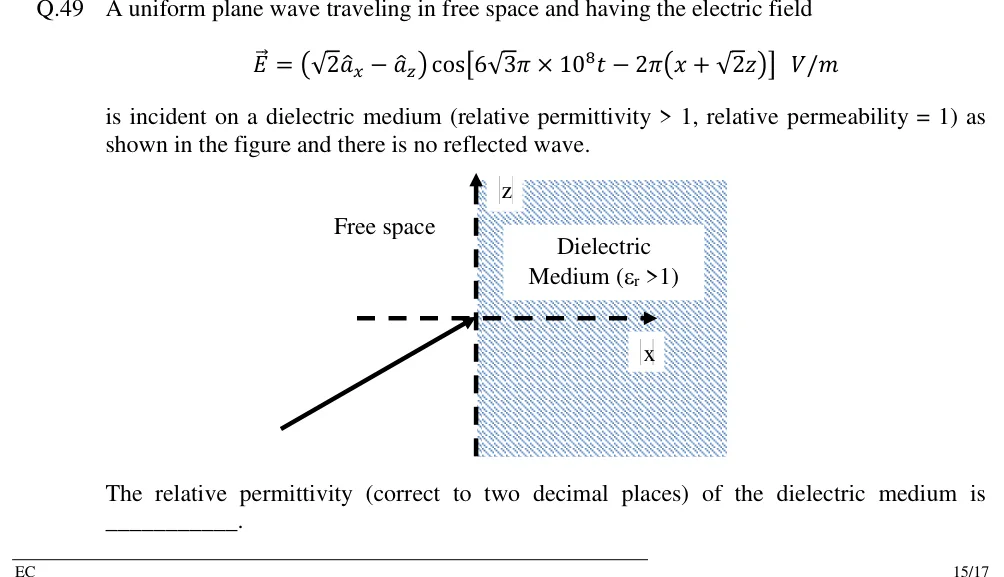
GATE 2018 EC question 49: The figure shows a vertical dashed line: the z-axis, with its arrow pointing up and labelled z.Tap to open full size
Figure from the GATE 2018 EC paper. It is part of the question.
Figure description

The figure shows a vertical dashed line: the z-axis, with its arrow pointing up and labelled z. This line is the interface, the plane x = 0. To the left of it is the label "Free space". To the right, the region x > 0 is hatched and labelled "Dielectric Medium (ε_r > 1)". A horizontal dashed line (the x-axis) runs through the origin on the interface, with its arrow pointing right into the dielectric and labelled x. A solid line comes from the lower left in free space and ends at the origin. It is the incident ray, travelling up and to the right, so its direction has positive x and positive z components. No reflected or transmitted ray is drawn.

Answer and solution

ANSWER

The relative permittivity of the dielectric is .

Official answer: 1.9 to 2.1Source: Official answer key, GATE 2018 EC (IIT Guwahati)

  1. Compare the phase with . This gives and . So , and . Check against free space, where (, ): . It matches.

  2. Check that the wave is transverse: . So this is a valid uniform plane wave.

  3. The interface is the plane , so its normal is . Both and are positive, so the wave travels towards , from free space into the dielectric, as the figure shows. The plane of incidence contains and the normal, so it is the -plane.

  4. has only and components, so it lies in the plane of incidence, and lies along . This is parallel (TM) polarisation.

  5. Measure the angle of incidence from the normal (the -axis): and , so . The figure is not drawn to scale, so take the angle from and not from the sketch.

  6. For parallel polarisation the reflection coefficient is . It is zero at the Brewster angle. When , that angle is , because medium 1 is free space. (For perpendicular polarisation between non-magnetic media no such angle exists. Here the wave is parallel-polarised, so 'no reflected wave' means it is incident at .)

  7. Set : , so . Check with Snell's law: . This gives and , which is exactly the Brewster condition.

KEY IDEA

'No reflected wave' for a wave whose lies in the plane of incidence (parallel/TM polarisation) means it arrives at the Brewster angle. Between non-magnetic media that angle is . Read from the wave vector in the phase: , measured from the interface normal .

WATCH OUT FOR

One mistake is measuring the angle from the interface instead of the normal. That gives and , which the condition rules out. Another is writing without the square root, which gives . A third is reading the angle off the sketch, which is not to scale: the drawn ray makes about with the normal. Some students also try a Brewster condition for perpendicular polarisation, but between non-magnetic media none exists. This wave is parallel-polarised because has only and components.

From the GATE 2018 EC paper. Every question of this paper · Download the full paper · All 10 Plane waves questions, with notes

More Plane waves questions