IAE Academy

GATE 2026 EC Q.24: solution and answer

GATE 2026 · ECQ.24 · 1 mark · MCQ

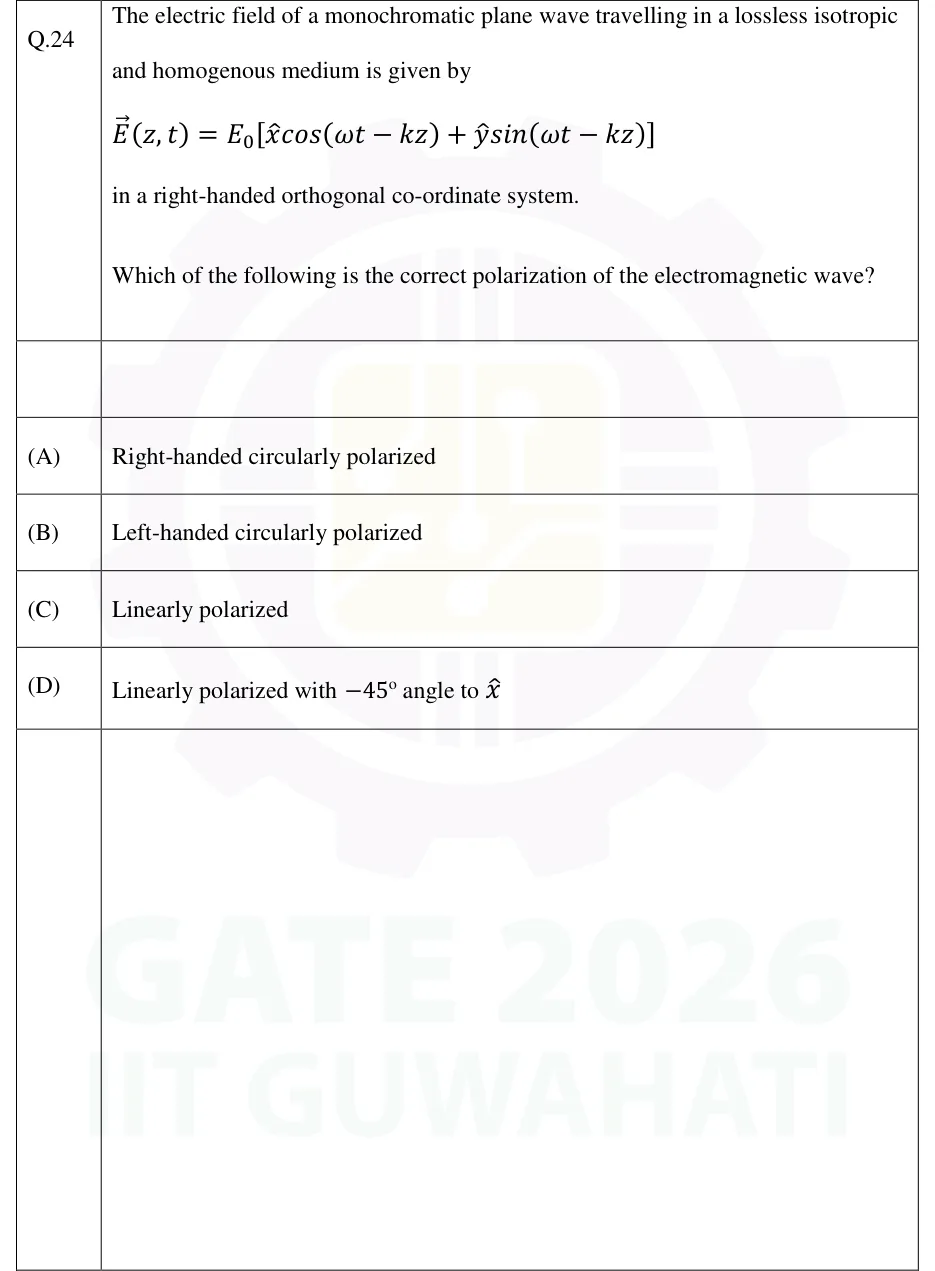
The electric field of a monochromatic plane wave travelling in a lossless isotropic and homogenous medium is given by

in a right-handed orthogonal co-ordinate system.

Which of the following is the correct polarization of the electromagnetic wave?

  1. (A)

    Right-handed circularly polarized

  2. (B)

    Left-handed circularly polarized

  3. (C)

    Linearly polarized

  4. (D)

    Linearly polarized with angle to

See the question in the paper

Answer and solution

ANSWER

(A) Right-handed circularly polarized. The components are equal in amplitude and apart in phase, and at a fixed plane turns from towards . With the right-hand fingers curled that way, the thumb points along , the direction the wave travels.

Official answer: ASource: Official answer key, GATE 2026 EC (IIT Guwahati)

  1. Direction of travel. Write and . Both components carry the phase , so the wave travels along .

  2. Amplitudes and phase. Write . The two components have equal amplitude and differ in phase by . The magnitude is constant: , so the tip of traces a circle. The wave is circularly polarized, not linearly polarized, which rules out (C) and (D).

  3. Sense of rotation. Fix the plane , so . At , . At , . As time goes on, the field turns from towards .

  4. Right-hand rule (IEEE convention). In a right-handed system, curl the fingers of the right hand from to and the thumb points along , which is the direction of travel. The rotation and the propagation obey the right-hand rule, so the wave is right-hand circularly polarized.

  5. Phasor check. Since , the phasor is . The -component lags the -component by in a wave travelling along . That is the standard form of a right-hand circularly polarized wave, so the answer is (A).

KEY IDEA

Equal amplitudes with a phase difference give circular polarization. To find the sense, fix one plane (say ) and follow as time increases. If the right-hand fingers curl the way turns and the thumb points along the direction of travel, the wave is right-handed (IEEE convention). Equivalently, for travel along the phasor is RHCP and is LHCP.

WATCH OUT FOR

Two errors lead to (B). (1) Tracking the rotation in space at a fixed instant (letting vary) rather than in time at a fixed plane: along the vector turns the opposite way, so the sense comes out reversed. (2) Using the classical optics convention, which names the sense as seen by an observer facing the oncoming wave. Under that convention the same wave is called left-handed. GATE uses the IEEE (engineering) convention, where the sense is judged with the thumb along the direction of travel. The stem's mention of a right-handed co-ordinate system points to that convention.

From the GATE 2026 EC paper. Every question of this paper · Download the full paper · All 10 Plane waves questions, with notes

More Plane waves questions