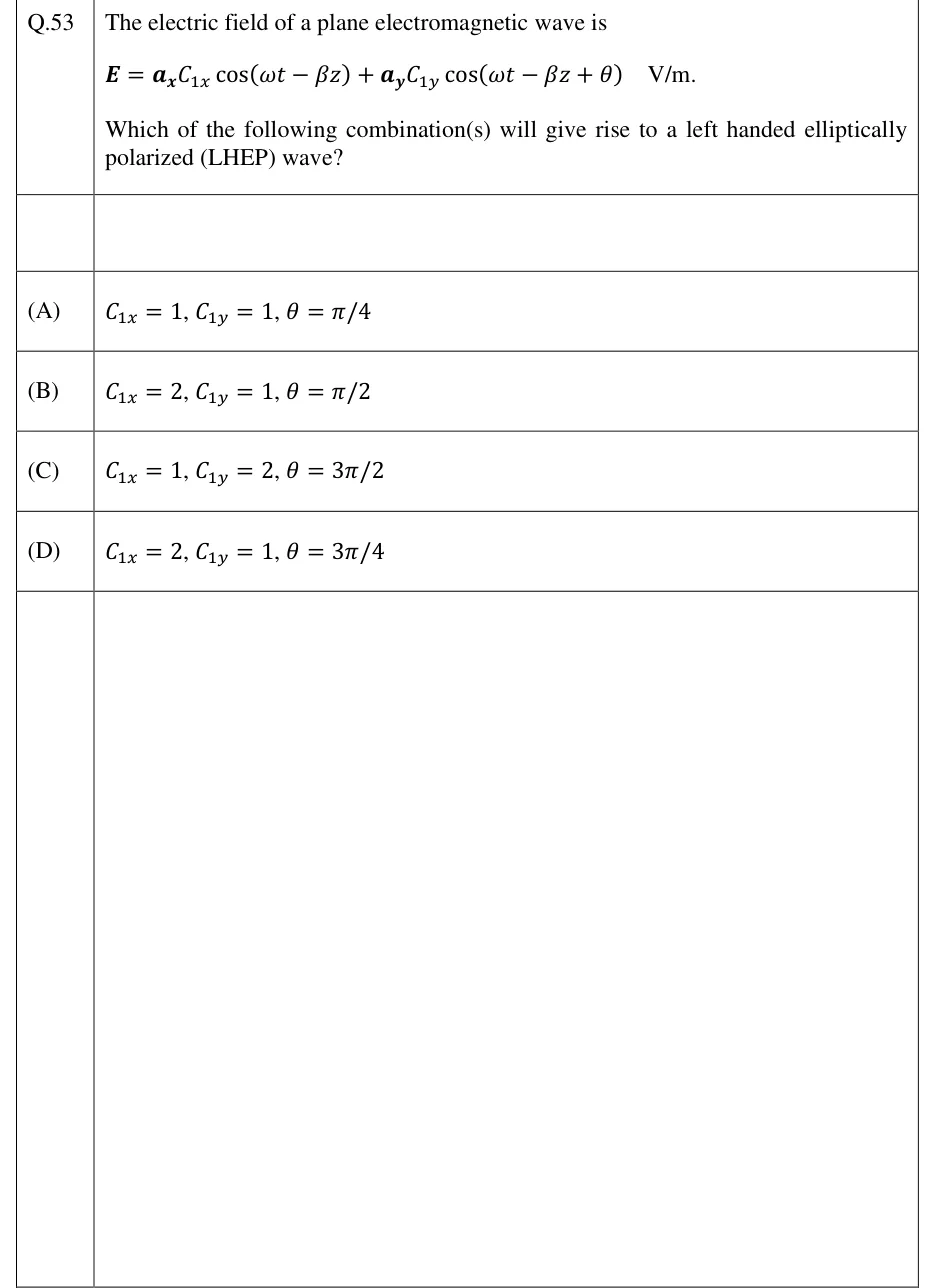
The electric field of a plane electromagnetic wave is
Which of the following combination(s) will give rise to a left handed elliptically polarized (LHEP) wave?
- (A)
- (B)
- (C)
- (D)

The electric field of a plane electromagnetic wave is
Which of the following combination(s) will give rise to a left handed elliptically polarized (LHEP) wave?
ANSWER
Options (A), (B) and (D) give a left-handed elliptically polarized wave. Option (C) is right-handed elliptical.
Official answer: A, B, DSource: Official answer key, GATE 2023 EC (IIT Kanpur)
The phase term is , so the wave travels in the direction. Look at the plane : and , so leads by .
Sense of rotation. The vector points along the axis about which turns, by the right-hand rule. Its -component is This does not depend on , so the field never reverses its direction of rotation. If the -component is negative, so turns in the negative sense about (the positive sense about ).
Handedness (IEEE convention). Point the thumb along the direction of travel (). The wave is left-handed if the fingers of the left hand curl the way turns, which is the negative sense about : . So we need , i.e. ( leads ). For , and the wave is right-handed.
Elliptical, not linear or circular. The polarization is linear if or . It is circular only if and or . Every other combination with both amplitudes non-zero is elliptical.
(A) , . The amplitudes are equal but , so the wave is elliptical (an ellipse tilted at ). , so it is left-handed: LHEP.
(B) , , . The amplitudes differ, so the wave is elliptical (an upright ellipse, major axis along ). , so it is left-handed: LHEP.
(C) , , . The wave is elliptical, but : lags by and the wave is right-handed elliptical (RHEP). Not correct.
(D) , , . The wave is elliptical and , so it is left-handed: LHEP.
The left-handed elliptical cases are (A), (B) and (D).
KEY IDEA
For , travelling along , sets the handedness. With ( leads ) the wave is left-handed in the IEEE convention, and with it is right-handed. The polarization is elliptical unless or (linear), or the amplitudes are equal and or (circular).
WATCH OUT FOR
One mistake is using the optics convention, where the wave is viewed coming towards the observer. That reverses the handedness, so it would pick (C) alone. Another is rejecting (A) because its amplitudes are equal: equal amplitudes give a circle only when or , and with the path is a tilted ellipse. It is also a mistake to call (B) circular just because , since its amplitudes are unequal.
From the GATE 2023 EC paper. Every question of this paper · Download the full paper · All 10 Plane waves questions, with notes