
IAE Academy

GATE 2020 IN Q.47: solution and answer

GATE 2020 · INQ.47 · 2 marks · NAT

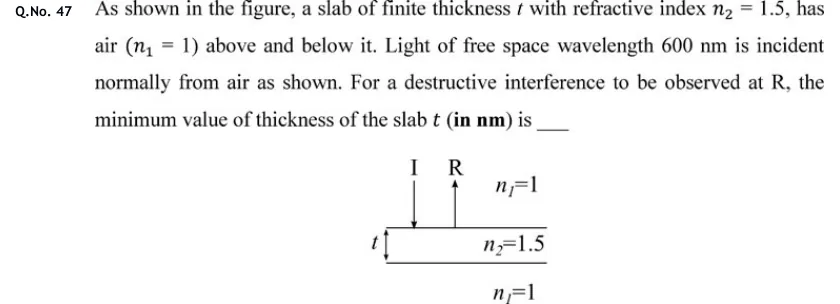
As shown in the figure, a slab of finite thickness with refractive index , has air () above and below it. Light of free space wavelength 600 nm is incident normally from air as shown. For a destructive interference to be observed at R, the minimum value of thickness of the slab (in nm) is ____
GATE 2020 IN question 47: A horizontal slab bounded by two parallel horizontal lines, the gap between them marked with a vertical double arrow…Tap to open full size
Figure from the GATE 2020 IN paper. It is part of the question.
Figure description

A horizontal slab bounded by two parallel horizontal lines, the gap between them marked with a vertical double arrow labelled t on the left. Above the slab is the region labelled n_1 = 1, inside the slab n_2 = 1.5, and below the slab n_1 = 1. Above the slab, a downward arrow labelled I (incident ray) meets the top surface normally, and just to its right an upward arrow labelled R (reflected ray) leaves the top surface normally.

Answer and solution

ANSWER

The minimum slab thickness for destructive interference at R is .

Official answer: 200Source: Official answer key, GATE 2020 IN (IIT Delhi)

  1. Phase change on reflection. At the top face the light goes from air () into the slab (). That is a rarer-to-denser reflection, so ray 1 picks up a phase shift of , which is the same as an extra path of . At the bottom face the light goes from the slab into air, a denser-to-rarer reflection, so ray 2 picks up no phase shift.

  2. Path difference from the slab. At normal incidence, ray 2 crosses the slab twice, so it travels an extra optical path of .

  3. Total effective path difference between the two reflected rays. A shift can be written as either or , and both give the same interference condition. Taking :

  4. Condition for destructive interference: . The reflection term cancels on both sides, leaving gives , which means there is no slab, so the smallest real slab comes from .

  5. Minimum thickness ():

  6. Check. Inside the slab the wavelength is , so is half a wavelength in the slab. The round trip adds exactly one wavelength, so the only phase difference left is the from reflection, and the two rays cancel. The same result holds if you count every multiple reflection: a half-wave layer with the same medium on both sides reflects nothing at that wavelength.

KEY IDEA

When the slab has the same medium (air) on both sides, only one of the two reflections picks up a phase shift. That shift already makes the two rays opposite in phase, so for destructive interference the round trip must be a whole number of wavelengths: . The smallest non-zero thickness is a half-wave layer, .

WATCH OUT FOR

One mistake is to forget the shift at the top face, or to count a shift at both faces. Either way you get and the wrong answer , which is the condition for constructive reflection here. Another is to use the free-space path instead of the optical path , which gives .

From the GATE 2020 IN paper. Every question of this paper · Download the full paper · All 10 Plane waves questions, with notes

More Plane waves questions