
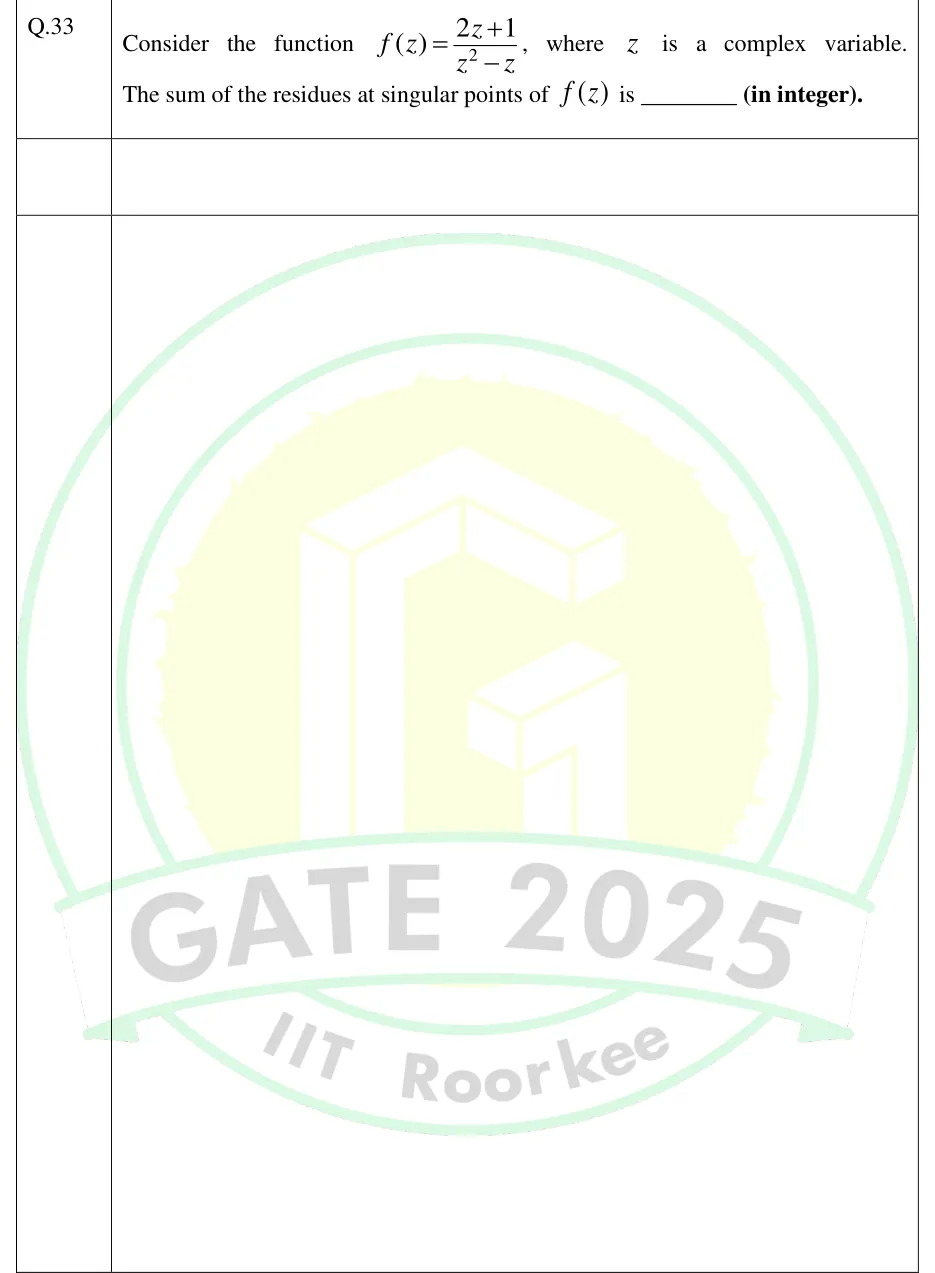
Consider the function , where is a complex variable. The sum of the residues at singular points of is ________ (in integer).
GATE 2025 IN Q.33: solution and answer
Answer and solution
ANSWER
The residues are at and at , so their sum is .
Official answer: 2Source: Official answer key, GATE 2025 IN (IIT Roorkee)
Factor the denominator: , so . The only singular points are and . The numerator is not zero at either point (it equals and ), so both are simple poles.
At a simple pole the residue is .
At : .
At : .
Sum of the residues: .
Check with partial fractions: , because . The residues are the coefficients, and .
Second check: for large , , so the residue at infinity is . All residues, including the one at infinity, add to zero, so the finite residues must add to .
KEY IDEA
For a proper rational function with simple poles, each residue is the partial-fraction coefficient: cover up the factor and put in what is left. As a quick check, the finite residues of a rational function add up to minus the residue at infinity. That equals the coefficient of in the large- expansion, here the leading-coefficient ratio .
WATCH OUT FOR
Using where the pole is at , or getting the sign wrong in at , so the residue there comes out instead of and the sum becomes . Another slip is to include the residue at infinity () in the sum and answer . The question asks only for the singular points, which are and .
From the GATE 2025 IN paper. Every question of this paper · Download the full paper · All 24 Complex analysis questions, with notes
More Complex analysis questions
- GATE 2024 EC Q.43 · MCQ · 2 marksLet z be a complex variable. If f(z)=(sin (π z))/(z^2(z-2)) and C is the circle in the complex plane with…
- GATE 2024 EE Q.30 · MSQ · 1 markWhich of the following complex functions is/are analytic on the complex plane?
- GATE 2024 EE Q.31 · NAT · 1 markConsider the complex function f(z) = cos z + e^z^2. The coefficient of z^5 in the Taylor series expansion of…
- GATE 2024 IN Q.11 · MCQ · 1 markLet z = x + iy be a complex variable and z be its complex conjugate. The equation z^2 + z^2 = 2 represents a