
IAE Academy

GATE 2025 IN Q.49: solution and answer

GATE 2025 · INQ.49 · 2 marks · MSQ

Choose the correct statement(s) from the following options, regarding Cauchy's theorem on complex integration where is a simple closed path in a simply connected domain .

  1. (A)

    Cauchy's theorem cannot be directly applied to conclude that when , and is the unit circle

  2. (B)

    If is analytic in , then it can be concluded that for any simple closed path in

  3. (C)

    The function must be analytic in to conclude for any simple closed path in

  4. (D)

    when , since the function is not analytic at
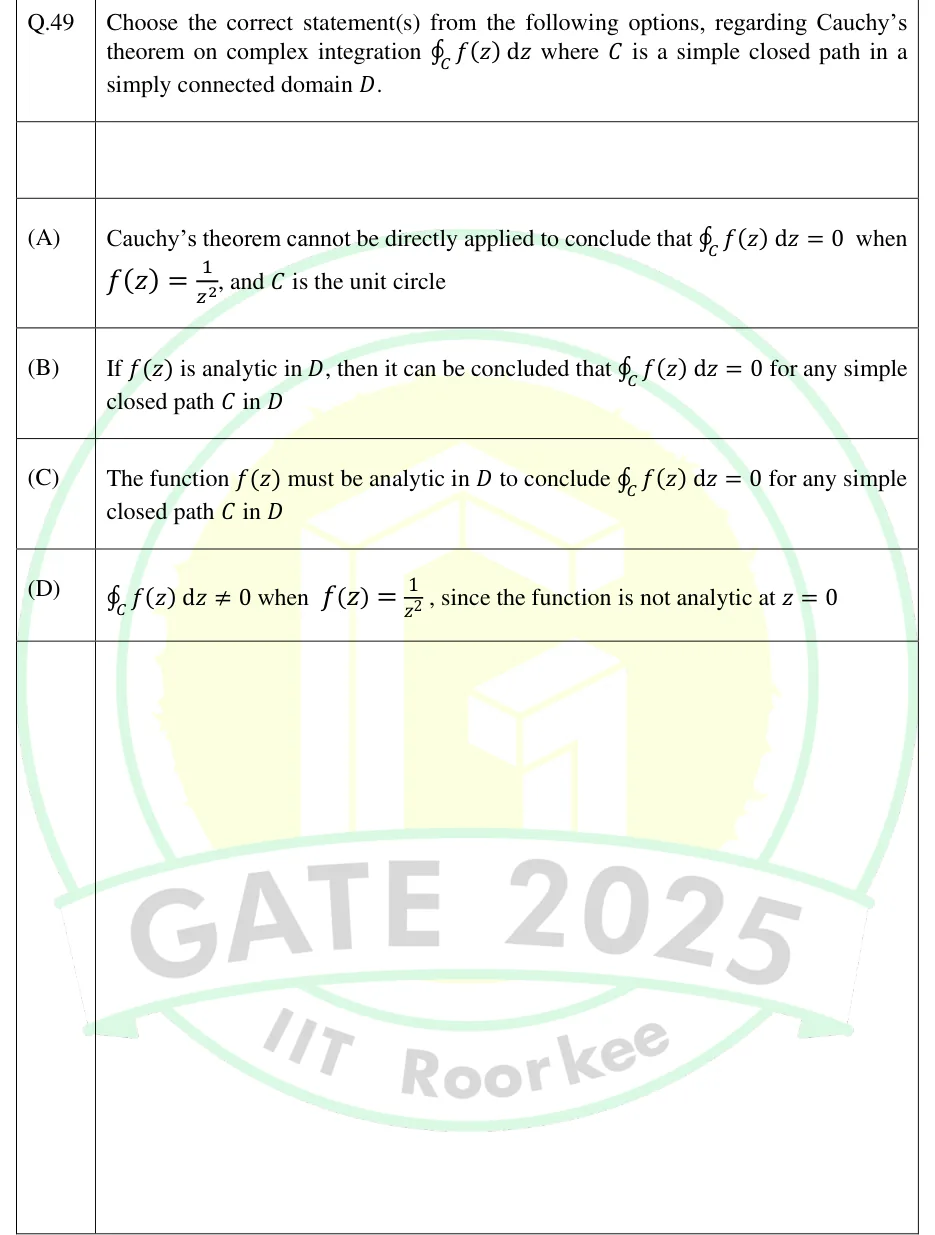
See the question in the paper

Answer and solution

ANSWER

(A) and (B) are correct. Cauchy's theorem needs f to be analytic on and inside C, and 1/z² fails this at z = 0, so the theorem cannot be applied directly (A). If f is analytic in D, the theorem gives zero (B). The integral of 1/z² around the unit circle is in fact 0 (its residue is 0), so (D) is false. For the same reason analyticity is sufficient but not necessary, so (C) is false.

Official answer: A, BSource: Official answer key, GATE 2025 IN (IIT Roorkee)

  1. Cauchy's integral theorem: if is analytic in a simply connected domain , then for every simple closed path in . Statement (B) is exactly this theorem, so (B) is true.

  2. (A): is not defined at , where it has a pole of order 2. A simply connected domain that contains the unit circle must also contain everything inside it, including . So is not analytic in , the hypothesis of Cauchy's theorem fails, and the theorem cannot be used directly to conclude . (A) is true.

  3. (D), computed directly: on put , so :

  4. Check with residues: the Laurent series of about is just . It has no term, so and . Put another way, has the single-valued antiderivative for , so its integral around any closed path that does not pass through is . In general for every integer . The integral is zero even though is not analytic at , so (D) is false: a function that fails to be analytic at a point inside does not, for that reason alone, have a non-zero integral.

  5. (C): Cauchy's theorem makes analyticity a sufficient condition for . It is not a necessary one. Step 4 gives a counterexample: is not analytic at , yet its integral is zero around every closed path that avoids , including paths that enclose it. So it is false that "must" be analytic. (Morera's theorem, a partial converse, also requires to be continuous at every point of . is not even defined at , so the example does not contradict it.) (C) is false.

  6. Correct statements: (A) and (B).

KEY IDEA

Cauchy's theorem runs one way only: if f is analytic in D, the integral is zero. The converse does not follow. A function with a singularity inside C can still have a zero integral whenever its residue there is zero. 1/z² is the standard example, because it has the single-valued antiderivative −1/z. The theorem is silent in that case, so you cannot use it, but you also cannot conclude the integral is non-zero.

WATCH OUT FOR

Reading Cauchy's theorem as "analytic if and only if the integral is zero". That reading makes (C) and (D) look true: (D) because "not analytic, therefore non-zero" and (C) because "must be analytic". The integral of 1/z² around the unit circle is 0 because the residue is 0. Some students also cite Morera's theorem to defend (C), but Morera needs f to be continuous throughout D, and 1/z² is not continuous at z = 0.

From the GATE 2025 IN paper. Every question of this paper · Download the full paper · All 24 Complex analysis questions, with notes

More Complex analysis questions