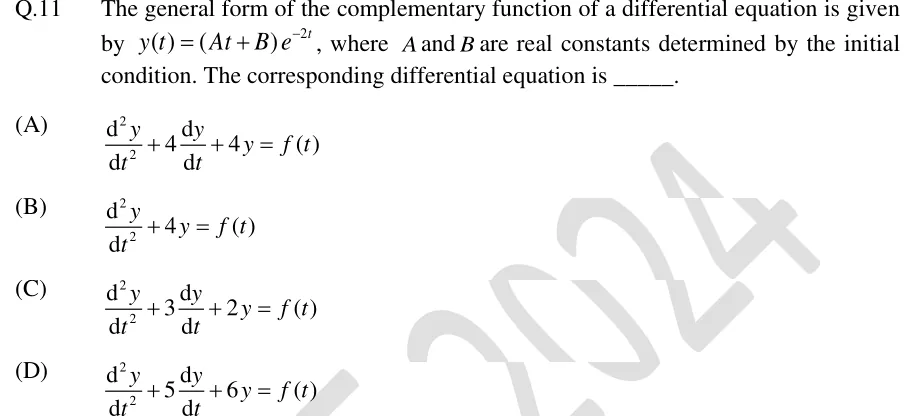
The general form of the complementary function of a differential equation is given by , where and are real constants determined by the initial condition. The corresponding differential equation is ______.
- (A)
- (B)
- (C)
- (D)

The general form of the complementary function of a differential equation is given by , where and are real constants determined by the initial condition. The corresponding differential equation is ______.
ANSWER
The differential equation is , option (A).
Official answer: ASource: Official answer key, GATE 2024 EC (IISc Bengaluru)
For a linear ODE with constant coefficients, the complementary function (CF) comes from the roots of the auxiliary equation. A CF of the form means is a repeated (double) root.
Here the CF is , so is a root of multiplicity 2.
The auxiliary equation is therefore
Replacing by the operator gives which is option (A).
Checking the others: (B) gives , so CF . (C) gives , so CF . (D) gives , so CF . None of these contains the term , so only (A) fits.
KEY IDEA
A factor of multiplying in the complementary function means is a repeated root of the auxiliary equation. So comes from . The forcing term only changes the particular integral, never the CF.
WATCH OUT FOR
Choosing (D) or (C) because each has as a root. They have two distinct roots, so their CF is a sum of two different exponentials with no term. The other common slip is taking (B) because it shows a 4. But has roots , which give an oscillating CF, not a decaying one.
From the GATE 2024 EC paper. Every question of this paper · Download the full paper · All 19 Differential equations questions, with notes