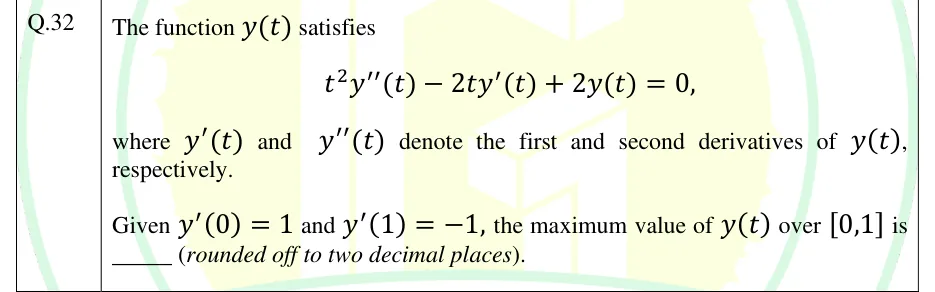
The function satisfies
where and denote the first and second derivatives of , respectively.
Given and , the maximum value of over is ______ (rounded off to two decimal places).

The function satisfies
where and denote the first and second derivatives of , respectively.
Given and , the maximum value of over is ______ (rounded off to two decimal places).
ANSWER
, so the maximum over is .
Official answer: 0.25Source: Official answer key, GATE 2025 EC (IIT Roorkee)
The equation is a Cauchy-Euler equation: each derivative is multiplied by . So try , which gives and .
Substituting and dividing by gives the auxiliary equation , so or .
The roots are real and distinct, so the general solution is , with .
Apply the given conditions, which are on the derivative: , and .
So . It is a polynomial, so it is smooth on all of , including the singular point , and it satisfies the equation there too: .
For the maximum, set , which lies inside . Since , this point is a maximum.
At the endpoints , so the maximum of over is .
KEY IDEA
This is a Cauchy-Euler equation, where each derivative is multiplied by . Substituting turns it into the algebraic equation . Its roots give the polynomial solution , and the two conditions on fix and . What is left is an ordinary maximisation over a closed interval: check the stationary point and both endpoints.
WATCH OUT FOR
The most common slip is reading the conditions as and when they are on . This cannot even work, because every solution has . The second is writing the auxiliary equation as , which drops the from and gives false complex roots. The third is forgetting to compare the stationary value with the endpoint values and .
From the GATE 2025 EC paper. Every question of this paper · Download the full paper · All 19 Differential equations questions, with notes