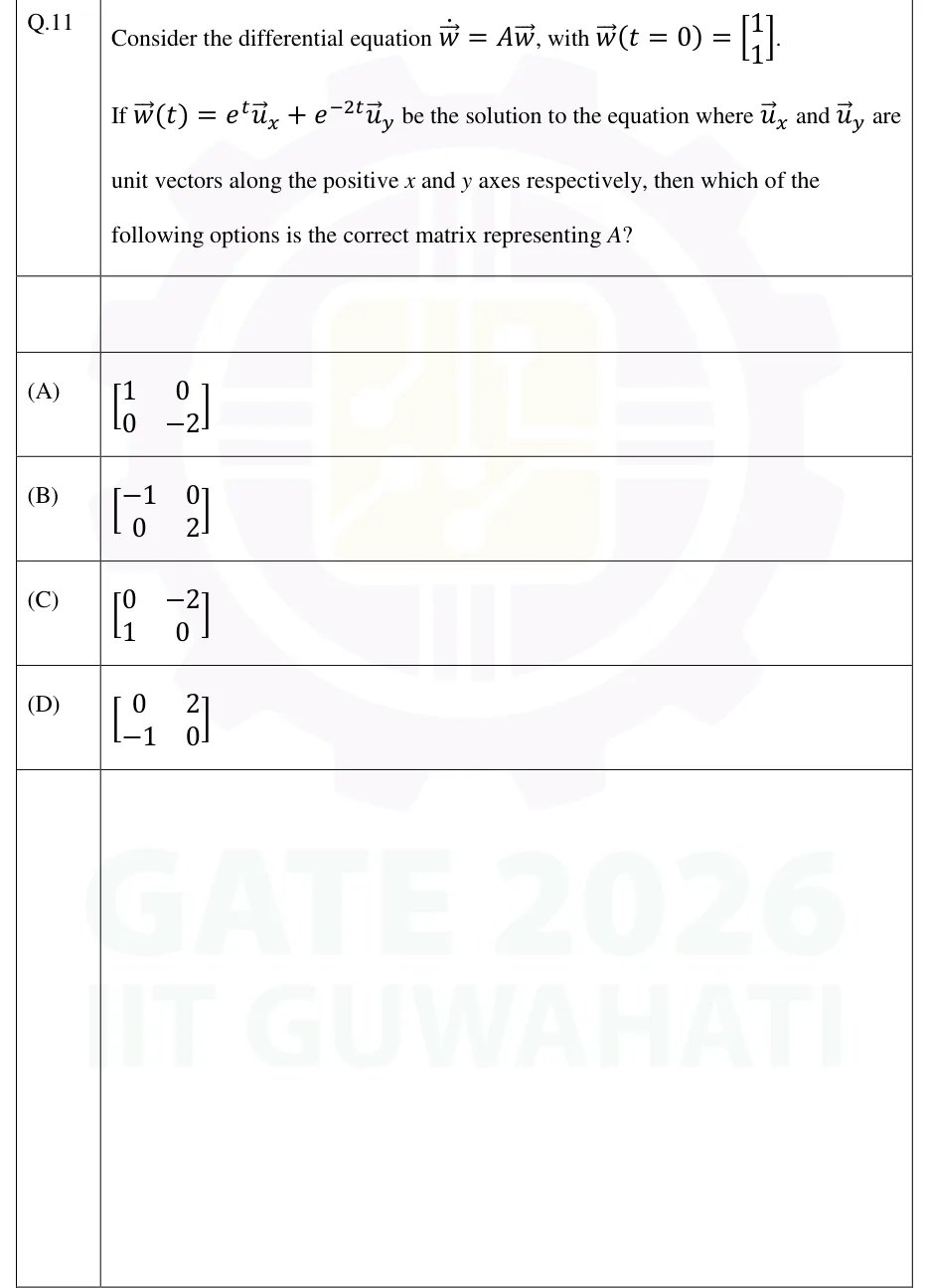
Consider the differential equation , with .
If be the solution to the equation where and are unit vectors along the positive and axes respectively, then which of the following options is the correct matrix representing ?
- (A)
- (B)
- (C)
- (D)

Consider the differential equation , with .
If be the solution to the equation where and are unit vectors along the positive and axes respectively, then which of the following options is the correct matrix representing ?
ANSWER
The answer is (A), . The solution means is an eigenvector with eigenvalue and is an eigenvector with eigenvalue , so is diagonal with entries and .
Official answer: ASource: Official answer key, GATE 2026 EC (IIT Guwahati)
Write the solution in components: . At this is , so it satisfies the initial condition.
Differentiate each component: .
Split the solution into its modes: . Substituting into gives for every .
The functions and are linearly independent, so their coefficients must match separately: and . So and are eigenvectors of with eigenvalues and . (A mode solves the system only when .)
The columns of are and , so
Check: . The other options fail. (B) gives , which has the wrong signs. (C) gives and (D) gives , and both swap the two components. Also, (C) and (D) both have trace and determinant , so their eigenvalues are . That would give oscillatory solutions, not real exponentials. So the answer is (A).
KEY IDEA
For , each term of the solution is a mode, and a mode only works when . Here the modes lie along (with ) and (with ). The eigenvectors are the standard basis vectors, so is simply : its eigenvalues sit on the diagonal in the same order as the axes.
WATCH OUT FOR
One mistake is picking (B) by reading the exponent as a pole at , which flips the signs. The eigenvalue is the coefficient of in the exponent itself, so it is and not . Another is choosing (C) or (D) because they contain the right numbers and in off-diagonal places. But those matrices mix and , and their eigenvalues would give oscillation, not and .
From the GATE 2026 EC paper. Every question of this paper · Download the full paper · All 19 Differential equations questions, with notes