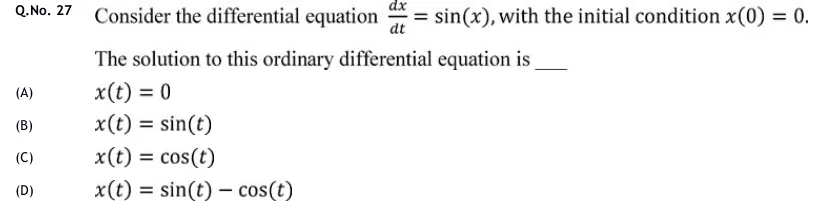
Consider the differential equation , with the initial condition .
The solution to this ordinary differential equation is ____
- (A)
- (B)
- (C)
- (D)

Consider the differential equation , with the initial condition .
The solution to this ordinary differential equation is ____
ANSWER
The solution is : the initial value is an equilibrium of , and because the solution is unique, stays at 0 for all . Option (A).
Official answer: ASource: Official answer key, GATE 2020 IN (IIT Delhi)
The right-hand side is , a function of the dependent variable , not of . So this is an autonomous equation with . It is not .
Equilibrium (constant) solutions satisfy : . The initial value is one of these equilibria.
Check : and , so the ODE holds. The initial condition holds too.
Uniqueness (Picard–Lindelöf theorem): has , so is Lipschitz. The initial value problem therefore has exactly one solution, and that solution is .
Rule out the other options directly. (C): . (D): . (B) meets the initial condition, but while . These are not equal: at , but .
So the solution is , option (A).
KEY IDEA
In an autonomous equation , every root of gives a constant solution. If the initial value sits on such a root and is Lipschitz, uniqueness says the solution never leaves it. Here , so .
WATCH OUT FOR
Reading as and integrating gives . That is not an option, and it tempts students to pick (B) or (C) by pattern. A second trap: separating variables as divides by , which is zero at . That throws away exactly the equilibrium solution the initial condition picks out, and then has no finite for .
From the GATE 2020 IN paper. Every question of this paper · Download the full paper · All 19 Differential equations questions, with notes