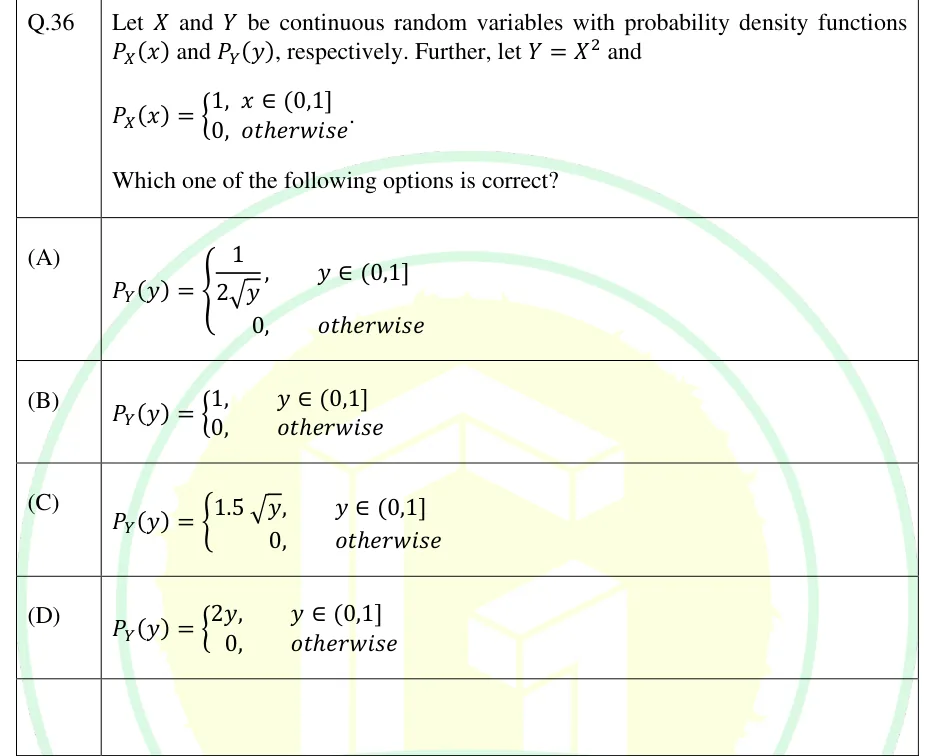
Let and be continuous random variables with probability density functions and , respectively. Further, let and
Which one of the following options is correct?
- (A)
- (B)
- (C)
- (D)

Let and be continuous random variables with probability density functions and , respectively. Further, let and
Which one of the following options is correct?
ANSWER
for and otherwise, which is option (A).
Official answer: ASource: Official answer key, GATE 2025 EE (IIT Roorkee)
Range of . takes values only in , and is strictly increasing there, mapping onto . So : for and for , which gives outside .
CDF method. For , , because .
Use the uniform density. Since , .
Differentiate. for .
Check with the change-of-variable formula. For a monotone map, . Here and , so . Same result.
Why normalisation can't decide it. Every option integrates to 1 over : , , and . So checking that an option is a valid density doesn't pick the answer. The density derived above does, and it is option (A).
KEY IDEA
To find the density of a function of a random variable, work out the CDF first and then differentiate: on , so . For a monotone map, the shortcut gives the same answer.
WATCH OUT FOR
Assuming is uniform because is uniform (option B). Squaring squeezes values near 0 closer together, so piles up near 0 and its density grows without bound as . A second trap is checking only that an option integrates to 1. All four options do, so that test can't decide the answer. A third is multiplying by where the formula needs .
From the GATE 2025 EE paper. Every question of this paper · Download the full paper · All 33 Probability & statistics questions, with notes