
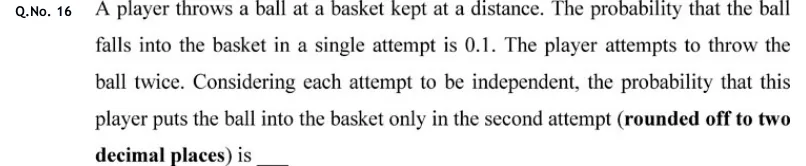
A player throws a ball at a basket kept at a distance. The probability that the ball falls into the basket in a single attempt is 0.1. The player attempts to throw the ball twice. Considering each attempt to be independent, the probability that this player puts the ball into the basket only in the second attempt (rounded off to two decimal places) is ____
GATE 2020 IN Q.16: solution and answer
Answer and solution
ANSWER
The probability that the player puts the ball into the basket only in the second attempt is .
Official answer: 0.09Source: Official answer key, GATE 2020 IN (IIT Delhi)
Let stand for a throw that goes in and for a miss. For a single attempt , so by the complement rule .
"Only in the second attempt" describes exactly one outcome of the two throws: the first throw misses and the second goes in. That is the event . The outcomes and are excluded because the ball went in on the first throw, and is excluded because it never went in.
The attempts are independent, so the multiplication rule gives
already has two decimal places, so no rounding is needed and the answer is . This is also the geometric-distribution probability that the first success comes on trial : .
KEY IDEA
Read "only in the second attempt" as one specific sequence: a miss on the first throw, then a basket on the second. Independence lets you multiply the two probabilities: . This is the geometric probability that the first success comes on trial 2.
WATCH OUT FOR
Answering by ignoring the requirement that the first throw misses. Another error is answering , which is and wrongly includes the case where the ball goes in on the first throw only. A third is answering , which is the probability of scoring on both throws.
From the GATE 2020 IN paper. Every question of this paper · Download the full paper · All 33 Probability & statistics questions, with notes
More Probability & statistics questions
- GATE 2018 EC Q.23 · NAT · 1 markLet X_1, X_2, X_3 and X_4 be independent normal random variables with zero mean and unit variance.
- GATE 2018 IN Q.3 · MCQ · 1 markX and Y are two independent random variables with variances 1 and 2, respectively. Let Z = X - Y.
- GATE 2018 IN Q.5 · MCQ · 1 markConsider a sequence of tossing of a fair coin where the outcomes of tosses are independent.
- GATE 2018 IN Q.27 · MCQ · 2 marksTwo bags A and B have equal number of balls. Bag A has 20% red balls and 80% green balls.