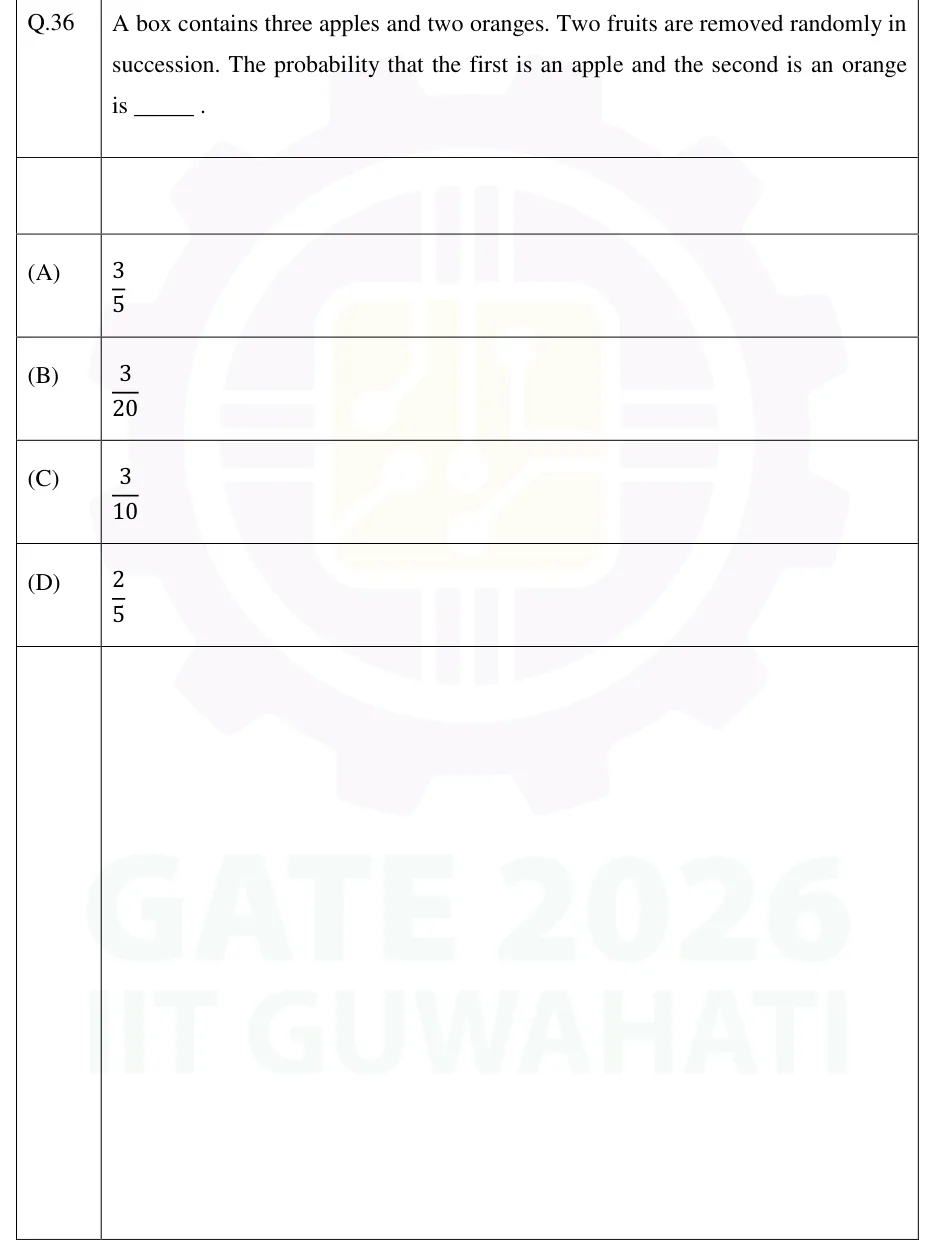
A box contains three apples and two oranges. Two fruits are removed randomly in succession. The probability that the first is an apple and the second is an orange is ______ .
- (A)
- (B)
- (C)
- (D)

A box contains three apples and two oranges. Two fruits are removed randomly in succession. The probability that the first is an apple and the second is an orange is ______ .
ANSWER
The probability that the first fruit is an apple and the second is an orange is , which is option (C).
Official answer: CSource: Official answer key, GATE 2026 IN (IIT Guwahati)
The box holds apples and oranges, fruits in all. "Removed in succession" means the first fruit is not put back before the second is drawn, so this is drawing without replacement. Let be "first fruit is an apple" and be "second fruit is an orange".
First draw: .
Once an apple is out, fruits are left, and all oranges are still among them. So .
Multiplication rule for dependent events:
Check by counting ordered pairs: there are equally likely ordered draws, and of them are (apple, orange). So the probability is , which is option (C).
KEY IDEA
Drawing in succession means drawing without replacement, so the events are dependent. For a specified order, multiply the probability of the first draw by the conditional probability of the second draw given the first: . Counting ordered pairs ( favourable out of ) gives the same answer.
WATCH OUT FOR
Each wrong option matches a specific slip. (A) is on its own. It is also the probability of one apple and one orange in either order, , so it is what you get if you ignore the order the question asks for. (D) is the probability of drawing an orange from the full box. Treating the draws as independent (with replacement) gives , which is not an option. That is a sign the second draw has to use the fruits left in the box.
From the GATE 2026 IN paper. Every question of this paper · Download the full paper · All 33 Probability & statistics questions, with notes