IAE Academy

GATE 2024 EC Q.25: solution and answer

GATE 2024 · ECQ.25 · 1 mark · MSQ

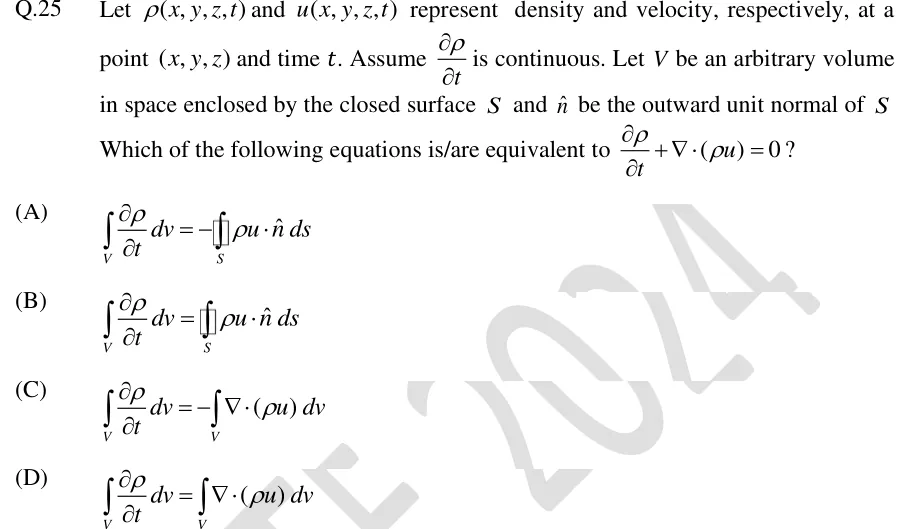
Let and represent density and velocity, respectively, at a point and time . Assume is continuous. Let be an arbitrary volume in space enclosed by the closed surface and be the outward unit normal of . Which of the following equations is/are equivalent to ?

  1. (A)

  2. (B)

  3. (C)

  4. (D)

See the question in the paper

Answer and solution

ANSWER

(A) and (C) are both equivalent to . (C) is the point form integrated over an arbitrary volume. (A) is (C) with the divergence theorem applied: the rate at which mass in increases equals minus the net outward mass flux through .

Official answer: A, CSource: Official answer key, GATE 2024 EC (IISc Bengaluru)

  1. The given equation is the continuity equation in point form: at every point and every time .

  2. Integrate both sides over the arbitrary volume : This is option (C), so the given equation implies (C).

  3. Conversely, (C) says for every volume , where is continuous ( is continuous by hypothesis, and is taken smooth enough for its divergence to exist, as the divergence theorem requires). If at some point, continuity keeps throughout a small ball around it, and taking as that ball gives a positive integral, which contradicts (C). The same argument rules out . So everywhere: (C) is equivalent to the given equation, not just a consequence of it.

  4. Apply the Gauss divergence theorem, , with and the outward normal, to the right-hand side of (C): This is option (A). Its right-hand side equals that of (C) for every , so (A) is equivalent to (C), and therefore to the given equation.

  5. Options (B) and (D) have the wrong sign. By the divergence theorem (B) is the same statement as (D), and the argument of step 3 turns (D) into at every point. Together with the given equation that would force everywhere, which is not true in general. So neither is equivalent. Physically, (B) would mean the mass inside grows when there is a net outward flux of mass, which contradicts conservation of mass.

  6. Hence the correct options are (A) and (C).

KEY IDEA

When the integrand is continuous, a point-form equation holds everywhere exactly when its integral is zero over every volume. The Gauss divergence theorem then turns into the outward flux . So the integral forms (C) and (A) are equivalent to the point form, not merely consequences of it.

WATCH OUT FOR

The usual slip is dropping the minus sign when moving to the right-hand side, which leads to (B) or (D). A second one is marking only (A) because (C) looks like 'just an intermediate step'. Since the equation must hold for every volume , (C) is fully equivalent to the point form too. Remember that points outward, so a positive flux means mass is leaving .

From the GATE 2024 EC paper. Every question of this paper · Download the full paper · All 23 Vector calculus questions, with notes

More Vector calculus questions