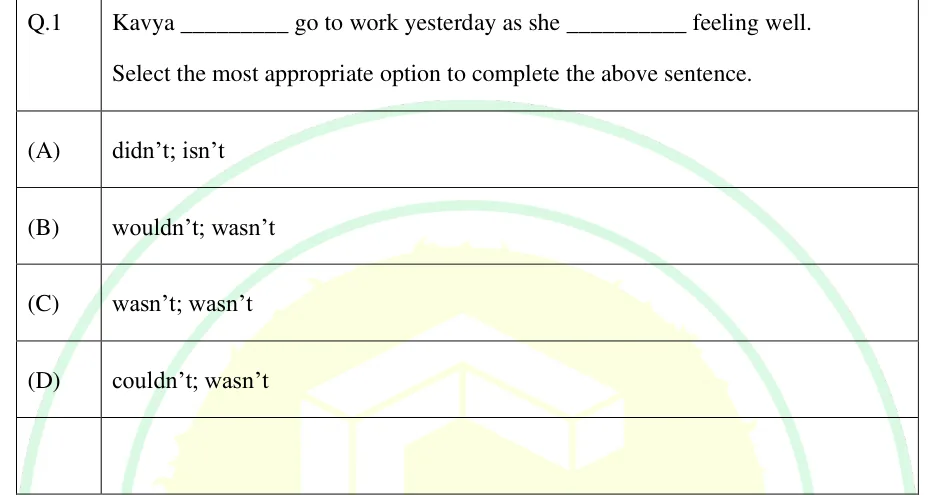
Kavya _________ go to work yesterday as she __________ feeling well.
Select the most appropriate option to complete the above sentence.
- (A)
didn’t; isn’t
- (B)
wouldn’t; wasn’t
- (C)
wasn’t; wasn’t
- (D)
couldn’t; wasn’t

Kavya _________ go to work yesterday as she __________ feeling well.
Select the most appropriate option to complete the above sentence.
didn’t; isn’t
wouldn’t; wasn’t
wasn’t; wasn’t
couldn’t; wasn’t
ANSWER
(D) couldn’t; wasn’t. The sentence reads: "Kavya couldn’t go to work yesterday as she wasn’t feeling well."
Official answer: DSource: Official answer key, GATE 2025 EE (IIT Roorkee)
The time marker "yesterday" puts the whole sentence in the past, so both blanks need past-tense forms.
Second blank: "as she ______ feeling well" gives the reason, and it holds at the same past time. "feeling" needs a form of "be" in front of it, and the past negative is "wasn't" (was + not + feeling, the past continuous). "isn't" is present tense and clashes with "yesterday", so (A) is out.
First blank: the word after it is the bare verb "go", so the blank must be a modal or "did". "wasn't go" is ungrammatical, because "was" would need "going" after it. So (C) is out.
That leaves (B) "wouldn't go" and (D) "couldn't go". In the past, "would not" signals refusal or unwillingness: she chose not to go. "could not" signals inability: she was not able to go.
The reason given is illness ("she wasn't feeling well"). Illness takes away your ability to do something; it is not a choice. So the modal of inability, "couldn't", fits the cause-and-effect link made by "as".
Completed sentence: "Kavya couldn't go to work yesterday as she wasn't feeling well." Answer: (D).
KEY IDEA
Fill the blanks in two passes. First use tense and grammar: "yesterday" needs past forms, and the bare verb "go" after the first blank needs a modal or "did". Then use meaning: illness stops you from being able to do something, so the modal of inability, "couldn't", fits better than the modal of refusal, "wouldn't".
WATCH OUT FOR
Picking (B) "wouldn't; wasn't" because it is also grammatical. "Wouldn't go" means Kavya refused to go, which is a choice. Being unwell is a reason she was unable to go, so "couldn't" is the right fit. Some students also pick (C) because it repeats "wasn't", but "wasn't go" is ungrammatical ("was" would need "going").
From the GATE 2025 EE paper. Every question of this paper · Download the full paper · All 32 Grammar & vocabulary questions, with notes