
IAE Academy

GATE 2018 EC GA Q.10: solution and answer

GATE 2018 · ECGA Q.10 · 2 marks · MCQ

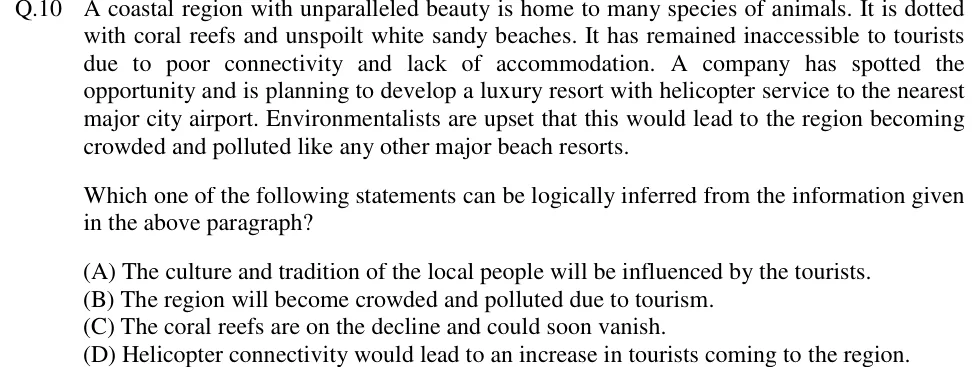
A coastal region with unparalleled beauty is home to many species of animals. It is dotted with coral reefs and unspoilt white sandy beaches. It has remained inaccessible to tourists due to poor connectivity and lack of accommodation. A company has spotted the opportunity and is planning to develop a luxury resort with helicopter service to the nearest major city airport. Environmentalists are upset that this would lead to the region becoming crowded and polluted like any other major beach resorts.

Which one of the following statements can be logically inferred from the information given in the above paragraph?

  1. (A)

    The culture and tradition of the local people will be influenced by the tourists.

  2. (B)

    The region will become crowded and polluted due to tourism.

  3. (C)

    The coral reefs are on the decline and could soon vanish.

  4. (D)

    Helicopter connectivity would lead to an increase in tourists coming to the region.
See the question in the paper

Answer and solution

ANSWER

(D) Helicopter connectivity would lead to an increase in tourists coming to the region.

Official answer: DSource: Official answer key, GATE 2018 EC (IIT Guwahati)

  1. What counts as an inference: the statement must follow from the facts given in the passage. It cannot rest on outside knowledge, and it cannot rest only on the opinion of a group the passage mentions.

  2. The stated cause: the region "has remained inaccessible to tourists due to poor connectivity and lack of accommodation." The passage names exactly two things that keep tourists away: poor connectivity and no accommodation.

  3. The planned change: the company will build a luxury resort, which removes the accommodation problem, and run a helicopter service to the nearest major city airport, which removes the connectivity problem. The helicopter service takes away exactly the obstacle the passage blames, so tourists who could not reach the region before will be able to. The passage also says the company "has spotted the opportunity", and that opportunity is the arrival of visitors. So better connectivity would bring more tourists. That is option (D), which uses the cautious "would", in line with the passage.

  4. Option (A): the passage never mentions local people, their culture or their traditions. This needs information the passage does not give, so reject it.

  5. Option (B): the passage says only that environmentalists "are upset that this would lead to" crowding and pollution. That is a fear held by one group, not a fact the passage states. Also, "will become" claims a certainty the passage does not support. Reject it.

  6. Option (C): the passage says only that the region "is dotted with coral reefs". Nothing says the reefs are declining or could vanish. Reject it.

  7. Only (D) follows directly from the passage's own cause-and-effect statement. The answer is (D).

KEY IDEA

The passage says outright why tourists stay away: poor connectivity (and a lack of accommodation). If the plan removes that stated cause, you can infer that the effect reverses and more tourists come. That inference rests on the passage's own facts. A claim that rests only on what one group fears does not count.

WATCH OUT FOR

Picking (B) because the passage mentions crowding and pollution. Those words come from the environmentalists' worry ("are upset that this would lead to"), not from a fact the passage states, and "will become" turns that worry into a certainty. (A) and (C) also fail because they bring in things the passage never mentions: local culture, and reefs in decline.

From the GATE 2018 EC paper. Every question of this paper · Download the full paper · All 18 Reading questions, with notes

More Reading questions