IAE Academy

EVERY GATE PAPER

Reading comprehension and narrative sequencing

Reading comprehension questions give a short passage and ask what it states, implies, assumes or argues. Narrative sequencing gives jumbled sentences and asks for the only order in which they make a coherent paragraph. You solve both the same way: treat the passage as the whole universe, so an option is right only if the text supports it, and read the small words exactly. That means quantifiers such as all, some and only, connectives such as however and therefore, and pronouns that point back to something already said.

18 previous-year questions · 18 solved · 5 practice questions

What GATE comprehension questions ask

In the verbal-ability part of General Aptitude, a comprehension question gives you a short passage and asks one question about it. The passage is the entire universe of the question. An option is correct only if the passage supports it. Being true, sensible or well known does not make it correct. You may still use the ordinary meanings of words and the everyday facts needed simply to read a sentence (that noon is not overnight, that a week has seven days). What you may not bring in is information about the passage's topic that the passage itself does not give. The skill being tested is exact reading: knowing what a set of sentences commits you to and what it does not.

The question stems do two different jobs. Some ask what the passage says or commits you to: a stated fact, an inference, the main idea, the tone, the meaning of a word as it is used, or the purpose a sentence serves. Others ask about the passage's argument: what it takes for granted (an assumption), or what new information would make it stronger or weaker. Before you read the options, decide which job the stem is asking for, because each job has a different kind of correct answer.

Stem wording

What it asks for

The correct option

Typical wrong option

'According to the passage', 'the passage states'

A fact given in the passage, possibly in other words

A faithful paraphrase of one sentence

The same words with a changed quantifier, or with cause and effect reversed

'Can be inferred', 'is implied', 'must be true'

What follows from the passage, often by combining two sentences

A statement that cannot be false if every sentence of the passage is true

A plausible next thought, or a fact that is true in the real world but absent from the passage

'Is best supported by the passage'

The option the text backs most strongly

An option every part of which the text backs; if two seem backed, the more cautiously worded one

A stronger version of a supported claim (all, only, always)

'Assumption', 'the argument presupposes'

An unstated premise without which the conclusion does not follow

An option whose negation breaks the argument

An option that merely helps, or one that is stronger than the argument needs

'If true, strengthens', 'if true, weakens', 'most seriously undermines'

New information, taken as true, that makes the conclusion more likely (strengthen) or less likely (weaken)

An option that closes the gap between evidence and conclusion (strengthen), or widens it, often with another explanation (weaken)

An option that only repeats the evidence, or is about the topic but not about the link from evidence to conclusion

'Main idea', 'central point', 'best title'

The single claim that the whole passage serves

Covers every sentence's purpose, and no more

One detail (too narrow) or the general subject (too broad)

'The author mentions X in order to', 'the primary purpose'

The job a sentence, an example or the whole passage does

Names the role: background, example, objection, evidence or conclusion

An option that restates what X says instead of why it is there

'As used in the passage, the word X means'

The sense the word has in that sentence

The meaning that still makes sense when put in place of the word

The word's commonest meaning, when the passage uses another sense

'Tone', 'the author's attitude'

The author's stance, read from the evaluative words used

A tone word whose strength matches those words

An extreme tone (contemptuous, ecstatic) for a measured passage

'Cannot be inferred', 'EXCEPT', 'least supported'

The one option that is NOT supported

The option that is unsupported or contradicted

Treating the question as an ordinary inference question

EXAM TIP

'Best supported by the passage' and 'best supports the conclusion' point in opposite directions. In the first, the passage is the evidence and the option must follow from it. In the second (usually worded 'which of the following, if true, ...'), the option is new evidence and must make the passage's conclusion more likely. Read the preposition before anything else.

Restatement, inference, extrapolation and outside knowledge

It helps to sort each option in an inference-type question into one of five classes. A restatement says what one sentence already says, in different words. An inference is a new statement that is written nowhere but is forced by the passage, usually by combining two sentences, so it cannot be false while the passage is true. An extrapolation goes beyond the passage: a prediction, a recommendation, a cause the passage never gave, or a claim about a wider group. Outside knowledge is a statement about the topic that may well be true in the world but that the passage never touches. A contradiction conflicts with a sentence of the passage.

Only the first two classes are supported by the passage. Extrapolation tempts because it sounds like a sensible next thought. Outside knowledge tempts because you know it to be true. Neither is evidence from the passage, so an option that is correct in real life but not supported by the text is wrong. The examiner is testing whether you can keep the two apart.

THE INFERENCE TEST

Here is read 'means exactly the same as'. For 'can be inferred', 'is implied' and 'must be true', an option passes only if it holds in every situation in which all the passage's sentences hold. 'Probably true' and 'true in real life' do not pass. Ordinary word meanings may be used in applying the test; facts about the topic that the passage does not give may not.

Class

What it does

Test

Supported?

Restatement

Repeats a sentence in other words

You can point to one sentence that says it

Yes

Inference

Combines or applies stated facts to reach something unwritten

It cannot be false if every sentence is true

Yes

Extrapolation

Predicts, recommends, widens the group or adds a cause

It could be false while the passage is true

No

Outside knowledge

Brings in facts about the topic that the passage does not mention

The passage is silent on it

No

Contradiction

Conflicts with the passage

Some sentence says otherwise

No

WORKED EXAMPLE

Passage: 'Every bus on Route 7 has been electric for the past two years. These buses are charged only at the depot, and only overnight. Last week, one Route 7 bus stopped at noon because its battery had run out.'

Classify each statement as a restatement, an inference, an extrapolation or outside knowledge.
(i) Every bus on Route 7 runs on electricity.
(ii) The bus that stopped last week was electric.
(iii) The bus that stopped was not charged between 9 a.m. and noon that day.
(iv) Route 7 should go back to diesel buses.
(v) Electric buses can travel a shorter distance on one charge than diesel buses can on one tank.

Solution
  1. (i) says sentence 1 in other words, so it is a restatement. It is supported.

  2. (ii) Sentence 1 says every Route 7 bus has been electric for the past two years. Sentence 3 says a Route 7 bus stopped last week, which falls within those two years. Together they force the conclusion that the bus was electric. It is written nowhere, yet it cannot be false while the passage is true, so it is an inference.

  3. (iii) Sentence 2 says these buses are charged only at the depot and only overnight, and by (ii) the bus that stopped is one of them. 9 a.m. to noon is not overnight (an ordinary word meaning, not outside knowledge), so the bus was not charged then. The statement applies a stated rule to the case, so it is an inference.

  4. (iv) is a recommendation. The passage reports a single breakdown and never compares electric buses with diesel ones. The statement goes beyond the text, so it is an extrapolation. It is not supported.

  5. (v) may or may not be true in real life, but the passage says nothing about diesel buses. It is outside knowledge and is not supported.

Answer: (i) is a restatement; (ii) and (iii) are inferences; (iv) is an extrapolation; (v) is outside knowledge. Only (i), (ii) and (iii) are supported by the passage.

EXAM TIP

When a stem asks what is 'most likely' or 'most reasonably' inferred, no option may be strictly forced. Choose the one that needs the fewest and smallest outside assumptions. Still reject anything stronger than the text, and anything that rests on outside knowledge.

Strong words, weak words and the logic of 'only', 'unless' and 'some'

Small words decide how much a statement claims. Quantifiers (all, some), frequency words (always, often), certainty words (must, may), exclusivity words (only, the sole) and causal verbs (causes, is linked to) set the strength of a claim, and a stronger claim needs stronger support. An option may be as strong as the passage or weaker, but never stronger. Upgrading one word, for example from 'some' to 'all', from 'may' to 'will', or from 'a reason' to 'the only reason', is enough to make an option unsupported.

Kind of word

Strong (claims more)

Weak or hedged (claims less)

Quantity

all, every, each, none, no

some, many, a few, several, at least one

Frequency

always, never

often, usually, sometimes, rarely

Certainty

must, will, certainly, proves, cannot

may, might, can, could, suggests, is likely to

Exclusivity and superlatives

only, solely, alone, the sole, the best, the most

one of, among, a factor, partly

Causation

causes, results in, is responsible for

is associated with, is linked to, coincides with, follows

  1. Never stronger than the text. If the passage says 'many', 'can' or 'is linked to', an option that says 'all', 'will' or 'causes' is unsupported.

  2. Weaker follows from stronger only if the group exists. 'All the trainees passed' gives 'some trainees passed' provided there were trainees.

  3. 'Some' means at least one and possibly all. 'Some X are not Y' cannot be drawn from 'some X are Y'.

  4. 'Only' moves the 'every' onto the other group. 'Only graduates may apply' means that everyone allowed to apply is a graduate. It does not mean that every graduate may apply.

  5. 'A only if B' makes B necessary for A, not sufficient. From A you get B, and from not-B you get not-A. From B alone you learn nothing about A.

  6. 'Unless' means 'if not'. 'The match is played unless it rains' means that if it does not rain, the match is played; equivalently, if the match is not played, it rained. Read strictly, it says nothing about what happens if it rains, even though everyday speech often hints that the match is then off. In reasoning questions, use the strict reading.

  7. 'All' cannot be reversed; 'no' and 'some' can. 'All doctors are graduates' does not give 'all graduates are doctors'. 'No X is a Y' gives 'no Y is an X', and 'some X are Y' gives 'some Y are X'. 'Some X are not Y' cannot be reversed: 'some animals are not dogs' does not give 'some dogs are not animals'.

  8. Sequence and correlation are not cause. 'After X was introduced, Y rose' and 'X is associated with Y' do not support 'X caused Y'.

  9. A comparison says nothing about absolute amounts. 'Town A gets more rain than Town B' does not make Town A a rainy town.

The same rules in compact form. In these boxes, is read 'says exactly the same as', and 'or' means one or both (inclusive) unless a sentence adds 'but not both'.

CONTRAPOSITIVE

Of the three standard rearrangements of an if-then statement (converse, inverse, contrapositive), only the contrapositive keeps the meaning. The converse (if B then A) and the inverse (if not A then not B) do NOT follow; they are equivalent to each other, not to the original.

'IF' (SUFFICIENT CONDITION)

The part that follows 'if' is sufficient: it guarantees the other part. 'Only if', below, points the other way. 'A if and only if B' asserts both directions: if B then A, and if A then B.

'ONLY IF' (NECESSARY CONDITION)

B is necessary for A. Knowing that B holds tells you nothing about A; knowing that B fails tells you that A fails.

'ONLY'

The group named after 'only' becomes the one that every member of the other group belongs to. It does not say that every X is a Y.

'UNLESS'

Replace 'unless' with 'if not'. Its contrapositive, 'if not A then B', is the same statement. On its own, the sentence says nothing about the case where B occurs.

'SOME' (REASONING CONVENTION)

'Some' means at least one and possibly all. It does not by itself mean 'not all'. 'At least' and 'at most' are read inclusively.

NEGATION OF 'ALL'

The opposite of 'all' is 'not all', not 'none'. You need this when you apply the negation test to an option that contains 'all' or 'every'.

NEGATION OF 'SOME'

The opposite of 'at least one' is 'none'. Read the other way, the opposite of 'no X is a Y' is 'at least one X is a Y'.

NEGATION OF 'AND'

Denying 'both' says only that at least one of the two fails. It does not say that both fail.

NEGATION OF 'OR'

Denying 'either' (inclusive or) says that both fail. This is what 'neither A nor B' means.

Assumption, support, main idea and tone

An assumption is an unstated premise that the argument needs: without it, the evidence does not lead to the conclusion. It is not the conclusion itself, and it is not just something that would help. Assumptions sit in the gap between evidence and conclusion. Look for the gap where the conclusion uses a term the evidence never mentions, treats a correlation or a sequence of events as a cause, generalises from a sample to everyone, or projects the past onto the future.

NEGATION TEST FOR AN ASSUMPTION

Here is read 'leads to'. State the mildest opposite of the option (the opposite of 'all' is 'not all'). If the conclusion then no longer follows from the evidence, the option is an assumption the argument needs. If the argument survives, it is not an assumption.

  1. Find the conclusion. Signal words: therefore, so, hence, thus, clearly, it follows that, which shows that.

  2. Find the evidence offered for it.

  3. Name the gap: a new term in the conclusion, cause drawn from correlation, sample to whole, past to future, or 'no other explanation'.

  4. Negate each option. Keep the one whose negation breaks the link between evidence and conclusion.

  5. Reject options stronger than the argument needs ('every', 'the best', 'the only'). An argument rarely needs a superlative.

WORKED EXAMPLE

Passage: 'In a certain city, the number of cycling accidents reported to the police fell by a fifth in the year after the new cycle lanes opened. Clearly, the cycle lanes have made cycling in the city safer.'

Which one of the following is an assumption on which the conclusion depends?
(A) Cycle lanes are the best way to make roads safe.
(B) Cycling in the city did not decline by a fifth or more during that year.
(C) Every cyclist in the city now uses the cycle lanes.
(D) Accidents involving only cars also fell during that year.

Solution
  1. Conclusion (signalled by 'Clearly'): the lanes have made cycling safer. Evidence: reported cycling accidents fell by a fifth after the lanes opened.

  2. Gap: fewer accidents show that cycling became safer only if the amount of cycling did not fall at least as fast. With a fifth less cycling and a fifth fewer accidents, each trip would be exactly as risky as before. The argument also needs the lanes, and not something else, to be the reason for the fall.

  3. Negate (B): 'Cycling declined by a fifth or more.' Accidents per unit of cycling then did not fall at all, so the evidence no longer shows that cycling became safer, and the conclusion no longer follows. So (B) is required.

  4. Negate (A): 'Cycle lanes are not the best way.' The lanes could still have made cycling safer, so the argument survives. (A) is too strong, because it is a superlative.

  5. Negate (C): 'Some cyclists do not use the lanes.' The lanes can still have made cycling safer overall. (C) is too strong ('every').

  6. (D) is about car-only accidents, which the argument never relies on. Negating it leaves the argument intact, and if (D) were true it would hint at a city-wide cause, so the argument does not need it.

Answer: (B)

EXAM TIP

The negation test finds assumptions the argument needs. A few stems ask instead for an assumption that would allow the conclusion to be drawn ('which of the following, if assumed, makes the conclusion follow'). There, pick the option that, added to the evidence, guarantees the conclusion. It may be stronger than a needed assumption, so do not reject it for strength alone.

Strengthen and weaken questions ('Which of the following, if true, most strengthens / weakens the argument?') work the other way round from inference questions. You accept each option as true even though the passage does not say it, and ask what it does to the link between evidence and conclusion. A strengthener closes the gap, for example by ruling out another explanation. A weakener widens it, for example by offering another cause, by showing that a sample is unrepresentative, or by showing that the evidence does not measure what the conclusion claims. In the cycle-lane argument above, 'more people cycled in the city that year than the year before' strengthens it, because accidents fell even though there was more cycling. 'That year the police stopped recording accidents in which nobody was hurt' weakens it, because the fall may come from the change in recording. An option that only repeats the evidence, or is about the topic but not about the link, does neither.

The main idea (also called the central point or best title) is the single claim that every sentence of the passage serves. Wrong options usually fall into one of three types. They are too narrow: one detail, example or supporting fact. They are too broad: the general subject, or a claim that covers more than the passage discusses. Or they are distorted: the right topic, but with a changed relation or a stronger word. One common structure is belief, turn, author's view. When a passage opens with what 'many people think' and then turns with 'but', 'yet' or 'however', the main idea is normally the view after the turn; confirm that it also accounts for the sentences that follow.

Tone is the author's attitude, read from evaluative words such as 'unfortunately', 'rightly', 'a mere', 'remarkable' or 'so-called'. If a passage has few such words, its tone is neutral, objective or analytical. Match the strength of the tone word to the text: a passage that politely points out a weakness is critical or sceptical, not contemptuous or hostile. Useful tone words to know include objective, analytical, appreciative, admiring, critical, sceptical, cautionary, ironic, sarcastic, nostalgic, indignant, optimistic and pessimistic.

Narrative sequencing: ordering jumbled sentences

A sequencing question gives a set of jumbled sentences labelled P, Q, R, S and so on, and asks for the order that makes a coherent paragraph. It may be set as a choice among orders, or as a question about the position of one sentence. In a well-set question only one order works, because the sentences are tied together by visible links: words that point back, connectives that relate one sentence to the one before, and a thread of time or logic. Look for the links; do not try orders at random.

Clue

Signal words

What it tells you

Pronoun or demonstrative pointing back

he, she, it, they, this, that, these, such, the former, the latter

The sentence comes after the one that names what the word refers to, so it cannot open the paragraph, unless the thing referred to is named in the same sentence ('When the engineer arrived, she ...').

Contrast connective at or near the start of a sentence

however, but, yet, on the other hand, nevertheless, instead

It follows the sentence it contrasts with, usually immediately.

Result or conclusion connective

therefore, so, thus, hence, as a result, consequently

It follows its cause. A sentence that sums up ('thus', 'in short') is a likely closer.

Addition connective

also, moreover, further, besides, in addition

It follows an earlier point of the same kind.

Sequence and time markers

first, then, next, at first, later, finally, eventually, within a month, dates

They put events in time order: 'first' before 'then' before 'finally'.

Example marker

for example, for instance, such as

It comes after the general statement it illustrates.

Article and repeated noun

'a' or 'an' introduces; 'the' or a repeated noun refers back

First mention ('stone posts') usually comes before a definite repeat ('the stone posts').

  1. Find the opener. It introduces the topic in full and contains no backward-pointing pronoun or connective. Rule out any sentence that begins with he, she, they, such, however, therefore, also or then, or that uses 'this', 'it' or 'the' for something not yet introduced. A 'this' of time ('This year ...'), an empty 'it' ('It is often said that ...') and 'the' for something generally known ('the monsoon') do not point back.

  2. Lock the pronoun links. Every 'it', 'they', 'this' or 'such' must come after the sentence that introduces what it refers to.

  3. Lock the connective links. A contrast follows what it contrasts with, and a result follows its cause.

  4. Follow the thread. General comes before specific, claim before example, problem before attempt before result, earlier before later.

  5. Form mandatory pairs (X immediately before Y) and use them to eliminate options. An option that breaks any pair is out.

  6. Find the closer. It is often a result, a conclusion ('thus', 'finally') or a sentence that looks back on the whole.

  7. Read the final order once, from start to finish, to confirm that every reference and connective lands correctly.

ORDERS LEFT AFTER FIXING THE OPENER AND K LINKS

is the number of sentences, and is the number of 'X comes immediately before Y' links you have found (links may chain, as in X then Y then Z, which counts as two). The count holds when the links are consistent: no sentence is given two different immediate successors or two different immediate predecessors, the links form no loop, and no link places a sentence before the opener. With no clues there are orders. For five sentences that is 120 orders with no clues, 24 once the opener is fixed, 6 after one link and 2 after two links. A few firm clues are therefore enough to eliminate options.

WORKED EXAMPLE

Arrange the sentences into a coherent paragraph.
P: It was this second step that finally made the bridge usable through the monsoon.
Q: For years, the villagers crossed the river on a bamboo bridge that the monsoon floods washed away every year.
R: First, they replaced the bamboo posts with stone ones.
S: The stone posts survived the floods, but the deck of the bridge was still carried away.
T: So they then tied the deck to the posts with steel cables.

(A) QRSTP (B) QSRTP (C) RQSTP (D) QRTSP

Solution
  1. Opener: Q introduces the villagers, the river and the bridge, and points back to nothing. Every other sentence does point back: R has 'First, they', S has 'The stone posts', T has 'So they then' and P has 'this second step'. Q opens, which eliminates (C).

  2. R introduces the stone posts, and S begins 'The stone posts survived', so R comes before S (pair RS). This eliminates (B).

  3. S ends on a problem that is still unsolved: the deck is carried away. T begins 'So they then tied the deck', which is the response to that problem, so S comes before T (pair ST). This eliminates (D).

  4. P refers to 'this second step'. The first step is R ('First') and the second is T ('then'), so P follows T. P also reads as a conclusion ('finally').

  5. The full order is Q, R, S, T, P. It matches (A), and reading it through confirms that every reference lands correctly.

Answer: (A) QRSTP

EXAM TIP

When options are given, use them. First check which sentence each option opens with, then test one mandatory pair against the survivors. Two firm checks often leave a single option. Still read that order through once, because a trap option can satisfy one pair and break another.

EXAM TIP

The same clues answer two related forms. To choose the sentence that best fills a gap in a paragraph, pick the one that connects to the sentences on both sides of the gap. To spot the sentence that does not belong, look for the one that shares the topic but breaks the chain of references and connectives.

Exam traps and a routine for every question

  1. Read the question stem first, and label its type: stated fact, inference, assumption, strengthen or weaken, main idea, purpose, word meaning, tone, or an EXCEPT/NOT question.

  2. Read the passage once. Mark the conclusion words, quantifiers (all, some, only), contrast words (but, however) and causal words (because, so).

  3. Before looking at the options, predict what the answer must do. For example: fill the gap between evidence and conclusion, or cover the view after the turn.

  4. For each option, find the sentence or sentences that support it. If no sentence supports it, it is not supported. (In strengthen and weaken questions, instead take the option as true and ask what it does to the link between evidence and conclusion.)

  5. Eliminate options with stronger words than the passage, outside knowledge, reversed relations or a shift of scope (one town to all towns, past to future).

  6. In inference and 'best supported' questions, between two survivors prefer the one that makes the smaller claim while still being fully supported. In main-idea questions, prefer the one that covers the whole passage; in strengthen and weaken questions, the one with the larger effect on the link.

Trap

What it looks like

Why it fails

True in the world

A fact you know about the passage's topic

The passage neither states nor implies it, and the question is about the passage, not the world.

Stronger word

The passage says 'many', 'can' or 'is linked to'; the option says 'all', 'will' or 'causes'

The option claims more than the text backs.

Reversed relation

The passage says 'A only if B'; the option says 'if B then A'. Or cause and effect are swapped

The option uses the same words but states a different logical relation.

Scope shift

The passage is about one town, one year or one group; the option is about all towns, the future or everyone

It is an extrapolation beyond the cases the passage describes.

Echo words

The option copies phrases from the passage

Overlapping words are not support. Check the relation the option actually states.

Half right

The first half matches the passage; the second half adds a claim or a 'because'

An option is supported only if every part of it is supported.

Too narrow or too broad (main idea)

A single detail or example, or the general subject

The main idea must cover the whole passage and no more.

EXAM TIP

In EXCEPT, NOT, 'cannot be inferred' and 'least supported' questions, the correct option is the unsupported one. Circle the negative word before reading the options, then mark each option 'supported' or 'not supported'. The single 'not supported' option is the answer.

EXAM TIP

In an MSQ, judge each option on its own against the passage. More than one option can be correct, and finding one correct option does not make another less likely. Apply the conventions strictly: 'some' means at least one, and 'at least' and 'at most' are inclusive.

PREVIOUS-YEAR QUESTIONS

18 questions from the EC, EE and IN papers

Try each question first, then open the answer. We placed each question under a topic ourselves; the exam paper does not label topics.

See these papers in full: GATE ECE 2025 · GATE ECE 2024 · GATE ECE 2023 · GATE ECE 2022 · GATE ECE 2020 · GATE ECE 2018 · GATE EE 2026 · GATE EE 2025 · GATE EE 2023 · GATE EE 2022 · GATE EE 2020 · GATE IN 2025 · GATE IN 2023 · GATE IN 2022 · GATE IN 2020

GATE 2026 EE GA Q.4

GATE 2026 · EEGA Q.4 · 1 mark · MCQ

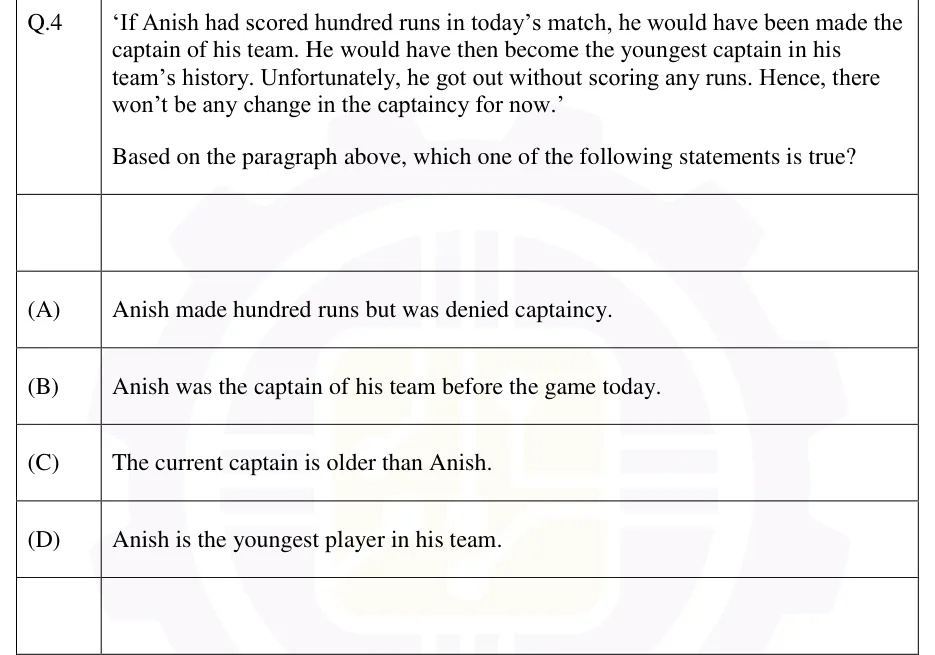
‘If Anish had scored hundred runs in today’s match, he would have been made the captain of his team. He would have then become the youngest captain in his team’s history. Unfortunately, he got out without scoring any runs. Hence, there won’t be any change in the captaincy for now.’

Based on the paragraph above, which one of the following statements is true?

  1. (A)

    Anish made hundred runs but was denied captaincy.

  2. (B)

    Anish was the captain of his team before the game today.

  3. (C)

    The current captain is older than Anish.

  4. (D)

    Anish is the youngest player in his team.

Answer and solution
See the question in the paper
GATE 2026 EE GA Q.4: answer and solution

GATE 2025 EC GA Q.6

GATE 2025 · ECGA Q.6 · 2 marks · MCQ

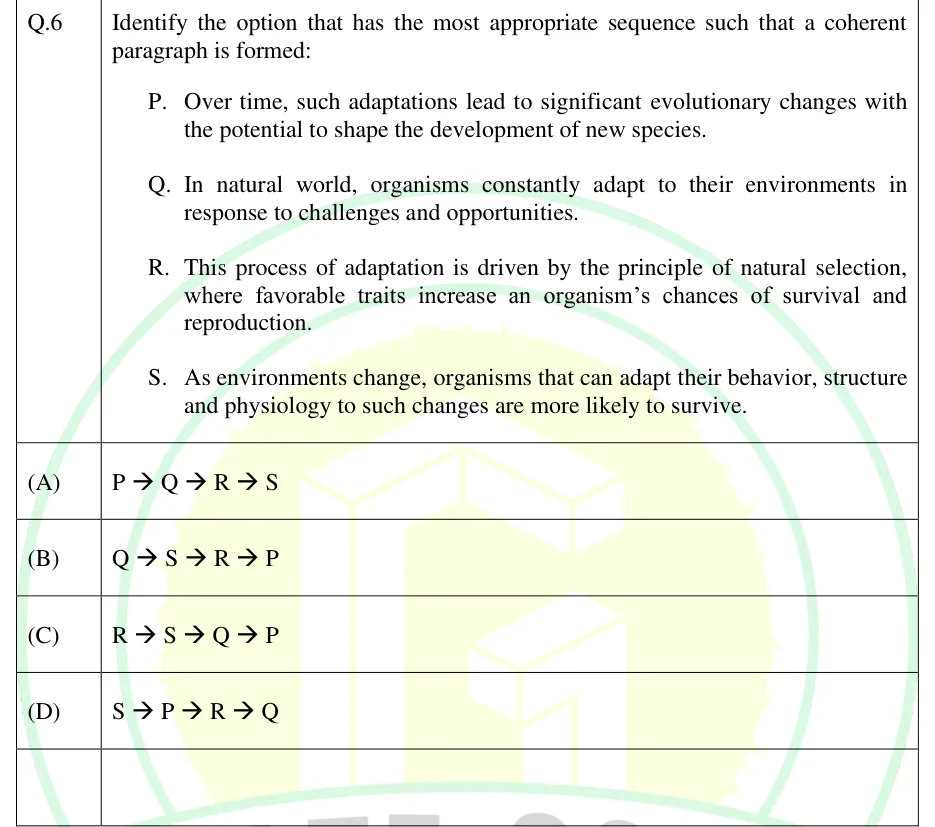
Identify the option that has the most appropriate sequence such that a coherent paragraph is formed:

P. Over time, such adaptations lead to significant evolutionary changes with the potential to shape the development of new species.

Q. In natural world, organisms constantly adapt to their environments in response to challenges and opportunities.

R. This process of adaptation is driven by the principle of natural selection, where favorable traits increase an organism’s chances of survival and reproduction.

S. As environments change, organisms that can adapt their behavior, structure and physiology to such changes are more likely to survive.

  1. (A)

    P → Q → R → S

  2. (B)

    Q → S → R → P

  3. (C)

    R → S → Q → P

  4. (D)

    S → P → R → Q

Answer and solution
See the question in the paper
GATE 2025 EC GA Q.6: answer and solution

GATE 2025 EE GA Q.6

GATE 2025 · EEGA Q.6 · 2 marks · MCQ

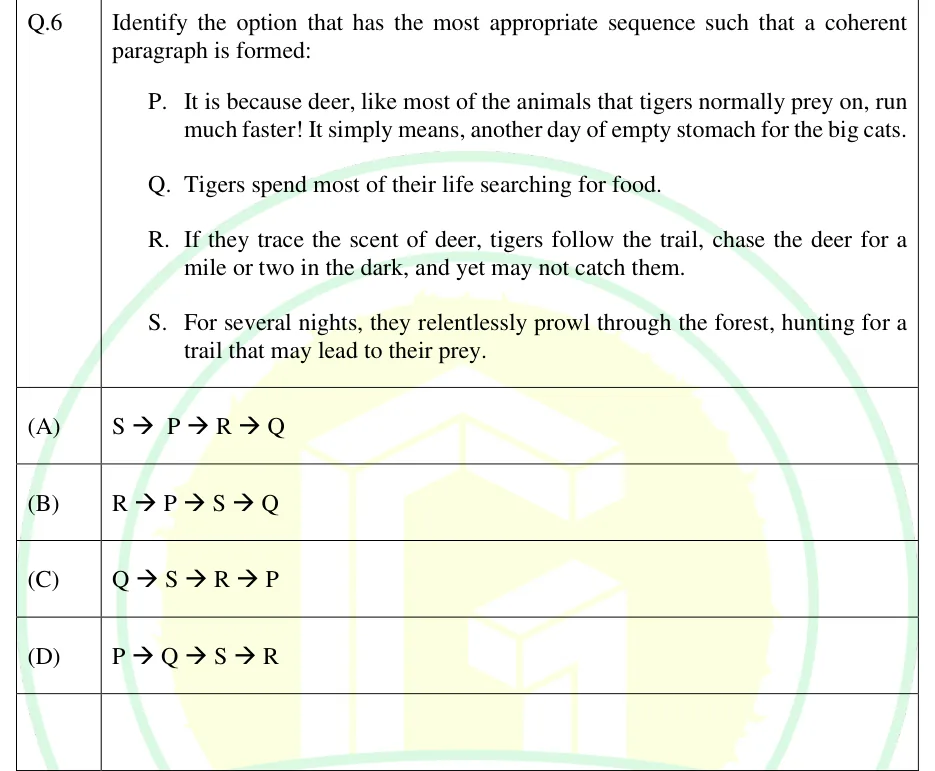
Identify the option that has the most appropriate sequence such that a coherent paragraph is formed:

P. It is because deer, like most of the animals that tigers normally prey on, run much faster! It simply means, another day of empty stomach for the big cats.

Q. Tigers spend most of their life searching for food.

R. If they trace the scent of deer, tigers follow the trail, chase the deer for a mile or two in the dark, and yet may not catch them.

S. For several nights, they relentlessly prowl through the forest, hunting for a trail that may lead to their prey.

  1. (A)

    S → P → R → Q

  2. (B)

    R → P → S → Q

  3. (C)

    Q → S → R → P

  4. (D)

    P → Q → S → R

Answer and solution
See the question in the paper
GATE 2025 EE GA Q.6: answer and solution

GATE 2025 IN GA Q.6

GATE 2025 · INGA Q.6 · 2 marks · MCQ

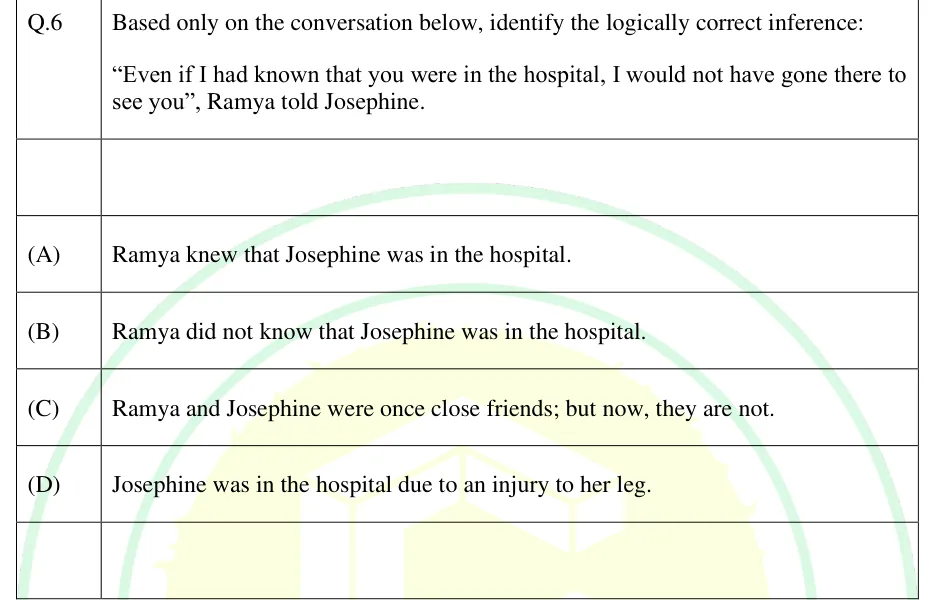
Based only on the conversation below, identify the logically correct inference:

“Even if I had known that you were in the hospital, I would not have gone there to see you”, Ramya told Josephine.

  1. (A)

    Ramya knew that Josephine was in the hospital.

  2. (B)

    Ramya did not know that Josephine was in the hospital.

  3. (C)

    Ramya and Josephine were once close friends; but now, they are not.

  4. (D)

    Josephine was in the hospital due to an injury to her leg.

Answer and solution
See the question in the paper
GATE 2025 IN GA Q.6: answer and solution

GATE 2024 EC GA Q.6

GATE 2024 · ECGA Q.6 · 2 marks · MCQ

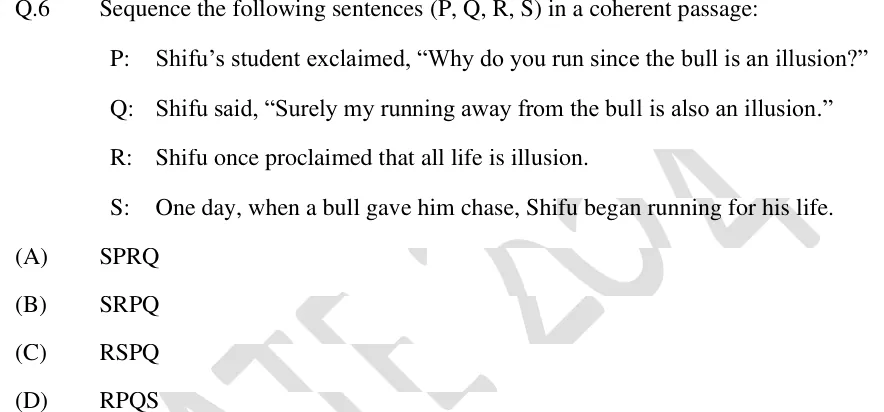
Sequence the following sentences (P, Q, R, S) in a coherent passage:

P: Shifu’s student exclaimed, “Why do you run since the bull is an illusion?”

Q: Shifu said, “Surely my running away from the bull is also an illusion.”

R: Shifu once proclaimed that all life is illusion.

S: One day, when a bull gave him chase, Shifu began running for his life.

  1. (A)

    SPRQ

  2. (B)

    SRPQ

  3. (C)

    RSPQ

  4. (D)

    RPQS

Answer and solution
See the question in the paper
GATE 2024 EC GA Q.6: answer and solution

GATE 2023 EC GA Q.8

GATE 2023 · ECGA Q.8 · 2 marks · MCQ

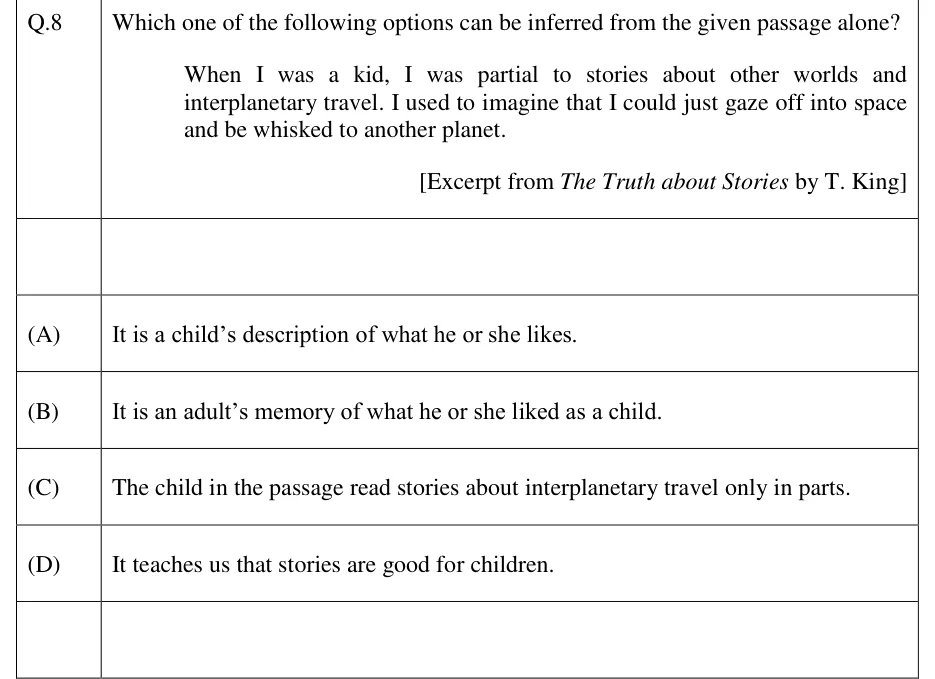
Which one of the following options can be inferred from the given passage alone?

When I was a kid, I was partial to stories about other worlds and interplanetary travel. I used to imagine that I could just gaze off into space and be whisked to another planet.

[Excerpt from The Truth about Stories by T. King]

  1. (A)

    It is a child’s description of what he or she likes.

  2. (B)

    It is an adult’s memory of what he or she liked as a child.

  3. (C)

    The child in the passage read stories about interplanetary travel only in parts.

  4. (D)

    It teaches us that stories are good for children.

Answer and solution
See the question in the paper
GATE 2023 EC GA Q.8: answer and solution

GATE 2023 EE GA Q.4

GATE 2023 · EEGA Q.4 · 1 mark · MCQ

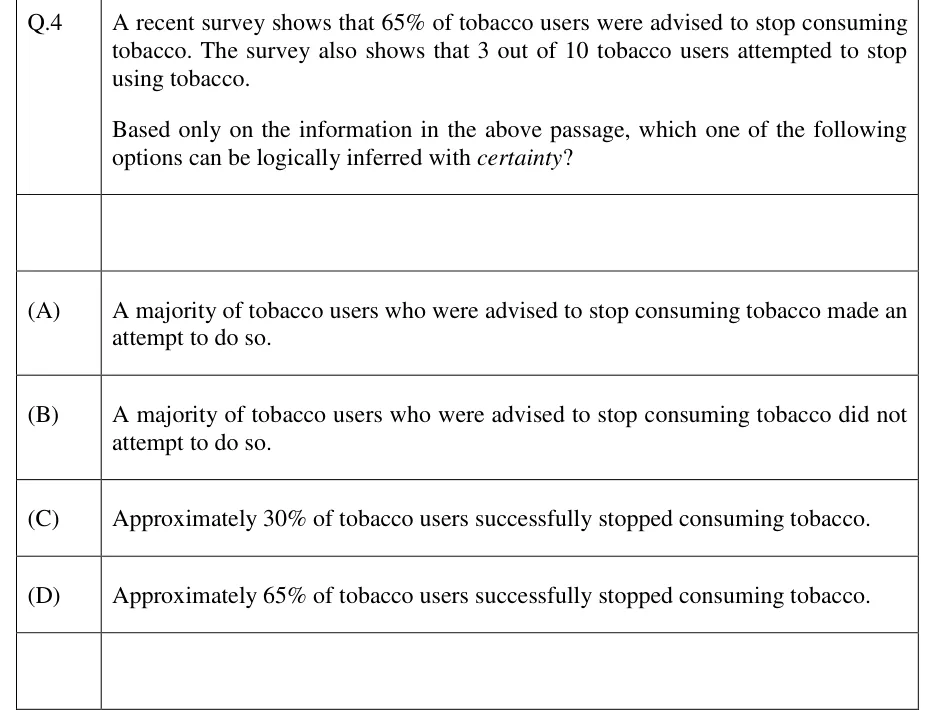
A recent survey shows that 65% of tobacco users were advised to stop consuming tobacco. The survey also shows that 3 out of 10 tobacco users attempted to stop using tobacco.

Based only on the information in the above passage, which one of the following options can be logically inferred with certainty?

  1. (A)

    A majority of tobacco users who were advised to stop consuming tobacco made an attempt to do so.

  2. (B)

    A majority of tobacco users who were advised to stop consuming tobacco did not attempt to do so.

  3. (C)

    Approximately 30% of tobacco users successfully stopped consuming tobacco.

  4. (D)

    Approximately 65% of tobacco users successfully stopped consuming tobacco.

Answer and solution
See the question in the paper
GATE 2023 EE GA Q.4: answer and solution

GATE 2023 EE GA Q.8

GATE 2023 · EEGA Q.8 · 2 marks · MCQ

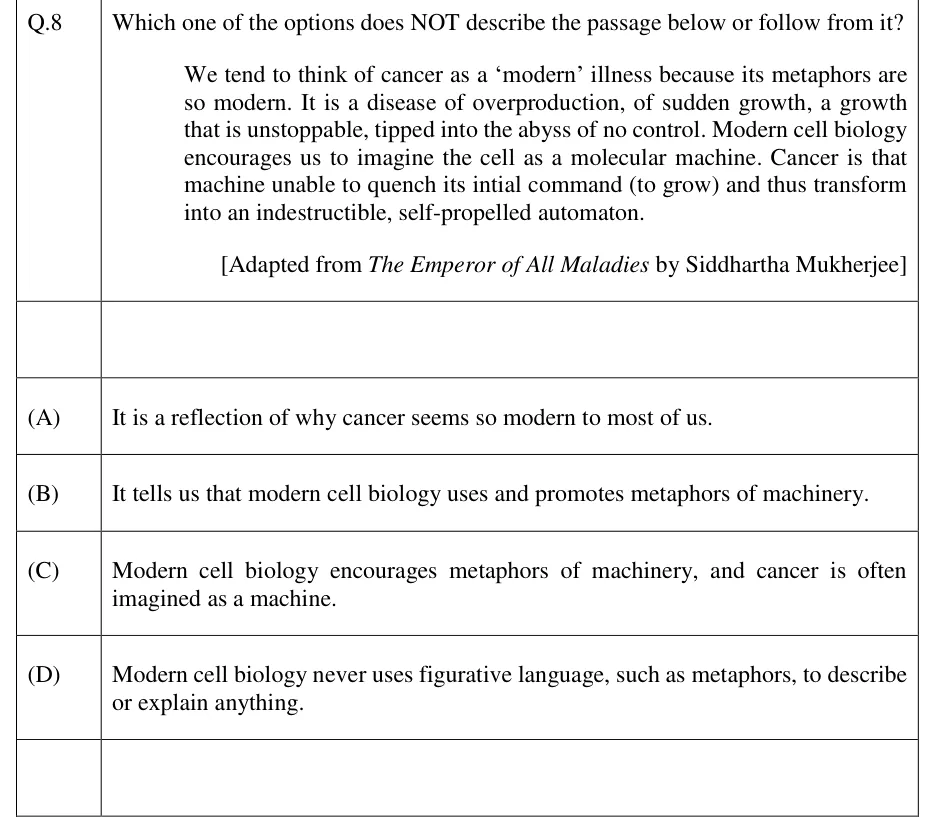
Which one of the options does NOT describe the passage below or follow from it?

We tend to think of cancer as a ‘modern’ illness because its metaphors are so modern. It is a disease of overproduction, of sudden growth, a growth that is unstoppable, tipped into the abyss of no control. Modern cell biology encourages us to imagine the cell as a molecular machine. Cancer is that machine unable to quench its intial command (to grow) and thus transform into an indestructible, self-propelled automaton.

[Adapted from The Emperor of All Maladies by Siddhartha Mukherjee]

  1. (A)

    It is a reflection of why cancer seems so modern to most of us.

  2. (B)

    It tells us that modern cell biology uses and promotes metaphors of machinery.

  3. (C)

    Modern cell biology encourages metaphors of machinery, and cancer is often imagined as a machine.

  4. (D)

    Modern cell biology never uses figurative language, such as metaphors, to describe or explain anything.

Answer and solution
See the question in the paper
GATE 2023 EE GA Q.8: answer and solution

GATE 2023 IN GA Q.8

GATE 2023 · INGA Q.8 · 2 marks · MCQ

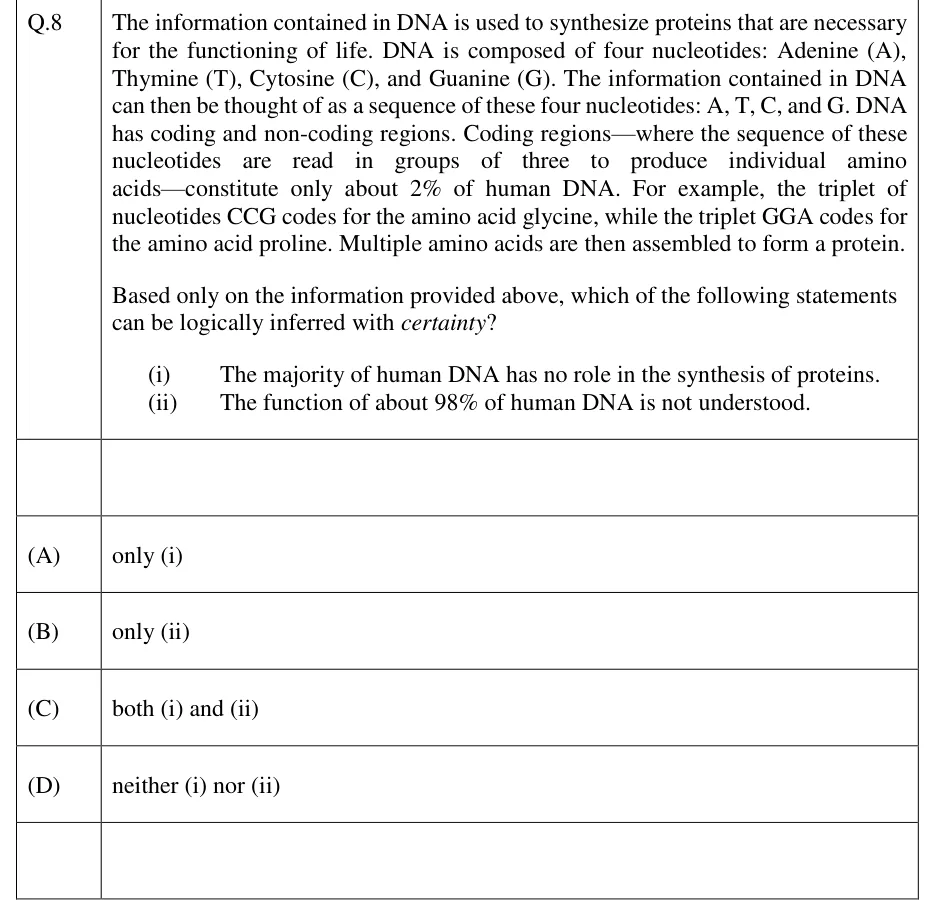
The information contained in DNA is used to synthesize proteins that are necessary for the functioning of life. DNA is composed of four nucleotides: Adenine (A), Thymine (T), Cytosine (C), and Guanine (G). The information contained in DNA can then be thought of as a sequence of these four nucleotides: A, T, C, and G. DNA has coding and non-coding regions. Coding regions—where the sequence of these nucleotides are read in groups of three to produce individual amino acids—constitute only about 2% of human DNA. For example, the triplet of nucleotides CCG codes for the amino acid glycine, while the triplet GGA codes for the amino acid proline. Multiple amino acids are then assembled to form a protein.

Based only on the information provided above, which of the following statements can be logically inferred with certainty?

(i) The majority of human DNA has no role in the synthesis of proteins.

(ii) The function of about 98% of human DNA is not understood.

  1. (A)

    only (i)

  2. (B)

    only (ii)

  3. (C)

    both (i) and (ii)

  4. (D)

    neither (i) nor (ii)

Answer and solution
See the question in the paper
GATE 2023 IN GA Q.8: answer and solution

GATE 2022 EC GA Q.6

GATE 2022 · ECGA Q.6 · 2 marks · MCQ

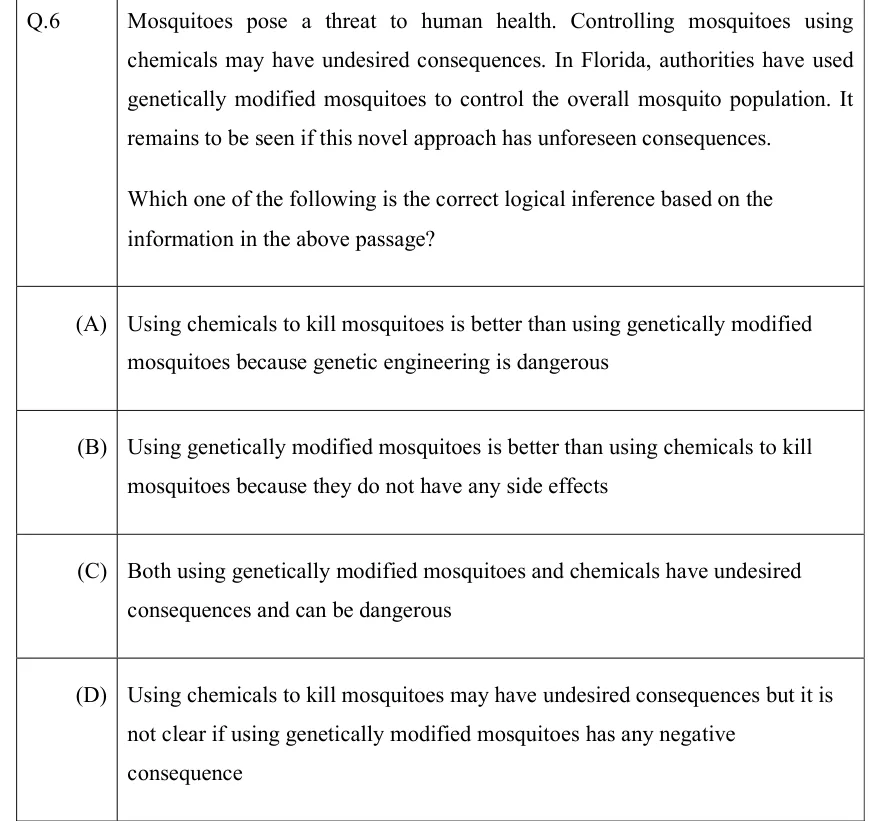
Mosquitoes pose a threat to human health. Controlling mosquitoes using chemicals may have undesired consequences. In Florida, authorities have used genetically modified mosquitoes to control the overall mosquito population. It remains to be seen if this novel approach has unforeseen consequences.

Which one of the following is the correct logical inference based on the information in the above passage?

  1. (A)

    Using chemicals to kill mosquitoes is better than using genetically modified mosquitoes because genetic engineering is dangerous

  2. (B)

    Using genetically modified mosquitoes is better than using chemicals to kill mosquitoes because they do not have any side effects

  3. (C)

    Both using genetically modified mosquitoes and chemicals have undesired consequences and can be dangerous

  4. (D)

    Using chemicals to kill mosquitoes may have undesired consequences but it is not clear if using genetically modified mosquitoes has any negative consequence

Answer and solution
See the question in the paper
GATE 2022 EC GA Q.6: answer and solution

GATE 2022 EE GA Q.6

GATE 2022 · EEGA Q.6 · 2 marks · MCQ

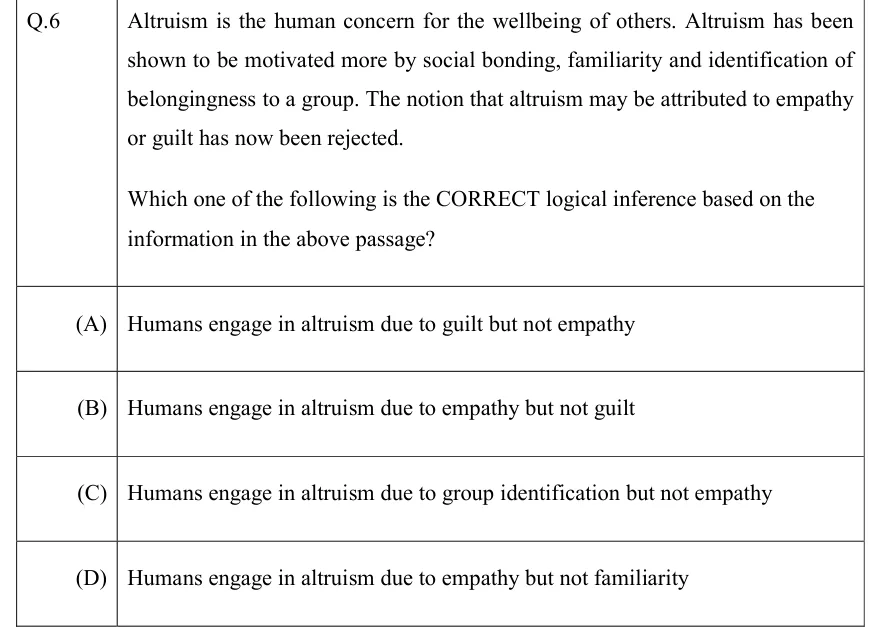
Altruism is the human concern for the wellbeing of others. Altruism has been shown to be motivated more by social bonding, familiarity and identification of belongingness to a group. The notion that altruism may be attributed to empathy or guilt has now been rejected.

Which one of the following is the CORRECT logical inference based on the information in the above passage?

  1. (A)

    Humans engage in altruism due to guilt but not empathy

  2. (B)

    Humans engage in altruism due to empathy but not guilt

  3. (C)

    Humans engage in altruism due to group identification but not empathy

  4. (D)

    Humans engage in altruism due to empathy but not familiarity

Answer and solution
See the question in the paper
GATE 2022 EE GA Q.6: answer and solution

GATE 2022 IN GA Q.6

GATE 2022 · INGA Q.6 · 2 marks · MCQ

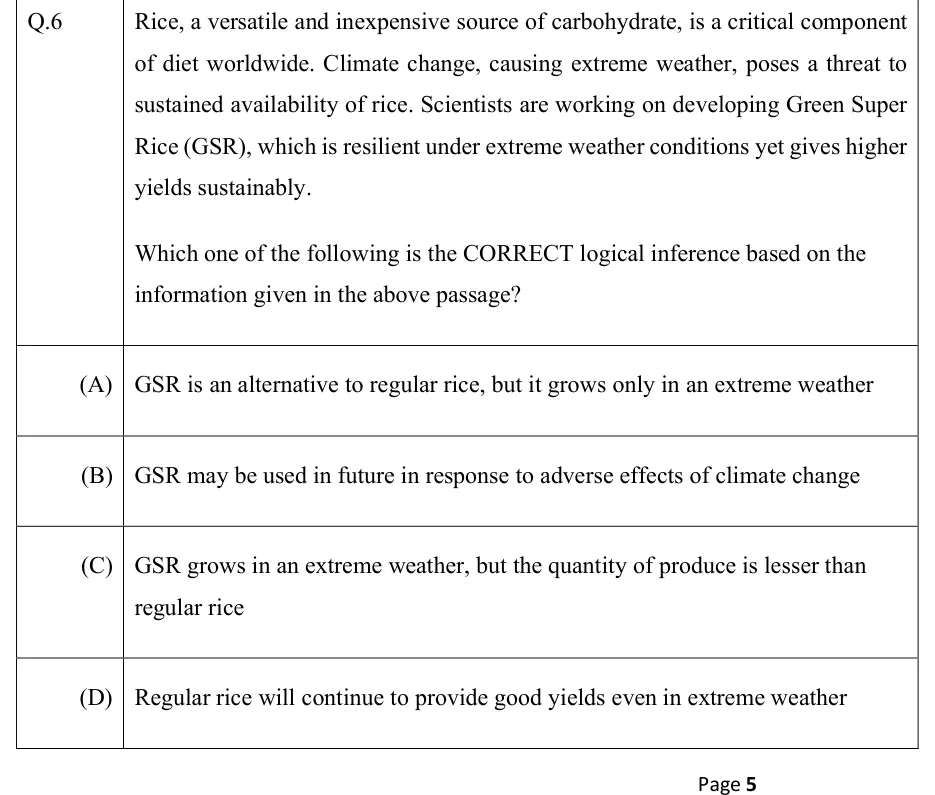
Rice, a versatile and inexpensive source of carbohydrate, is a critical component of diet worldwide. Climate change, causing extreme weather, poses a threat to sustained availability of rice. Scientists are working on developing Green Super Rice (GSR), which is resilient under extreme weather conditions yet gives higher yields sustainably.

Which one of the following is the CORRECT logical inference based on the information given in the above passage?

  1. (A)

    GSR is an alternative to regular rice, but it grows only in an extreme weather

  2. (B)

    GSR may be used in future in response to adverse effects of climate change

  3. (C)

    GSR grows in an extreme weather, but the quantity of produce is lesser than regular rice

  4. (D)

    Regular rice will continue to provide good yields even in extreme weather

Answer and solution
See the question in the paper
GATE 2022 IN GA Q.6: answer and solution

GATE 2020 EC GA Q.4

GATE 2020 · ECGA Q.4 · 1 mark · MCQ

The Canadian constitution requires that equal importance be given to English and French. Last year, Air Canada lost a lawsuit, and had to pay a six-figure fine to a French-speaking couple after they filed complaints about formal in-flight announcements in English lasting 15 seconds, as opposed to informal 5 second messages in French.

The French-speaking couple were upset at ______.

  1. (A)

    the in-flight announcements being made in English.

  2. (B)

    the English announcements being clearer than the French ones.

  3. (C)

    the English announcements being longer than the French ones.

  4. (D)

    equal importance being given to English and French.

Answer and solution
See the question in the paper
GATE 2020 EC GA Q.4: answer and solution

GATE 2020 EC GA Q.6

GATE 2020 · ECGA Q.6 · 2 marks · MCQ

The global financial crisis in 2008 is considered to be the most serious world-wide financial crisis, which started with the sub-prime lending crisis in USA in 2007. The sub-prime lending crisis led to the banking crisis in 2008 with the collapse of Lehman Brothers in 2008. The sub-prime lending refers to the provision of loans to those borrowers who may have difficulties in repaying loans, and it arises because of excess liquidity following the East Asian crisis.

Which one of the following sequences shows the correct precedence as per the given passage?

  1. (A)

    East Asian crisis→ subprime lending crisis →banking crisis→ global financial crisis.

  2. (B)

    Subprime lending crisis→ global financial crisis→ banking crisis→ East Asian crisis.

  3. (C)

    Banking crisis→ subprime lending crisis→ global financial crisis → East Asian crisis.

  4. (D)

    Global financial crisis → East Asian crisis → banking crisis → subprime lending crisis.

Answer and solution
See the question in the paper
GATE 2020 EC GA Q.6: answer and solution

GATE 2020 EE GA Q.6

GATE 2020 · EEGA Q.6 · 2 marks · MCQ

Non-performing Assets (NPAs) of a bank in India is defined as an asset, which remains unpaid by a borrower for a certain period of time in terms of interest, principal, or both. Reserve Bank of India (RBI) has changed the definition of NPA thrice during 1993-2004, in terms of the holding period of loans. The holding period was reduced by one quarter each time. In 1993, the holding period was four quarters (360 days).

Based on the above paragraph, the holding period of loans in 2004 after the third revision was ______ days.

  1. (A)

    45

  2. (B)

    90

  3. (C)

    135

  4. (D)

    180

Answer and solution
See the question in the paper
GATE 2020 EE GA Q.6: answer and solution

GATE 2020 IN GA Q.6

GATE 2020 · INGA Q.6 · 2 marks · MCQ

Crowd funding deals with mobilisation of funds for a project from a large number of people, who would be willing to invest smaller amounts through web-based platforms in the project.

Based on the above paragraph, which of the following is correct about crowd funding?

  1. (A)

    Funds raised through unwilling contributions on web-based platforms.

  2. (B)

    Funds raised through large contributions on web-based platforms.

  3. (C)

    Funds raised through coerced contributions on web-based platforms.

  4. (D)

    Funds raised through voluntary contributions on web-based platforms.

Answer and solution
See the question in the paper
GATE 2020 IN GA Q.6: answer and solution

GATE 2018 EC GA Q.8

GATE 2018 · ECGA Q.8 · 2 marks · MCQ

The Cricket Board has long recognized John’s potential as a leader of the team. However, his on-field temper has always been a matter of concern for them since his junior days. While this aggression has filled stadia with die-hard fans, it has taken a toll on his own batting. Until recently, it appeared that he found it difficult to convert his aggression into big scores. Over the past three seasons though, that picture of John has been replaced by a cerebral, calculative and successful batsman-captain. After many years, it appears that the team has finally found a complete captain.

Which of the following statements can be logically inferred from the above paragraph?

(i) Even as a junior cricketer, John was considered a good captain.

(ii) Finding a complete captain is a challenge.

(iii) Fans and the Cricket Board have differing views on what they want in a captain.

(iv) Over the past three seasons John has accumulated big scores.

  1. (A)

    (i), (ii) and (iii) only

  2. (B)

    (iii) and (iv) only

  3. (C)

    (ii) and (iv) only

  4. (D)

    (i), (ii), (iii) and (iv)

Answer and solution
See the question in the paper
GATE 2018 EC GA Q.8: answer and solution

GATE 2018 EC GA Q.10

GATE 2018 · ECGA Q.10 · 2 marks · MCQ

A coastal region with unparalleled beauty is home to many species of animals. It is dotted with coral reefs and unspoilt white sandy beaches. It has remained inaccessible to tourists due to poor connectivity and lack of accommodation. A company has spotted the opportunity and is planning to develop a luxury resort with helicopter service to the nearest major city airport. Environmentalists are upset that this would lead to the region becoming crowded and polluted like any other major beach resorts.

Which one of the following statements can be logically inferred from the information given in the above paragraph?

  1. (A)

    The culture and tradition of the local people will be influenced by the tourists.

  2. (B)

    The region will become crowded and polluted due to tourism.

  3. (C)

    The coral reefs are on the decline and could soon vanish.

  4. (D)

    Helicopter connectivity would lead to an increase in tourists coming to the region.

Answer and solution
See the question in the paper
GATE 2018 EC GA Q.10: answer and solution

PRACTICE

5 questions to test yourself

PRACTICE 11 mark · NAT

The five sentences below, labelled P, Q, R, S and T, form a paragraph when arranged in the correct order.
P: Within a month, the square was crowded every Sunday morning.
Q: The town council therefore decided to close the main square to traffic on Sundays and let the farmers sell their produce there.
R: Farmers from the nearby villages had long complained that there was no place in the town where they could sell their vegetables.
S: At first, only a handful of farmers set up stalls, and few buyers came.
T: Word spread quickly, however, and more farmers and buyers arrived each week.

When the sentences are arranged in the correct order, what is the position (1 to 5) of sentence S?

Answer and solution

Answer:

  1. Opener: R introduces the farmers and their complaint and points back to nothing. Q ('therefore'), S ('At first'), T ('however') and P ('the square') all depend on something earlier.

  2. Q's 'therefore' gives the council's response to the complaint in R, so R comes before Q. Q also introduces the square.

  3. S ('At first, only a handful') describes the early days of the market that Q created, so S comes after Q.

  4. T's 'however' contrasts the growth it describes with the slow start in S, so S comes directly before T.

  5. P ('Within a month ... crowded') is the result of that growth, so it closes the paragraph.

  6. The order is R, Q, S, T, P, so S is in position 3.

PRACTICE 22 marks · MCQ

Passage: 'Employees of a company who chose to attend its optional weekend workshop on time management submitted their monthly reports late less often than employees who did not attend. The manager therefore concluded that making the workshop compulsory for all employees would reduce the number of late reports across the company.'

Which one of the following is an assumption on which the manager's conclusion depends?

  1. (A)

    Every employee who attended the workshop submitted all reports on time.

  2. (B)

    The lower rate of late reports among those who attended was at least partly due to the workshop itself, and not entirely due to some existing difference between the employees who chose to attend and those who did not.

  3. (C)

    Late reports are the most serious problem the company faces.

  4. (D)

    Employees would rather attend a workshop on a weekday than at a weekend.

Answer and solution

Answer: (B)

  1. Conclusion: a compulsory workshop would reduce late reports. Evidence: employees who chose to attend were late less often.

  2. Gap: the attendees selected themselves. They may have been more punctual to begin with, and the argument needs the workshop itself to have caused at least part of the difference.

  3. Negate (B): the whole difference came from who chose to attend, and none of it from the workshop. Making everyone else attend would then give no reason to expect fewer late reports, so the conclusion fails. (B) is required.

  4. (B) says 'at least partly' because the argument still works if the workshop explains only part of the difference. An option claiming that the workshop explains all of it would be stronger than the argument needs.

  5. Negate (A): some attendees were late at times. The group could still be late less often, so the argument survives. (A) is stronger than the argument needs.

  6. Negating (C) or (D) does not affect whether the workshop reduces late reports, so both are outside the argument.

PRACTICE 32 marks · NAT

Passage: 'In a certain village, every household that owns a tractor also owns a water pump. Some households that own a water pump do not own a tractor. No household in the village owns more than one tractor.'

Convention: 'some' means at least one, and possibly all.

Consider the following statements.
(i) At least one household in the village owns a water pump but not a tractor.
(ii) At least one household in the village owns a tractor.
(iii) A household in the village that does not own a water pump does not own a tractor.
(iv) More households in the village own a water pump than own a tractor.
(v) Every household in the village that owns a water pump owns a tractor.
(vi) Every household in the village that owns a tractor owns exactly one tractor.

How many of these statements MUST be true according to the passage?

Answer and solution

Answer:

  1. (i): sentence 2 with 'some' = at least one. It must be true.

  2. (ii): sentence 2 says only that some pump owners lack a tractor; under the convention this does not imply that any other pump owner has one. Sentence 1 is also true if no household owns a tractor. It need not be true.

  3. (iii): this is the contrapositive of sentence 1. It must be true.

  4. (iv): the tractor-owning households are all among the pump-owning households (sentence 1), and at least one pump owner has no tractor (sentence 2). So the pump owners number at least one more than the tractor owners. This holds even if no household owns a tractor. It must be true.

  5. (v): this contradicts sentence 2, so it is false.

  6. (vi): a household that owns a tractor owns at least one, and by sentence 3 at most one, so exactly one. It must be true.

  7. Statements (i), (iii), (iv) and (vi) must be true: 4.

PRACTICE 41 mark · MCQ

Passage: 'Many people believe that the more words a writer knows, the better the writer will be. Yet a writer who knows ten thousand words but cannot arrange them clearly is understood less often than one who knows half as many and arranges them well. A vocabulary supplies the bricks; it is the skill of arranging them that builds the house.'

Which one of the following best states the main idea of the passage?

  1. (A)

    Writers should avoid using uncommon words.

  2. (B)

    Learning new words is a waste of a writer's time.

  3. (C)

    For good writing, the skill of arranging words clearly matters more than the size of the vocabulary.

  4. (D)

    A large vocabulary makes a writer harder to understand.

Answer and solution

Answer: (C)

  1. Structure: a common belief (sentence 1), then the turn 'Yet', then the author's view, restated through the metaphor in sentence 3.

  2. The view after the turn is that the ability to arrange words matters more than how many words a writer knows. That is (C).

  3. (A) is never discussed, so it is an extrapolation.

  4. (B) is too strong. The passage says vocabulary 'supplies the bricks', which means it is still needed.

  5. (D) distorts the comparison. The writer is understood less because of poor arrangement, not because of a large vocabulary.

PRACTICE 52 marks · MSQ

Passage: 'The college library lends books only to students who have returned every book they borrowed earlier. Every first-year student of the college has borrowed at least one book from the library this term. Today the library lent a book to a second-year student of the college and refused to lend a book to a first-year student of the college.'

Select ALL the statements that can be inferred from the passage alone.

  1. (A)

    The second-year student had returned every book he or she borrowed earlier.

  2. (B)

    The first-year student had failed to return at least one book borrowed earlier.

  3. (C)

    The first-year student has borrowed at least one book from the library this term.

  4. (D)

    Any student who has returned every book borrowed earlier will be lent a book on request.

Answer and solution

Answer: (A), (C)

  1. Rewrite sentence 1: the library lends to a student ONLY IF that student has returned every earlier book. In other words, if the library lent a book, the student had returned everything. Returning everything is necessary for a loan, not sufficient.

  2. (A): the second-year student was lent a book, so that student had returned every earlier book. It can be inferred. (If the student had never borrowed before, the statement is still true, because there is no unreturned book.)

  3. (B): being refused does not show that a book was unreturned. The passage gives no reason for the refusal, and 'only if' does not run backwards. It cannot be inferred.

  4. (C): sentence 2 covers every first-year student of the college, and this student is one of them. It can be inferred.

  5. (D): this is the converse ('if returned, then lent'), which 'only if' does not give. It cannot be inferred.

  6. The correct options are A and C.

OFFICIAL GATE 2027 SYLLABUS WORDING

Copied from the GATE 2027 syllabus; see all 2027 syllabi.

EVERY GATE PAPER

Reading and comprehension, Narrative sequencing

Preparing in Kolkata? See IAE Academy’s GATE courses.