IAE Academy

EVERY GATE PAPER

Logical and analytical reasoning

Logical and analytical reasoning asks you to state only what the given information forces: conclusions deduced from statements (syllogisms, conditionals, assumptions), rules induced from examples (series, codes, analogies), arrangements built from clues (seating, family trees, directions, clocks, calendars, inequality chains) and counts of people in overlapping groups. No outside knowledge is needed: each question type has a fixed method (a Venn diagram, a case table, a sketch on a grid or a short formula), and the traps lie in small words such as 'some', 'only if', 'left of' and 'between' rather than in hard calculation.

41 previous-year questions · 39 solved · 6 practice questions

Deduction, induction and syllogisms

Deduction draws a conclusion that must be true whenever the given statements are true. Induction generalises from observed cases to a rule, so its conclusion is only probable, and one counter-example is enough to break it.

In a deduction question, take the statements as true even when they clash with real life ('All metals are liquids'). A conclusion follows only if the statements alone force it; general knowledge cannot be added.

Syllogisms use four statement forms. Read some as at least one, possibly all: 'Some A are B' does not tell you that some A are not B. 'Only a few A are B' (or 'only some') is stronger: it says that some A are B and some A are not B. By the usual convention in these puzzles, every class that is named has at least one member unless the question says otherwise; this is what lets 'All A are B' imply 'Some A are B'.

The four statement forms

Statement

Venn picture

Converse that follows

Also follows

All A are B

Circle A inside circle B (A may equal B)

Some B are A

Some A are B

No A is B

Circles A and B do not overlap

No B is A

Some A are not B; some B are not A

Some A are B

A and B overlap; the overlap may be all of A or all of B

Some B are A

Nothing more

Some A are not B

Part of A lies outside B

None: 'Some B are not A' does not follow

Nothing more

Testing a conclusion with Venn diagrams

  1. Draw one diagram that satisfies every statement, with only the overlaps the statements force.

  2. Read the conclusion off it. If it is false in this diagram, it does not follow.

  3. If it is true, try to redraw the circles, still satisfying every statement, so that it becomes false. If you can, the conclusion does not follow; it is only possible.

  4. A conclusion follows only if it is true in every diagram that satisfies all the statements.

  5. If two conclusions each fail, check whether they are a complementary pair (see the tip below). If they are, the answer is 'either I or II follows'.

Two statements joined by a middle term B

Every definite conclusion here relies on the convention that each named class has at least one member.

Statement 1

Statement 2

Definite conclusion

All A are B

All B are C

All A are C (so some C are A)

All A are B

No B is C

No A is C

Some A are B

All B are C

Some A are C

Some A are B

No B is C

Some A are not C

No A is B

All B are C

Some C are not A

No A is B

Some B are C

Some C are not A

Some A are not B

All C are B

Some A are not C

All B are A

All B are C

Some A are C (and some C are A)

All B are A

No B is C

Some A are not C

All A are B

Some B are C

None about A and C

All A are B

All C are B

None about A and C

Some A are B

Some B are C

None about A and C

No A is B

No B is C

None about A and C

EITHER-OR PAIRS

Two conclusions about the same two classes are complementary when exactly one of them must be true: 'Some A are B' with 'No A is B', and 'All A are B' with 'Some A are not B'. Choose 'either I or II follows' only when neither follows on its own and they form such a pair. 'All A are B' with 'No A is B' is not a pair: both can be false together.

POSSIBILITY IS A DIFFERENT QUESTION

'All A being C is a possibility' is true if at least one valid diagram shows it. 'All A are C' as a conclusion needs every valid diagram to show it. Read which of the two the question is asking before you judge.

WORKED EXAMPLE · SYLLOGISM WITH AN EITHER-OR PAIR

Statements: All pumps are machines. Some machines are motors. No motor is a valve.

Conclusions: I. Some pumps are motors. II. No pump is a motor. III. Some machines are not valves. IV. No pump is a valve.

Which conclusions follow?

Solution
  1. Draw the pump circle inside the machine circle, a motor circle overlapping the machine circle, and a valve circle clear of the motor circle. The statements do not say whether pumps meet motors, or whether pumps meet valves.

  2. I and II: the pump circle can overlap the motor circle (I true) or sit in the part of the machine circle outside motors (II true). Neither is forced, but exactly one of 'Some pumps are motors' and 'No pump is a motor' must be true, so either I or II follows.

  3. III: some machines are motors, and no motor is a valve, so those machines are not valves. III follows.

  4. IV: a pump that is not a motor may still be a valve, because the valve circle may overlap the pump circle outside the motor circle. IV does not follow.

Answer: III follows, and either I or II follows; IV does not follow.

Conditional statements, conclusions and assumptions

Many deduction questions are built from 'if', 'only if' and 'unless'. Rewrite each sentence as ('if P, then Q') before judging it. Then is sufficient for , and is necessary for .

CONTRAPOSITIVE

Always equivalent to the original. The converse and the inverse do NOT follow from (they are equivalent to each other, not to the original).

IMPLICATION AS 'OR', AND ITS DENIAL

'If P, then Q' is false only when P is true and Q is false. So the denial of 'If it rains, the match is called off' is 'It rains and the match is not called off', not 'If it rains, the match is not called off'.

IF, ONLY IF, UNLESS

'Only if' introduces the necessary condition. 'Unless' means 'if not'. 'P if and only if Q' means both and .

NEGATING QUANTIFIED STATEMENTS

The negation of 'all' is 'some … not', not 'none'. Use these to find contradictory pairs and to run the negation test for assumptions.

DE MORGAN'S LAWS

Read 'or' as inclusive (one or both) unless the wording makes it exclusive ('but not both', 'exactly one of').

Valid and invalid inferences

Rule: 'If the relay trips, the alarm sounds.'

Form

Given

Conclusion

Valid?

Affirming the antecedent

The relay tripped.

The alarm sounded.

Valid

Denying the consequent

The alarm did not sound.

The relay did not trip.

Valid

Affirming the consequent

The alarm sounded.

The relay tripped.

Invalid: something else may have set it off

Denying the antecedent

The relay did not trip.

The alarm did not sound.

Invalid

In a statement and conclusion question, a conclusion follows only if it must be true whenever the statement is true. Facts from outside the statement cannot be added, apart from universally known ones (a week has seven days).

In a statement and assumption question, an assumption is something unstated that the speaker must take for granted for the statement (a claim, a plan, a piece of advice) to make sense.

Negation test for an assumption

  1. State the purpose or claim of the statement in one line.

  2. Negate the candidate assumption.

  3. If the statement becomes pointless or self-contradictory once the candidate is false, the candidate is an assumption (it is implicit).

  4. If the statement still makes sense, the candidate is not an assumption, however reasonable it sounds.

  5. Be wary of candidates containing 'only', 'all', 'never' or 'best' unless the statement itself is that strong.

ASSUMPTION VERSUS CONCLUSION

An assumption comes before the statement (the speaker needs it); a conclusion comes after it (it is drawn from it). A candidate can be true, and even likely, without being an assumption.

WORKED EXAMPLE · STATEMENT AND ASSUMPTIONS

Statement: The city corporation has announced that, from next month, households that hand over wet and dry waste in separate bins will get a 5% rebate on property tax.

Assumptions: I. Some households will start separating their waste in order to get the rebate. II. At present, no household in the city separates its waste.

Which assumption(s) is/are implicit?

Solution
  1. Purpose of the statement: to use a tax rebate to get more households to separate their waste.

  2. Negate I: 'No household will change its behaviour for the rebate.' Offering the rebate then achieves nothing, and the announcement loses its point. I is implicit.

  3. Negate II: 'Some households already separate their waste.' The scheme still makes sense: it rewards them and encourages the rest. II is not implicit, and its 'no household' is stronger than anything the statement needs.

Answer: Only I is implicit.

Induction: number series, letter series and coding-decoding

A series question gives a few terms produced by a hidden rule. Test simple rules in a fixed order, and accept a rule only when it produces every given term. If two different rules fit all the terms, the options decide: check each option against both rules.

Rules to test, in order

  1. First differences; if they are not constant, second differences. Constant non-zero differences at the -th level mean the terms are a polynomial of degree in the position .

  2. Ratios of consecutive terms: , or followed by (for example ).

  3. Known sequences: squares, cubes, , , primes, factorials.

  4. Alternate terms: if the terms rise and fall, split them into two interleaved series (odd and even positions).

  5. Each term from the previous two: sum (as in 1, 1, 2, 3, 5, 8), difference or product.

  6. Differences that themselves form a known series (primes, squares, a geometric series).

ARITHMETIC AND GEOMETRIC SERIES

-th term of an arithmetic series (constant difference ) and of a geometric series (constant ratio ). Positions are counted from .

SERIES WITH CONSTANT SECOND DIFFERENCES

Applies when the second differences are all equal to ; is the first difference. Example: 5, 11, 23, 41, 65 has and , so .

LETTER POSITIONS

Opposite (mirror) pairs A–Z, B–Y, …, M–N have positions that add to 27. A forward shift of with wrap-around gives position , so Y shifted forward by 3 is B. A backward shift of is the same as a forward shift of , so C shifted back by 3 is Z.

Positions and opposite letters

Letter

Position

Opposite

Position

A

1

Z

26

B

2

Y

25

C

3

X

24

D

4

W

23

E

5

V

22

F

6

U

21

G

7

T

20

H

8

S

19

I

9

R

18

J

10

Q

17

K

11

P

16

L

12

O

15

M

13

N

14

ANCHOR LETTERS

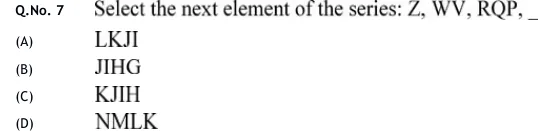
E = 5, J = 10, O = 15, T = 20, Y = 25. Counting from the nearest anchor is faster and safer than counting from A. Letter series use the same tests as number series once letters are turned into positions: B, E, J, Q, ? is 2, 5, 10, 17, ?, which is , so the next letter is 26 = Z.

In coding-decoding, a word is changed by a rule applied to its letters (a shift, a mirror, a swap of positions or a reversal of the whole word), or whole words are replaced by code words. For letter codes, write the positions of the original and coded letters in two rows and read the differences.

For word codes, each word keeps the same code word in every message, but the code words need not be in the same order as the words. So a word's code must appear in every message that contains the word and in no message that lacks it. From 'sky is blue' = 'ka to ri' and 'blue is deep' = 'mo ri ka': 'sky' = 'to' and 'deep' = 'mo', while 'is' and 'blue' share 'ka' and 'ri' between them, and a third message is needed to separate those two.

WORKED EXAMPLE · INTERLEAVED SERIES

Find the next two terms: 4, 9, 7, 16, 10, 25, 13, ?, ?

Solution
  1. The terms rise and fall, so split them by position. Odd positions: 4, 7, 10, 13. Even positions: 9, 16, 25.

  2. Odd positions increase by 3, so the next one is 16. Even positions are , so the next one is .

  3. The 8th term is an even-position term (36) and the 9th an odd-position term (16).

Answer: 36, 16

WORKED EXAMPLE · LETTER CODING

In a certain code, GATE is written as HCWI. How is MATH written in that code?

Solution
  1. Positions: G, A, T, E = 7, 1, 20, 5 and H, C, W, I = 8, 3, 23, 9. The shifts are +1, +2, +3, +4, one for each position in the word.

  2. Apply the same shifts to M, A, T, H = 13, 1, 20, 8: this gives 14, 3, 23, 12 = N, C, W, L.

Answer: NCWL

Analogies: word and number relationships

An analogy A : B :: C : D says that A is related to B in the same way as C is related to D, in the same order. Solve it by writing a precise bridge sentence for the given pair and testing every option against that sentence.

Common relationships

Relationship

Example

Bridge sentence

Synonym

Candid : Frank

A means the same as B

Antonym

Scarce : Abundant

A means the opposite of B

Part and whole

Petal : Flower

A is a part of B

Member and class

Cobra : Reptile

A is a kind of B

Cause and effect

Virus : Infection

A causes B

Degree (intensity)

Tired : Exhausted

B is a much stronger form of A

Tool and function

Scissors : Cutting

A is used for B

Worker and tool

Surgeon : Scalpel

A works with B

Instrument and quantity

Thermometer : Temperature

A measures B

Raw material and product

Pulp : Paper

A is made into B

Method

  1. Write a bridge sentence that uses both words and says exactly how they are linked: 'a petal is a part of a flower' is better than 'both are found in gardens'.

  2. Test every option with the same sentence, keeping the order of the pair.

  3. If more than one option fits, make the sentence more specific (what kind of part, how strong a degree) until one option remains.

  4. Check the direction: Flower : Petal (whole to part) is not the same as Petal : Flower (part to whole).

ODD ONE OUT

Classification (odd one out) questions use the same idea in reverse: find a property or relationship that fits every option but one, and make it specific enough that exactly one option fails it.

In a numerical analogy the pair hides a rule : a square or cube with a small adjustment (, ), a multiple, a digit sum or a reversal of digits. A single pair can fit several rules, so use every pair that is given to fix the rule before applying it.

LETTER ANALOGIES

For pairs such as ACE : BDF, compare positions letter by letter (1, 3, 5 to 2, 4, 6). The rule may be one shift applied to every letter, or a different shift at each position; check all three letters before choosing.

WORKED EXAMPLE · NUMERICAL ANALOGY

The pairs and follow the same rule. Find in .

Solution
  1. From alone, two rules fit: (64 + 1) and (64 + 1). They give 126 and 101 for , so one pair is not enough.

  2. Test both with : fits, but does not.

  3. The rule is , so .

Answer: 126

Arrangements, ranks, blood relations and truth-tellers

Arrangement puzzles place people or objects in a row, around a table, or in an order (of height, age or floor) using a set of clues. Start with a definite clue (a fixed seat, or two people fixed relative to each other), draw it, and then add the clues that attach to what is already drawn. When a clue allows two placements, draw both cases side by side and let a later clue eliminate one. Answer the question only after every clue has been checked against the finished picture.

Left and right

Situation

Left means

Right means

Row, everyone facing north

towards the west end

towards the east end

Row, everyone facing south

towards the east end

towards the west end

Circle, everyone facing the centre

clockwise (seen from above)

anticlockwise

Circle, everyone facing outwards

anticlockwise

clockwise

'Second to the left of P' is the seat two places to P's left, with one seat in between; 'immediately to the left' is the adjacent seat. In a circle of equally spaced seats ( even), the person opposite is places away in either direction. If some people in a row face north and others face south, apply left and right person by person.

RANK IN A ROW

For one person who is -th from the left and -th from the right in a single row of people. The same holds for ranks from the top and the bottom of a list with no ties.

PEOPLE BETWEEN TWO PERSONS IN A ROW

X is -th from the left and Y is -th from the right in a row of . If , X and Y are the same person. Convert both to positions from the same end if in doubt: Y is at position from the left.

NUMBER OF SEATINGS

Ways to seat distinct people. Around a circle only relative positions matter, so rotations count as one arrangement. Divide by 2 only when clockwise and anticlockwise orders are not distinguished, as for a garland of distinct beads ().

WORKED EXAMPLE · CIRCULAR SEATING

Six friends P, Q, R, S, T and U sit around a circular table, equally spaced and facing the centre. Q sits second to the left of P. T sits opposite Q. S sits immediately to the right of T. R is not a neighbour of P. Who sits opposite P, and who sits immediately to the left of T?

Solution
  1. Facing the centre, left is clockwise and right is anticlockwise. Number the seats clockwise from P as 0 to 5, with P at 0.

  2. Q is second to the left of P, so Q is at 2. T is opposite Q (three seats away), so T is at 5. S is immediately to the right of T, one seat anticlockwise, so S is at 4.

  3. Seats 1 and 3 remain for R and U. Seat 1 is next to P, and R is not P's neighbour, so R is at 3 and U is at 1.

  4. Clockwise from P the order is P, U, Q, R, S, T. Opposite P (seat 3) is R. Immediately to the left of T is one seat clockwise from seat 5, which is seat 0: P.

Answer: R sits opposite P, and P sits immediately to the left of T.

For blood relations, draw a family tree: one generation per level, a horizontal line joining siblings, a double line (or =) joining a married couple, and each person's gender marked only when a clue states it. A name alone, or a word such as 'child', 'sibling' or 'cousin', does not fix gender, and without it the exact relation (brother or sister, nephew or niece) may not be determinable.

Relation words

Relation

Term

Father's or mother's father

Grandfather (paternal or maternal)

Father's brother / mother's brother

Paternal uncle / maternal uncle

Father's sister / mother's sister

Paternal aunt / maternal aunt

Brother's or sister's son / daughter

Nephew / niece

Child of a parent's brother or sister

Cousin

Spouse's father / mother

Father-in-law / mother-in-law

Son's wife / daughter's husband

Daughter-in-law / son-in-law

Spouse's brother, or sister's husband

Brother-in-law

Spouse's sister, or brother's wife

Sister-in-law

Grandparent's brother

Grand-uncle

THE WORD 'ONLY'

'Only' pins down a person. 'The only daughter of my mother's father' must be my mother, because she is a daughter of that man and he has just one. 'A daughter of my mother's father' could be my mother or my maternal aunt.

WORKED EXAMPLE · CODED BLOOD RELATIONS

means A is the mother of B; means A is the brother of B; means A is the father of B; means A is the sister of B. Given , how is M related to N, and how is K related to M?

Solution
  1. Each sign relates the letter on its left to the letter on its right, so read the chain one pair at a time: M is the brother of R; R is the mother of K; K is the father of N.

  2. R is the mother of N's father, that is, N's paternal grandmother. M is her brother, so M is N's grand-uncle. N's gender is not given, and it is not needed for this relation.

  3. K is a father, so K is male. K is the son of M's sister R, so K is M's nephew.

Answer: M is N's grand-uncle (brother of N's paternal grandmother), and K is M's nephew.

Truth-teller and liar puzzles

  1. Every statement a truth-teller makes is true and every statement a liar makes is false, unless the question defines another type (for example an alternator, whose statements alternate between true and false).

  2. Nobody of either type can say 'I am a liar': a truth-teller saying it would be lying, and a liar saying it would be telling the truth.

  3. Anybody of either type can say 'I am a truth-teller', so that statement on its own tells you nothing.

  4. When these are the only two types: if X says 'Y is a truth-teller', X and Y are of the same type; if X says 'Y is a liar', they are of opposite types.

  5. If X says 'At least one of X and Y is a liar', X is a truth-teller and Y is a liar: a liar cannot say it, because coming from a liar it would be true.

  6. Assume a type for one person, work out what every statement then forces, and reject the assumption at the first contradiction. Then try the other case.

  7. The answer is what holds in every assignment that survives. If more than one survives, only the facts common to all of them are certain.

Direction sense, clocks and calendars

Draw direction problems on a grid with north up and east to the right. A right turn is clockwise, a left turn is anticlockwise, and an about-turn is . A turn of clockwise from north faces north-east; each of the four in-between directions (north-east, south-east, south-west and north-west) lies from the two main directions it is named after. Keep track of the direction the person is facing after every turn, not only the position.

Example: walk 6 km north, turn right and walk 3 km, turn right and walk 12 km, then turn left and walk 5 km. The legs are north 6, east 3, south 12 and east 5, so the net displacement is 8 km east and 6 km south. The walker is km from the start, towards the south-east (named by quadrant, since the east and south parts are not equal), and is facing east.

STRAIGHT-LINE DISTANCE

Take east and north as positive, west and south as negative. Name the direction by its quadrant (for example south-east when the net movement is east and south), or by the axis if one component is zero.

SHADOWS

Shadow puzzles take the sun as due east in the morning and due west in the evening. A morning shadow therefore points west and an evening shadow points east; a person facing their own shadow in the morning is facing west.

SPEEDS OF THE HANDS

At H hours M minutes (H on the 12-hour dial, using 0 for 12) the hour hand is degrees past 12 and the minute hand is degrees past 12, both measured clockwise.

ANGLE BETWEEN THE HANDS

Angle in degrees at H hours M minutes, with H the hour on the 12-hour dial (use 0 for 12). Example: at 7:24, .

TIME FOR A GIVEN ANGLE

Minutes past H o'clock (H from 0 to 11, using 0 for 12) at which the hands are degrees apart, for . These values solve or . Keep only values with . In the first pair, the minus sign gives a moment before the minute hand passes the hour hand and the plus sign a moment after. Try the second pair whenever a value from the first pair falls outside the range: between 1 and 2 o'clock the hands are at right angles at and at , and the second time comes only from the second pair.

COINCIDENCES AND COUNTS

For a correct clock. In 12 hours the hands coincide 11 times, are opposite 11 times, and are at right angles 22 times (any angle strictly between and occurs 22 times). In 24 hours each count doubles.

FAST OR SLOW CLOCK

For a clock whose hands coincide every minutes of correct time. A positive value is a gain (the clock runs fast), a negative value a loss. With the clock gains min per day.

CLOCK SEEN IN A MIRROR

For an upright plane mirror beside the clock, which swaps left and right. H is the hour on the 12-hour dial (use 0 for 12), and a result of 0 hours is read as 12. It is the same as subtracting the actual time from 12:00: the image of 4:20 reads 7:40, the image of 3:00 reads 9:00 and the image of 12:20 reads 11:40.

ELEVEN, NOT TWELVE

Between H and H + 1 o'clock the hands coincide once, except between 11 and 12: they next meet at 12:00, which belongs to the following hour. That is why the count in 12 hours is 11, not 12.

Calendar questions are solved by counting odd days, the days left over after removing complete weeks. Moving a date forward by odd days moves its weekday forward by (modulo 7).

LEAP YEAR (GREGORIAN RULE)

2028 and 2000 are leap years; 2100 and 1900 are not.

ODD DAYS

The pattern repeats every 400 years, so years 1601 to 1900 also give 1 odd day. Months: 31 days = 3 odd days, 30 days = 2, February = 0 (1 in a leap year).

WEEKDAY FROM ODD DAYS

Count the complete years before the given year (using the values above), then the complete months of the given year, then the day of the month itself (Gregorian rules applied throughout).

SAME DATE, LATER YEAR

The weekday of a date moves forward by 1 each year, and by 2 when a 29 February falls between the two dates. From Saturday 15 August 2026 to 15 August 2031 the shift is (29 February 2028 lies between), so 15 August 2031 is a Friday.

When a calendar repeats

Valid while no century year that is not a leap year (such as 2100) lies in the span.

Year Y

Same calendar again

Example

Leap year

Y + 28

2028 and 2056

Y mod 4 = 1 (year after a leap year)

Y + 6

2029 and 2035

Y mod 4 = 2

Y + 11

2026 and 2037

Y mod 4 = 3

Y + 11

2027 and 2038

WHEN THE EXTRA DAY COUNTS

The +2 applies only when 29 February lies between the two dates. From 1 March 2027 to 1 March 2028 it does, and from 1 January 2028 to 1 January 2029 it does; from 1 January 2027 to 1 January 2028 it does not.

HOW A CENTURY YEAR ENDS

Years 1 to 100, 1 to 200, 1 to 300 and 1 to 400 leave 5, 3, 1 and 0 odd days, so the last day of a year divisible by 100 is always a Friday, Wednesday, Monday or Sunday, never a Tuesday, Thursday or Saturday. 31 December 1900 was a Monday and 31 December 2000 a Sunday.

WORKED EXAMPLE · RIGHT ANGLES ON A CLOCK

At what times between 4 o'clock and 5 o'clock are the hands of a clock at right angles?

Solution
  1. Use with and .

  2. Minus sign: min.

  3. Plus sign: min. Both values lie in .

  4. The second pair adds nothing here: is more than 60, and is negative.

  5. Check the first: the hour hand is at degrees and the minute hand at degrees, which are apart.

Answer: minutes past 4 and minutes past 4.

WORKED EXAMPLE · ODD-DAYS METHOD

Find the day of the week on 26 January 1950.

Solution
  1. Complete years before 1950: 1949 years = 1600 + 300 + 49.

  2. 1600 years: 0 odd days (a multiple of 400). The next 300 years (1601 to 1900): 1 odd day.

  3. 49 years (1901 to 1949): the leap years are 1904, 1908, …, 1948, which is 12 of them, leaving 37 ordinary years. Odd days , and , so 5.

  4. 1 January to 26 January 1950: 26 days, and , so 5.

  5. Total , and . Code 4 is Thursday.

Answer: Thursday

Numerical relations and inequality chains

Inequality questions give relations such as and ask which conclusions follow. Join the statements through their common terms into one chain, then read the relation between the two terms asked about by following the path that connects them.

CHAINS THAT GIVE A DEFINITE RELATION

A definite relation follows only if every sign on the path between the two terms points the same way; an = sign fits either direction and can sit anywhere in the chain. The relation is = if every sign on the path is =, strict ( or ) if at least one sign is strict, and otherwise or .

CHAINS THAT GIVE NO RELATION

Signs that point in opposite directions (here B is smaller than both) leave A and C undetermined. The same holds for and for .

When 'either I or II' follows

  1. Both conclusions relate the same two terms.

  2. Neither conclusion follows definitely on its own.

  3. Exactly one of the two must be true, because together they cover every possibility and cannot both hold. Typical pairs: and when is known; and when nothing is known about A and C.

OPERATING ON AN INEQUALITY

Multiplying or dividing both sides by a negative number reverses the sign. Squaring is safe only when both sides are non-negative: , but .

Some questions code the signs (for example 'P @ Q means P is not less than Q'). Decode every statement into , , , or first, then apply the chain rules: 'not less than' is , 'not greater than' is , and 'neither greater than nor equal to' is .

Ordering puzzles in words ('P is heavier than Q but lighter than R') are the same chains. Write each clue as an inequality, merge them, and check that the order is fully fixed before naming a position such as 'second heaviest'.

FOLLOW THE PATH, NOT THE LOOK

A conclusion such as needs a path from Q to T whose signs all point one way. If every path between them runs through a term that is smaller than both (or larger than both), nothing follows about Q and T, however likely the conclusion looks.

WORKED EXAMPLE · CHAIN WITH AN EITHER-OR PAIR

Statements: and .

Conclusions: I. II. III. IV.

Which conclusions follow?

Solution
  1. I: . Every sign points the same way and one is strict, so . I follows.

  2. II and III: the path from R to T is . S is smaller than both, so R and T are not definitely related, and neither II nor III follows on its own.

  3. II and III relate the same pair, and exactly one of and must be true. So either II or III follows.

  4. IV: , so . IV follows.

Answer: I and IV follow, and either II or III follows.

Overlapping groups and Venn counting

Questions about people who belong to overlapping groups (those who study French, German, both or neither) are solved with a Venn diagram or with the formulas below. Read a count such as '15 play both cricket and football' as the whole overlap, including anyone who also plays a third game; words such as 'only' or 'exactly' restrict it to one region. Fill the diagram from the inside out: the region common to all the groups first, then the regions common to two, then each group alone, and check that no region comes out negative.

TWO GROUPS

is the total number of people and the number in group A. The number in A only is .

THREE GROUPS

Each pairwise count includes the people who are in all three groups.

EXACTLY ONE, EXACTLY TWO

Here , and . Both follow from and , where is the number of people in exactly of the groups.

LEAST AND GREATEST OVERLAP

For two groups drawn from the same people, when nothing else is known. If 70% of a class like tea and 60% like coffee, at least 30% and at most 60% of the class like both.

WORKED EXAMPLE · TWO LANGUAGES

In a batch of 60 students, 35 study French, 30 study German and 12 study neither language. How many study both languages, and how many study only French?

Solution
  1. Students who study at least one language: .

  2. Both: .

  3. Only French: , and only German: . Check: .

Answer: 17 study both languages, and 18 study only French.

PREVIOUS-YEAR QUESTIONS

41 questions from the EC, EE and IN papers

Try each question first, then open the answer. 2 show the official answer only. We placed each question under a topic ourselves; the exam paper does not label topics.

See these papers in full: GATE ECE 2026 · GATE ECE 2025 · GATE ECE 2024 · GATE ECE 2023 · GATE ECE 2022 · GATE ECE 2020 · GATE EE 2026 · GATE EE 2025 · GATE EE 2024 · GATE EE 2023 · GATE EE 2022 · GATE EE 2020 · GATE EE 2018 · GATE IN 2026 · GATE IN 2025 · GATE IN 2024 · GATE IN 2023 · GATE IN 2022 · GATE IN 2020

GATE 2026 EC GA Q.2

GATE 2026 · ECGA Q.2 · 1 mark · MCQ

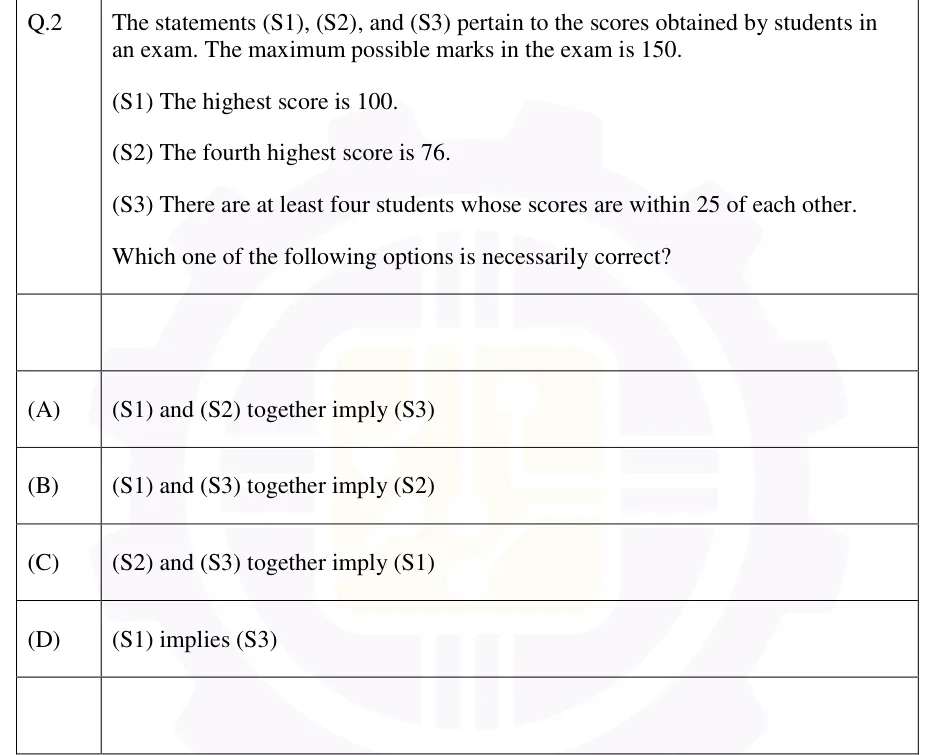
The statements (S1), (S2), and (S3) pertain to the scores obtained by students in an exam. The maximum possible marks in the exam is 150.

(S1) The highest score is 100.

(S2) The fourth highest score is 76.

(S3) There are at least four students whose scores are within 25 of each other.

Which one of the following options is necessarily correct?

  1. (A)

    (S1) and (S2) together imply (S3)

  2. (B)

    (S1) and (S3) together imply (S2)

  3. (C)

    (S2) and (S3) together imply (S1)

  4. (D)

    (S1) implies (S3)
Answer and solution
See the question in the paper
GATE 2026 EC GA Q.2: answer and solution

GATE 2026 EC GA Q.5

GATE 2026 · ECGA Q.5 · 1 mark · MCQ

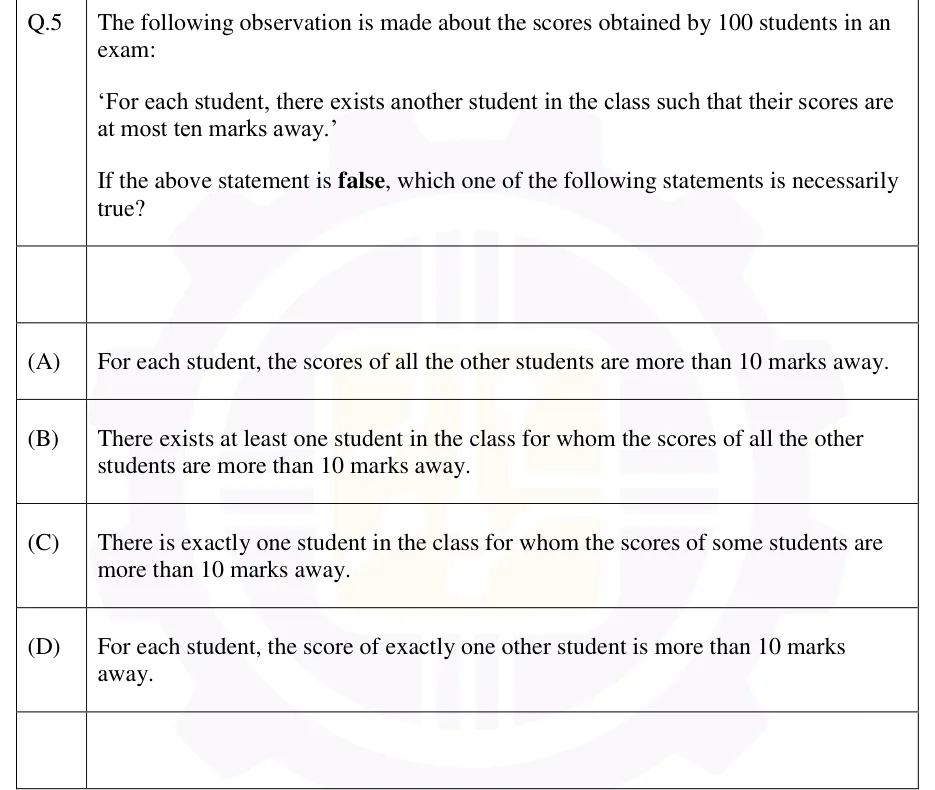
The following observation is made about the scores obtained by 100 students in an exam:

‘For each student, there exists another student in the class such that their scores are at most ten marks away.’

If the above statement is false, which one of the following statements is necessarily true?

  1. (A)

    For each student, the scores of all the other students are more than 10 marks away.

  2. (B)

    There exists at least one student in the class for whom the scores of all the other students are more than 10 marks away.

  3. (C)

    There is exactly one student in the class for whom the scores of some students are more than 10 marks away.

  4. (D)

    For each student, the score of exactly one other student is more than 10 marks away.

Official answer
See the question in the paper
GATE 2026 EC GA Q.5: official answer

GATE 2026 EC GA Q.7

GATE 2026 · ECGA Q.7 · 2 marks · MCQ

Three children P, Q, R and two grown-ups X, Y play a badminton doubles tournament. X and Y are parents to two of the children playing. The child of X is not the same as the child of Y. Exactly one of the children does not have a parent playing in the tournament. The following rules are followed:

(i) A parent and his/her child cannot be on the same team.
(ii) A match can feature at most one parent and his/her child, that is, a maximum of one parent-child pair can play in a match.

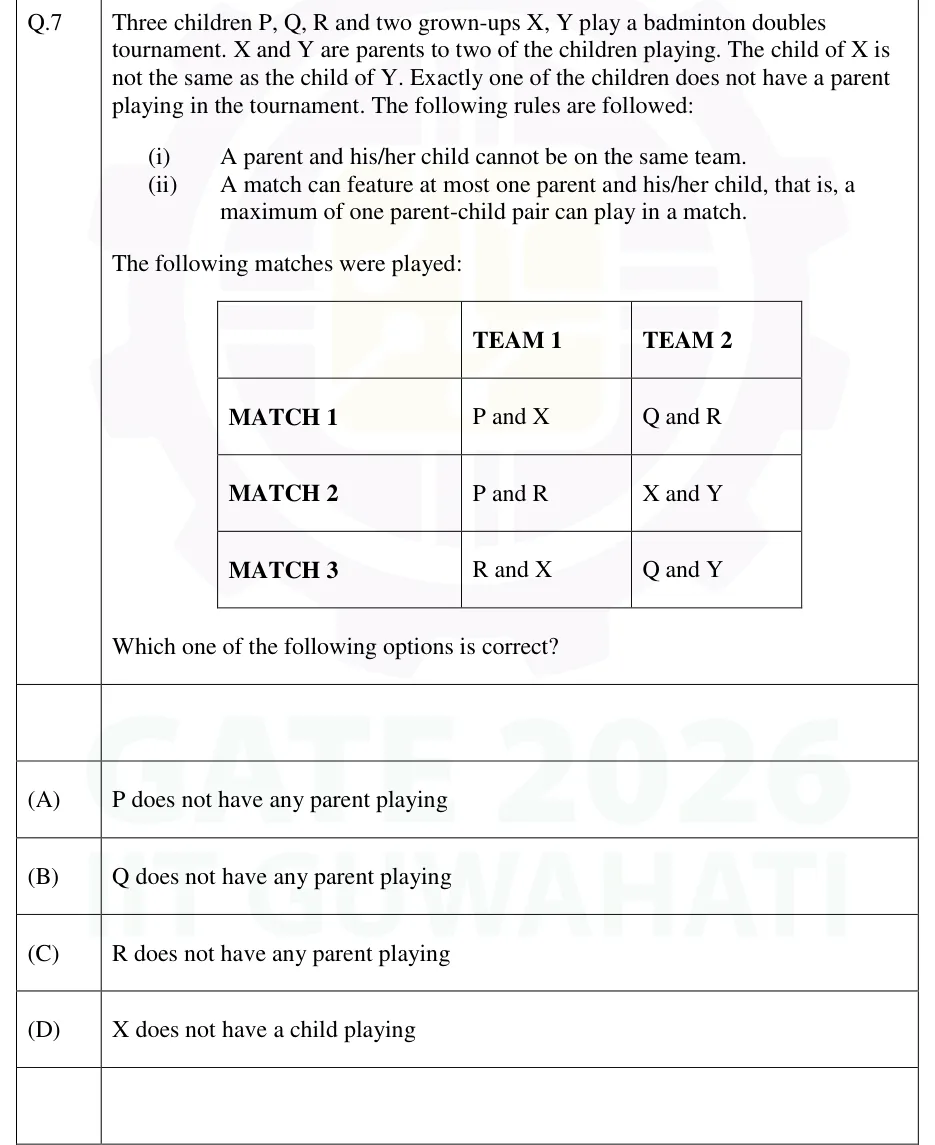
The following matches were played:

| | TEAM 1 | TEAM 2 |
|---|---|---|
| MATCH 1 | P and X | Q and R |
| MATCH 2 | P and R | X and Y |
| MATCH 3 | R and X | Q and Y |

Which one of the following options is correct?

GATE 2026 EC GA question 7: A table with three columns headed (blank), TEAM 1, TEAM 2 and three rows: MATCH 1 — Team 1: P and X, Team 2: Q and R;Tap to open full size
Figure from the GATE 2026 EC paper. It is part of the question.
Figure description

A table with three columns headed (blank), TEAM 1, TEAM 2 and three rows: MATCH 1 — Team 1: P and X, Team 2: Q and R; MATCH 2 — Team 1: P and R, Team 2: X and Y; MATCH 3 — Team 1: R and X, Team 2: Q and Y.

  1. (A)

    P does not have any parent playing

  2. (B)

    Q does not have any parent playing

  3. (C)

    R does not have any parent playing

  4. (D)

    X does not have a child playing

Answer and solution
GATE 2026 EC GA Q.7: answer and solution

GATE 2026 EE GA Q.8

GATE 2026 · EEGA Q.8 · 2 marks · MCQ

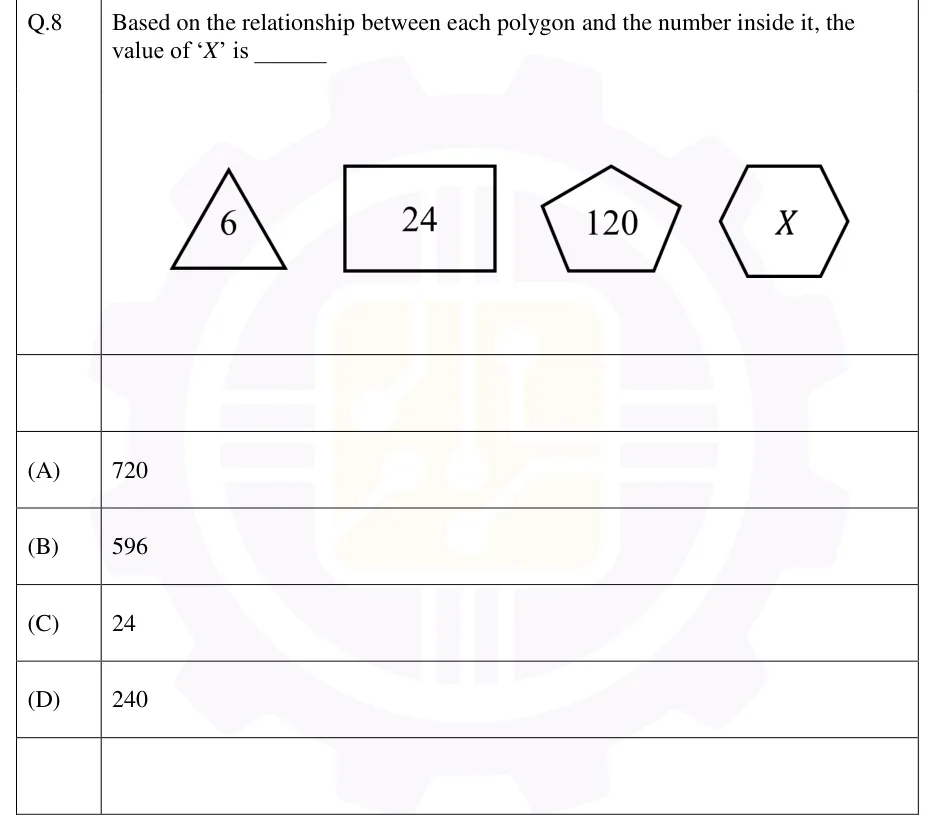
Based on the relationship between each polygon and the number inside it, the value of ‘X’ is ______

GATE 2026 EE GA question 8: Four unshaded outline polygons in one horizontal row, each with a number written at its centre.Tap to open full size
Figure from the GATE 2026 EE paper. It is part of the question.
Figure description

Four unshaded outline polygons in one horizontal row, each with a number written at its centre. From left to right: (1) an upright triangle (apex at the top, base horizontal) containing the number 6; (2) a rectangle, wider than it is tall (landscape), containing the number 24; (3) a regular pentagon with one vertex pointing up and a horizontal base, containing the number 120; (4) a regular hexagon with flat top and bottom edges and vertices pointing left and right, containing the italic letter X. No other lines, labels or shading.

  1. (A)

    720

  2. (B)

    596

  3. (C)

    24

  4. (D)

    240

Answer and solution
GATE 2026 EE GA Q.8: answer and solution

GATE 2026 EE GA Q.9

GATE 2026 · EEGA Q.9 · 2 marks · MCQ

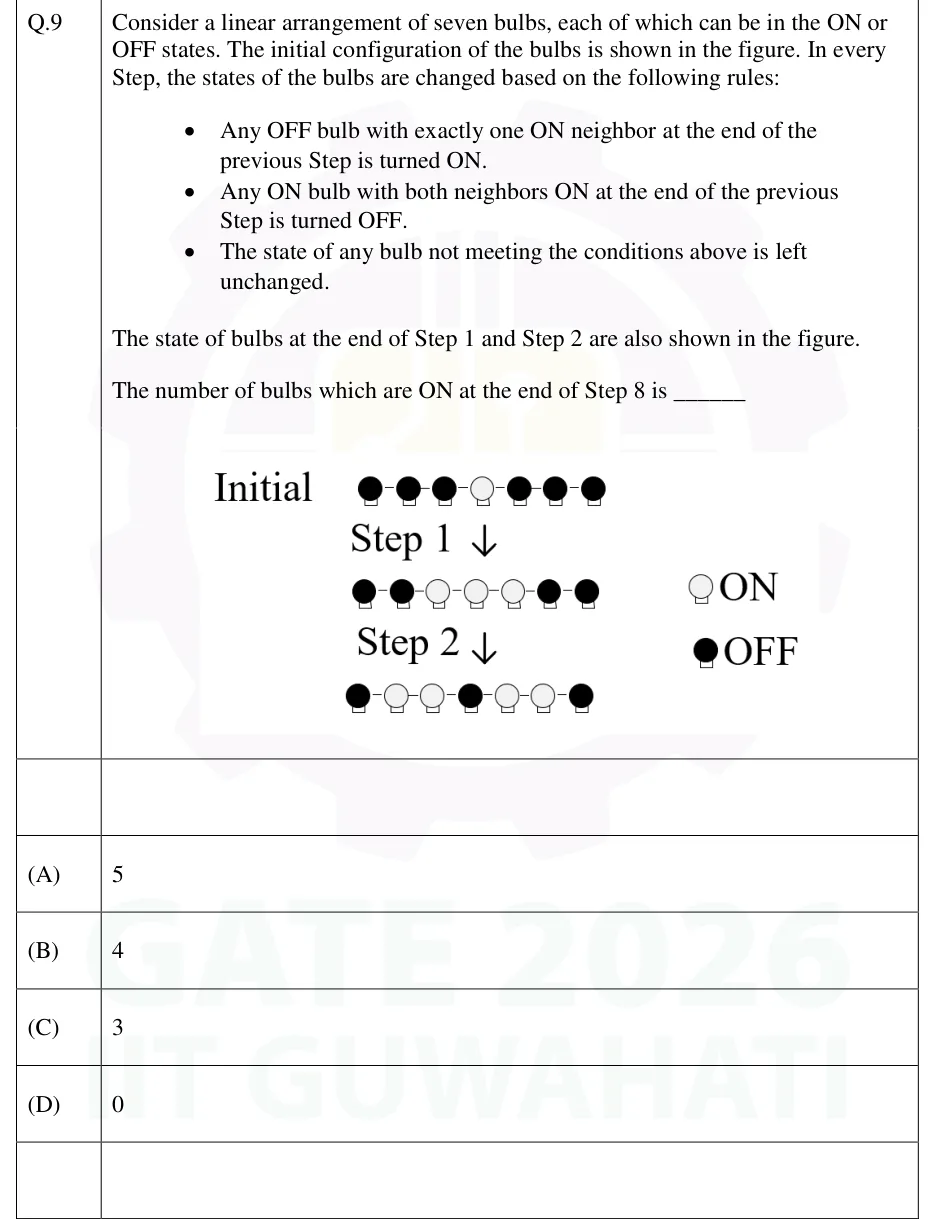
Consider a linear arrangement of seven bulbs, each of which can be in the ON or OFF states. The initial configuration of the bulbs is shown in the figure. In every Step, the states of the bulbs are changed based on the following rules:

  • Any OFF bulb with exactly one ON neighbor at the end of the previous Step is turned ON.
  • Any ON bulb with both neighbors ON at the end of the previous Step is turned OFF.
  • The state of any bulb not meeting the conditions above is left unchanged.

The state of bulbs at the end of Step 1 and Step 2 are also shown in the figure.

The number of bulbs which are ON at the end of Step 8 is ______

GATE 2026 EE GA question 9: Three horizontal rows of seven bulb icons joined by short dashes, stacked vertically.Tap to open full size
Figure from the GATE 2026 EE paper. It is part of the question.
Figure description

Three horizontal rows of seven bulb icons joined by short dashes, stacked vertically. A legend on the right shows a hollow (white) bulb labelled 'ON' and a filled (black) bulb labelled 'OFF'. Row 1, labelled 'Initial' on its left: black, black, black, white, black, black, black (only the 4th bulb ON). Below it the label 'Step 1' with a downward arrow. Row 2: black, black, white, white, white, black, black (bulbs 3, 4, 5 ON). Below it the label 'Step 2' with a downward arrow. Row 3: black, white, white, black, white, white, black (bulbs 2, 3, 5, 6 ON).

  1. (A)

    5

  2. (B)

    4

  3. (C)

    3

  4. (D)

    0

Answer and solution
GATE 2026 EE GA Q.9: answer and solution

GATE 2026 IN GA Q.3

GATE 2026 · INGA Q.3 · 1 mark · MCQ

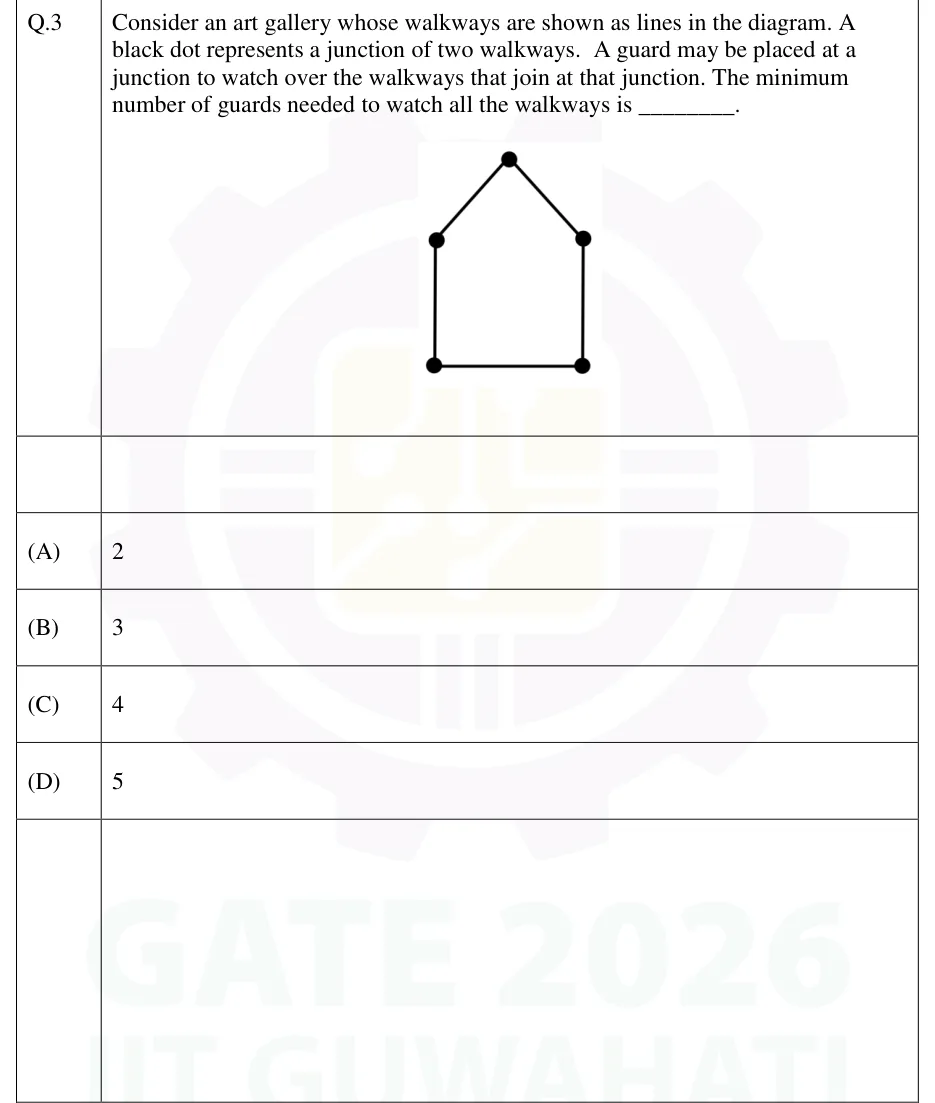
Consider an art gallery whose walkways are shown as lines in the diagram. A black dot represents a junction of two walkways. A guard may be placed at a junction to watch over the walkways that join at that junction. The minimum number of guards needed to watch all the walkways is ________.

GATE 2026 IN GA question 3: A closed house-shaped pentagon drawn with 5 straight lines and 5 black dots (junctions) at its corners.Tap to open full size
Figure from the GATE 2026 IN paper. It is part of the question.
Figure description

A closed house-shaped pentagon drawn with 5 straight lines and 5 black dots (junctions) at its corners. The dots are: one at the top centre (apex); one at the upper left and one at the upper right, both at the same height below the apex; one at the bottom left directly below the upper-left dot; one at the bottom right directly below the upper-right dot. Lines: apex to upper-left (slanting down to the left); apex to upper-right (slanting down to the right); upper-left straight down to bottom-left (vertical); upper-right straight down to bottom-right (vertical); bottom-left to bottom-right (horizontal). No other lines, no labels. Every junction joins exactly two walkways.

  1. (A)

    2

  2. (B)

    3

  3. (C)

    4

  4. (D)

    5

Answer and solution
GATE 2026 IN GA Q.3: answer and solution

GATE 2026 IN GA Q.5

GATE 2026 · INGA Q.5 · 1 mark · MCQ

A coin with heads facing up is shown as (H) and a coin with tails facing up is shown as (T) .

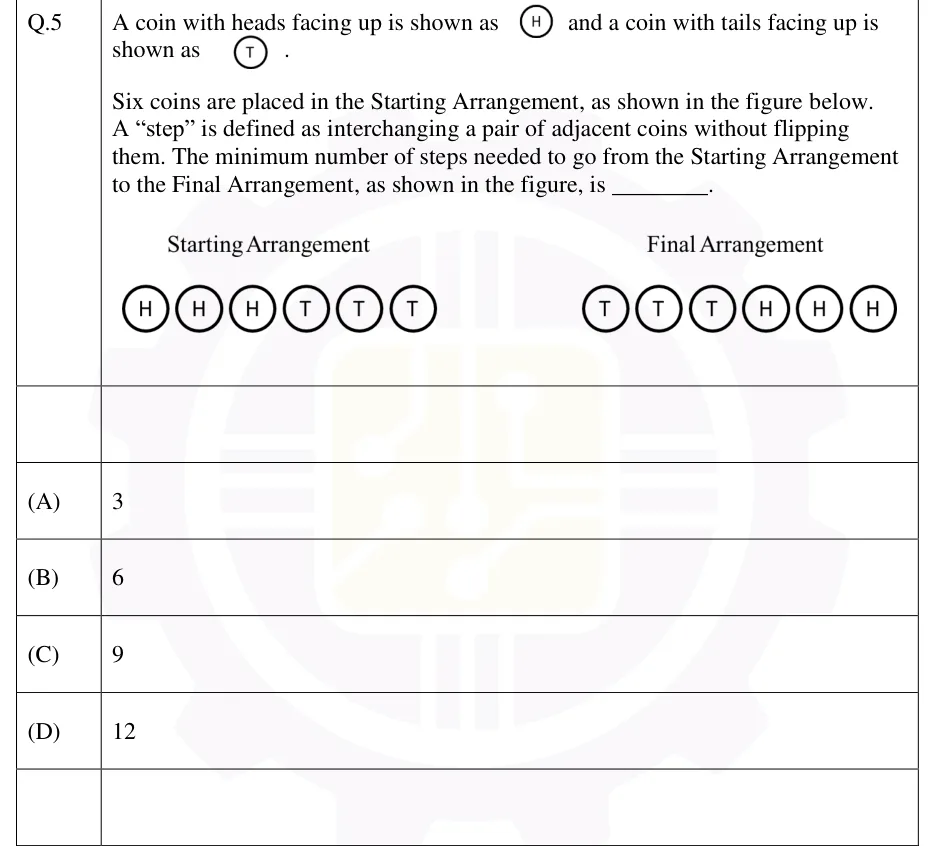
Six coins are placed in the Starting Arrangement, as shown in the figure below. A “step” is defined as interchanging a pair of adjacent coins without flipping them. The minimum number of steps needed to go from the Starting Arrangement to the Final Arrangement, as shown in the figure, is ______.

GATE 2026 IN GA question 5: The coins are drawn as small circles with a letter inside: a circle containing H is a coin with heads up, and a circle…Tap to open full size
Figure from the GATE 2026 IN paper. It is part of the question.
Figure description

The coins are drawn as small circles with a letter inside: a circle containing H is a coin with heads up, and a circle containing T is a coin with tails up. Below the text there are two rows of six circles side by side in a horizontal line. On the left, under the heading "Starting Arrangement", the row reads from left to right: H, H, H, T, T, T. On the right, under the heading "Final Arrangement", the row reads from left to right: T, T, T, H, H, H.

  1. (A)

    3

  2. (B)

    6

  3. (C)

    9

  4. (D)

    12

Answer and solution
GATE 2026 IN GA Q.5: answer and solution

GATE 2026 IN GA Q.8

GATE 2026 · INGA Q.8 · 2 marks · MCQ

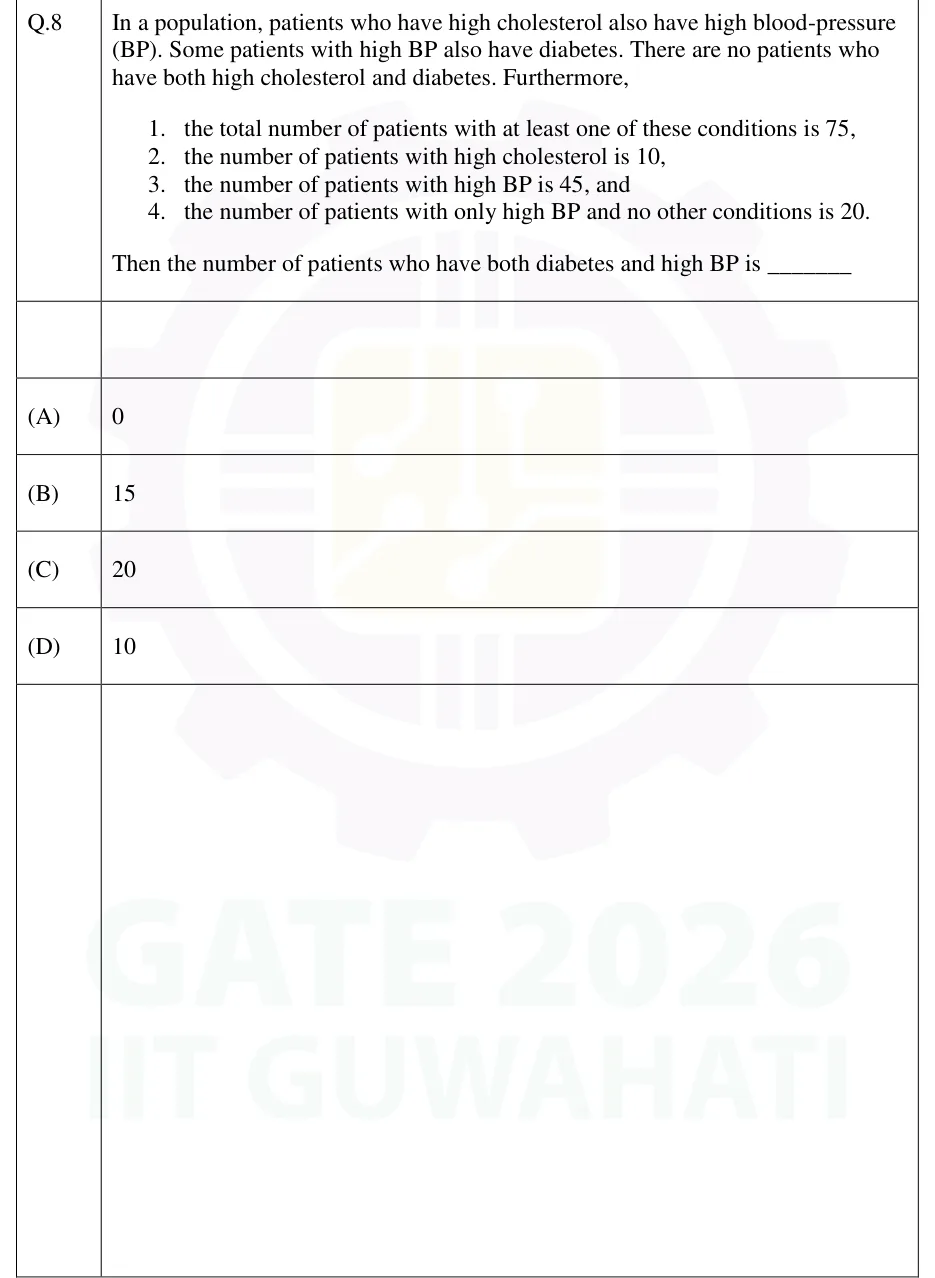
In a population, patients who have high cholesterol also have high blood-pressure (BP). Some patients with high BP also have diabetes. There are no patients who have both high cholesterol and diabetes. Furthermore,

1. the total number of patients with at least one of these conditions is 75,
2. the number of patients with high cholesterol is 10,
3. the number of patients with high BP is 45, and
4. the number of patients with only high BP and no other conditions is 20.

Then the number of patients who have both diabetes and high BP is ______

  1. (A)

    0

  2. (B)

    15

  3. (C)

    20

  4. (D)

    10

Answer and solution
See the question in the paper
GATE 2026 IN GA Q.8: answer and solution

GATE 2025 EC GA Q.8

GATE 2025 · ECGA Q.8 · 2 marks · MCQ

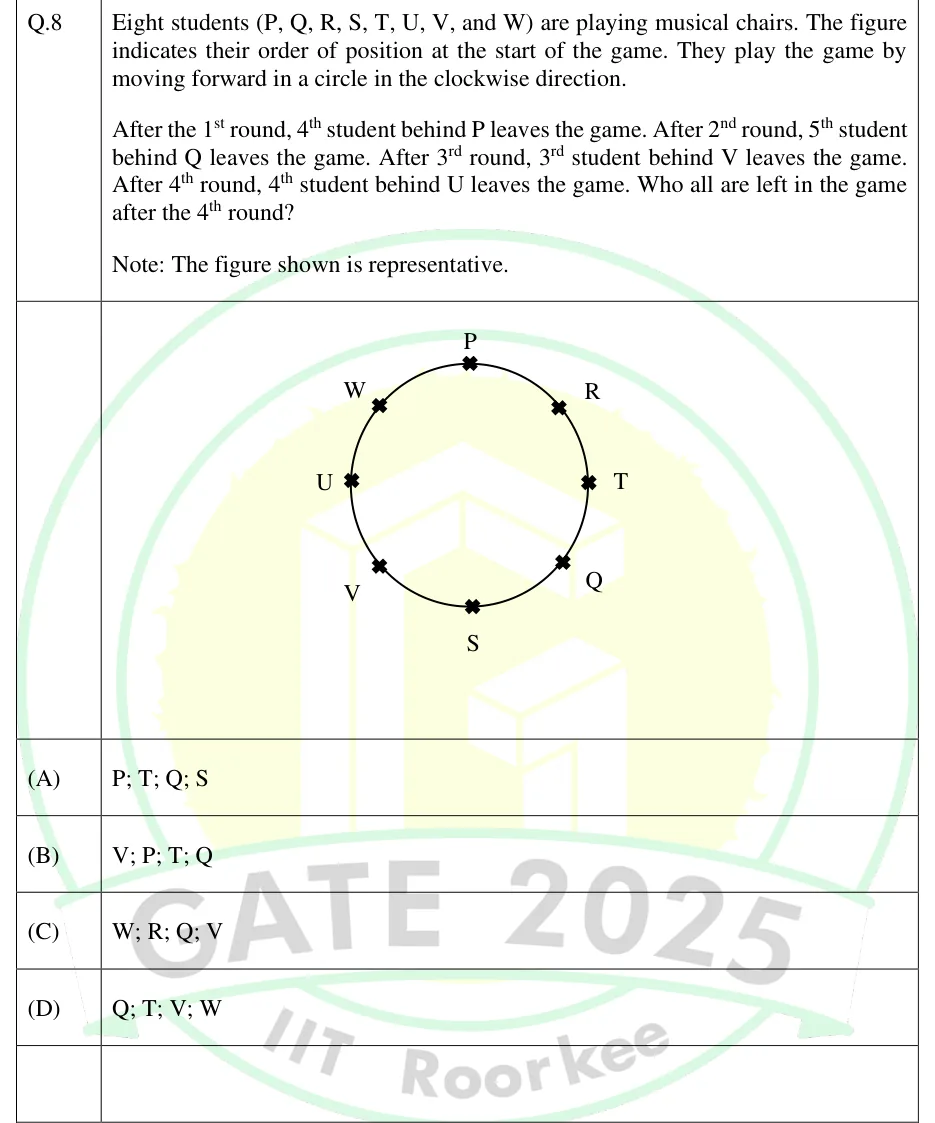
Eight students (P, Q, R, S, T, U, V, and W) are playing musical chairs. The figure indicates their order of position at the start of the game. They play the game by moving forward in a circle in the clockwise direction.

After the 1 round, 4 student behind P leaves the game. After 2 round, 5 student behind Q leaves the game. After 3 round, 3 student behind V leaves the game. After 4 round, 4 student behind U leaves the game. Who all are left in the game after the 4 round?

Note: The figure shown is representative.

GATE 2025 EC GA question 8: A single circle with eight equally spaced positions on it, each marked with a bold cross and labelled with a letter…Tap to open full size
Figure from the GATE 2025 EC paper. It is part of the question.
Figure description

A single circle with eight equally spaced positions on it, each marked with a bold cross and labelled with a letter outside the circle. Going clockwise from the top: P at the top (12 o'clock), R at upper right (about 1:30), T at the right (3 o'clock), Q at lower right (about 4:30), S at the bottom (6 o'clock), V at lower left (about 7:30), U at the left (9 o'clock), W at upper left (about 10:30). So the clockwise order is P, R, T, Q, S, V, U, W and back to P. No arrows or other markings.

  1. (A)

    P; T; Q; S

  2. (B)

    V; P; T; Q

  3. (C)

    W; R; Q; V

  4. (D)

    Q; T; V; W

Answer and solution
GATE 2025 EC GA Q.8: answer and solution

GATE 2025 EE GA Q.4

GATE 2025 · EEGA Q.4 · 1 mark · MCQ

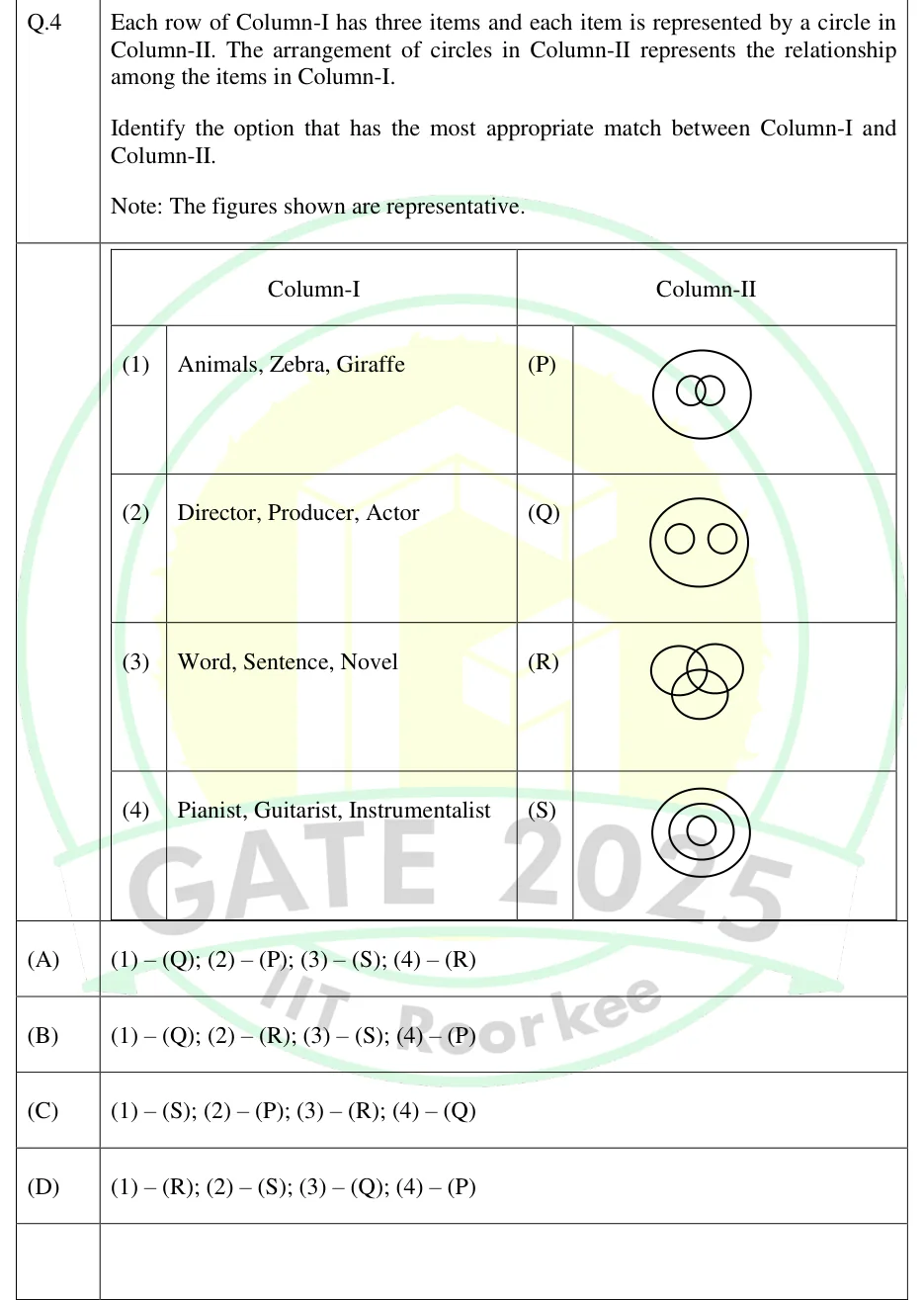
Each row of Column-I has three items and each item is represented by a circle in Column-II. The arrangement of circles in Column-II represents the relationship among the items in Column-I.

Identify the option that has the most appropriate match between Column-I and Column-II.

Note: The figures shown are representative.

| Column-I | Column-II |
|---|---|
| (1) Animals, Zebra, Giraffe | (P) Figure |
| (2) Director, Producer, Actor | (Q) Figure |
| (3) Word, Sentence, Novel | (R) Figure |
| (4) Pianist, Guitarist, Instrumentalist | (S) Figure |

GATE 2025 EE GA question 4: Column-II has four circle diagrams, one per row.Tap to open full size
Figure from the GATE 2025 EE paper. It is part of the question.
Figure description

Column-II has four circle diagrams, one per row. (P): one large circle with two small circles inside it, near its centre; the two small circles overlap each other. (Q): one large circle with two small circles inside it, side by side; the two small circles do not touch or overlap. (R): three circles of equal size arranged in a triangle (two on top, one below and between them), each overlapping the other two, with no circle enclosing another. (S): three concentric circles, small inside medium inside large, so each circle lies completely inside the next.

  1. (A)

    (1) – (Q); (2) – (P); (3) – (S); (4) – (R)

  2. (B)

    (1) – (Q); (2) – (R); (3) – (S); (4) – (P)

  3. (C)

    (1) – (S); (2) – (P); (3) – (R); (4) – (Q)

  4. (D)

    (1) – (R); (2) – (S); (3) – (Q); (4) – (P)

Answer and solution
GATE 2025 EE GA Q.4: answer and solution

GATE 2025 EE GA Q.7

GATE 2025 · EEGA Q.7 · 2 marks · MCQ

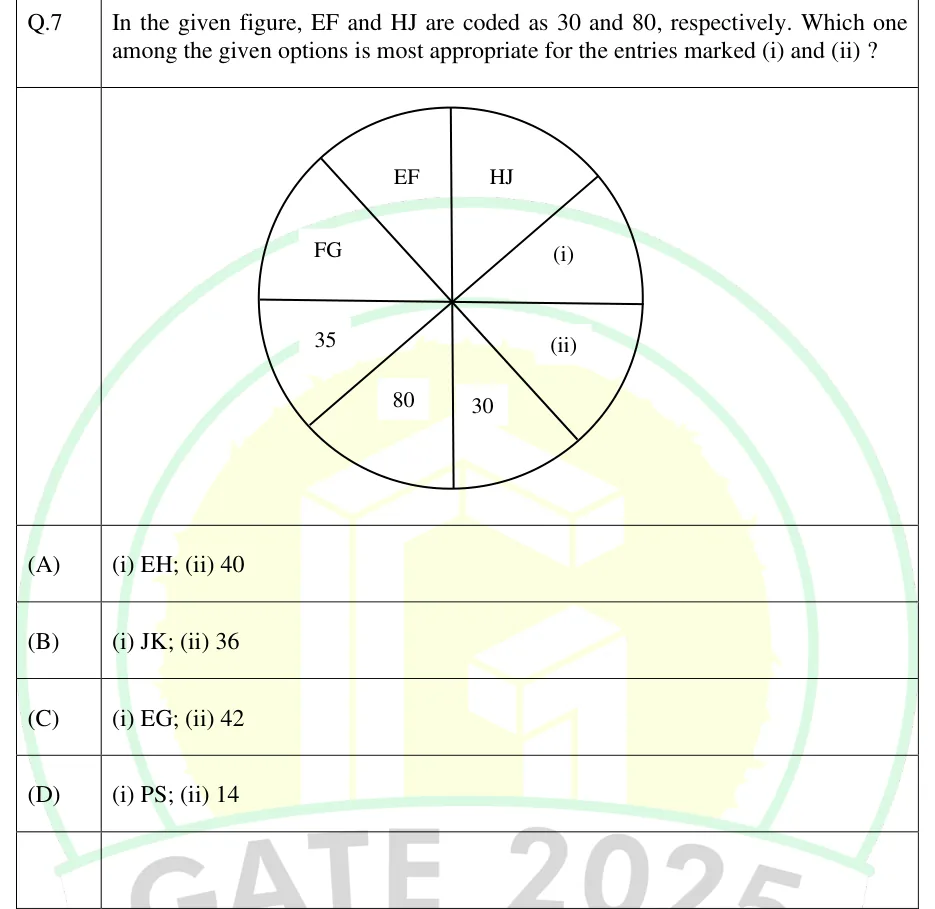
In the given figure, EF and HJ are coded as 30 and 80, respectively. Which one among the given options is most appropriate for the entries marked (i) and (ii) ?

GATE 2025 EE GA question 7: A circle divided into 8 equal sectors by four lines through the centre: one vertical, one horizontal, and two diagonals…Tap to open full size
Figure from the GATE 2025 EE paper. It is part of the question.
Figure description

A circle divided into 8 equal sectors by four lines through the centre: one vertical, one horizontal, and two diagonals (upper-left to lower-right, and upper-right to lower-left). Going clockwise from the top, the entries in the sectors are: HJ (between the top of the vertical line and the upper-right diagonal), (i) (between the upper-right diagonal and the right half of the horizontal line), (ii) (between the right half of the horizontal line and the lower-right diagonal), 30 (between the lower-right diagonal and the bottom of the vertical line), 80 (between the bottom of the vertical line and the lower-left diagonal), 35 (between the lower-left diagonal and the left half of the horizontal line), FG (between the left half of the horizontal line and the upper-left diagonal), and EF (between the upper-left diagonal and the top of the vertical line). So diametrically opposite pairs are EF and 30, HJ and 80, (i) and 35, (ii) and FG.

  1. (A)

    (i) EH; (ii) 40

  2. (B)

    (i) JK; (ii) 36

  3. (C)

    (i) EG; (ii) 42

  4. (D)

    (i) PS; (ii) 14

Answer and solution
GATE 2025 EE GA Q.7: answer and solution

GATE 2025 IN GA Q.10

GATE 2025 · INGA Q.10 · 2 marks · MCQ

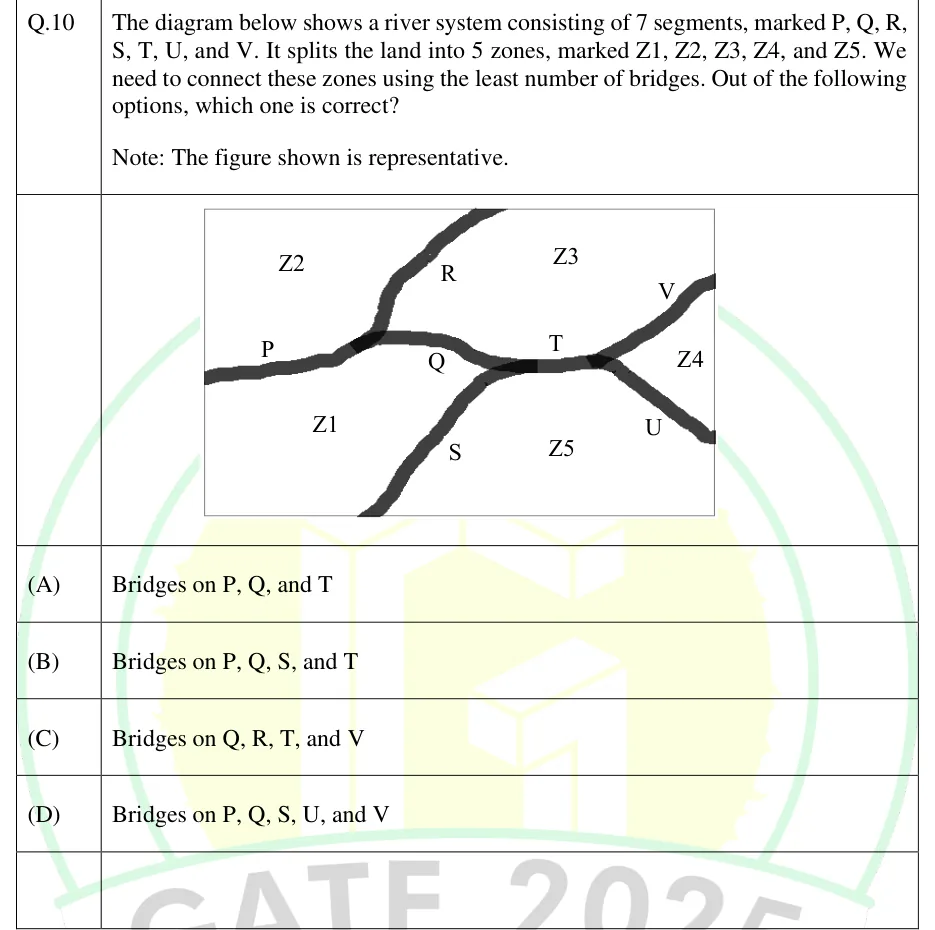
The diagram below shows a river system consisting of 7 segments, marked P, Q, R, S, T, U, and V. It splits the land into 5 zones, marked Z1, Z2, Z3, Z4, and Z5. We need to connect these zones using the least number of bridges. Out of the following options, which one is correct?

Note: The figure shown is representative.

GATE 2025 IN GA question 10: A rectangle (the land) crossed by thick dark curved lines (the river), with three junction points roughly along a…Tap to open full size
Figure from the GATE 2025 IN paper. It is part of the question.
Figure description

A rectangle (the land) crossed by thick dark curved lines (the river), with three junction points roughly along a horizontal line near the middle. Junction J1 is left of centre, junction J2 is at the centre, junction J3 is right of centre. Segment P runs from the left edge of the rectangle, slightly below mid-height, rightwards to J1. Segment R runs from J1 up and to the right, curving to leave through the top edge slightly right of centre. Segment Q runs roughly horizontally from J1 to J2, dipping slightly. Segment S runs from J2 down and to the left, leaving through the bottom edge left of centre. Segment T runs roughly horizontally from J2 to J3. Segment V runs from J3 up and to the right, leaving through the right edge near the top. Segment U runs from J3 down and to the right, leaving through the right edge near the bottom. Zone labels: Z2 in the top-left region (above P, left of R); Z3 in the top-middle region (right of R, above Q and T, left of and above V); Z4 on the right between V (above) and U (below); Z5 in the bottom-middle region (right of S, below T, left of and below U); Z1 in the bottom-left region (below P and Q, left of S). Segment letters are printed beside their segments: P above the left part of P, R to the right of R, Q below Q, T above T, V left of V, U left of U, S right of S.

  1. (A)

    Bridges on P, Q, and T

  2. (B)

    Bridges on P, Q, S, and T

  3. (C)

    Bridges on Q, R, T, and V

  4. (D)

    Bridges on P, Q, S, U, and V

Answer and solution
GATE 2025 IN GA Q.10: answer and solution

GATE 2024 EC GA Q.2

GATE 2024 · ECGA Q.2 · 1 mark · MCQ

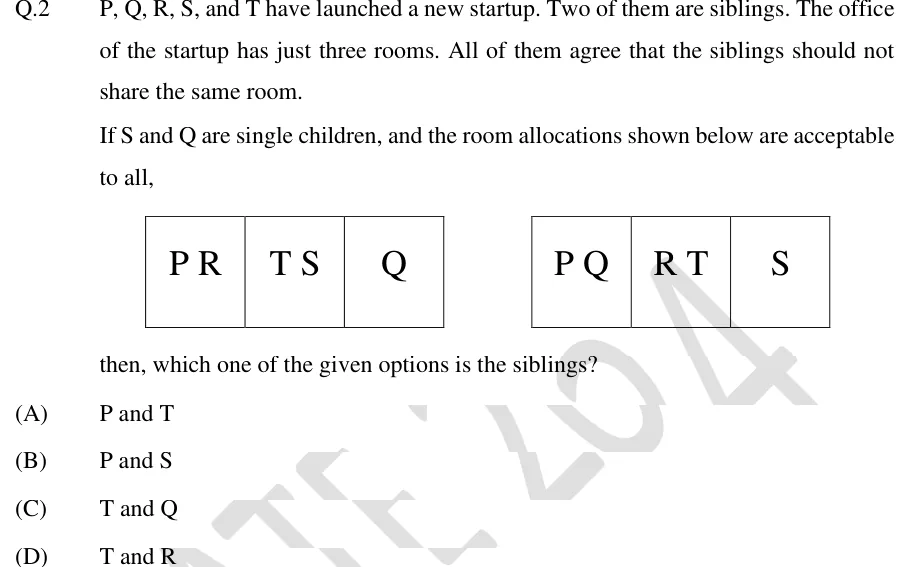
P, Q, R, S, and T have launched a new startup. Two of them are siblings. The office of the startup has just three rooms. All of them agree that the siblings should not share the same room.

If S and Q are single children, and the room allocations shown below are acceptable to all,

[Figure: two room allocations]

then, which one of the given options is the siblings?

GATE 2024 EC GA question 2: Two separate diagrams side by side, each a row of three adjacent rectangular boxes (rooms).Tap to open full size
Figure from the GATE 2024 EC paper. It is part of the question.
Figure description

Two separate diagrams side by side, each a row of three adjacent rectangular boxes (rooms). Left diagram: first box contains "P R", second box contains "T S", third box contains "Q". Right diagram: first box contains "P Q", second box contains "R T", third box contains "S".

  1. (A)

    P and T

  2. (B)

    P and S

  3. (C)

    T and Q

  4. (D)

    T and R

Answer and solution
GATE 2024 EC GA Q.2: answer and solution

GATE 2024 EE GA Q.2

GATE 2024 · EEGA Q.2 · 1 mark · MCQ

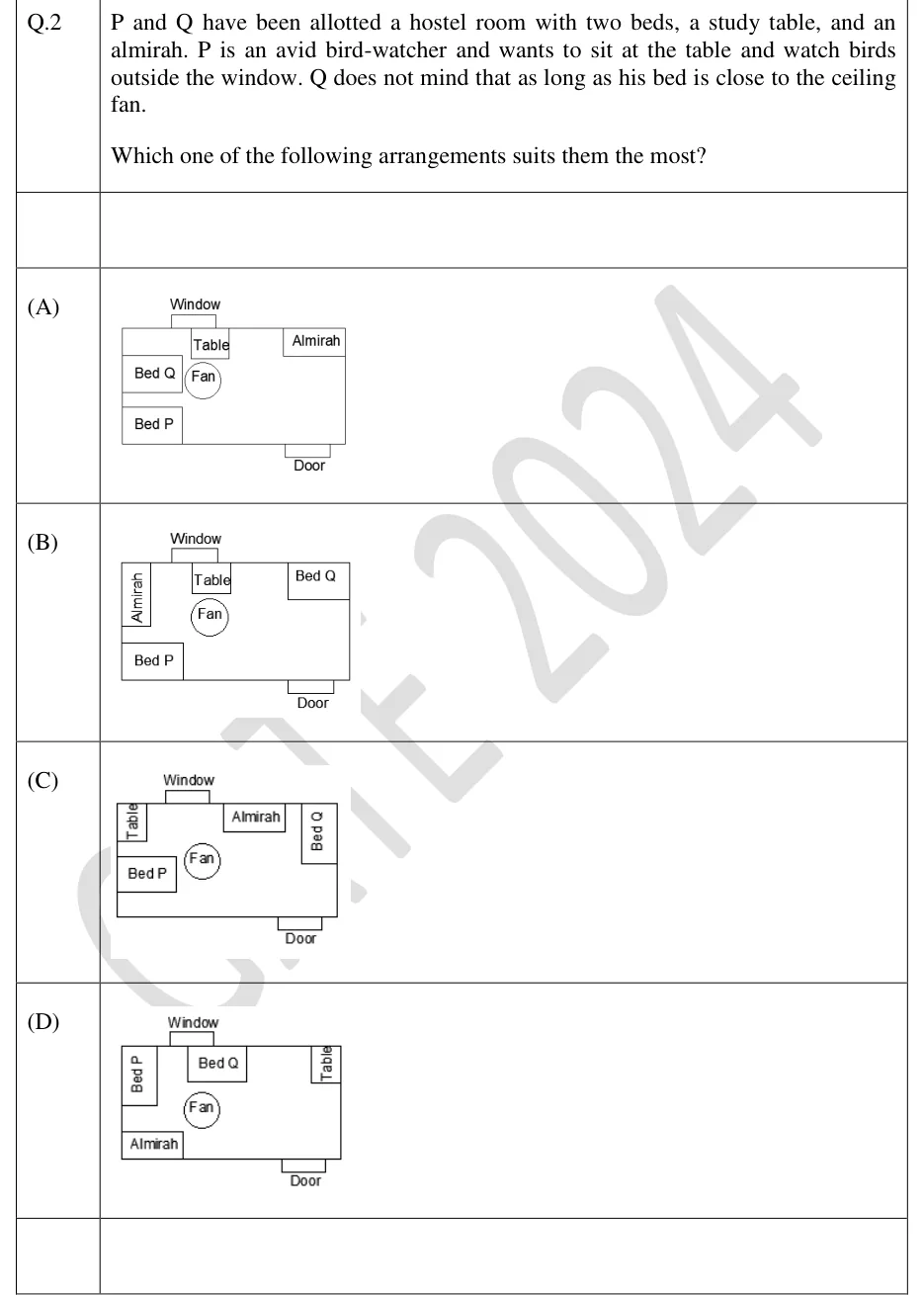
P and Q have been allotted a hostel room with two beds, a study table, and an almirah. P is an avid bird-watcher and wants to sit at the table and watch birds outside the window. Q does not mind that as long as his bed is close to the ceiling fan.

Which one of the following arrangements suits them the most?

GATE 2024 EE GA question 2: Each option is a top-view floor plan of the same rectangular room, wider than it is tall.Tap to open full size
Figure from the GATE 2024 EE paper. It is part of the question.
Figure description

Each option is a top-view floor plan of the same rectangular room, wider than it is tall. In every option the Window is a small rectangle on the outside of the top wall, left of centre (about one third of the way from the left), and the Door is a small rectangle on the outside of the bottom wall, right of centre. The Fan is a labelled circle inside the room. Only the positions of Table, Almirah, Bed P and Bed Q change. (A) Table: small rectangle on the inside of the top wall, directly below the window. Almirah: rectangle in the top-right corner. Bed Q: rectangle on the left wall, a little below the top-left corner. Fan: circle just to the right of Bed Q and just below the table. Bed P: rectangle in the bottom-left corner, below Bed Q. (B) Table: small rectangle directly below the window. Almirah: tall rectangle standing along the left wall in the top-left corner (label written vertically). Fan: circle directly below the table. Bed Q: rectangle in the top-right corner, far from the fan. Bed P: rectangle in the bottom-left corner. (C) Table: tall rectangle standing along the left wall in the top-left corner (label written vertically), not below the window. Almirah: rectangle on the inside of the top wall, right of the window. Bed Q: tall rectangle along the right wall in the top-right corner (label written vertically). Bed P: rectangle on the left wall just below the table. Fan: circle just to the right of Bed P, left of centre. (D) Bed P: tall rectangle along the left wall in the top-left corner (label written vertically). Bed Q: rectangle on the inside of the top wall, directly below the window. Fan: circle directly below Bed Q. Table: tall rectangle along the right wall in the top-right corner (label written vertically), far from the window. Almirah: rectangle in the bottom-left corner.

  1. (A)

    Figure — Table directly below the window; Bed Q on the left wall with the Fan immediately beside it; Bed P in the bottom-left corner; Almirah in the top-right corner.

  2. (B)

    Figure — Table directly below the window with the Fan below it; Bed Q in the top-right corner, away from the Fan; Almirah upright along the left wall at the top-left corner; Bed P in the bottom-left corner.

  3. (C)

    Figure — Table upright along the left wall at the top-left corner, away from the window; Almirah on the top wall right of the window; Bed Q upright along the right wall at the top-right corner; Bed P on the left wall beside the Fan.

  4. (D)

    Figure — Bed Q directly below the window with the Fan below it; Bed P upright along the left wall at the top-left corner; Table upright along the right wall at the top-right corner, away from the window; Almirah in the bottom-left corner.

Answer and solution
GATE 2024 EE GA Q.2: answer and solution

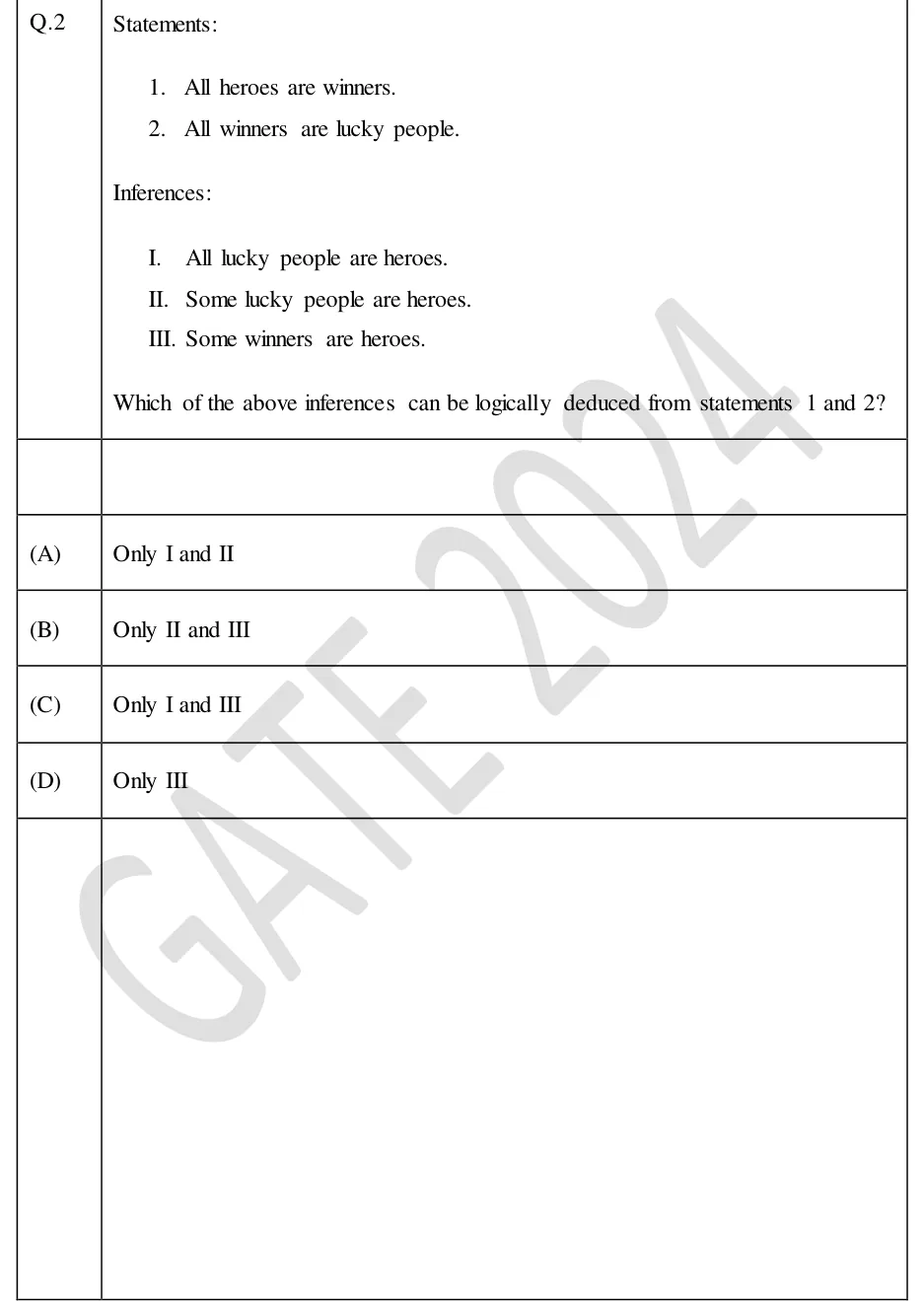
GATE 2024 IN GA Q.2

GATE 2024 · INGA Q.2 · 1 mark · MCQ

Statements:

1. All heroes are winners.
2. All winners are lucky people.

Inferences:

I. All lucky people are heroes.
II. Some lucky people are heroes.
III. Some winners are heroes.

Which of the above inferences can be logically deduced from statements 1 and 2?

  1. (A)

    Only I and II

  2. (B)

    Only II and III

  3. (C)

    Only I and III

  4. (D)

    Only III

Answer and solution
See the question in the paper
GATE 2024 IN GA Q.2: answer and solution

GATE 2023 EC GA Q.6

GATE 2023 · ECGA Q.6 · 2 marks · MCQ

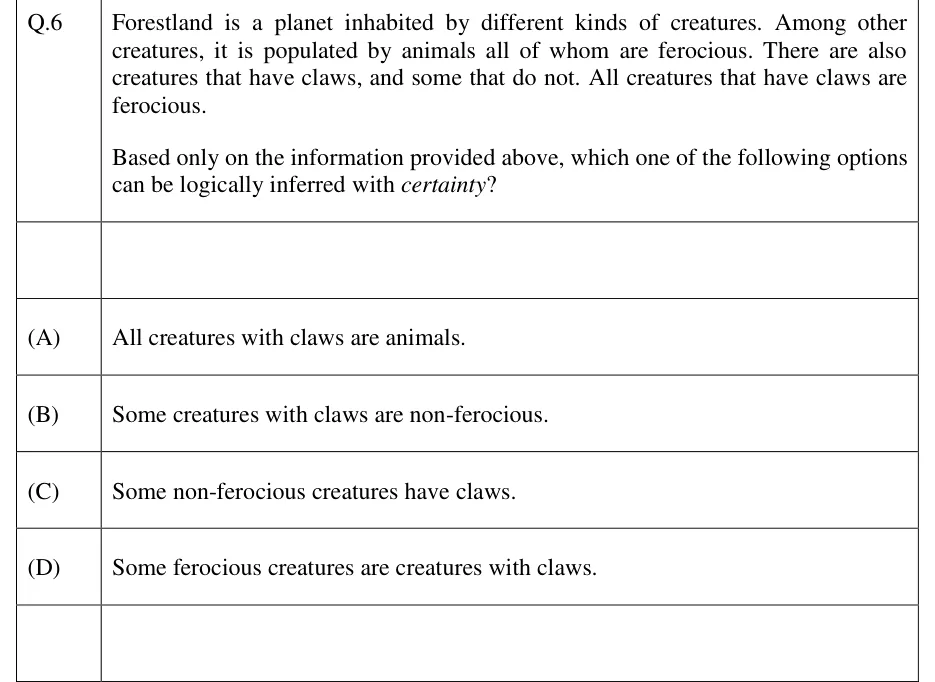
Forestland is a planet inhabited by different kinds of creatures. Among other creatures, it is populated by animals all of whom are ferocious. There are also creatures that have claws, and some that do not. All creatures that have claws are ferocious.

Based only on the information provided above, which one of the following options can be logically inferred with certainty?

  1. (A)

    All creatures with claws are animals.

  2. (B)

    Some creatures with claws are non-ferocious.

  3. (C)

    Some non-ferocious creatures have claws.

  4. (D)

    Some ferocious creatures are creatures with claws.

Answer and solution
See the question in the paper
GATE 2023 EC GA Q.6: answer and solution

GATE 2023 EC GA Q.9

GATE 2023 · ECGA Q.9 · 2 marks · MCQ

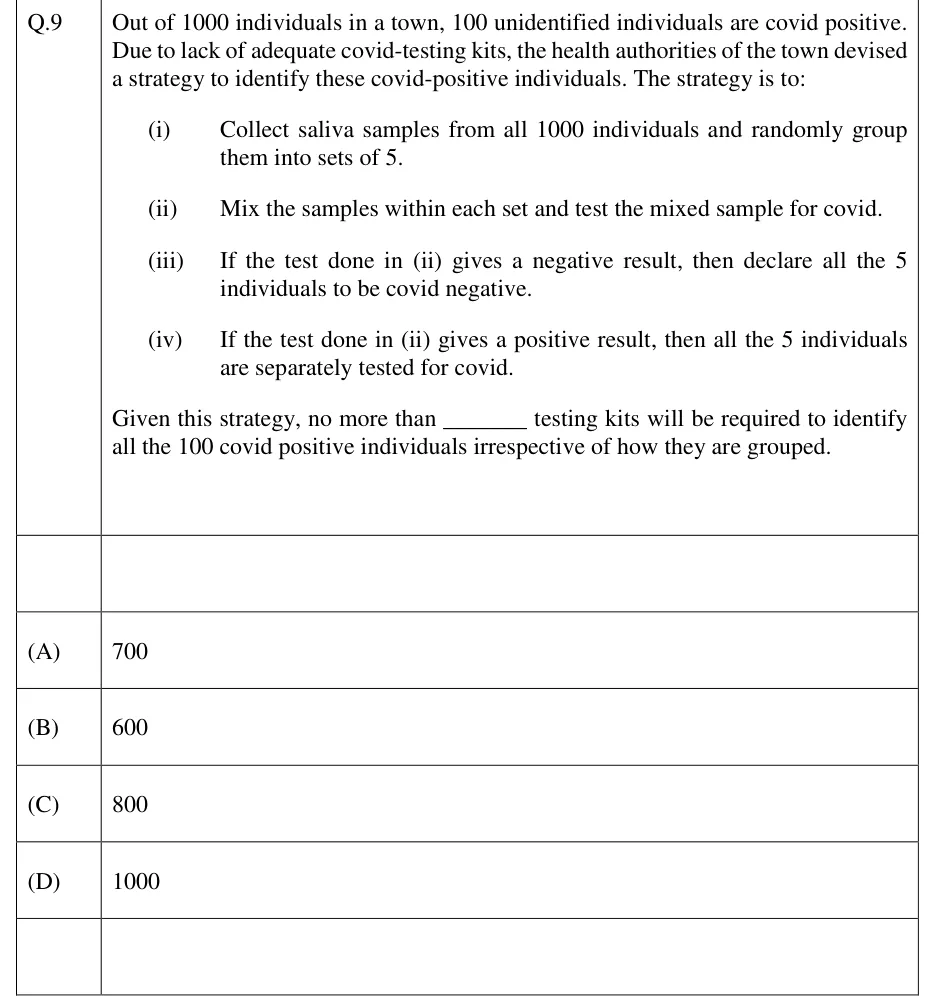
Out of 1000 individuals in a town, 100 unidentified individuals are covid positive. Due to lack of adequate covid-testing kits, the health authorities of the town devised a strategy to identify these covid-positive individuals. The strategy is to:

(i) Collect saliva samples from all 1000 individuals and randomly group them into sets of 5.

(ii) Mix the samples within each set and test the mixed sample for covid.

(iii) If the test done in (ii) gives a negative result, then declare all the 5 individuals to be covid negative.

(iv) If the test done in (ii) gives a positive result, then all the 5 individuals are separately tested for covid.

Given this strategy, no more than ______ testing kits will be required to identify all the 100 covid positive individuals irrespective of how they are grouped.

  1. (A)

    700

  2. (B)

    600

  3. (C)

    800

  4. (D)

    1000

Answer and solution
See the question in the paper
GATE 2023 EC GA Q.9: answer and solution

GATE 2023 EE GA Q.6

GATE 2023 · EEGA Q.6 · 2 marks · MCQ

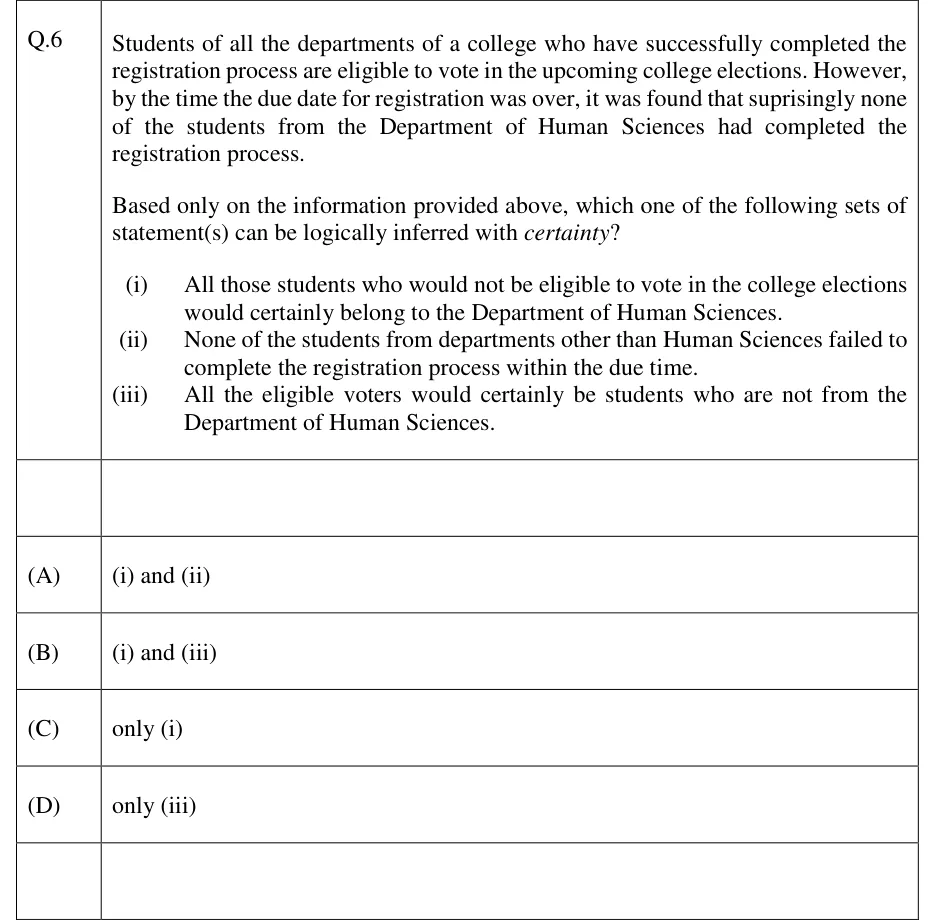
Students of all the departments of a college who have successfully completed the registration process are eligible to vote in the upcoming college elections. However, by the time the due date for registration was over, it was found that suprisingly none of the students from the Department of Human Sciences had completed the registration process.

Based only on the information provided above, which one of the following sets of statement(s) can be logically inferred with certainty?

(i) All those students who would not be eligible to vote in the college elections would certainly belong to the Department of Human Sciences.

(ii) None of the students from departments other than Human Sciences failed to complete the registration process within the due time.

(iii) All the eligible voters would certainly be students who are not from the Department of Human Sciences.

  1. (A)

    (i) and (ii)

  2. (B)

    (i) and (iii)

  3. (C)

    only (i)

  4. (D)

    only (iii)

Answer and solution
See the question in the paper
GATE 2023 EE GA Q.6: answer and solution

GATE 2023 IN GA Q.6

GATE 2023 · INGA Q.6 · 2 marks · MCQ

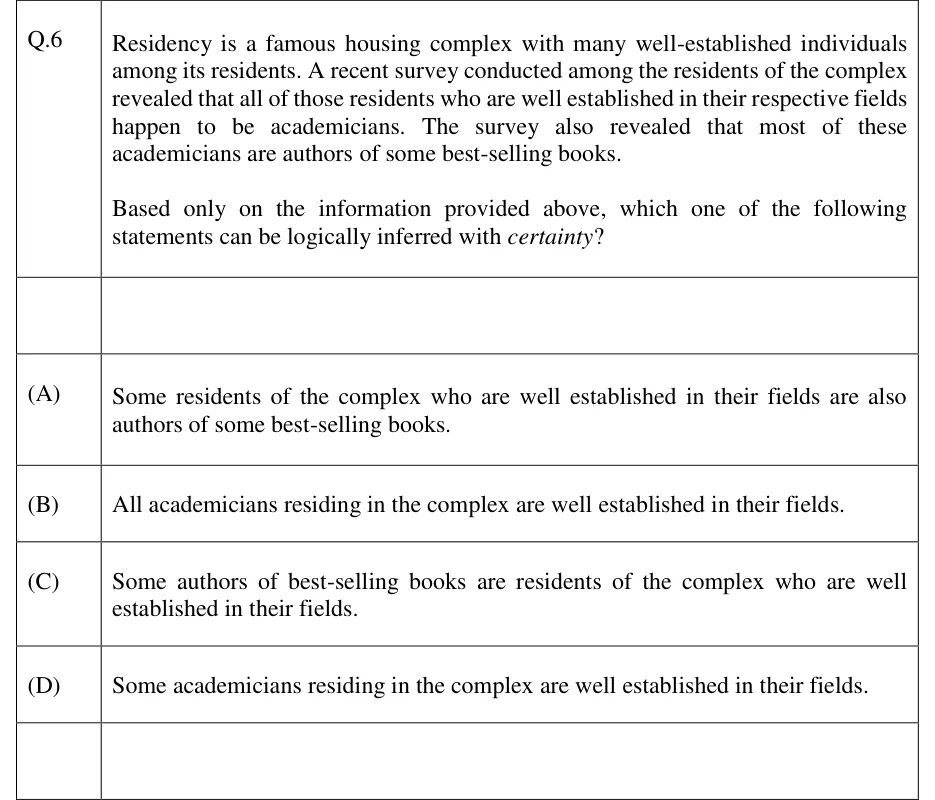
Residency is a famous housing complex with many well-established individuals among its residents. A recent survey conducted among the residents of the complex revealed that all of those residents who are well established in their respective fields happen to be academicians. The survey also revealed that most of these academicians are authors of some best-selling books.

Based only on the information provided above, which one of the following statements can be logically inferred with certainty?

  1. (A)

    Some residents of the complex who are well established in their fields are also authors of some best-selling books.

  2. (B)

    All academicians residing in the complex are well established in their fields.

  3. (C)

    Some authors of best-selling books are residents of the complex who are well established in their fields.

  4. (D)

    Some academicians residing in the complex are well established in their fields.

Official answer

Official answer: marks to all candidatesSource: Official answer key, GATE 2023 IN (IIT Kanpur)

See the question in the paper
GATE 2023 IN GA Q.6: official answer

GATE 2022 EC GA Q.9

GATE 2022 · ECGA Q.9 · 2 marks · MCQ

In a class of five students P, Q, R, S and T, only one student is known to have copied in the exam. The disciplinary committee has investigated the situation and recorded the statements from the students as given below.

Statement of P: R has copied in the exam.

Statement of Q: S has copied in the exam.

Statement of R: P did not copy in the exam.

Statement of S: Only one of us is telling the truth.

Statement of T: R is telling the truth.

The investigating team had authentic information that S never lies.

Based on the information given above, the person who has copied in the exam is

  1. (A)

    R

  2. (B)

    P

  3. (C)

    Q

  4. (D)

    T

Answer and solution
See the question in the paper
GATE 2022 EC GA Q.9: answer and solution

GATE 2022 EE GA Q.4

GATE 2022 · EEGA Q.4 · 1 mark · MCQ

Given below are two statements and four conclusions drawn based on the statements.

Statement 1: Some bottles are cups.

Statement 2: All cups are knives.

Conclusion I: Some bottles are knives.

Conclusion II: Some knives are cups.

Conclusion III: All cups are bottles.

Conclusion IV: All knives are cups.

Which one of the following options can be logically inferred?

  1. (A)

    Only conclusion I and conclusion II are correct

  2. (B)

    Only conclusion II and conclusion III are correct

  3. (C)

    Only conclusion II and conclusion IV are correct

  4. (D)

    Only conclusion III and conclusion IV are correct

Answer and solution
See the question in the paper
GATE 2022 EE GA Q.4: answer and solution

GATE 2022 EE GA Q.9

GATE 2022 · EEGA Q.9 · 2 marks · MCQ

The letters P, Q, R, S, T and U are to be placed one per vertex on a regular convex hexagon, but not necessarily in the same order.

Consider the following statements:

  • The line segment joining R and S is longer than the line segment joining P and Q.
  • The line segment joining R and S is perpendicular to the line segment joining P and Q.
  • The line segment joining R and U is parallel to the line segment joining T and Q.

Based on the above statements, which one of the following options is CORRECT?

  1. (A)

    The line segment joining R and T is parallel to the line segment joining Q and S

  2. (B)

    The line segment joining T and Q is parallel to the line joining P and U

  3. (C)

    The line segment joining R and P is perpendicular to the line segment joining U and Q

  4. (D)

    The line segment joining Q and S is perpendicular to the line segment joining R and P

Answer and solution
See the question in the paper
GATE 2022 EE GA Q.9: answer and solution

GATE 2022 IN GA Q.4

GATE 2022 · INGA Q.4 · 1 mark · MCQ

Six persons P, Q, R, S, T and U are sitting around a circular table facing the center not necessarily in the same order. Consider the following statements:

  • P sits next to S and T.
  • Q sits diametrically opposite to P.
  • The shortest distance between S and R is equal to the shortest distance between T and U.

Based on the above statements, Q is a neighbor of

  1. (A)

    U and S

  2. (B)

    R and T

  3. (C)

    R and U

  4. (D)

    P and S

Answer and solution
See the question in the paper
GATE 2022 IN GA Q.4: answer and solution

GATE 2022 IN GA Q.9

GATE 2022 · INGA Q.9 · 2 marks · MCQ

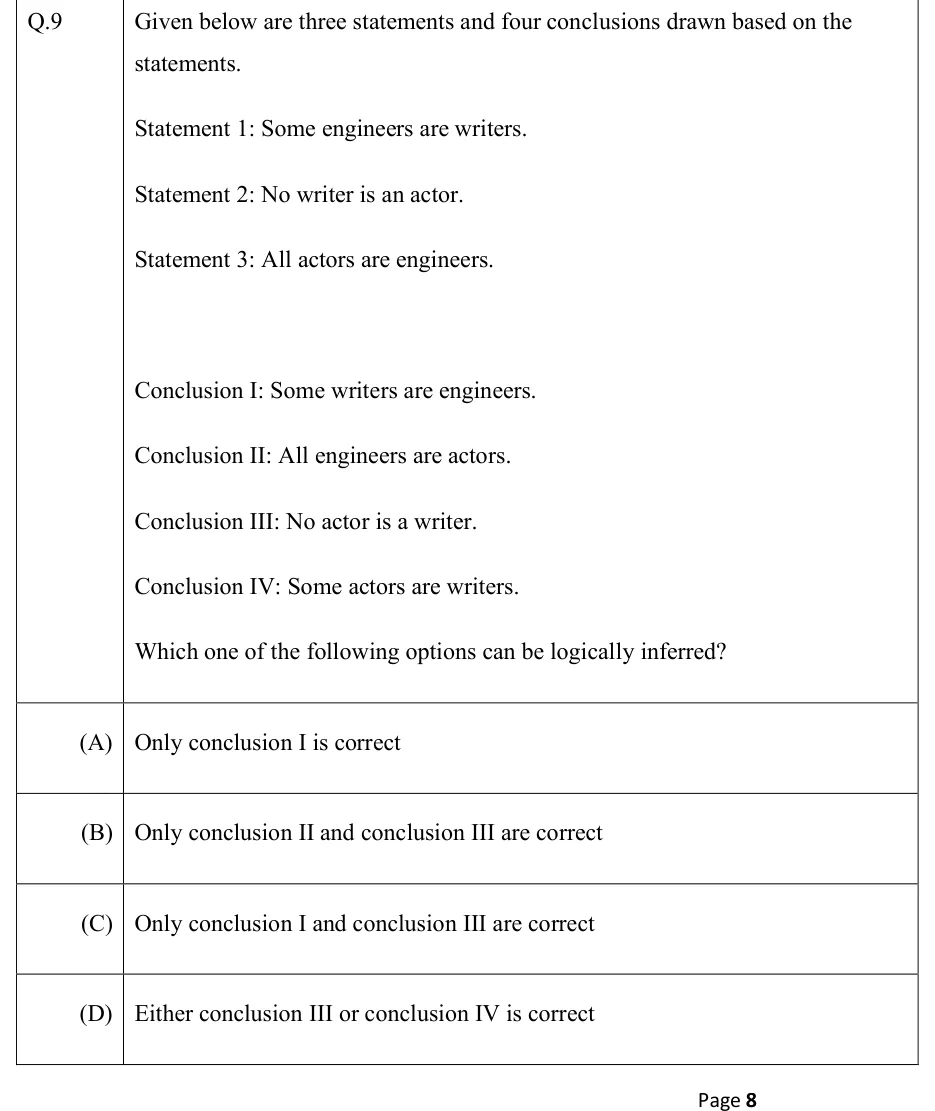
Given below are three statements and four conclusions drawn based on the statements.

Statement 1: Some engineers are writers.

Statement 2: No writer is an actor.

Statement 3: All actors are engineers.

Conclusion I: Some writers are engineers.

Conclusion II: All engineers are actors.

Conclusion III: No actor is a writer.

Conclusion IV: Some actors are writers.

Which one of the following options can be logically inferred?

  1. (A)

    Only conclusion I is correct

  2. (B)

    Only conclusion II and conclusion III are correct

  3. (C)

    Only conclusion I and conclusion III are correct

  4. (D)

    Either conclusion III or conclusion IV is correct

Answer and solution
See the question in the paper
GATE 2022 IN GA Q.9: answer and solution

GATE 2018 EE GA Q.10

GATE 2018 · EEGA Q.10 · 2 marks · MCQ

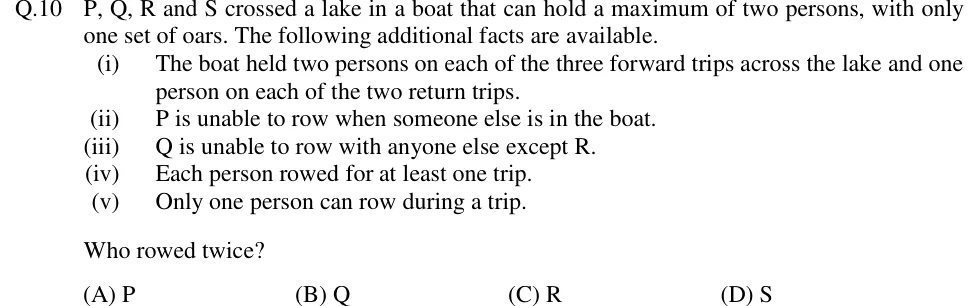
P, Q, R and S crossed a lake in a boat that can hold a maximum of two persons, with only one set of oars. The following additional facts are available.

(i) The boat held two persons on each of the three forward trips across the lake and one person on each of the two return trips.

(ii) P is unable to row when someone else is in the boat.

(iii) Q is unable to row with anyone else except R.

(iv) Each person rowed for at least one trip.

(v) Only one person can row during a trip.

Who rowed twice?

  1. (A)

    P

  2. (B)

    Q

  3. (C)

    R

  4. (D)

    S

Answer and solution
See the question in the paper
GATE 2018 EE GA Q.10: answer and solution

PRACTICE

6 questions to test yourself

PRACTICE 11 mark · MCQ

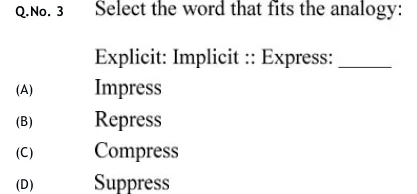
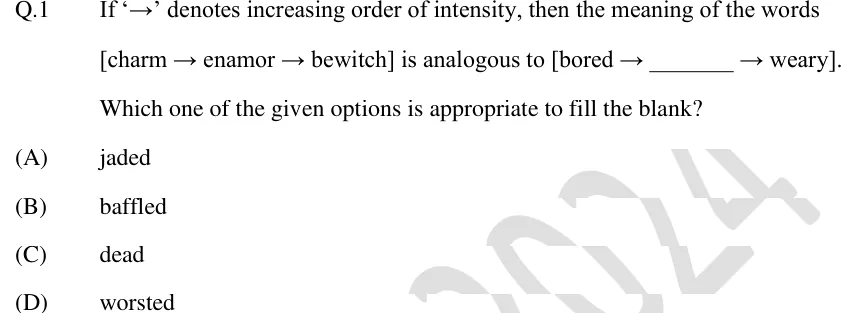
Select the option in which the two words are related in the same way as the words in the pair Drizzle : Downpour.

  1. (A)

    Rain : Flood

  2. (B)

    Breeze : Gale

  3. (C)

    Cloud : Sky

  4. (D)

    Thunder : Lightning

Answer and solution

Answer: (B)

  1. Bridge sentence: a drizzle is light rain and a downpour is heavy rain, so the pair is the same phenomenon at low and at high intensity (degree).

  2. A breeze is a light wind and a gale is a strong wind: the same phenomenon at low and at high intensity.

  3. Rain : Flood is cause and effect; Cloud : Sky is an object and where it is seen; Thunder : Lightning is an effect and its cause. Only (B) matches.

PRACTICE 22 marks · MSQ

Statements: No sensor is cheap. Some gadgets are sensors. All gadgets are devices.

Assuming the statements to be true, which of the following conclusions logically follow?

  1. (A)

    Some devices are not cheap.

  2. (B)

    Some gadgets are not cheap.

  3. (C)

    No gadget is cheap.

  4. (D)

    Some devices are sensors.

Answer and solution

Answer: (A), (B), (D)

  1. Some gadgets are sensors, so there is at least one gadget x that is a sensor.

  2. x is a sensor, so x is not cheap; x is a gadget, so (B) 'Some gadgets are not cheap' follows.

  3. x is a gadget, so x is a device. Hence (A) 'Some devices are not cheap' and (D) 'Some devices are sensors' both follow.

  4. (C) does not follow: a gadget that is not a sensor may be cheap, and the statements say nothing about such gadgets.

PRACTICE 31 mark · NAT

The smaller angle, in degrees, between the hour hand and the minute hand of a correctly working analog clock at 2:50 is ______.

Answer and solution

Answer:

  1. .

  2. is more than , so the smaller angle is .

PRACTICE 42 marks · MCQ

Each of X, Y and Z is either a truth-teller, who always tells the truth, or a liar, who always lies.
X says: 'Exactly one of us three is a truth-teller.'
Y says: 'X is a liar.'
Z says: 'Y and I are of different types.'

Which of the following is correct?

  1. (A)

    Only X is a truth-teller.

  2. (B)

    Only Y is a truth-teller.

  3. (C)

    X and Z are truth-tellers, and Y is a liar.

  4. (D)

    All three are liars.

Answer and solution

Answer: (A)

  1. Y's statement makes X and Y opposite types: if Y tells the truth, X is a liar, and if Y lies, X is a truth-teller.

  2. Suppose Z is a truth-teller. Then Y and Z differ, so Y is a liar and X is a truth-teller. But then X and Z are both truth-tellers, so X's statement 'exactly one' is false, which a truth-teller cannot say. So Z is a liar.

  3. Z lies, so Y and Z are of the same type: Y is a liar, and therefore X is a truth-teller.

  4. Check: there is exactly one truth-teller (X), so X's statement is true; Y's 'X is a liar' is false; Z's 'Y and I are of different types' is false. This is the only consistent assignment.

PRACTICE 52 marks · NAT

Given that 26 January 2027 is a Tuesday, the number of Sundays in the calendar year 2028 is ______.

Answer and solution

Answer:

  1. 2027 is not a leap year, and 29 February 2028 comes after 26 January 2028, so from 26 January 2027 to 26 January 2028 the weekday moves forward by 1: 26 January 2028 is a Wednesday.

  2. 1 January 2028 is 25 days earlier, and , so count back 4 days from Wednesday: 1 January 2028 is a Saturday.

  3. 2028 is a leap year with days. Every weekday occurs 52 times, and the two extra days are the first two days of the year, Saturday and Sunday, which occur 53 times.

  4. So 2028 has 53 Sundays.

PRACTICE 62 marks · NAT

In a group of 100 students, 45 play cricket, 40 play football and 35 play hockey. 15 play both cricket and football, 12 play both football and hockey, 10 play both cricket and hockey, and 5 play all three games. Each of the counts for two games includes the students who play all three. The number of students who play exactly one of the three games is ______.

Answer and solution

Answer:

  1. , and .

  2. Exactly one .

  3. Check by regions: cricket only , football only , hockey only , and .

  4. The data are consistent: at least one game , which does not exceed 100, so 12 students play none of the three.

OFFICIAL GATE 2027 SYLLABUS WORDING

Copied from the GATE 2027 syllabus; see all 2027 syllabi.

EVERY GATE PAPER

Logic: deduction and induction, Analogy, Numerical relations and reasoning

Preparing in Kolkata? See IAE Academy’s GATE courses.