
IAE Academy

GATE 2022 IN GA Q.9: solution and answer

GATE 2022 · INGA Q.9 · 2 marks · MCQ

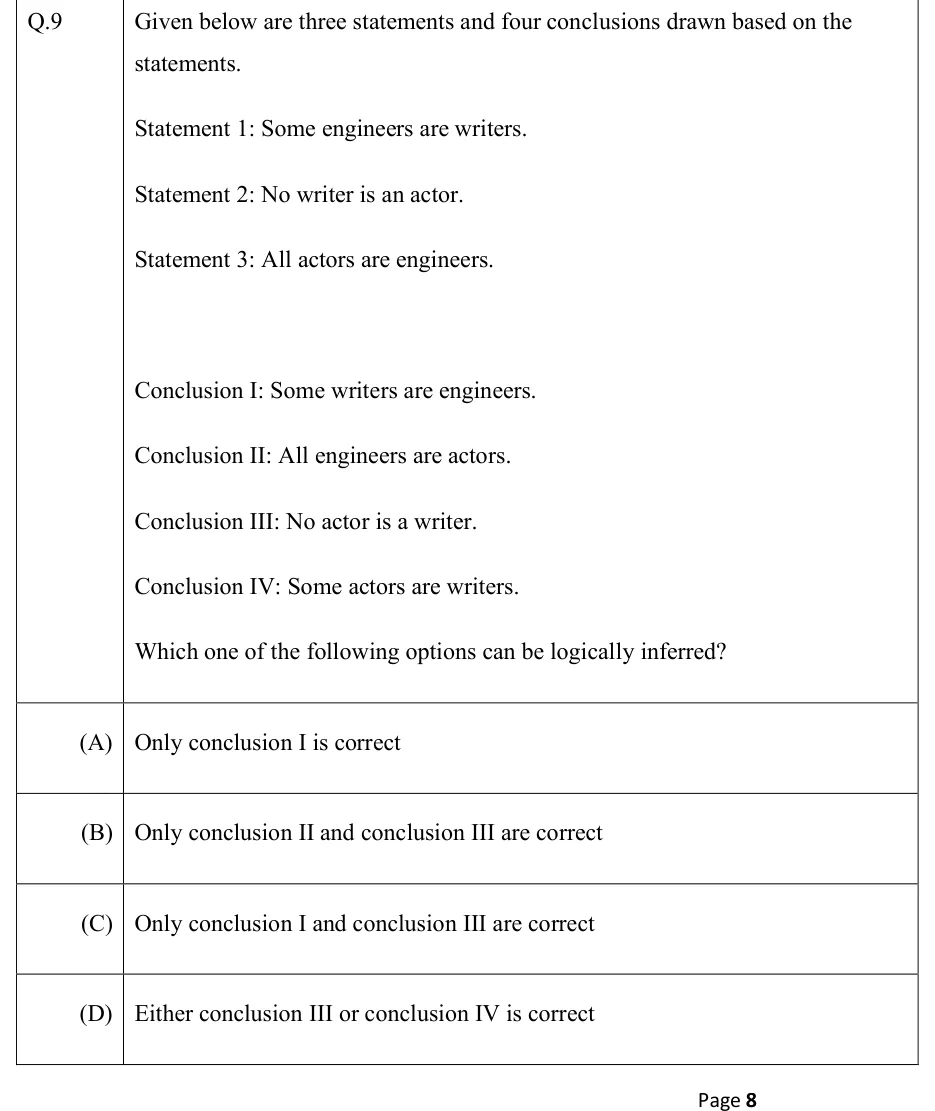
Given below are three statements and four conclusions drawn based on the statements.

Statement 1: Some engineers are writers.

Statement 2: No writer is an actor.

Statement 3: All actors are engineers.

Conclusion I: Some writers are engineers.

Conclusion II: All engineers are actors.

Conclusion III: No actor is a writer.

Conclusion IV: Some actors are writers.

Which one of the following options can be logically inferred?

  1. (A)

    Only conclusion I is correct

  2. (B)

    Only conclusion II and conclusion III are correct

  3. (C)

    Only conclusion I and conclusion III are correct

  4. (D)

    Either conclusion III or conclusion IV is correct
See the question in the paper

Answer and solution

ANSWER

Only Conclusion I and Conclusion III follow, so the answer is (C).

Official answer: CSource: Official answer key, GATE 2022 IN (IIT Kharagpur)

  1. Write the statements in standard form, with E = engineers, W = writers, A = actors. Statement 1, "Some E are W", is an I-type (particular affirmative). Statement 2, "No W is A", is an E-type (universal negative). Statement 3, "All A are E", is an A-type (universal affirmative).

  2. Conclusion I: an I-type statement converts to another I-type ("Some E are W" "Some W are E"), because an overlap between two groups is an overlap from either side. So Conclusion I follows from Statement 1.

  3. Conclusion II: an A-type statement does not convert to another A-type. "All actors are engineers" puts the actors inside the engineers and says nothing about every engineer. In fact II is definitely false: by Statement 1 some engineers are writers, and by Statement 2 no writer is an actor, so those engineers are not actors. So Conclusion II does not follow.

  4. Conclusion III: an E-type statement converts to another E-type ("No W is A" "No A is W"), because two groups with nothing in common have nothing in common from either side. So Conclusion III follows from Statement 2.

  5. Conclusion IV: "Some actors are writers" is the contradictory of Conclusion III (an I-type against the E-type with the same terms). III is definitely true, so IV is definitely false.

  6. The "either III or IV" option is used only when two conclusions form a complementary pair and neither one follows on its own. Here III follows outright, so option (D) does not describe the result. Option (A) is also wrong, because it leaves out III.

  7. Only Conclusions I and III follow, which is option (C).

KEY IDEA

Use the conversion rules. An I-type (\"Some X are Y\") and an E-type (\"No X is Y\") can both be reversed, so I comes from Statement 1 and III from Statement 2. An A-type (\"All X are Y\") cannot be reversed, so II fails. II is actually false: the engineers who are writers cannot be actors. IV contradicts III, which is true, so IV is false.

WATCH OUT FOR

Choosing (D) because III and IV look like a complementary pair. The \"either-or\" answer applies only when neither conclusion of the pair follows by itself. Here III follows directly from Statement 2, so you name it on its own, not as half of an either-or. A second trap is reversing \"All actors are engineers\" into \"All engineers are actors\" (Conclusion II). An A-type statement never converts to another A-type.

From the GATE 2022 IN paper. Every question of this paper · Download the full paper · All 41 Reasoning questions, with notes

More Reasoning questions