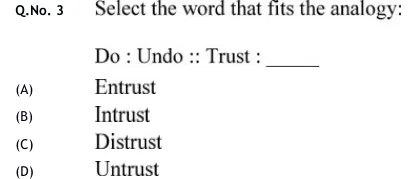
Select the word that fits the analogy:
Do : Undo :: Trust : ______
- (A)
Entrust
- (B)
Intrust
- (C)
Distrust
- (D)
Untrust

Select the word that fits the analogy:
Do : Undo :: Trust : ______
Entrust
Intrust
Distrust
Untrust
ANSWER
(C) Distrust. \"Undo\" is \"do\" with its standard negating prefix, and \"distrust\" is \"trust\" with its standard negating prefix.
Official answer: CSource: Official answer key, GATE 2020 EE (IIT Delhi)
Find the relation in the first pair. "Undo" is the verb "Do" with the negating prefix un- added, and it means to reverse or cancel what was done. So the relation is: a word and its opposite, formed by adding the negating prefix that English normally uses with that word.
Apply the same relation to "Trust". We need the accepted English word that means the opposite of trust and is formed from "trust" with a negating prefix.
(A) "Entrust" means to give something or someone into another person's care. The prefix en- here means "put into"; it does not negate the word. Rejected.
(B) "Intrust" is an old, rarely used spelling of "entrust", with the same meaning. Rejected.
(D) "Untrust" is not used in standard modern English. The negating prefix that goes with "trust" is dis-, not un-. Rejected.
(C) "Distrust" means to lack trust in someone or something. It is the accepted opposite of "trust": dis- negates "trust" the same way un- negates "do".
So Do : Undo :: Trust : Distrust. The answer is (C).
KEY IDEA
In a word-formation analogy, first name exactly how the second word is made from the first. Here a negating prefix turns a word into its opposite (do → undo). Then use the prefix English actually uses with the new word. For \"trust\" that prefix is dis-, which gives \"distrust\".
WATCH OUT FOR
Copying the prefix instead of the relation. Students see un- in \"Undo\" and pick \"Untrust\", but English negates \"trust\" with dis-. Another trap is taking \"Entrust\" or \"Intrust\" because they look like prefixed forms of \"trust\". Neither one negates it: both mean to hand something over to someone's care.
From the GATE 2020 EE paper. Every question of this paper · Download the full paper · All 41 Reasoning questions, with notes