IAE Academy

GATE 2018 EE GA Q.10: solution and answer

GATE 2018 · EEGA Q.10 · 2 marks · MCQ

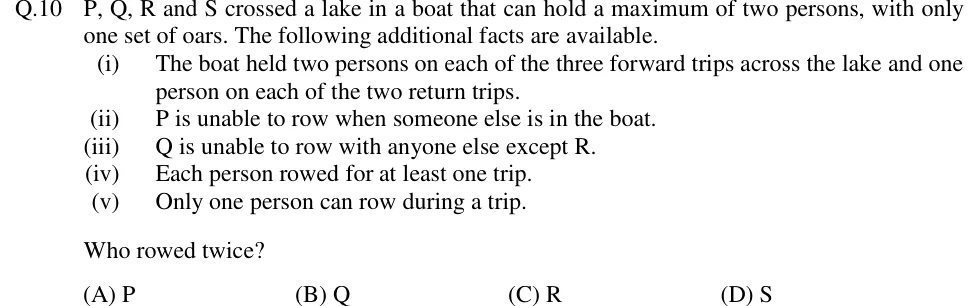
P, Q, R and S crossed a lake in a boat that can hold a maximum of two persons, with only one set of oars. The following additional facts are available.

(i) The boat held two persons on each of the three forward trips across the lake and one person on each of the two return trips.

(ii) P is unable to row when someone else is in the boat.

(iii) Q is unable to row with anyone else except R.

(iv) Each person rowed for at least one trip.

(v) Only one person can row during a trip.

Who rowed twice?

  1. (A)

    P

  2. (B)

    Q

  3. (C)

    R

  4. (D)

    S

See the question in the paper

Answer and solution

ANSWER

R rowed twice. Option (C).

Official answer: CSource: Official answer key, GATE 2018 EE (IIT Guwahati)

  1. Count the rowing turns. There are 3 forward trips with 2 people each and 2 return trips with 1 person each, so 5 trips in all. Exactly one person rows each trip (v), and each of the 4 people rows at least once (iv). So exactly one person rows twice.

  2. What P can row. By (ii), P rows only when alone in the boat. Forward trips always carry two people, so P can row only a return trip. Everyone starts on the near side and ends on the far side, so each person crosses forward exactly once more than they cross back.

  3. P rows exactly one return. Suppose P rowed both returns. Then P crosses forward 3 times, so P is on every forward trip. Q cannot row a return because both are taken, so Q must row a forward trip, and by (iii) R must be the other person on it. But every forward trip already holds P and one other person, so there is no room for both Q and R. Contradiction. So P rows exactly one return and crosses forward twice. The other return is made, and rowed, by someone else.

  4. Q never makes a return trip. Suppose Q made the other return. Then Q also crosses forward twice, so the six forward seats are . A trip has nobody who can row it: P cannot row with a passenger (ii), and Q rows only with R (iii). So P's two trips must be and , which leaves for the third trip. That is impossible. So Q never goes back and crosses exactly once, forward. Q must row at least once (iv), so Q rows that one trip, and by (iii) it is the trip with Q rowing.

  5. Who makes the second return? It is R or S, and that person crosses forward twice. The other of R and S never goes back, so they cross forward only once. Suppose S made the second return. Then R crosses forward only once, and that crossing is the trip , which Q rows. R makes no return either, because P and S have them. So R rows no trip at all, which breaks (iv). Therefore R makes and rows the second return, and R crosses forward twice.

  6. P's two crossings. The six forward seats are . The trip uses one Q seat and one R seat, which leaves , so P's two crossings are and . P cannot row either one (ii), so R rows and S rows .

  7. Tally and check. P rows 1 trip (a return), Q rows 1 (), S rows 1 () and R rows 2 ( and a return). That makes trips. One order that works: Q rows Q and R across; R rows back; S rows S and P across; P rows back; R rows R and P across. Every condition (i) to (v) holds. So R rowed twice, which is option (C).

KEY IDEA

There are 5 trips and 4 rowers, and each person rows at least once, so exactly one person rows twice. Each person crosses forward exactly once more than they come back. P can row only when alone, which means only on a return. So P rows one return and crosses forward twice. Q can then only row a forward trip with R. Counting the six forward seats (who fills them) leaves R as the only person who can take the second return, and R also has to row P across once.

WATCH OUT FOR

Two errors are common. The first is to assume that P, who can row only alone, rows both returns. That puts P on every forward trip and leaves no trip where Q can row with R. The second is to build one schedule where S rows twice without checking condition (iv): if S makes the second return, R's only crossing is the trip Q rows, so R never rows. A full case check also has to rule out R rowing both of P's crossings. That would need R on three forward trips, which the seat count does not allow.

From the GATE 2018 EE paper. Every question of this paper · Download the full paper · All 41 Reasoning questions, with notes

More Reasoning questions