IAE Academy

EVERY GATE PAPER

Spatial aptitude

Spatial aptitude tests whether you can predict how a figure looks after it is moved, turned, mirrored, resized, folded, cut, assembled or viewed from another side, in two and three dimensions. A small set of exact rules settles every such question: coordinate rules for rotation and reflection, reflection in each fold line when a sheet is unfolded, opposite-face rules for cube nets and dice, and counting formulas for grids. Working through them step by step is more reliable than guessing from the picture.

23 previous-year questions · 22 solved · 5 practice questions

Translation, rotation, reflection and scaling

A spatial question gives a figure and asks what it looks like after one or more operations. Four operations make up the transformation of shapes. Translation slides every point the same distance in the same direction, so nothing turns. Rotation turns the figure about a fixed centre through a stated angle. The direction matters: clockwise is the way a clock's hands move, and anticlockwise is the opposite way. Reflection (mirroring) flips the figure across a mirror line, and each point lands the same distance away on the other side. Scaling enlarges or shrinks the figure about a centre by a factor . The shape and every angle stay the same, and every length is multiplied by .

Translation, rotation and reflection keep lengths, angles and area unchanged. Translation and rotation also keep handedness: a letter F stays a readable F however it is turned. A reflection reverses handedness, and no rotation can undo that. This settles whether an option is a rotation of the given figure or its mirror image. The one exception is a figure that has a line of symmetry: its mirror image is then also a rotation of it, and the two cannot be told apart.

Conventions used below. Coordinates have to the right and upward. Angles are in degrees, and a positive angle means anticlockwise. A vertical mirror is a mirror line running up and down (the line ), and it swaps left and right. A horizontal mirror runs left to right (the line ). It swaps top and bottom, and its result is often called the water image.

TRANSLATION BY (A, B)

Every point moves by the same amount. Size, shape and orientation are unchanged.

ROTATION ABOUT THE ORIGIN THROUGH AN ANGLE Θ ANTICLOCKWISE

θ is in degrees and positive for anticlockwise; use −θ for a clockwise turn. For a centre other than the origin, use the next formula.

ROTATION ABOUT A POINT (A, B) THROUGH AN ANGLE Θ ANTICLOCKWISE

This is the origin rule applied to each point's position relative to : shift to the origin, rotate, then shift back. For a quarter turn anticlockwise it gives .

QUARTER AND HALF TURNS ABOUT THE ORIGIN

These are exact special cases of the rotation rule. For any other centre, apply them to each point's position relative to that centre.

CLOCKWISE AND ANTICLOCKWISE

So clockwise is anticlockwise. Reduce any angle modulo first: clockwise is clockwise.

REFLECTION IN A MIRROR LINE THROUGH THE ORIGIN

A vertical mirror (the y-axis) swaps left and right. A horizontal mirror (the x-axis) swaps top and bottom. Reflecting twice in the same line gives back the original figure.

REFLECTION IN A LINE NOT THROUGH THE ORIGIN

The mirror line is the perpendicular bisector of the segment joining each point to its image. Points on the mirror line stay where they are.

SCALING BY A FACTOR K

enlarges and shrinks. Angles are unchanged. The same factors apply to similar solids: surface area , volume .

SCALING ABOUT A CENTRE (A, B) BY A FACTOR K

Each point moves along the line from the centre through it, to times its original distance from the centre. The centre itself does not move. With the origin as centre this is .

TWO REFLECTIONS MAKE A ROTATION

Reflect in line first, then in line . Let the lines meet at a point O, and let be the angle through which must turn about O to lie along . The result is a rotation about O through , in that same direction. Two parallel lines a distance apart give a translation through , at right angles to the lines and in the direction from towards . A vertical mirror followed by a horizontal one (or the other way round) gives a turn about the point where they cross.

CLOCK SEEN IN A VERTICAL MIRROR

The mirror stands beside the clock, so it reflects in the line through 12 and 6. Subtract the actual time from 11:60 (that is, from 12:00): 4:25 gives 7:35, and 9:10 gives 2:50. For a time from 12:00 to 12:59, subtract from 23:60 instead (12:10 gives 11:50). Read a result of 0:mm as 12:mm (11:25 gives 0:35, that is 12:35). The rule is exact for both hands.

To follow a figure through several moves, follow the directions its features point in. The table shows where each direction goes under each operation.

Where a direction goes

Before

clockwise

anticlockwise

Vertical mirror

Horizontal mirror

Up

Right

Left

Down

Up

Down

Right

Down

Up

Left

Left

Right

Down

Left

Right

Up

Down

Up

Left

Up

Down

Right

Right

Left

WORKED EXAMPLE · ROTATION FOLLOWED BY REFLECTION

A point belongs to a figure. The figure is rotated anticlockwise about the origin, and the result is then reflected in the -axis. Find the final position of and the single transformation that has the same effect on every point.

Solution
  1. Rotation anticlockwise: , so .

  2. Reflection in the -axis: , so .

  3. For a general point: .

  4. The rule is reflection in the line . This is consistent with counting reflections: one rotation and one reflection make one reflection overall, so handedness is reversed.

Answer: ends at . The combined effect is a reflection in the line .

EXAM TIP

Count the reflections. With an even number (including zero), handedness is unchanged and the net effect is a rotation or a translation. With an odd number, handedness is reversed and the net effect is a reflection, possibly combined with a slide along the mirror line (a glide reflection). So if an option is the mirror image of a figure that has no line of symmetry, no sequence of rotations and translations can produce it.

EXAM TIP

A turn that looks clockwise from the front looks anticlockwise from behind. If a figure is drawn on a transparent sheet and the sheet is turned over, the figure you now see is its mirror image.

EXAM TIP

In simple block capitals, the letters A, H, I, M, O, T, U, V, W, X and Y look the same in a vertical mirror, and B, C, D, E, H, I, K, O and X look the same in a horizontal mirror. A word seen in a vertical mirror also has its letter order reversed. In a horizontal mirror the order stays the same and each letter turns upside down.

EXAM TIP

Do not use a subtraction rule for a clock seen in a horizontal mirror (its water image): the two reflected hands usually do not show a time a real clock could show. The minute hand at minutes appears at minutes (add 60 if this is negative), and the hour hand must be reflected separately in the line through 3 and 9. Read each hand on its own.

EXAM TIP

Follow two features rather than the whole figure, for example an arrowhead and a dot. Where they point after the move fixes the answer.

Symmetry, assembling and grouping

A figure has line symmetry about a line if reflecting it in that line leaves it unchanged. It has rotational symmetry of order if it looks the same in positions during one full turn about its centre. Order means no rotational symmetry. A figure that looks the same after a turn is said to have point symmetry; its order of rotational symmetry is even.

SMALLEST ANGLE OF ROTATIONAL SYMMETRY

N is the order of rotational symmetry. A regular polygon with n sides has N = n and n lines of symmetry.

Symmetry of common figures

Figure

Lines of symmetry

Order of rotational symmetry

Equilateral triangle

3

3

Isosceles triangle (not equilateral)

1

1

Square

4

4

Rectangle (not a square)

2

2

Rhombus (not a square)

2 (the diagonals)

2

Parallelogram (not a rectangle or rhombus)

0

2

Kite (not a rhombus)

1

1

Isosceles trapezium

1

1

Regular hexagon

6

6

Circle

Infinitely many

Infinite (any angle)

Capital letters N, S, Z (block style)

0

2

Assembling questions give a set of pieces and ask which target shape they form, or which piece completes a shape. First read whether the pieces may be turned over. If they may not (for example, because they are printed on one side only), allow only translations and rotations: a piece shaped like an L or an F and its mirror image are then different pieces. If the question does not say, check whether an option needs a piece to be turned over before you accept it.

Procedure for assembling pieces

  1. Check area first. Add the areas of the pieces (count unit squares or unit triangles) and compare with the target. Unequal areas rule out an option at once.

  2. Check the longest straight edges. A straight edge of the target of length L must be made from piece edges that add up to exactly L.

  3. Check the corners. Every corner of the target must be filled by one piece corner of that angle, or by several piece corners whose angles add up to it.

  4. Place the largest or most awkward piece first, then fill the remaining gap. The shape of the gap usually forces the next piece.

  5. If the pieces are drawn on a grid, colour the grid like a chessboard and compare the colours each piece covers (see the example).

SIDE OF A SQUARE ASSEMBLED FROM PIECES

The pieces fit together with no overlap and no gap, so their areas add. For example, pieces with a total area of 20 cm² can only form a square of side cm. This is a necessary condition, not a guarantee that the pieces fit.

Grouping questions ask for the odd one out, or for the figures that belong together. They usually hide a transformation: three options are rotations of one figure and the fourth is its mirror image, or three are the same shape at different scales. The quickest check is the clockwise-order test in the tip below.

WORKED EXAMPLE · AREA PASSES, COLOURING FAILS

A T-piece is made of four unit squares: three in a straight row, with a fourth attached to the middle square of the row. Can nine T-pieces be assembled into a square, if pieces may be turned over?

Solution
  1. Area check: . The area test is passed, so it cannot settle the question.

  2. Colour the square like a chessboard. It has 18 dark and 18 light unit squares.

  3. Wherever a T-piece is placed, its middle square and the square attached to it have opposite colours, and the two end squares of the row have the same colour as the attached one. So each piece covers 3 squares of one colour and 1 of the other, and adds or to the difference (dark minus light).

  4. Suppose pieces give and give . The total difference is .

  5. The square needs a difference of 0, which would require . That is impossible because is a whole number.

Answer: No. The area is right, but the colour count rules out every arrangement. In general, a region with equal numbers of dark and light squares can only be covered by an even number of T-pieces.

EXAM TIP

Clockwise-order test for rotation versus reflection: pick three distinct features of the figure, such as a dot, a shaded corner and an arrowhead, and read them going clockwise. In a rotated copy they come in the same cyclic order. In a mirror image the order is reversed.

EXAM TIP

Counting distinct shapes made of unit squares joined full edge to full edge: two such shapes are the same if one can be moved exactly onto the other. When both rotations and reflections are allowed, there are 2 shapes made of 3 squares, 5 made of 4 squares and 12 made of 5 squares. If turning over is not allowed, the counts are 2, 7 and 18.

Paper folding, cutting and punching

Folding a sheet along a line is a reflection: the part that moves lands on its own mirror image in the fold line. So anything punched or cut through the folded packet appears again, after unfolding, at its mirror image in each fold line. The folds are undone in reverse order. Every layer of paper under the punch gets its own hole.

HOLES FROM ONE PUNCH THROUGH N COMPLETE HALF-FOLDS

Valid when every fold doubles the whole packet and the punch does not touch any fold line. A punch that touches a fold line gives fewer holes, because holes merge across the fold.

STRIP FOLDED IN HALF N TIMES, THEN CUT ONCE ACROSS

All the folds are parallel and each one folds the whole strip in half, so the packet is layers thick. One straight cut runs right across the packet without touching a fold. It cuts the strip at places, which leaves pieces. For example, 3 folds and one cut give 9 pieces.

Unfolding procedure

  1. Write down each fold: its fold line, and which part moved onto which. Coordinates, with the sheet running from (0, 0) to (s, s), make diagonal folds painless.

  2. Mark the punch or cut on the final folded shape.

  3. Undo the last fold first. Reflect every hole in that fold line and keep the original as well, because both layers were punched.

  4. Undo each earlier fold the same way, working back to the first fold. The number of holes doubles at each step, except for a hole that touches the fold line.

  5. A hole or notch touching a fold line opens into a single hole that is symmetric about that line. A semicircular notch whose diameter lies on the fold becomes a full circle. A triangular notch whose base lies on the fold becomes a kite with the fold as its axis. The kite is a rhombus if the two sides meeting at the notch's apex are equal (a square if they also meet at a right angle), and an arrowhead shape if one of the angles at the base is obtuse.

  6. Check the answer: when every fold is a complete half-fold, the final pattern is mirror-symmetric about the first fold line.

WORKED EXAMPLE · TWO FOLDS, ONE PUNCH AND ONE NOTCH

A square sheet of side 8 cm has corners at (0, 0), (8, 0), (8, 8) and (0, 8), in cm. It is folded so that its right half lies on its left half (fold line ), and then so that its top half lies on its bottom half (fold line ). The folded packet now occupies , . A small round hole is punched at (1, 1). A semicircular notch of radius 0.5 cm is also cut, with its diameter on the folded edge and its centre at (2, 4). How many holes does the unfolded sheet have, and where are they?

Solution
  1. The punch at (1, 1) does not touch either fold line and passes through all 4 layers.

  2. Undo the second fold by reflecting in , that is . The punch gives holes at (1, 1) and (1, 7). The notch lay on this fold line, so it opens into one full circle of radius 0.5 cm centred at (2, 4).

  3. Undo the first fold by reflecting in , that is . The holes at (1, 1) and (1, 7) gain partners at (7, 1) and (7, 7). The circle at (2, 4) gains a partner at (6, 4).

  4. The round hole was doubled twice (4 holes). The notch was doubled only once (2 circles) because it lay on a fold line.

Answer: 6 holes: four small holes near the corners at (1, 1), (1, 7), (7, 1) and (7, 7), and two circles of radius 0.5 cm on the horizontal centre line, centred at (2, 4) and (6, 4).

EXAM TIP

Fold a square sheet in half along one midline, then in half again along the other midline. The corner of the packet where the two fold lines meet is the centre of the original sheet. Cut off a small right-angled triangle at that corner, with its two shorter sides along the folds. Unfolding leaves one hole at the centre of the sheet: a square standing on a corner if the two cut sides are equal, and a rhombus otherwise.

EXAM TIP

Holes appear only where there was paper under the punch. If a fold covers only part of the sheet, count the layers at the exact punch point instead of using .

EXAM TIP

Take a square with corners (0, 0) and (s, s) on one diagonal. Reflection in that diagonal is . Reflection in the other diagonal, the line , is .

Cubes and dice: nets, opposite faces and painted cubes

A cube has 6 faces, 12 edges and 8 corners. Each face shares an edge with 4 others and is opposite exactly one. The usual drawing of a cube or die shows the 3 faces that meet at one corner. So the three faces seen in such a view are always mutually adjacent, and none of them is opposite another.

Rules for a net (the flat six-square pattern that folds into a cube)

  1. Squares that share an edge in the net are adjacent on the cube.

  2. In any straight row or column of the net, alternate squares are opposite. In a row of three, the 1st and 3rd are opposite. In a row of four, the 1st and 3rd are opposite and so are the 2nd and 4th. A net never has five squares in a line.

  3. Z rule: suppose four squares sit in grid cells (column, row) = (1, 1), (2, 1), (2, 2) and (3, 2), or in any rotation or mirror image of this shape. That is two side-by-side pairs, with the second pair one row up and one column across. Then the two end squares, (1, 1) and (3, 2), are opposite.

  4. A 2 × 2 block of squares can never appear in a net, because only three faces meet at a corner of a cube. There are exactly 11 different nets of a cube.

Rules for several views of one die

  1. Two views with two faces in common: if their third faces differ, those third faces are opposite. Only two faces are adjacent to both common faces, and they are opposite each other.

  2. Two views with exactly one face in common: in each view, list the three faces going clockwise round the visible corner, starting with the common face. The second faces of the two lists are opposite, and so are the third faces.

  3. Elimination: a face seen in any view together with X is not opposite X. Once four different faces have been seen with X, the remaining face is opposite X.

OPPOSITE FACES OF A STANDARD DIE

Use this only when the question says the die is standard or ordinary. For any other die, work out the opposite faces from the views.

PAINTED N × N × N CUBE CUT INTO UNIT CUBES

Valid for all six faces painted and . The four counts add up to . Cubes with at least one painted face: .

PAINTED A × B × C CUBOID CUT INTO UNIT CUBES

Here p = a − 2, q = b − 2 and r = c − 2. Valid for all six faces painted and a, b, c ≥ 2. If some faces are unpainted, count directly by layer, row and column.

PIECES FROM PLANE CUTS PARALLEL TO THE FACES

x, y and z are the numbers of cuts in the three directions, with no pieces moved between cuts. For a fixed total number of cuts, the number of pieces is greatest when x, y and z are as nearly equal as possible. To cut a cube into equal cubes without moving pieces between cuts, the minimum number of plane cuts is .

WORKED EXAMPLE · OPPOSITE FACES FROM THREE VIEWS

The faces of a cube carry the letters A to F. Three views each show the three faces that meet at one corner. View 1 shows A, B and C. View 2 shows A, C and E. View 3 shows A, B and F. Which letter is opposite each of A, B and C?

Solution
  1. Views 1 and 2 share A and C, so their third faces, B and E, are opposite.

  2. Views 1 and 3 share A and B, so their third faces, C and F, are opposite.

  3. A is seen with B, C, E and F, so none of these is opposite A. The only letter left is D, so A and D are opposite.

  4. Check: the pairs (A, D), (B, E) and (C, F) use each letter exactly once.

Answer: A is opposite D, B is opposite E, and C is opposite F.

WORKED EXAMPLE · PAINTED CUBE AND CUTS

A cube of edge 4 cm is painted on all six faces and then cut into cubes of edge 1 cm, with no pieces moved between cuts. Find (a) the minimum number of cuts, (b) the number of small cubes with exactly two painted faces, and (c) the number with at least one painted face.

Solution
  1. (a) Each direction needs cuts, so the total is .

  2. (b) . These are the cubes along each edge, excluding the corners.

  3. (c) The unpainted cubes form the inner block of cubes, so cubes have paint.

  4. Check: .

Answer: (a) 9 cuts; (b) 24; (c) 56.

EXAM TIP

The painted-cube formulas assume paint on all six faces. If the bottom face (or any other face) is left unpainted, the layer next to it can contain unpainted cubes. Count by position instead of using the formula.

EXAM TIP

A face can never be opposite a face it appears beside in any view. Use this to rule out wrong pairs quickly before applying the two-view rules.

EXAM TIP

Turning a cube: a quarter turn about a vertical axis leaves the top and bottom faces where they are and moves each side face one place round. Tipping the cube forward over its front bottom edge moves the top face to the front, the front to the bottom, the bottom to the back and the back to the top, and leaves the left and right faces where they are.

EXAM TIP

Knowing the three opposite pairs does not fix a die completely. On a standard die, 1, 2 and 3 meet at one corner, and they can run either clockwise or anticlockwise round it, so there are two mirror-image standard dice. When an answer depends on which way round the faces run, decide it from the views given.

Counting squares, rectangles, triangles and cubes

Counting by eye misses figures. Count by a rule instead: either by size (every , then every , and so on) or by choosing the lines that form each figure. For a complete grid, choosing lines gives closed formulas. For an irregular figure, list the figures size by size and write down each count before adding. An grid here means rows and columns of unit squares, drawn with horizontal and vertical lines.

SQUARES IN AN N × N GRID

All sizes counted. For example, a 3 × 3 grid has 9 + 4 + 1 = 14 squares, and an 8 × 8 chessboard has 204.

SQUARES IN AN M × N GRID (M ≥ N)

A k × k square fits in (m − k + 1)(n − k + 1) positions, for k = 1 to n. For example, a 4 × 3 grid has 12 + 6 + 2 = 20 squares, and the closed form gives .

RECTANGLES (SQUARES INCLUDED) IN AN M × N GRID

Choose 2 of the m + 1 horizontal lines and 2 of the n + 1 vertical lines. For example, a 4 × 3 grid has 10 × 6 = 60 rectangles, and an 8 × 8 chessboard has 36 × 36 = 1296.

CUBES IN AN N × N × N BLOCK

Cubes of every size are counted. A k × k × k cube fits in positions.

CUBOIDS IN AN A × B × C BLOCK

Choose 2 of the dividing planes in each of the three directions (outer faces included).

TRIANGLES: K LINES FROM A VERTEX TO THE OPPOSITE SIDE, H LINES PARALLEL TO THAT SIDE

The k lines run from the vertex to different interior points of the opposite side, and each parallel line crosses the whole triangle. Every triangle uses two of the k + 2 lines through the vertex and one of the h + 1 lines parallel to the base (the base included).

TRIANGLES IN A TRIANGULAR GRID OF SIDE N

An equilateral triangle is divided into small equilateral triangles by lines parallel to its sides. The formula counts upright and inverted triangles of all sizes: n = 2 gives 5, n = 3 gives 13 and n = 4 gives 27.

LINES AND TRIANGLES THROUGH GIVEN POINTS

There are n points, exactly p of them (p ≥ 2) on one straight line, and no other three collinear. With no three collinear, lines = and triangles = .

DIAGONALS AND CORNER TRIANGLES OF A CONVEX POLYGON WITH N CORNERS

For example, a hexagon has 9 diagonals and 20 such triangles. The second count is not the number of triangles visible when all the diagonals are drawn, because that also includes triangles with corners where diagonals cross.

Counting triangles by line directions. A triangle is formed by three drawn lines that are pairwise non-parallel and do not all pass through one point, with all three sides lying along drawn segments. Group the drawn lines by direction. Each triangle then uses three different directions, and the choices can be counted one group at a time.

WORKED EXAMPLE · SQUARE WITH DIAGONALS AND MIDLINES

A square has both diagonals drawn, and also the two lines joining the midpoints of opposite sides. How many triangles are there in the figure?

Solution
  1. Take the square from (0, 0) to (2, 2). The drawn lines fall into four directions: horizontal ; vertical ; diagonal ; diagonal . All of them run fully across the square.

  2. Both diagonals with one horizontal line: the diagonals meet at the centre (1, 1). With or they form a triangle whose base is a side of the square and whose apex is the centre. passes through the centre and forms nothing. That gives 2 triangles, and using a vertical line instead gives 2 more, making 4.

  3. One horizontal line , one vertical line and the diagonal : the vertices are , and , which form a triangle whenever . There are such choices of .

  4. The same with the diagonal gives 6 more.

  5. Two lines in the same direction are parallel, so no other choice of three lines works. Total: .

  6. Cross-check by size: 8 smallest triangles; 4 made of two smallest ones (a side of the square with the centre as apex); 4 half-squares cut off by a diagonal. .

Answer: 16 triangles.

EXAM TIP

The grid formulas apply only to complete grids, where every line runs the full width or height. If a line stops short, count the affected sizes by hand.

EXAM TIP

Read the question carefully: in the same grid, 'how many squares' and 'how many rectangles' have different answers. A 4 × 3 grid has 20 squares but 60 rectangles.

Views of solids, cube stacks and figure series

Views. The top view (plan) is what you see looking straight down. The front view (elevation) is what you see looking horizontally at the front. In these notes the side view is the view from the right-hand side; check which side a question asks for. Each view is drawn without perspective, like a shadow with the visible edges drawn in.

Views of simple solids

Solid (resting on its base)

Top view

Front view

Side view

Cube

Square

Square

Square

Cuboid, length l left to right, breadth b front to back, height h

Rectangle l × b

Rectangle l × h

Rectangle b × h

Cylinder standing on a circular face

Circle

Rectangle

Rectangle

Cone standing on its base, apex up

Circle with a dot at the centre (the apex)

Isosceles triangle

Isosceles triangle

Sphere

Circle

Circle

Circle

Hemisphere, flat face down

Circle

Semicircle

Semicircle

Square pyramid, base edges parallel to the viewing directions

Square with both diagonals

Isosceles triangle

Isosceles triangle

EULER'S FORMULA FOR A CONVEX POLYHEDRON

V vertices, E edges, F faces. For a cube, 8 − 12 + 6 = 2. A prism on an n-sided base has V = 2n, E = 3n, F = n + 2. A pyramid on an n-sided base has V = n + 1, E = 2n, F = n + 1.

Stacks of unit cubes. Describe a stack by its top-view grid, writing the number of cubes in each column in its cell. The total number of cubes is the sum of all the entries. The front view shows, for each column of the grid from left to right, the tallest stack in that column. The right side view shows, for each row, the tallest stack in that row, with the front row on the viewer's left. Unless the question says otherwise, assume no cube floats: a column of height contains cubes.

COMPLETING A STACK TO AN L × B × H CUBOID

N is the number of cubes already in the stack. The cuboid must enclose the whole stack.

WORKED EXAMPLE · READING A STACK

A stack of unit cubes stands on a square base. Its top view gives the number of cubes in each column as follows. Back row, left to right: 3, 1, 2. Middle row: 2, 0, 1. Front row: 1, 1, 1. No cube floats. Find (a) the number of cubes, (b) the heights shown in the front view and in the right side view, and (c) the number of cubes needed to turn the stack into a solid cube.

Solution
  1. (a) Add the entries: .

  2. (b) Front view, grid columns from left to right: , , . So the heights are 3, 1, 2.

  3. Right side view: seen from the right, the front row is on the viewer's left. Row maxima: front row , middle row , back row . So the heights are 1, 2, 3 from left to right.

  4. (c) .

Answer: (a) 12 cubes; (b) front view heights 3, 1, 2 and right side view heights 1, 2, 3, both read left to right; (c) 15 cubes.

Figure series and patterns. A figure series often runs several independent rules at once. One element turns by a fixed angle, another moves round the corners, a count goes up by one, a shading alternates. Split the figure into its elements and find each element's rule separately. The answer must satisfy all the rules at once.

ELEMENT MOVING ROUND N EQUALLY SPACED POSITIONS

The element starts at position and moves s positions per step, counted in the stated direction. For an angle, the turn after t steps is reduced modulo .

TOTAL MOVEMENT WHEN THE STEP GROWS BY ONE EACH TIME

Use this when an element moves 1 position, then 2, then 3, and so on. Reduce the total modulo the number of positions.

WORKED EXAMPLE · TWO RULES AT ONCE

Each figure in a series is a square with 8 marked positions: its 4 corners and the midpoints of its 4 sides. In figure 1 a dot is at the top-left corner. To reach figure 2 it moves clockwise by 1 position, then by 2 positions to reach figure 3, then by 3, and so on. An arrow at the centre points up (north) in figure 1 and turns anticlockwise from each figure to the next. Describe figure 6.

Solution
  1. From figure 1 to figure 6 there are 5 moves, so the dot travels positions clockwise.

  2. Positions repeat every 8, and . Number the positions clockwise from the top-left corner: 0 top-left, 1 top midpoint, 2 top-right, 3 right midpoint, 4 bottom-right, 5 bottom midpoint, 6 bottom-left, 7 left midpoint. The dot is at position 7, the midpoint of the left side.

  3. The arrow turns anticlockwise from north. takes it to west, to south, and to south-east.

Answer: In figure 6 the dot is at the midpoint of the left side and the arrow points south-east.

EXAM TIP

Different solids can share a view. A cylinder, a cone and a sphere all have a circular top-view outline, and a cube and a square pyramid both have a square one. Use at least two views to identify a solid, and the third as well when two still leave a choice.

EXAM TIP

A turn of per step returns to the start after 8 steps, and a turn of per step after 4. When a rule repeats every p steps, figure looks the same as figure for that element.

EXAM TIP

Pattern completion: when part of a symmetric pattern is missing, find the symmetry the visible parts share, such as a mirror line or a quarter turn about the centre. Build the missing part from the part that corresponds to it under that symmetry, then check the chosen option against every neighbouring part, not just one.

PREVIOUS-YEAR QUESTIONS

23 questions from the EC, EE and IN papers

Try each question first, then open the answer. One shows the official answer only. We placed each question under a topic ourselves; the exam paper does not label topics.

See these papers in full: GATE ECE 2026 · GATE ECE 2024 · GATE ECE 2023 · GATE ECE 2022 · GATE EE 2026 · GATE EE 2024 · GATE EE 2023 · GATE EE 2022 · GATE IN 2026 · GATE IN 2025 · GATE IN 2024 · GATE IN 2023 · GATE IN 2022

GATE 2026 EC GA Q.3

GATE 2026 · ECGA Q.3 · 1 mark · MCQ

The figure below has exactly three intersecting line segments with a rectangular portion WXYZ missing. Which one of the following options P, Q, R, and S is the missing portion WXYZ?
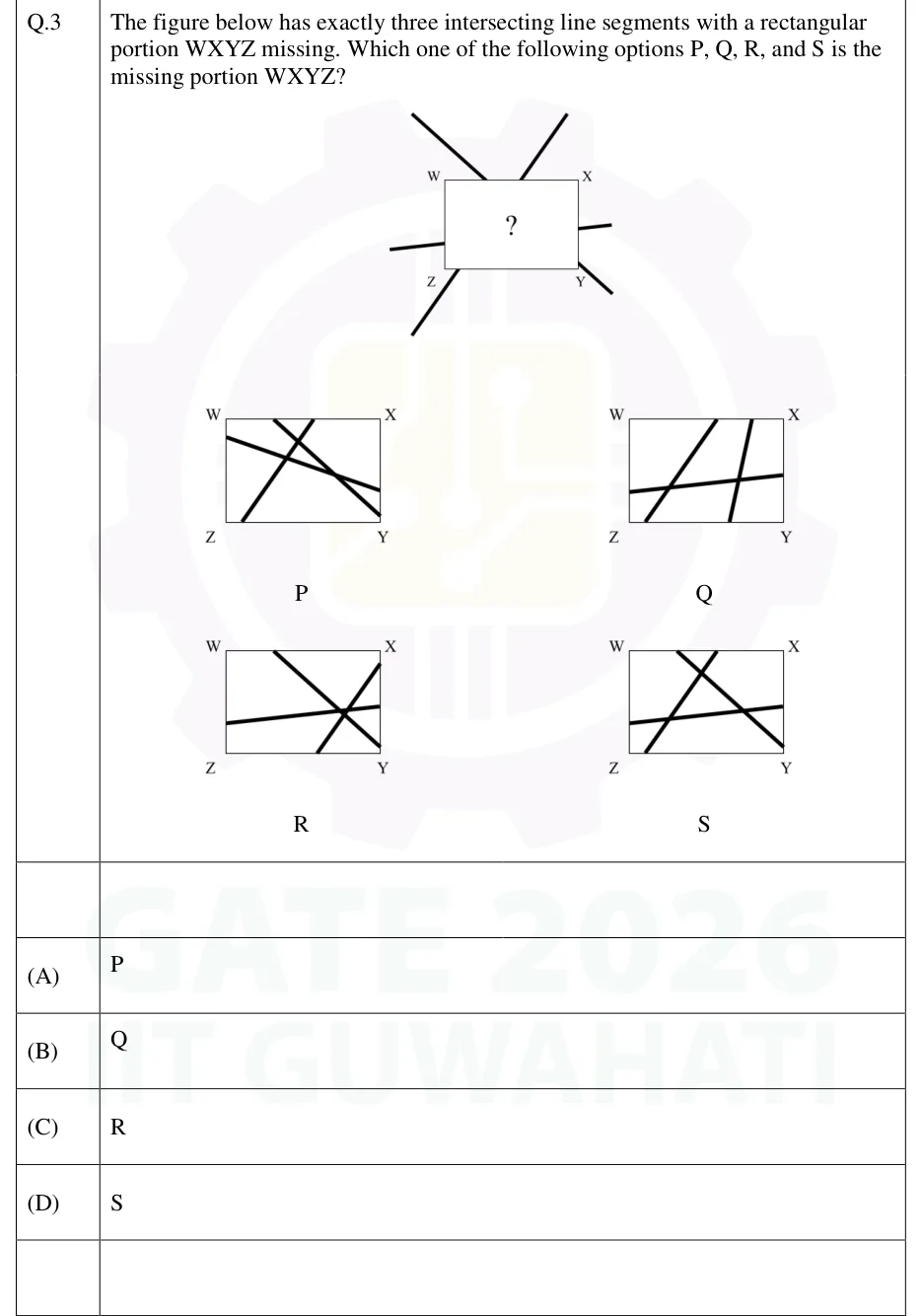
GATE 2026 EC GA question 3: MAIN FIGURE: a blank rectangle, wider than it is tall, with a "?" in its centre.Tap to open full size
Figure from the GATE 2026 EC paper. It is part of the question.
Figure description

MAIN FIGURE: a blank rectangle, wider than it is tall, with a "?" in its centre. Its corners are labelled W (top-left), X (top-right), Y (bottom-right) and Z (bottom-left). Six short thick line stubs stop at the rectangle's border. (1) Top edge, about 31% of the way from W to X: a stub comes down from the upper left, falling to the right, at roughly 40 degrees below the horizontal. (2) Top edge, about 57% of the way from W to X: a stub comes down from the upper right, rising to the right at roughly 55 degrees. (3) Left edge, about 70% of the way down from W: a nearly horizontal stub that rises slightly towards the rectangle. (4) Right edge, about 54% of the way down from X: a nearly horizontal stub that rises slightly to the right. (5) Bottom edge, about 10% of the way from Z to Y: a stub going down to the lower left, rising to the right at the same steep angle as stub 2. (6) Right edge, very close to Y (about 93% of the way down): a stub going down to the lower right, falling to the right at the same angle as stub 1. OPTIONS: four figures, each a filled-in rectangle labelled W (top-left), X (top-right), Y (bottom-right), Z (bottom-left), set out in a 2x2 grid: P top-left, Q top-right, R bottom-left, S bottom-right. P: one line falling to the right runs from the top edge at about 31% to the right edge near Y; a second line rising to the right runs from the bottom edge at about 10% to the top edge at about 57%, crossing the first just below the top edge; a third line falls to the right, from the left edge about 19% of the way down to the right edge about 69% of the way down. Q: two steep lines, both rising to the right and not crossing inside the rectangle: one from the bottom edge at about 10% to the top edge at about 57%, the other from the bottom edge at about 65% to the top edge at about 80%. A nearly horizontal line rising to the right, from the left edge about 70% of the way down to the right edge about 54% of the way down, crosses both. R: one line falling to the right runs from the top edge at about 31% to the right edge near Y; a line rising to the right runs from the bottom edge at about 60% to the right edge near X; a nearly horizontal line rising to the right runs from the left edge about 70% of the way down to the right edge about 54% of the way down. All three lines pass through one common point in the right half. S: one line falling to the right runs from the top edge at about 31% to the right edge near Y; a line rising to the right runs from the bottom edge at about 10% to the top edge at about 56%; a nearly horizontal line rising to the right runs from the left edge about 71% of the way down to the right edge about 54% of the way down. The three lines cross at three separate points, forming a small triangle.

  1. (A)

    P

  2. (B)

    Q

  3. (C)

    R

  4. (D)

    S

Answer and solution
GATE 2026 EC GA Q.3: answer and solution

GATE 2026 EC GA Q.10

GATE 2026 · ECGA Q.10 · 2 marks · MCQ

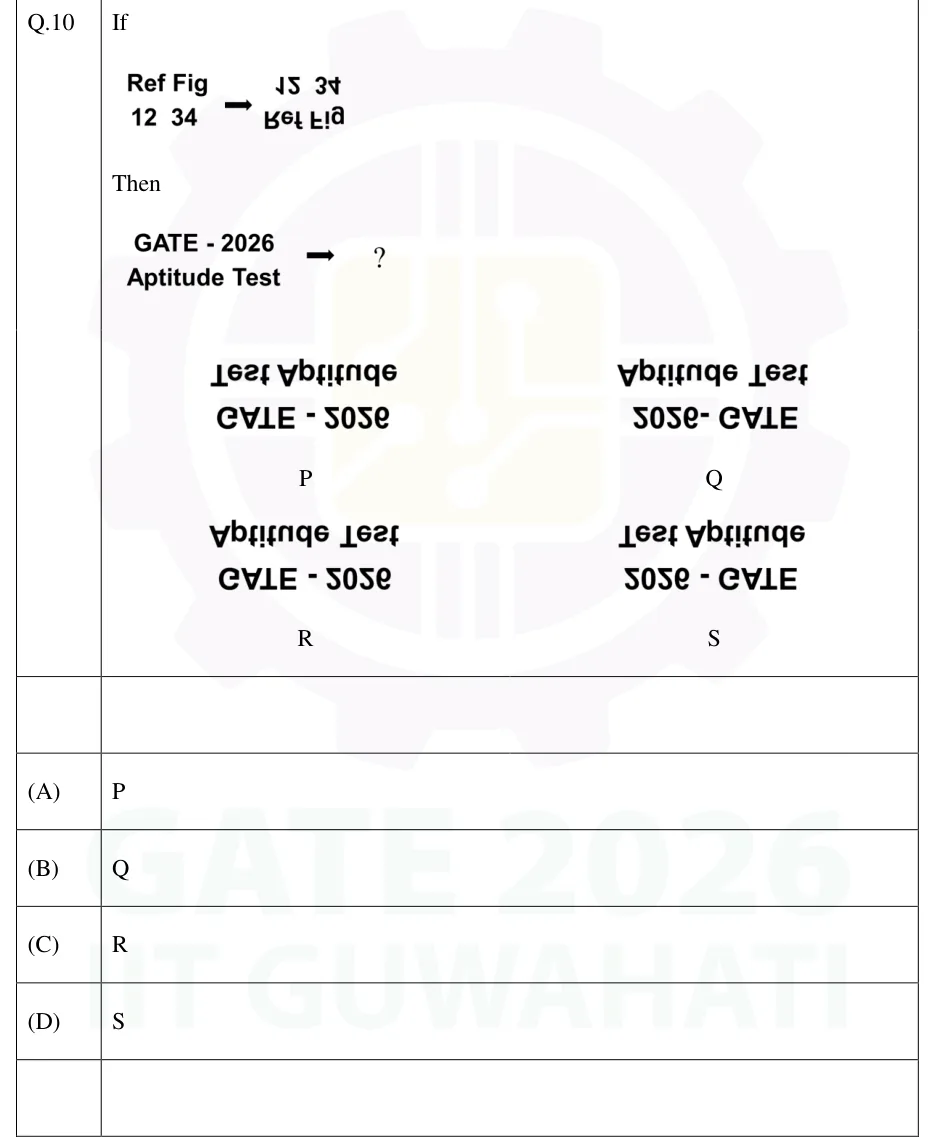
If

[Figure: two-line text "Ref Fig" over "12 34" its transformed image]

Then

[Figure: two-line text "GATE - 2026" over "Aptitude Test" ?]

[Figures P, Q, R, S: four candidate images, described below]

GATE 2026 EC GA question 10: Reference pair: on the left a two-line block of bold text, top line "Ref Fig", bottom line "12 34".Tap to open full size
Figure from the GATE 2026 EC paper. It is part of the question.
Figure description

Reference pair: on the left a two-line block of bold text, top line "Ref Fig", bottom line "12 34". A right-pointing arrow leads to a two-line block whose top line is "12 34" and bottom line is "Ref Fig". In the right block every character is turned upside down by a top-to-bottom flip (as in a water reflection): the letters and digits still read in their original left-to-right order (R-e-f F-i-g, 1-2 3-4), but each glyph is inverted vertically (f looks like t, g hangs upward, 4 has its triangle at the bottom, 3 looks unchanged). Question pair: a two-line block, top line "GATE - 2026", bottom line "Aptitude Test", then an arrow and a question mark. Four answer figures, each a two-line block drawn with the same vertically flipped glyphs: P (top left): top line "Test Aptitude", bottom line "GATE - 2026". Q (top right): top line "Aptitude Test", bottom line "2026- GATE". R (bottom left): top line "Aptitude Test", bottom line "GATE - 2026". S (bottom right): top line "Test Aptitude", bottom line "2026 - GATE".

  1. (A)

    P

  2. (B)

    Q

  3. (C)

    R

  4. (D)

    S

Answer and solution
GATE 2026 EC GA Q.10: answer and solution

GATE 2026 EE GA Q.2

GATE 2026 · EEGA Q.2 · 1 mark · MCQ

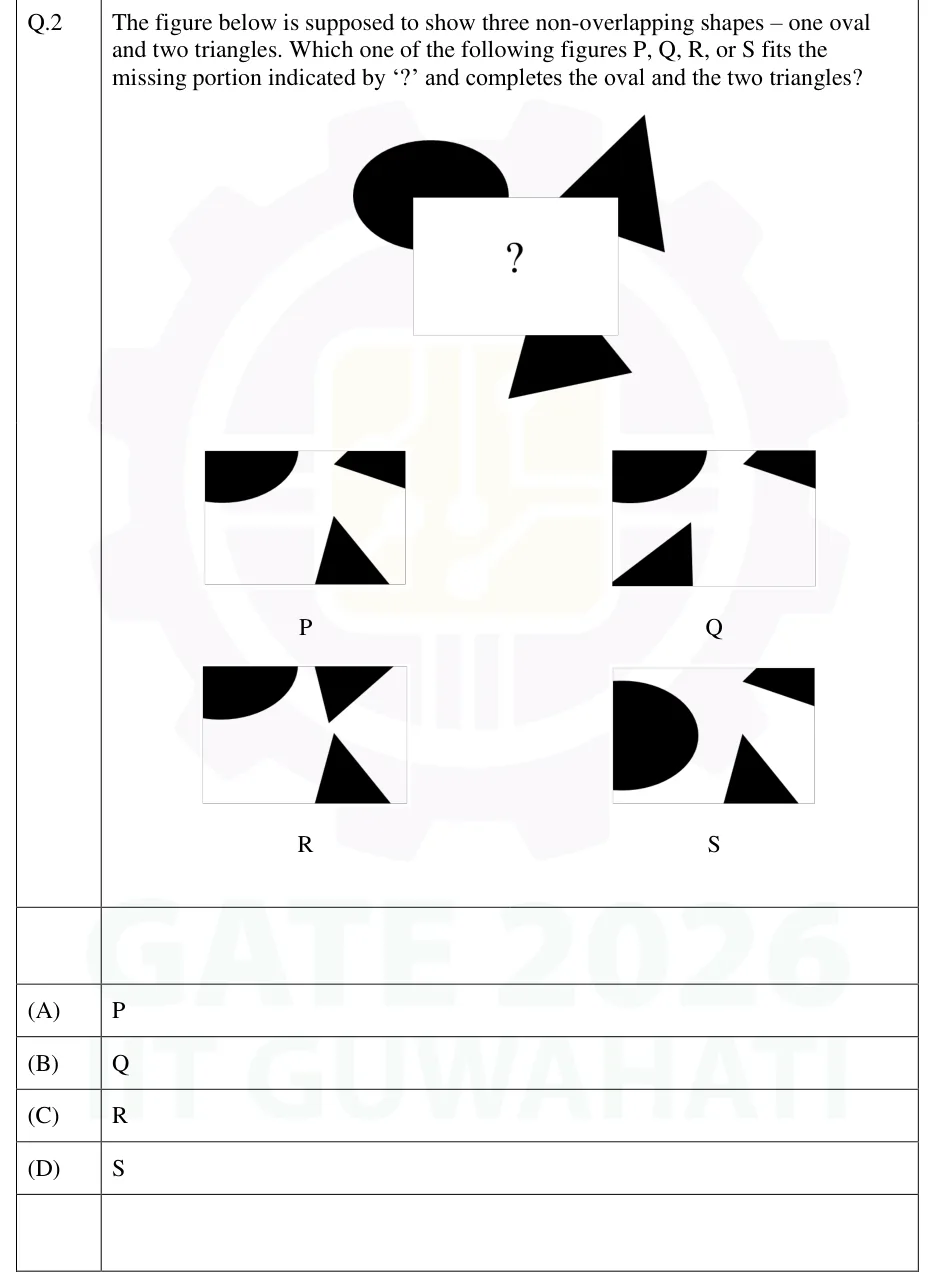
The figure below is supposed to show three non-overlapping shapes – one oval and two triangles. Which one of the following figures P, Q, R, or S fits the missing portion indicated by ‘?’ and completes the oval and the two triangles?

GATE 2026 EE GA question 2: Main figure: a white rectangular box marked '?' in the centre, about 1.5 times as wide as it is tall, hides parts of…Tap to open full size
Figure from the GATE 2026 EE paper. It is part of the question.
Figure description

Main figure: a white rectangular box marked '?' in the centre, about 1.5 times as wide as it is tall, hides parts of three solid black shapes. (1) Oval, upper left: a horizontal black ellipse. Its left part shows to the left of the box and its top pokes above the box's top edge. Its outline meets the box's top edge about 46% of the way across from the left, and the box's left edge about 37% of the way down, so the box hides the oval's lower-right part. (2) Triangle, upper right: a tall black triangle whose apex is above the box, a little higher than the top of the oval. Its long left side runs down-left and enters the box's top edge about 71% of the way across. Its right side runs almost straight down to a vertex to the right of the box, level with the bottom of the oval. From that vertex its lower side runs up-left and enters the box's right edge about 28% of the way down. So the triangle's third vertex is hidden inside the box near its top-right corner. (3) Triangle, lower middle: a black triangle below the box. Its bottom-left vertex points down-left and its right vertex points right. Its other two sides rise into the box's bottom edge, crossing it about 55% and 92% of the way across, so its upper vertex is hidden inside the box. Options P, Q, R and S are four rectangles the same shape as the box, each holding black pieces. P: a quarter-oval in the top-left corner (along the top edge to about 46% across, down the left edge to about 38%); a four-sided piece in the top-right corner (along the top edge from about 71% across to the corner, down the right edge to about 28%, with a pointed vertex at about 65% across and 10% down); a triangle standing on the bottom edge (base from about 55% to 91% across, apex at about 64% across and halfway down). Q: the same top-left quarter-oval and top-right piece as P, but its triangle sits at the bottom-left: its base runs along the bottom edge from the left corner to about 39% across, its right side is nearly vertical, and its apex is at about 38% across and 54% down. R: the same top-left quarter-oval and bottom triangle as P, but the top-right piece is an inverted triangle hanging from the top edge (from about 55% to 92% across) with its point at about 62% across and 41% down; it does not touch the right edge. S: a large half-oval (D shape) on the left edge, running from about 11% to about 90% down and bulging to about 42% across, so it does not touch the top edge; a top-right piece like P's; and a bottom triangle like P's.

  1. (A)

    P

  2. (B)

    Q

  3. (C)

    R

  4. (D)

    S

Answer and solution
GATE 2026 EE GA Q.2: answer and solution

GATE 2026 EE GA Q.5

GATE 2026 · EEGA Q.5 · 1 mark · MCQ

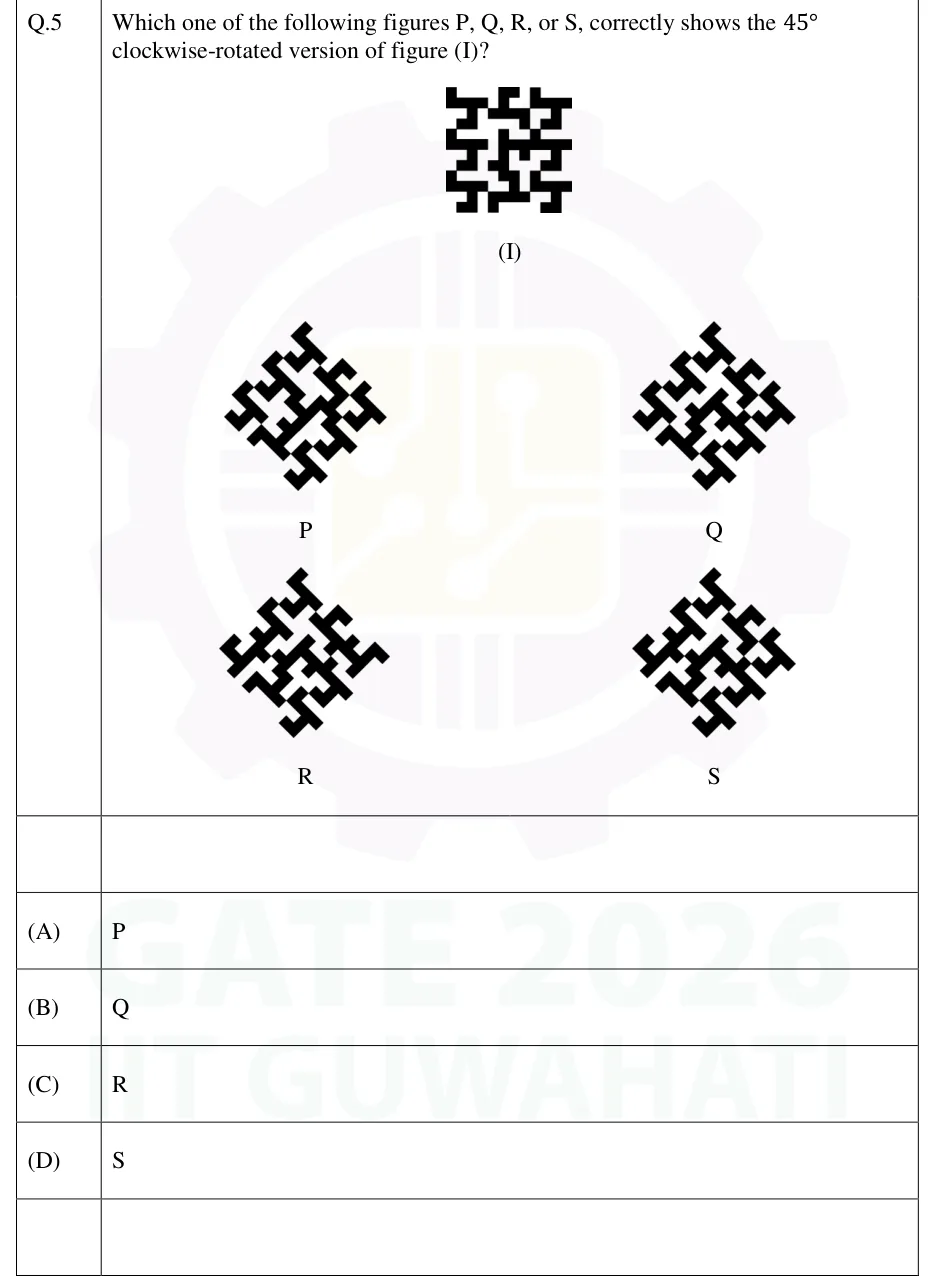
Which one of the following figures P, Q, R, or S, correctly shows the 45° clockwise-rotated version of figure (I)?

GATE 2026 EE GA question 5: Figure (I), at the top centre, is an upright square pattern of solid black unit squares on a 12 x 12 grid.Tap to open full size
Figure from the GATE 2026 EE paper. It is part of the question.
Figure description

Figure (I), at the top centre, is an upright square pattern of solid black unit squares on a 12 x 12 grid. Rows from top to bottom, columns from left to right, '#' = black and '.' = white: row 1 #....##.#...; row 2 ####.#..####; row 3..#.####..#.; row 4.##....#.##.; row 5 #....#..#...; row 6 ####.#######; row 7..#..#.#..#.; row 8.##.##...##.; row 9 #....##.#...; row 10 ####..#.####; row 11..#.####..#.; row 12.##.#....##.. It reads as a 3 x 3 array of 4 x 4 hook motifs. The basic hook is a bar of four squares with one square raised above its left end, and a stem that drops from its third square and turns left. All four corner hooks are identical and face the same way. The top-middle hook is turned through 180 degrees, the bottom-middle hook is mirrored top-to-bottom, and the central hook is turned 90 degrees anticlockwise. The central hook joins the right-middle and bottom-middle hooks into one 24-square piece. Below (I) are four diamond-shaped figures in a 2 x 2 arrangement: P top-left, Q top-right, R bottom-left, S bottom-right. Each is the same kind of pattern tilted 45 degrees so that a corner points straight up. Compared with (I) rotated 45 degrees clockwise: Q matches square for square. In P the central 4 x 4 block (rows 5-8, columns 5-8) is turned 180 degrees, reading..##/#.#./###./..#. instead of.#../.###/.#.#/##... In R the top-right and bottom-left corner hooks (now at the right and left vertices) are each turned an extra 90 degrees clockwise, each reading..##/#.#./###./..#.. In S only the bottom-left corner hook (now at the left vertex) is turned an extra 90 degrees clockwise. Options: (A) P, (B) Q, (C) R, (D) S.

  1. (A)

    P

  2. (B)

    Q

  3. (C)

    R

  4. (D)

    S

Answer and solution
GATE 2026 EE GA Q.5: answer and solution

GATE 2026 IN GA Q.7

GATE 2026 · INGA Q.7 · 2 marks · MCQ

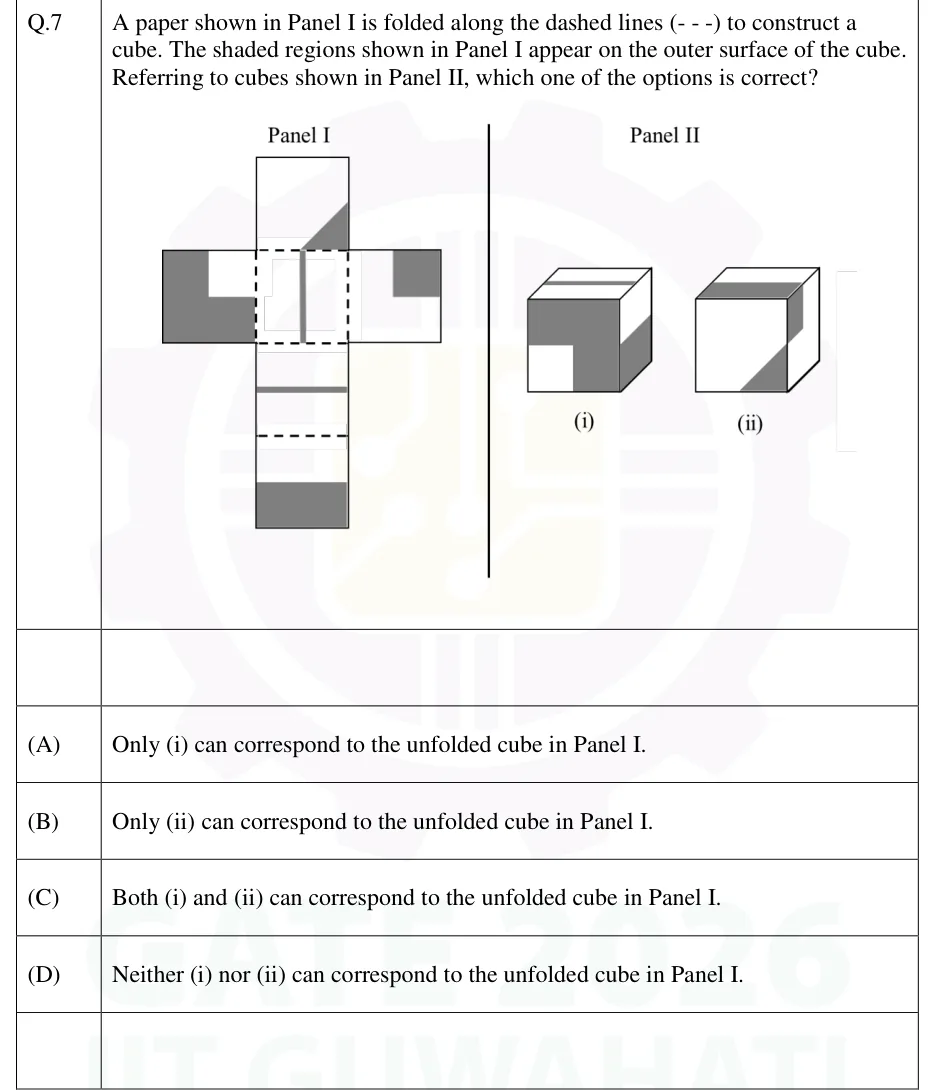
A paper shown in Panel I is folded along the dashed lines (- - -) to construct a cube. The shaded regions shown in Panel I appear on the outer surface of the cube. Referring to cubes shown in Panel II, which one of the options is correct?

GATE 2026 IN GA question 7: A vertical line separates Panel I (left) from Panel II (right).Tap to open full size
Figure from the GATE 2026 IN paper. It is part of the question.
Figure description

A vertical line separates Panel I (left) from Panel II (right). Panel I is a cross-shaped net of six equal squares: a centre square with one square above it, one to its left, one to its right, and a column of two squares below it. All four edges of the centre square are dashed, and so is the edge between the two lower squares. Every other outline is solid. Shading (grey on white): - Top square: a grey right isosceles triangle in its bottom-right corner. Its legs are half the side, lying along the bottom edge (shared with the centre square) and along the right edge. - Left square: grey everywhere except a white quarter-square in its top-right corner, the corner that touches the centre square's top-left corner. The grey region is L-shaped (three quarters of the square). - Centre square: a thin grey vertical stripe down the middle, running the full height. - Right square: a grey quarter-square in its top-right corner (the outer top corner). - Square directly below the centre: a thin grey horizontal stripe across the middle, running the full width. - Bottom square: its lower half is grey. Panel II shows two cubes in oblique view. Each shows its front, top and right faces. (i) Front face: grey with a white quarter-square in its bottom-left corner. Right face: lower half grey, and the boundary is horizontal at mid-height (parallel to the face's top edge). Top face: white with a thin grey stripe at mid-depth, parallel to the front edge. (ii) Front face: white with a grey right isosceles triangle in its bottom-right corner (legs half the side, along the bottom and right edges). Top face: the front half, next to the front edge, is grey. Right face: a grey quarter-square in its top-front corner.

  1. (A)

    Only (i) can correspond to the unfolded cube in Panel I.

  2. (B)

    Only (ii) can correspond to the unfolded cube in Panel I.

  3. (C)

    Both (i) and (ii) can correspond to the unfolded cube in Panel I.

  4. (D)

    Neither (i) nor (ii) can correspond to the unfolded cube in Panel I.

Answer and solution
GATE 2026 IN GA Q.7: answer and solution

GATE 2025 IN GA Q.4

GATE 2025 · INGA Q.4 · 1 mark · MCQ

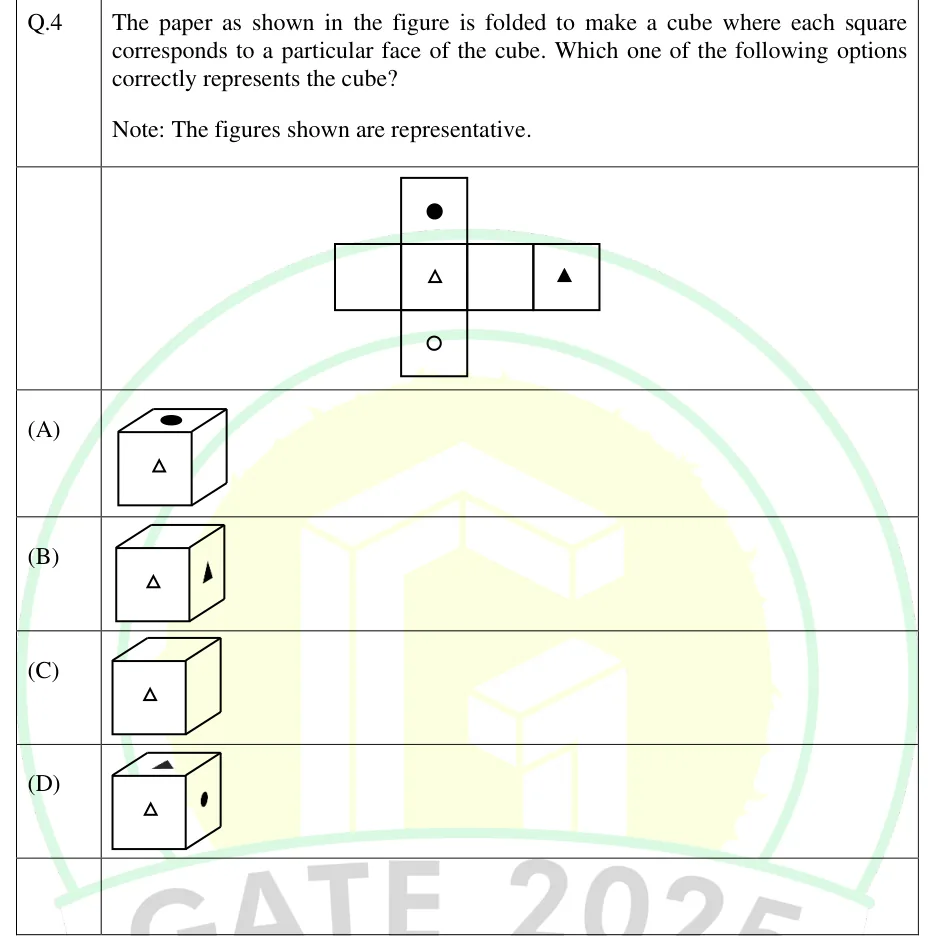
The paper as shown in the figure is folded to make a cube where each square corresponds to a particular face of the cube. Which one of the following options correctly represents the cube?

Note: The figures shown are representative.

GATE 2025 IN GA question 4: A cube net of six equal squares in a cross shape.Tap to open full size
Figure from the GATE 2025 IN paper. It is part of the question.
Figure description

A cube net of six equal squares in a cross shape. Middle row, four squares left to right: square 1 blank; square 2 an open (outline) triangle pointing up; square 3 blank; square 4 a filled black triangle pointing up. One square sits directly above square 2 with a filled black circle in it. One square sits directly below square 2 with an open (outline) circle in it. The options are drawings of cubes, each showing the front, top and right faces: (A) front an open triangle pointing up, top a filled black circle (drawn as an ellipse in perspective), right face blank; (B) front an open triangle, top blank, right face a filled black triangle; (C) front an open triangle, top and right faces both blank; (D) front an open triangle, top a filled black triangle, right face a filled black circle (drawn as an ellipse).

  1. (A)

    Figure — cube: front face an open triangle pointing up, top face a filled black circle, right face blank

  2. (B)

    Figure — cube: front face an open triangle, top face blank, right face a filled black triangle

  3. (C)

    Figure — cube: front face an open triangle, top face blank, right face blank

  4. (D)

    Figure — cube: front face an open triangle, top face a filled black triangle, right face a filled black circle

Answer and solution
GATE 2025 IN GA Q.4: answer and solution

GATE 2024 EC GA Q.9

GATE 2024 · ECGA Q.9 · 2 marks · MCQ

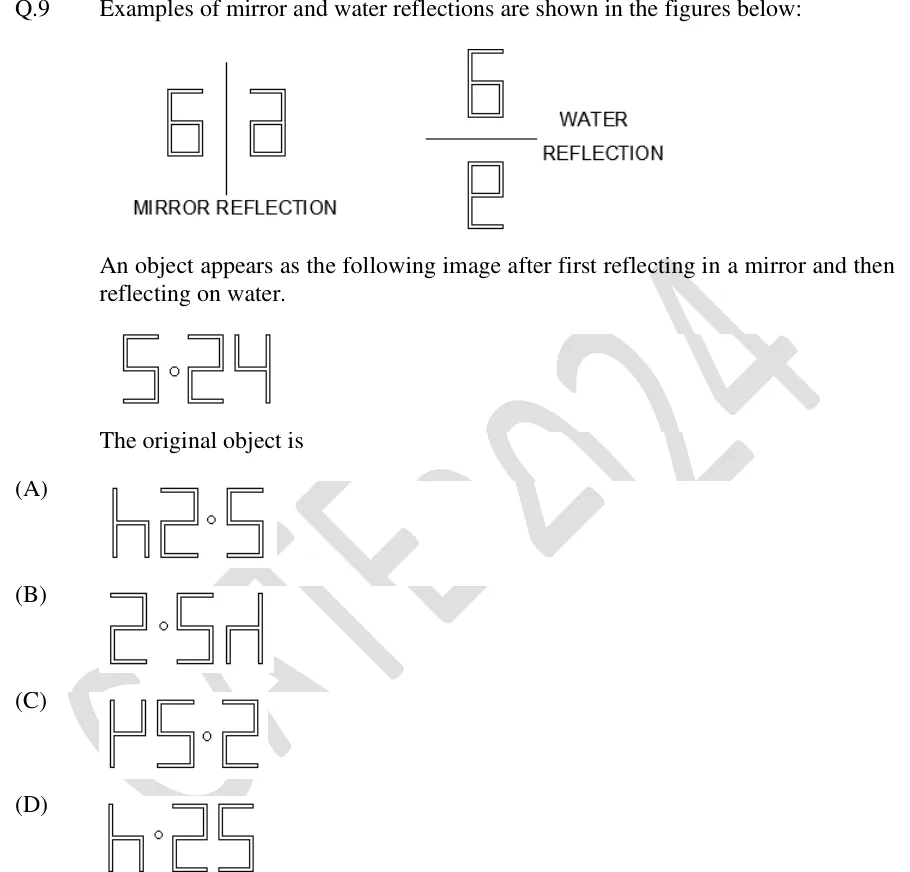
Examples of mirror and water reflections are shown in the figures below:

[Figure: MIRROR REFLECTION and WATER REFLECTION examples]

An object appears as the following image after first reflecting in a mirror and then reflecting on water.

[Figure: seven-segment characters reading 5·24]

The original object is

GATE 2024 EC GA question 9: Every character is a seven-segment-display glyph drawn with double (outlined) strokes.Tap to open full size
Figure from the GATE 2024 EC paper. It is part of the question.
Figure description

Every character is a seven-segment-display glyph drawn with double (outlined) strokes. Example 1, labelled MIRROR REFLECTION underneath: a seven-segment 6 (top, upper-left, middle, lower-left, bottom and lower-right segments lit) to the left of a vertical mirror line. To the right of the line is its left-right mirror image (top, upper-right, middle, lower-right, bottom and lower-left segments lit), which is a reversed 6. Example 2, labelled WATER REFLECTION to the right of a horizontal line: a seven-segment 6 above the line and, below it, its upside-down image (top, upper-left, upper-right, middle, lower-left and bottom segments lit). The observed image, after a mirror reflection followed by a water reflection, is four glyphs in a row. They are a seven-segment 5 (top, upper-left, middle, lower-right, bottom), a small circle (dot) very slightly below mid-height, a seven-segment 2 (top, upper-right, middle, lower-left, bottom) and a seven-segment 4 (upper-left, middle, upper-right, lower-right). The image reads 5·24. The options are figures in the same style. (A): h, 2, dot, 5, reading h2·5, with the dot slightly above mid-height. (B): 2, dot (slightly above mid-height), 5, then a glyph with a full right vertical, a middle bar and a lower-left vertical, which is a mirror-image h and also an upside-down 4. (C): a left-right mirror image of 4 (full left vertical, middle bar, upper-right vertical), then 5, dot (slightly below mid-height), 2. (D): h, dot, 2, 5, reading h·25.

  1. (A)

    Figure: seven-segment glyphs reading h2·5. They are h (full left vertical, middle bar, lower-right vertical), 2, a dot slightly above mid-height, and 5.

  2. (B)

    Figure: seven-segment glyphs reading 2·5 (dot slightly above mid-height), then a mirror-image h (full right vertical, middle bar, lower-left vertical).

  3. (C)

    Figure: seven-segment glyphs. They are a left-right mirror image of 4 (full left vertical, middle bar, upper-right vertical), 5, a dot slightly below mid-height, and 2.

  4. (D)

    Figure: seven-segment glyphs reading h·25. They are h, dot, 2, 5.

Answer and solution
GATE 2024 EC GA Q.9: answer and solution

GATE 2024 EC GA Q.10

GATE 2024 · ECGA Q.10 · 2 marks · MCQ

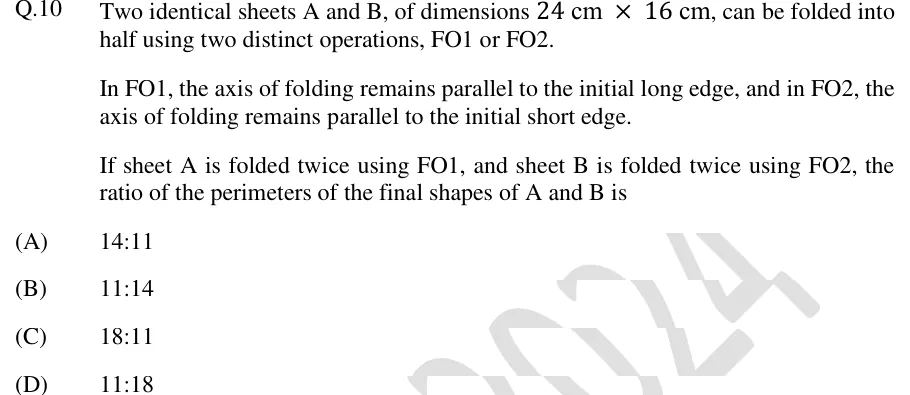
Two identical sheets A and B, of dimensions , can be folded into half using two distinct operations, FO1 or FO2.

In FO1, the axis of folding remains parallel to the initial long edge, and in FO2, the axis of folding remains parallel to the initial short edge.

If sheet A is folded twice using FO1, and sheet B is folded twice using FO2, the ratio of the perimeters of the final shapes of A and B is

  1. (A)

    14:11

  2. (B)

    11:14

  3. (C)

    18:11

  4. (D)

    11:18

Answer and solution
See the question in the paper
GATE 2024 EC GA Q.10: answer and solution

GATE 2024 EE GA Q.9

GATE 2024 · EEGA Q.9 · 2 marks · MCQ

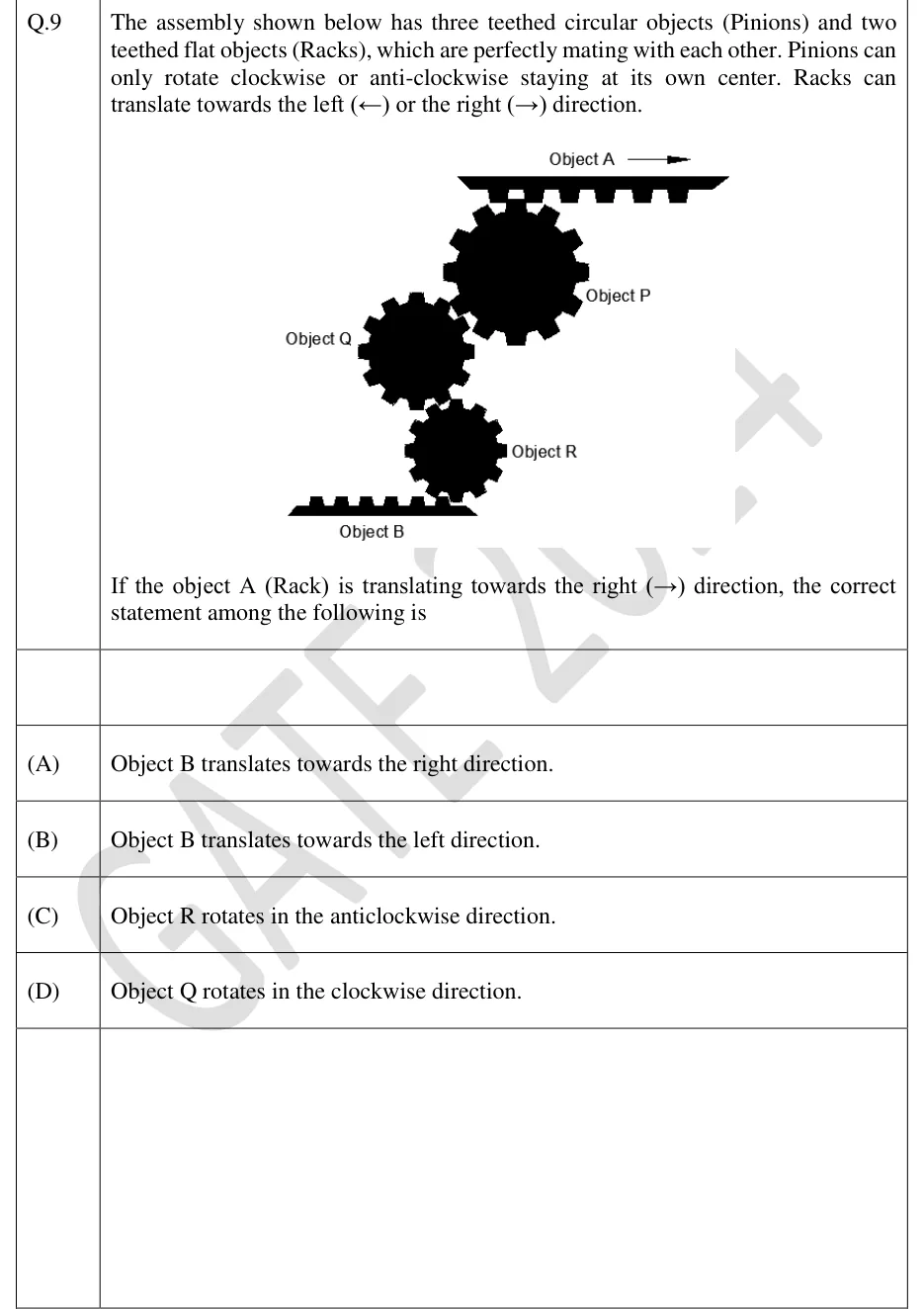
The assembly shown below has three teethed circular objects (Pinions) and two teethed flat objects (Racks), which are perfectly mating with each other. Pinions can only rotate clockwise or anti-clockwise staying at its own center. Racks can translate towards the left (←) or the right (→) direction.

[Figure]

If the object A (Rack) is translating towards the right (→) direction, the correct statement among the following is

GATE 2024 EE GA question 9: Black silhouette drawing of a gear train.Tap to open full size
Figure from the GATE 2024 EE paper. It is part of the question.
Figure description

Black silhouette drawing of a gear train. At the top is a horizontal rack labelled "Object A", with its teeth pointing downward and an arrow beside the label pointing to the right (→). Directly below Object A, meshing with its teeth, is the largest gear, "Object P" (label to its right). Down and to the left of P, meshing with P, is a medium gear, "Object Q" (label to its left). Below Q and slightly to the right, meshing with Q, is a smaller gear, "Object R" (label to its right). P and R do not touch. At the bottom is a horizontal rack labelled "Object B" (label below it), with its teeth pointing upward, meshing with R from underneath. So the order of contact is A (rack, on top of P) → P → Q → R → B (rack, under R).

  1. (A)

    Object B translates towards the right direction.

  2. (B)

    Object B translates towards the left direction.

  3. (C)

    Object R rotates in the anticlockwise direction.

  4. (D)

    Object Q rotates in the clockwise direction.

Answer and solution
GATE 2024 EE GA Q.9: answer and solution

GATE 2024 IN GA Q.9

GATE 2024 · INGA Q.9 · 2 marks · MCQ

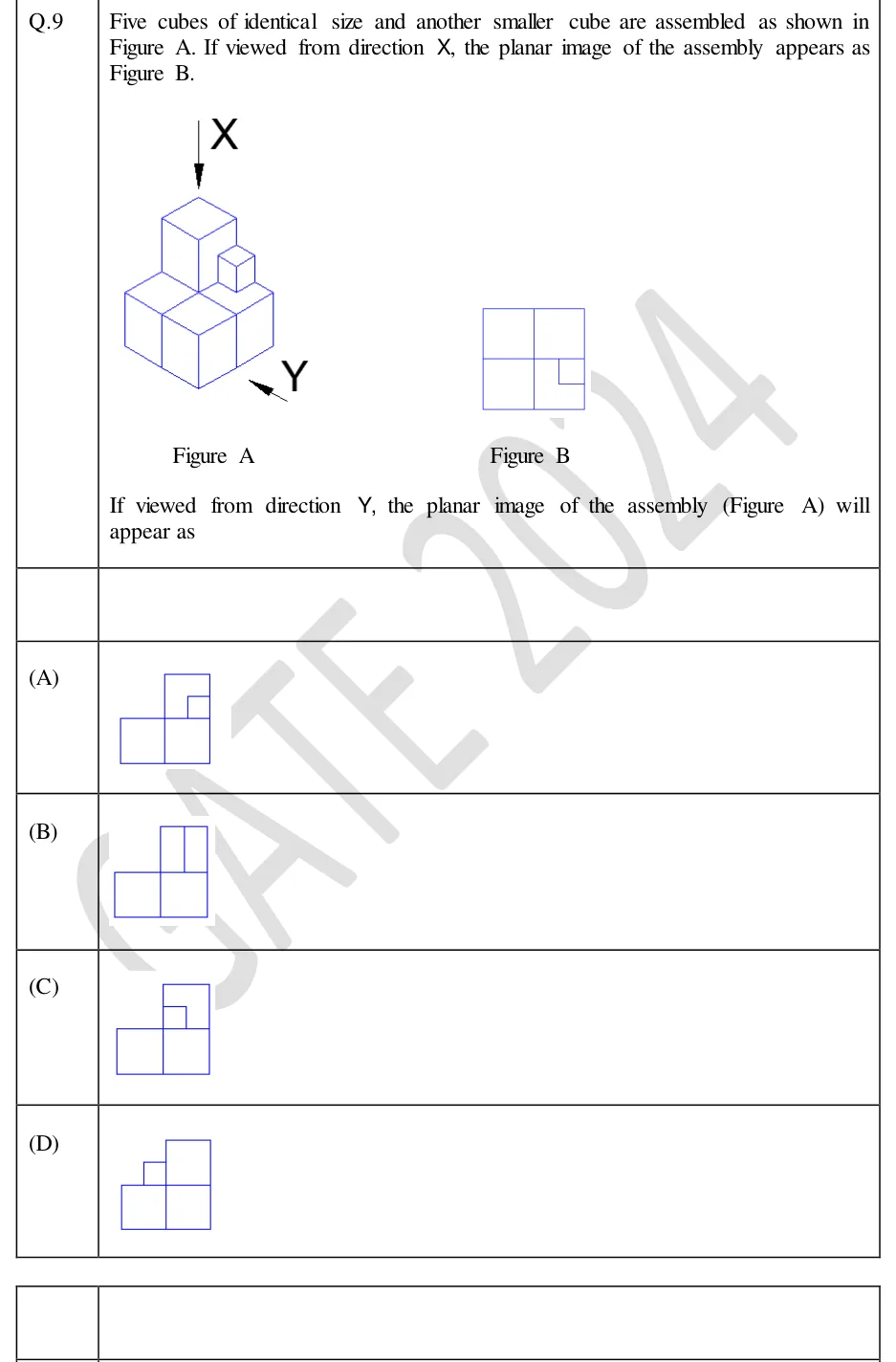
Five cubes of identical size and another smaller cube are assembled as shown in Figure A. If viewed from direction X, the planar image of the assembly appears as Figure B.

[Figure A] [Figure B]

If viewed from direction Y, the planar image of the assembly (Figure A) will appear as

GATE 2024 IN GA question 9: Figure A (isometric line drawing): four identical cubes form a 2 x 2 bottom layer.Tap to open full size
Figure from the GATE 2024 IN paper. It is part of the question.
Figure description

Figure A (isometric line drawing): four identical cubes form a 2 x 2 bottom layer. A fifth identical cube stands on the rear (farthest, top-of-picture) cube of that layer. The smaller cube, with edge half that of the others, rests on top of the right-hand bottom cube, in the corner of its top face that touches the right side face of the upper cube and the outer back-right edge of the block (so its side faces are flush with the upper cube and with the block's back-right face). Arrow X points straight down onto the top of the upper cube (top view). Arrow Y, at the lower right, points up and to the left, perpendicular to the lower-right vertical face of the block (the face formed by the front and right bottom cubes). Figure B (view from X): a square divided into 2 x 2 equal squares; the bottom-right square contains a small square (half its edge) in its upper-right corner.

  1. (A)

    Figure — two equal squares side by side on the bottom and one equal square above the right-hand one (an L-shape); inside the upper square, a small square of half the edge sits in its lower-right corner.

  2. (B)

    Figure — the same L-shape (two squares on the bottom, one above the right-hand one); the upper square is split into two equal halves by a full-height vertical line.

  3. (C)

    Figure — the same L-shape; inside the upper square, a small square of half the edge sits in its lower-left corner.

  4. (D)

    Figure — two equal squares on the bottom and one equal square above the right-hand one; a small square of half the edge sits on top of the left bottom square, outside the upper square and touching its left side.

Answer and solution
GATE 2024 IN GA Q.9: answer and solution

GATE 2023 EC GA Q.5

GATE 2023 · ECGA Q.5 · 1 mark · MCQ

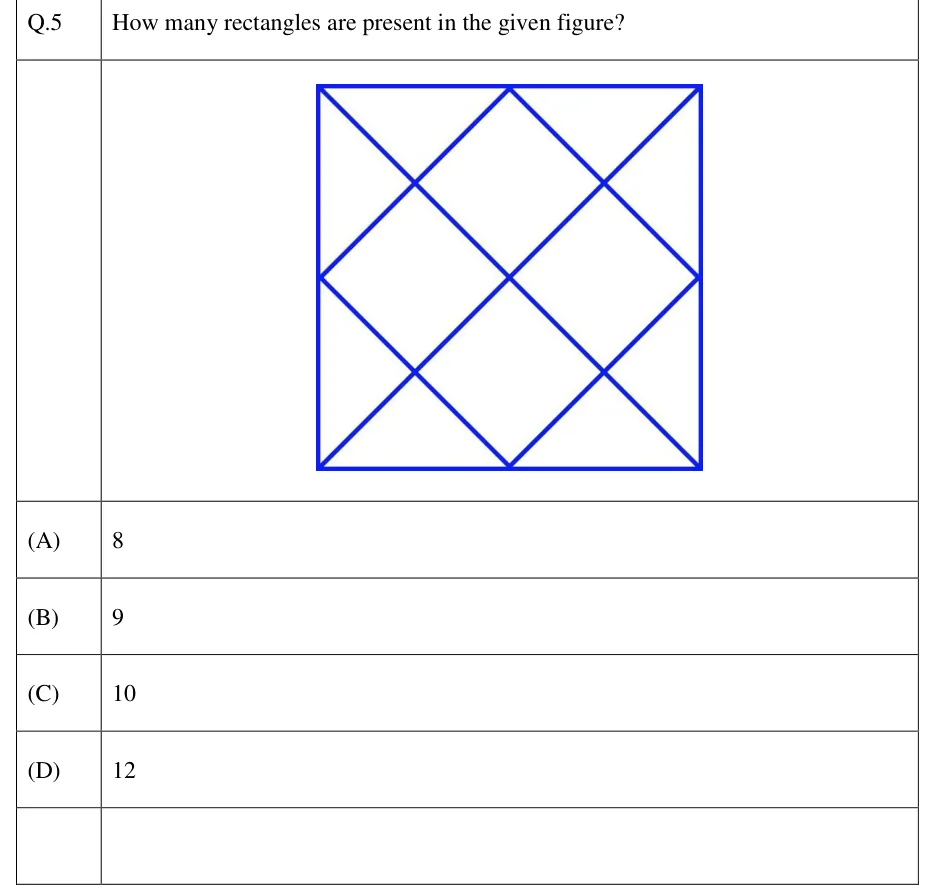
How many rectangles are present in the given figure?

GATE 2023 EC GA question 5: A square outline (drawn in blue lines, no shading).Tap to open full size
Figure from the GATE 2023 EC paper. It is part of the question.
Figure description

A square outline (drawn in blue lines, no shading). Take the corners as A (top-left), B (top-right), C (bottom-right), D (bottom-left), and the midpoints of the sides as P (top side), Q (right side), R (bottom side), S (left side). Both diagonals are drawn: AC from the top-left corner to the bottom-right corner, and BD from the top-right corner to the bottom-left corner, crossing at the centre O. The four midpoints are joined in order to form a tilted square (a diamond): PS, SR, RQ and QP. Each diagonal crosses two sides of the diamond at their midpoints. Together the diagonals and the diamond split the diamond into 4 equal small tilted squares that meet at O, and leave 4 corner triangles outside the diamond (at A, B, C, D), each of which is cut in two by the diagonal. There are no other lines and no labels in the figure.

  1. (A)

    8

  2. (B)

    9

  3. (C)

    10

  4. (D)

    12

Answer and solution
GATE 2023 EC GA Q.5: answer and solution

GATE 2023 EC GA Q.10

GATE 2023 · ECGA Q.10 · 2 marks · MCQ

A 100 cm 32 cm rectangular sheet is folded 5 times. Each time the sheet is folded, the long edge aligns with its opposite side. Eventually, the folded sheet is a rectangle of dimensions 100 cm 1 cm.

The total number of creases visible when the sheet is unfolded is ______.

  1. (A)

    32

  2. (B)

    5

  3. (C)

    31

  4. (D)

    63

Answer and solution
See the question in the paper
GATE 2023 EC GA Q.10: answer and solution

GATE 2023 EE GA Q.5

GATE 2023 · EEGA Q.5 · 1 mark · MCQ

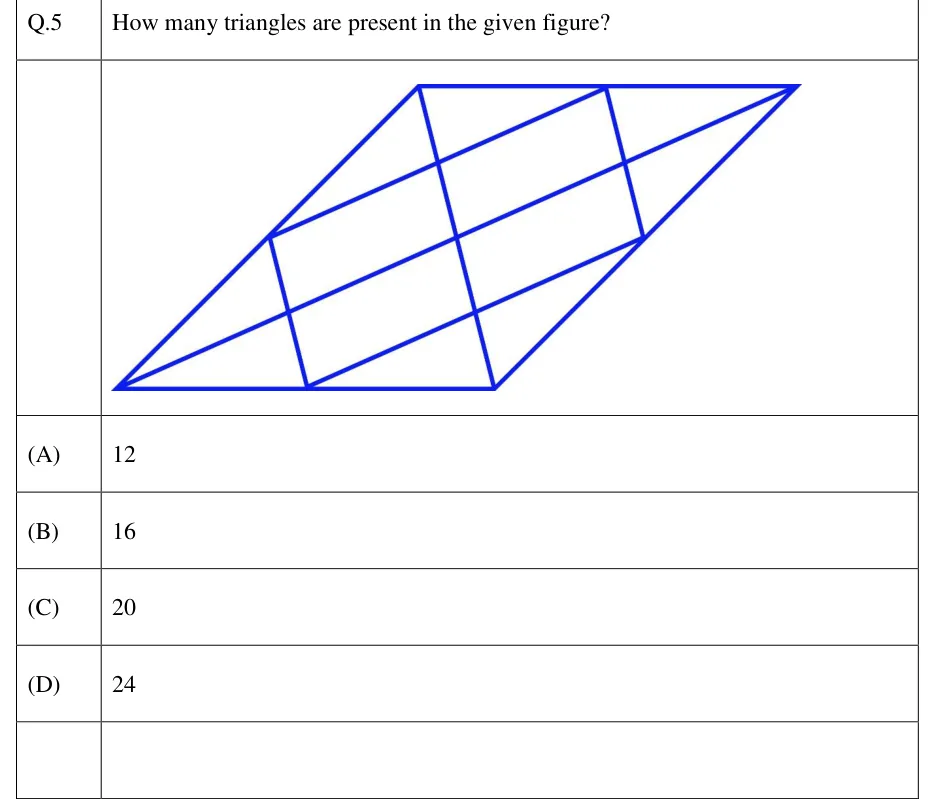
How many triangles are present in the given figure?

GATE 2023 EE GA question 5: A parallelogram drawn in blue lines.Tap to open full size
Figure from the GATE 2023 EE paper. It is part of the question.
Figure description

A parallelogram drawn in blue lines. Its top and bottom sides are horizontal, and the top side is shifted to the right of the bottom side, so the left and right sides slope up to the right. Label the corners A (bottom-left), B (bottom-right), C (top-right) and D (top-left). Both diagonals are drawn: the long one from A (bottom-left) to C (top-right), and the short, steep one from D (top-left) to B (bottom-right). The two diagonals cross at the centre O. The midpoints of the four sides, Q on AB, R on BC, P on CD and L on DA, are joined in order L-P, P-R, R-Q, Q-L. This makes an inner parallelogram that looks almost like a tilted rectangle. Its sides L-P and Q-R are parallel to diagonal AC, and its sides L-Q and P-R are parallel to diagonal DB. Diagonal AC crosses L-Q at E and P-R at F. Diagonal DB crosses L-P at H and Q-R at G. There are no other lines and no labels in the printed figure.

  1. (A)

    12

  2. (B)

    16

  3. (C)

    20

  4. (D)

    24

Answer and solution
GATE 2023 EE GA Q.5: answer and solution

GATE 2023 IN GA Q.5

GATE 2023 · INGA Q.5 · 1 mark · MCQ

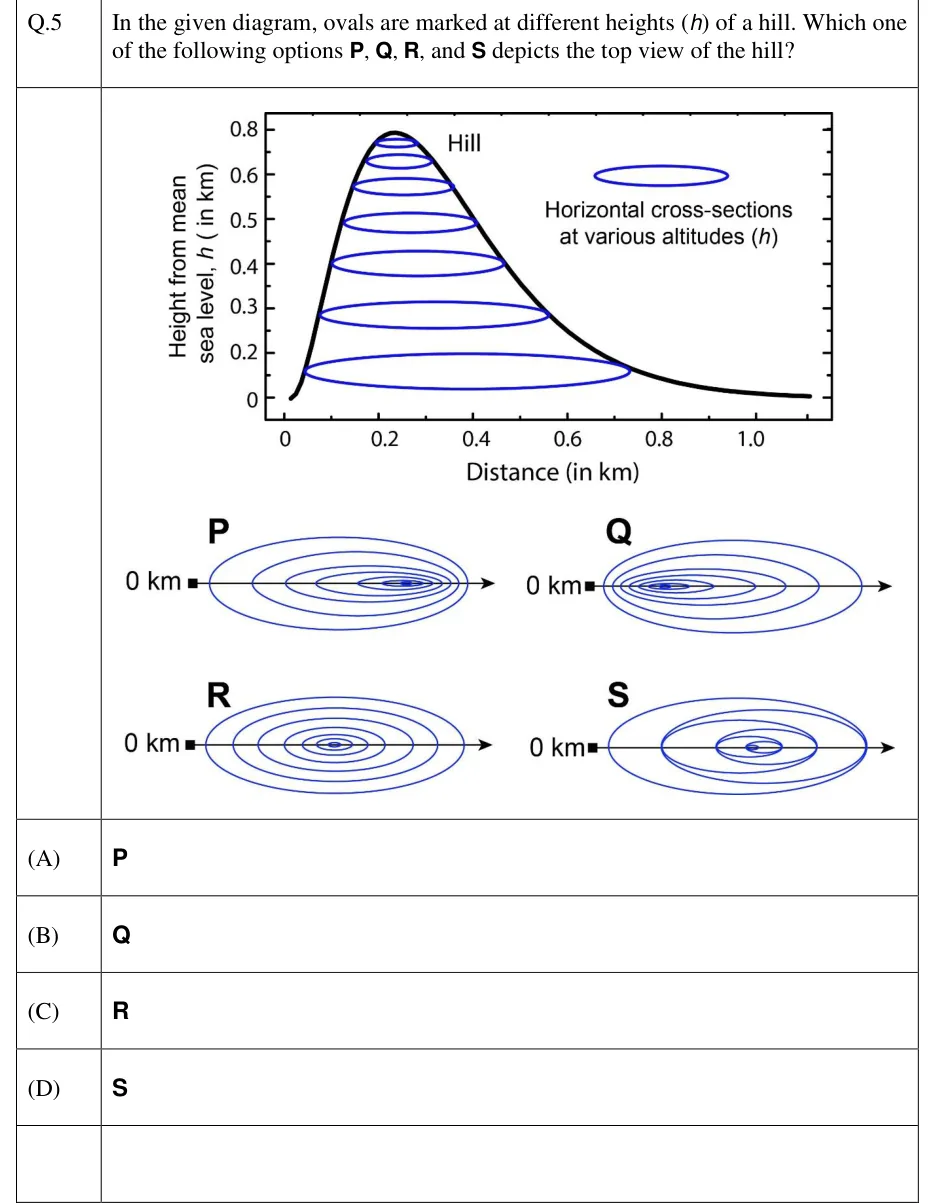
In the given diagram, ovals are marked at different heights () of a hill. Which one of the following options P, Q, R, and S depicts the top view of the hill?

GATE 2023 IN GA question 5: Main figure: a graph.Tap to open full size
Figure from the GATE 2023 IN paper. It is part of the question.
Figure description

Main figure: a graph. The vertical axis is labelled "Height from mean sea level, h (in km)". Its tick labels, from bottom to top, are 0, 0.2, 0.3, 0.4, 0.5, 0.6, 0.8. They are equally spaced on the page, so the printed scale skips 0.1 and 0.7. The horizontal axis is labelled "Distance (in km)", with labelled ticks at 0, 0.2, 0.4, 0.6, 0.8, 1.0 and unlabelled minor ticks between them. The frame runs to about 1.15 km. A thick black curve labelled "Hill" starts at about (0.01, 0) and rises very steeply to a single peak at about 0.23 km, level with the 0.8 tick. It then falls more gently and flattens into a long tail that almost reaches zero height at about 1.1 km. So the hill is steep on the left, near 0 km, and gentle on the right. Seven blue horizontal ovals (cross-sections) sit inside the curve at different heights. Each runs from the left side of the curve to the right side at its height. From top to bottom, their approximate horizontal extents are 0.19-0.28 km (just below the peak), 0.17-0.31, 0.14-0.36, 0.12-0.41, 0.09-0.47, 0.07-0.57 and 0.04-0.74 km. The lowest one lies between the 0 and 0.2 ticks. The left ends of the ovals are close together and the right ends are far apart. Legend at the upper right: a blue oval above the text "Horizontal cross-sections at various altitudes (h)". Below the graph are four option figures. Each is drawn on a horizontal arrow that starts at a small black square labelled "0 km" and points right. Each shows seven nested closed curves: six ellipses and a tiny filled innermost oval (a dot). In every option the outer ellipse's left edge is just to the right of the 0 km square. P: the inner ellipses shift further to the RIGHT the smaller they are. Their right edges are bunched together near the right end of the outer ellipse, their left edges are far apart, and the dot is about three-quarters of the way across. Q: the inner ellipses shift further to the LEFT the smaller they are. Their left edges are bunched together near the 0 km end, their right edges are far apart, and the dot is about a quarter of the way across. Q is the mirror image of P. R: the ellipses share one centre, and the dot is in the middle of the outer ellipse. The gap between neighbouring ellipses is the same on the left as on the right, and the gaps get smaller towards the centre. S: an outer ellipse with the other ellipses inside it. Each ellipse touches the next one inside it, alternating between right end and left end. The outer ellipse and the next one almost meet at the right end. That one and the next share a leftmost point about a fifth of the way across. The next pair meet at the right, and so on inwards. The dot is slightly right of the middle. The spacing is irregular.

  1. (A)

    P

  2. (B)

    Q

  3. (C)

    R

  4. (D)

    S

Answer and solution
GATE 2023 IN GA Q.5: answer and solution

GATE 2023 IN GA Q.10

GATE 2023 · INGA Q.10 · 2 marks · MCQ

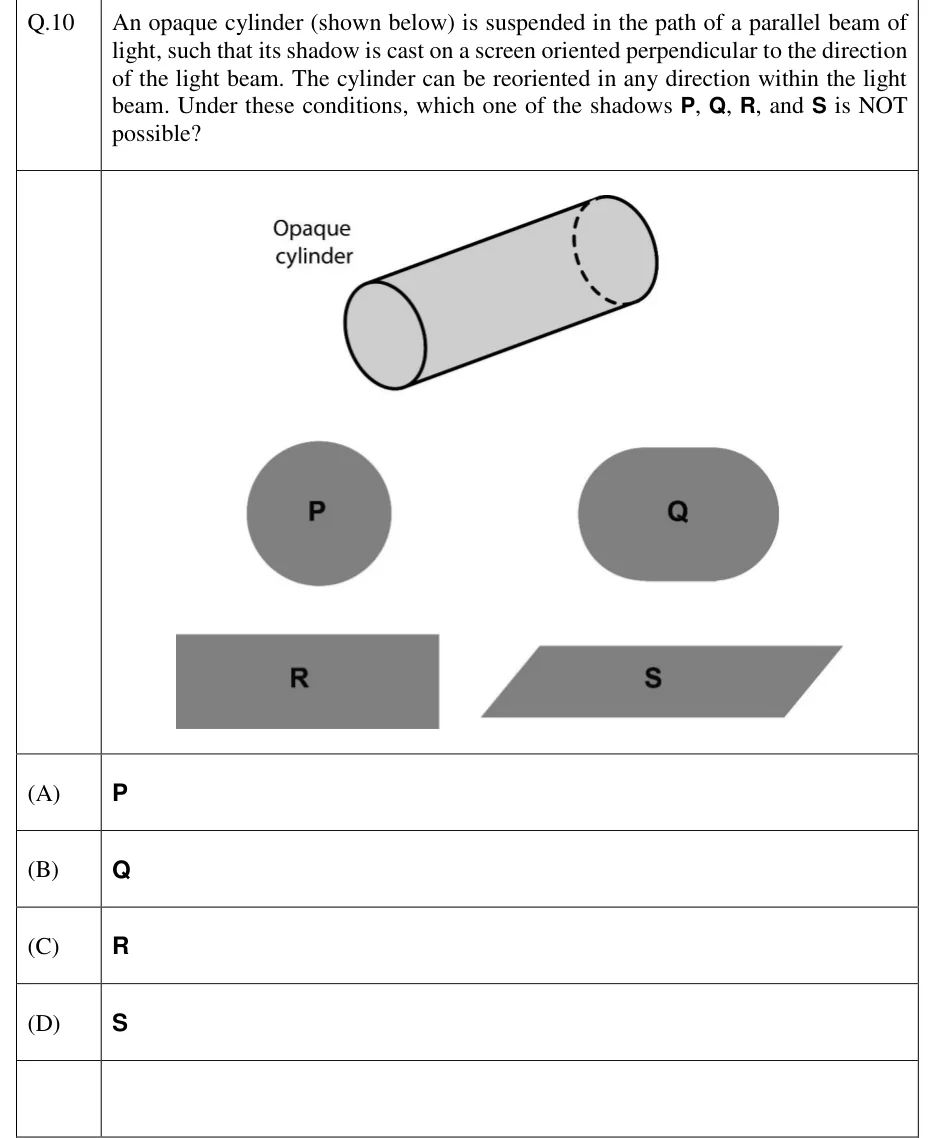
An opaque cylinder (shown below) is suspended in the path of a parallel beam of light, such that its shadow is cast on a screen oriented perpendicular to the direction of the light beam. The cylinder can be reoriented in any direction within the light beam. Under these conditions, which one of the shadows P, Q, R, and S is NOT possible?

GATE 2023 IN GA question 10: Top: a 3D sketch of a solid circular cylinder, shaded light grey.Tap to open full size
Figure from the GATE 2023 IN paper. It is part of the question.
Figure description

Top: a 3D sketch of a solid circular cylinder, shaded light grey. Its axis rises from lower left to upper right. The near end face (lower left) is drawn as a full ellipse with a solid outline. At the far end (upper right), the visible half of the ellipse is solid and the hidden half is dashed. Two straight solid lines, tangent to both end ellipses, form the top and bottom edges. The label "Opaque cylinder" sits above and to the left of the cylinder. Below it are four candidate shadows, each a flat dark-grey filled shape with its bold letter at the centre. P (upper left): a circle. Q (upper right): a stadium or capsule shape, wider than it is tall, with straight horizontal top and bottom edges and rounded left and right ends. R (lower left): an axis-aligned rectangle, wider than it is tall. S (lower right): a parallelogram with horizontal top and bottom edges and both sides slanting the same way (bottom-left corner further left than top-left, bottom-right corner further left than top-right), so it leans to the right.

  1. (A)

    P

  2. (B)

    Q

  3. (C)

    R

  4. (D)

    S

Answer and solution
GATE 2023 IN GA Q.10: answer and solution

GATE 2022 EC GA Q.4

GATE 2022 · ECGA Q.4 · 1 mark · MCQ

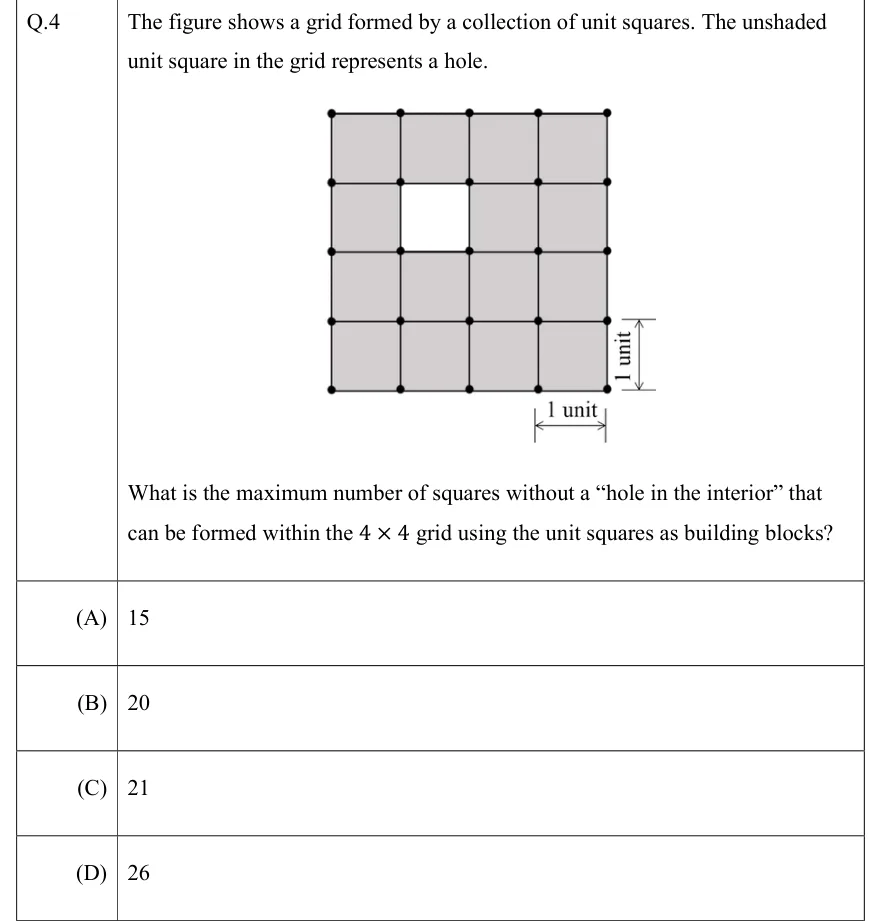
The figure shows a grid formed by a collection of unit squares. The unshaded unit square in the grid represents a hole.

[Figure]

What is the maximum number of squares without a “hole in the interior” that can be formed within the grid using the unit squares as building blocks?

GATE 2022 EC GA question 4: A 4 by 4 square grid made of 16 unit squares, with a black dot at each of its 25 grid-line intersections (5 by 5 lattice…Tap to open full size
Figure from the GATE 2022 EC paper. It is part of the question.
Figure description

A 4 by 4 square grid made of 16 unit squares, with a black dot at each of its 25 grid-line intersections (5 by 5 lattice points). Fifteen unit squares are shaded light grey. The one unshaded (white) unit square, the hole, is in the second row from the top and the second column from the left. Below the bottom-right unit square, a horizontal double-headed arrow spanning that square's width is labelled "1 unit". To the right of the bottom-right unit square, a vertical double-headed arrow spanning that square's height is labelled "1 unit" (text written vertically).

  1. (A)

    15

  2. (B)

    20

  3. (C)

    21

  4. (D)

    26

Answer and solution
GATE 2022 EC GA Q.4: answer and solution

GATE 2022 EC GA Q.5

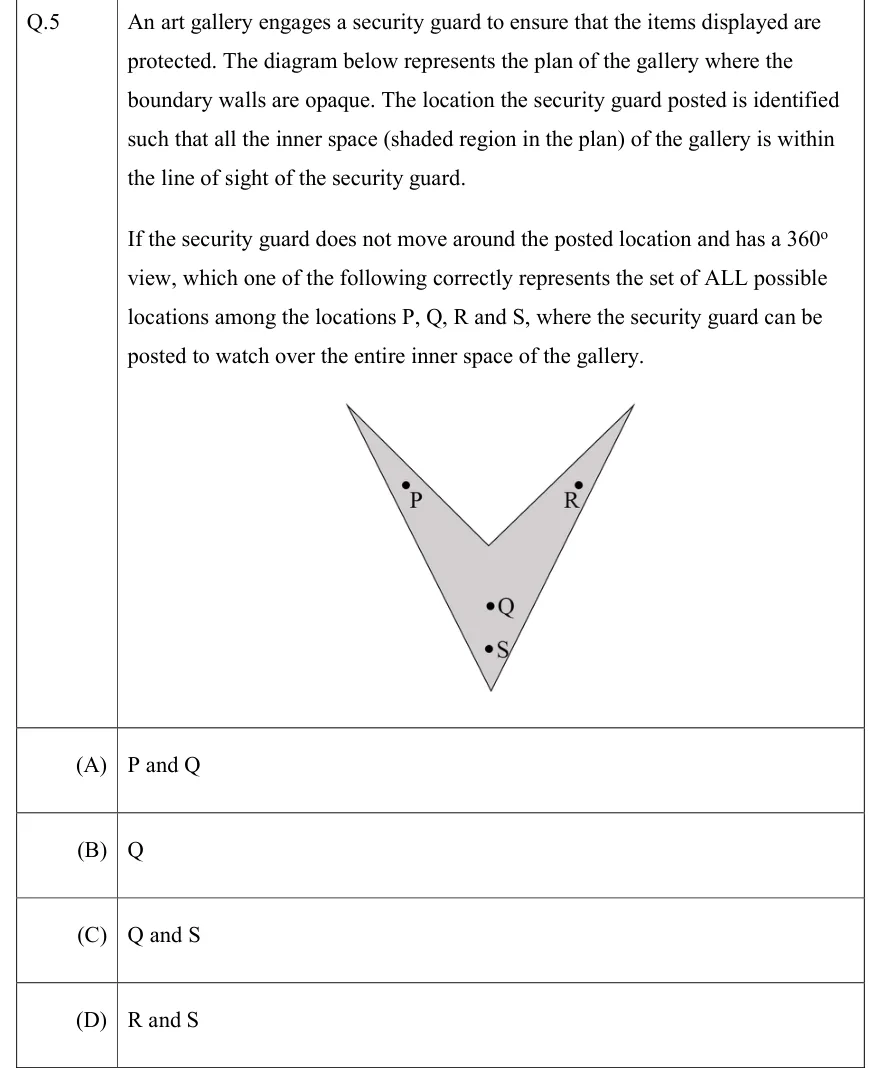
GATE 2022 · ECGA Q.5 · 1 mark · MCQ

An art gallery engages a security guard to ensure that the items displayed are protected. The diagram below represents the plan of the gallery where the boundary walls are opaque. The location the security guard posted is identified such that all the inner space (shaded region in the plan) of the gallery is within the line of sight of the security guard.

If the security guard does not move around the posted location and has a 360 view, which one of the following correctly represents the set of ALL possible locations among the locations P, Q, R and S, where the security guard can be posted to watch over the entire inner space of the gallery.

GATE 2022 EC GA question 5: A grey-shaded V-shaped (chevron) floor plan drawn as a concave quadrilateral with four vertices.Tap to open full size
Figure from the GATE 2022 EC paper. It is part of the question.
Figure description

A grey-shaded V-shaped (chevron) floor plan drawn as a concave quadrilateral with four vertices. There is a sharp top-left tip and a sharp top-right tip at the same height, and a sharp bottom tip directly below the middle. The fourth vertex is an inward (reflex) notch on the vertical centre line, about halfway down from the top tips to the bottom tip. The walls run: top-left tip to notch (inner edge of the left arm), notch to top-right tip (inner edge of the right arm), top-right tip to bottom tip (outer edge of the right arm), and bottom tip to top-left tip (outer edge of the left arm). The two arms are roughly mirror images, and the unshaded V-shaped gap between them lies above the notch. Four dots are marked inside the shaded region. P is in the upper part of the left arm, about a quarter of the way down, near that arm's inner wall. R is in the upper part of the right arm at about the same height, near that arm's inner wall. Q is on the vertical centre line, below the notch. S is on the same centre line below Q, close to the bottom tip, and its label touches the right outer wall. Q and S are in the single stem where the two arms merge; P and R are above the notch, one in each arm.

  1. (A)

    P and Q

  2. (B)

    Q

  3. (C)

    Q and S

  4. (D)

    R and S

Answer and solution
GATE 2022 EC GA Q.5: answer and solution

GATE 2022 EC GA Q.10

GATE 2022 · ECGA Q.10 · 2 marks · MCQ

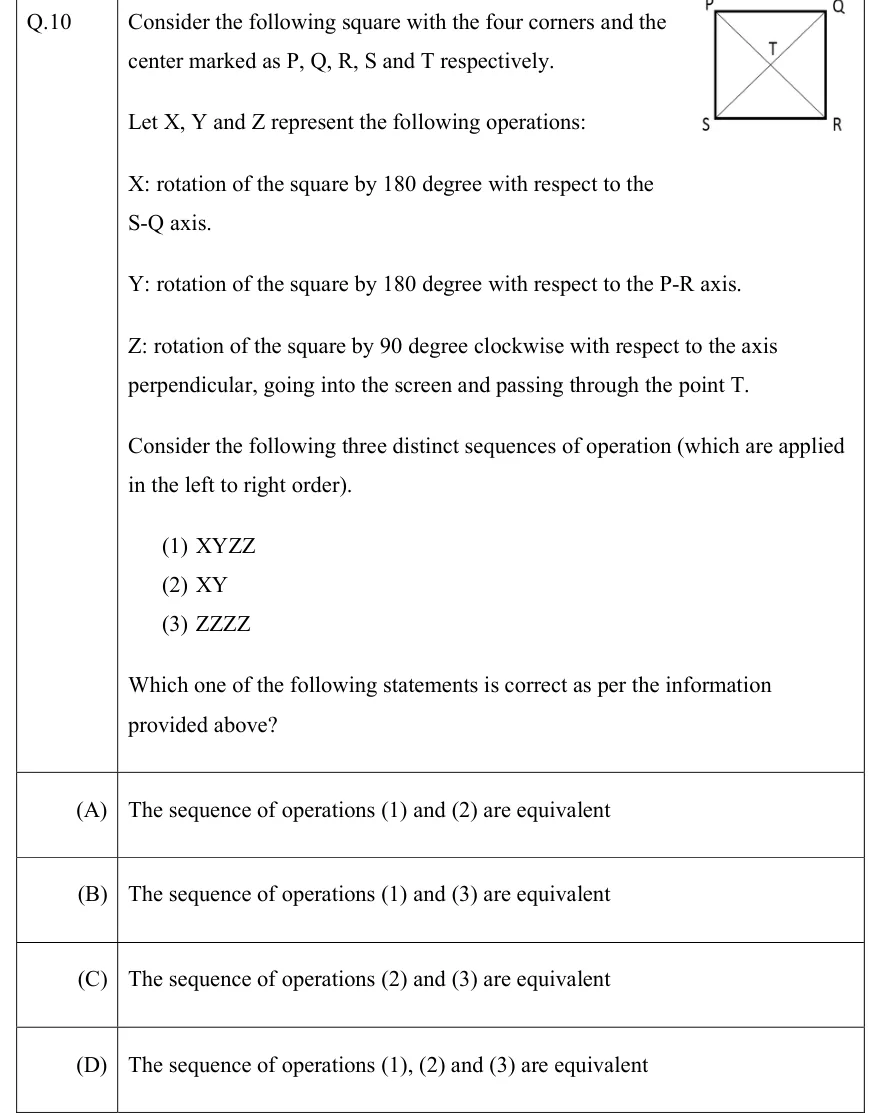
Consider the following square with the four corners and the center marked as P, Q, R, S and T respectively.

Let X, Y and Z represent the following operations:

X: rotation of the square by 180 degree with respect to the S-Q axis.

Y: rotation of the square by 180 degree with respect to the P-R axis.

Z: rotation of the square by 90 degree clockwise with respect to the axis perpendicular, going into the screen and passing through the point T.

Consider the following three distinct sequences of operation (which are applied in the left to right order).

(1) XYZZ
(2) XY
(3) ZZZZ

Which one of the following statements is correct as per the information provided above?

GATE 2022 EC GA question 10: A square drawn upright (sides horizontal and vertical) with both diagonals drawn as thin lines.Tap to open full size
Figure from the GATE 2022 EC paper. It is part of the question.
Figure description

A square drawn upright (sides horizontal and vertical) with both diagonals drawn as thin lines. Corner labels sit just outside the corners: P at the top-left, Q at the top-right, R at the bottom-right, S at the bottom-left. The two diagonals (P to R and Q to S) cross at the centre, which is labelled T just above the crossing point. The figure has no shading and no other marks.

  1. (A)

    The sequence of operations (1) and (2) are equivalent

  2. (B)

    The sequence of operations (1) and (3) are equivalent

  3. (C)

    The sequence of operations (2) and (3) are equivalent

  4. (D)

    The sequence of operations (1), (2) and (3) are equivalent

Answer and solution
GATE 2022 EC GA Q.10: answer and solution

GATE 2022 EE GA Q.5

GATE 2022 · EEGA Q.5 · 1 mark · MCQ

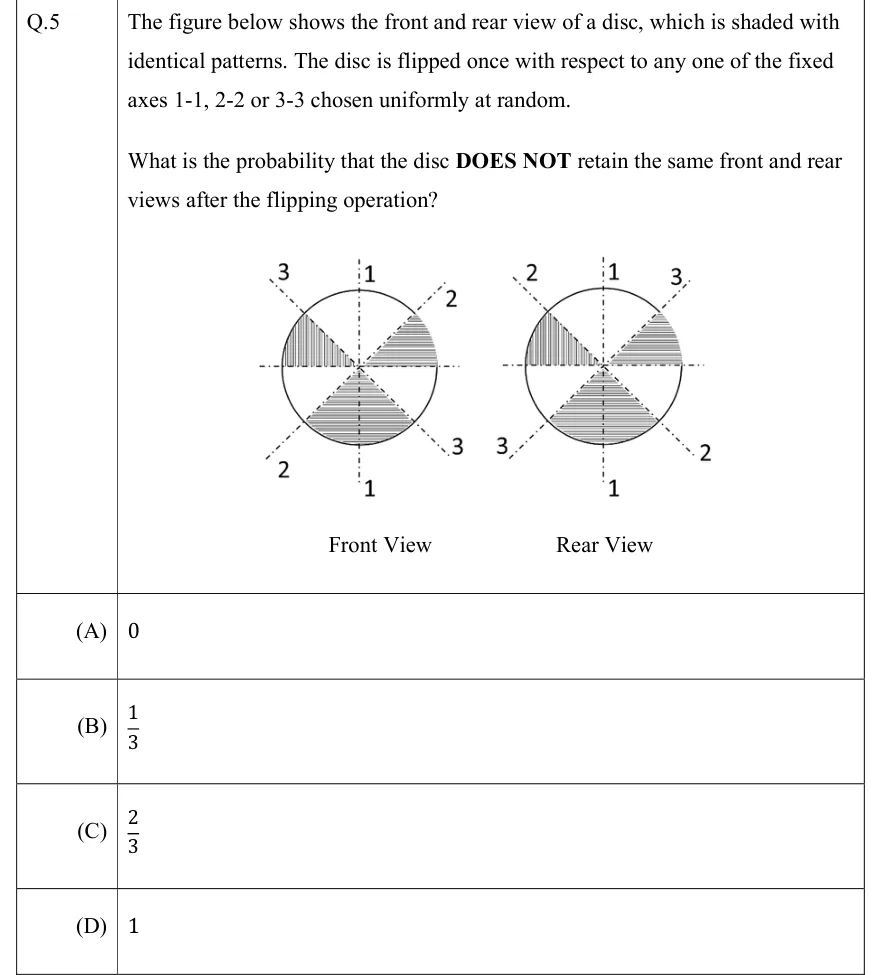
The figure below shows the front and rear view of a disc, which is shaded with identical patterns. The disc is flipped once with respect to any one of the fixed axes 1-1, 2-2 or 3-3 chosen uniformly at random.

What is the probability that the disc DOES NOT retain the same front and rear views after the flipping operation?

GATE 2022 EE GA question 5: Two equal circles side by side, captioned "Front View" (left) and "Rear View" (right).Tap to open full size
Figure from the GATE 2022 EE paper. It is part of the question.
Figure description

Two equal circles side by side, captioned "Front View" (left) and "Rear View" (right). In each circle a vertical dash-dot diameter runs past the rim and is labelled 1 at the top and 1 at the bottom (axis 1-1). Each circle also has an unlabelled horizontal dash-dot diameter and two slanted dash-dot diameters through the centre. The slanted diameters run past the rim, each at about 45 degrees to the horizontal, so they are roughly perpendicular to each other. Front View: axis 3-3 runs from upper-left (label 3) to lower-right (label 3), and axis 2-2 from upper-right (label 2) to lower-left (label 2). Rear View: the slanted labels are mirrored, with 2 at upper-left and lower-right and 3 at upper-right and lower-left. Axis 1-1 is unchanged. Both views are shaded identically: (i) the upper-left sector, between the left horizontal radius and the upper-left slanted radius (about 45 degrees), has vertical hatching; (ii) the upper-right sector, between the right horizontal radius and the upper-right slanted radius (about 45 degrees), has horizontal hatching; (iii) the large bottom sector, between the lower-left and lower-right slanted radii (about 90 degrees) and bisected by the lower half of 1-1, has horizontal hatching. Three regions are left white: the top region between the two upper slanted radii (about 90 degrees, containing the top of 1-1), and the two lower side regions between each horizontal radius and the adjacent lower slanted radius (about 45 degrees each).

  1. (A)

    0

  2. (B)

  3. (C)

  4. (D)

    1

Answer and solution
GATE 2022 EE GA Q.5: answer and solution

GATE 2022 EE GA Q.10

GATE 2022 · EEGA Q.10 · 2 marks · MCQ

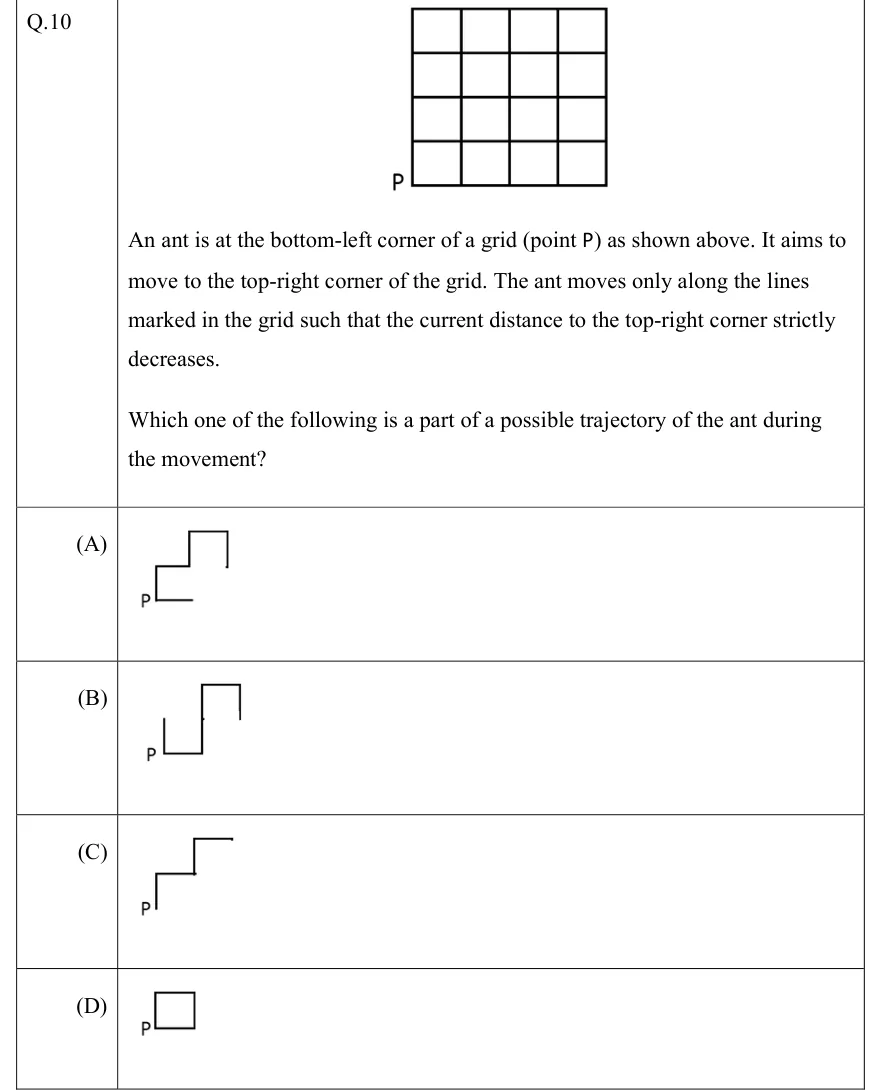
[Figure: a 4 x 4 square grid with P at its bottom-left corner]

An ant is at the bottom-left corner of a grid (point P) as shown above. It aims to move to the top-right corner of the grid. The ant moves only along the lines marked in the grid such that the current distance to the top-right corner strictly decreases.

Which one of the following is a part of a possible trajectory of the ant during the movement?

GATE 2022 EE GA question 10: Question figure: a 4 x 4 grid of equal squares (5 horizontal lines and 5 vertical lines, so 5 x 5 lattice points).Tap to open full size
Figure from the GATE 2022 EE paper. It is part of the question.
Figure description

Question figure: a 4 x 4 grid of equal squares (5 horizontal lines and 5 vertical lines, so 5 x 5 lattice points). The label P sits just left of the grid's bottom-left corner. There are no other labels. Option figures: each is drawn as unit segments, each segment standing for one grid edge. They are drawn at a somewhat smaller scale than the question grid, and every short segment in them has the same length. Each has the label P at its lower-left starting corner. Take P = (0,0), with x to the right and y upward, in units of one grid edge. (A) six unit segments: P(0,0) right to (1,0), where that stroke ends; P(0,0) up to (0,1); (0,1) right to (1,1); (1,1) up to (1,2); (1,2) right to (2,2); (2,2) down to (2,1), where the line ends. So two segments meet at P, one going right and one going up. (B) segments: (0,1) down to P(0,0), where the free end is at (0,1); P(0,0) right to (1,0); (1,0) up to (1,2), a two-unit vertical with a tiny tick at (1,1); (1,2) right to (2,2); (2,2) down to (2,1), where the line ends. Again two segments meet at P, one going up and one going right. (C) a staircase of four unit segments: P(0,0) up to (0,1); (0,1) right to (1,1); (1,1) up to (1,2); (1,2) right to (2,2), where it ends. (D) a closed unit square with P at its bottom-left corner: P(0,0) to (1,0) to (1,1) to (0,1) and back to P.

  1. (A)

    Figure: from P, one unit segment goes right along the bottom (and ends) and one goes up. From the top of the upward segment the path goes right 1, up 1, right 1, then down 1, where it ends.

  2. (B)

    Figure: a stroke that starts one unit above P and comes down to P, then goes right 1, up 2, right 1, then down 1, where it ends.

  3. (C)

    Figure: a staircase from P going up 1, right 1, up 1, right 1.

  4. (D)

    Figure: a closed unit square with P at its bottom-left corner (right 1, up 1, left 1, down 1 back to P).

Answer and solution
GATE 2022 EE GA Q.10: answer and solution

GATE 2022 IN GA Q.5

GATE 2022 · INGA Q.5 · 1 mark · MCQ

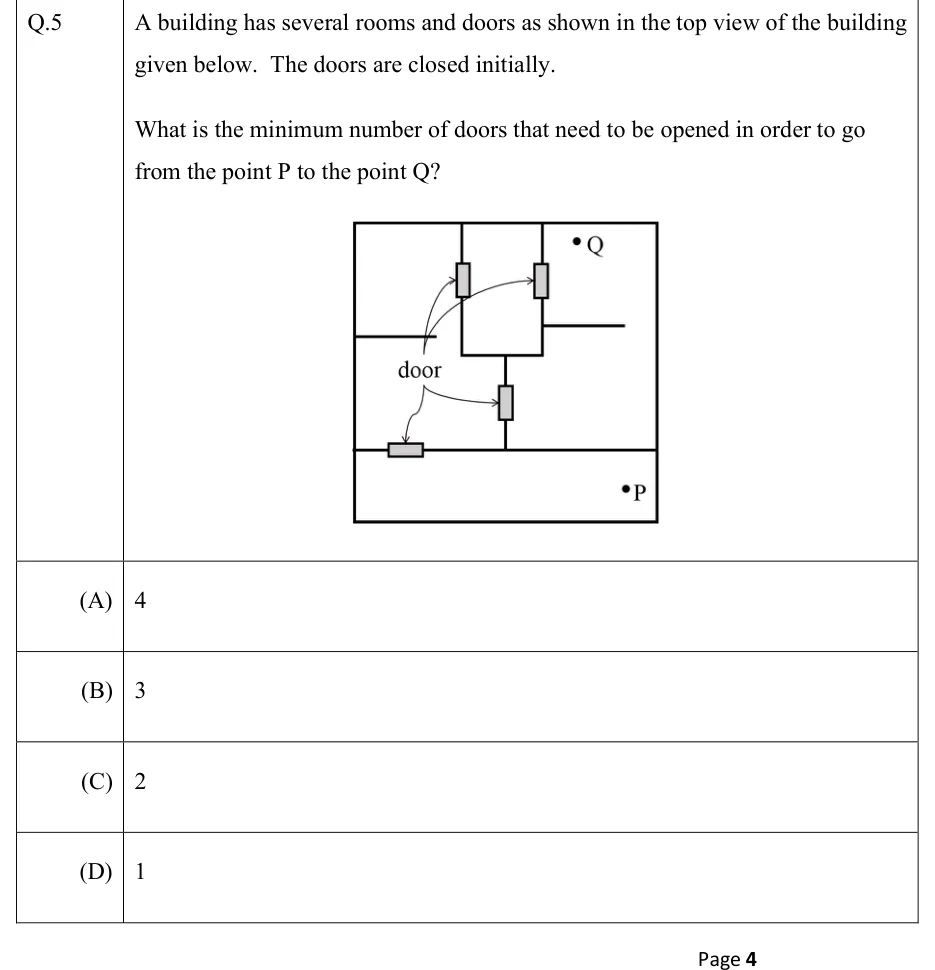
A building has several rooms and doors as shown in the top view of the building given below. The doors are closed initially.

What is the minimum number of doors that need to be opened in order to go from the point P to the point Q?

GATE 2022 IN GA question 5: Top view (floor plan) of a building drawn as a large, nearly square outer rectangle.Tap to open full size
Figure from the GATE 2022 IN paper. It is part of the question.
Figure description

Top view (floor plan) of a building drawn as a large, nearly square outer rectangle. A full-width horizontal wall about one quarter of the way up from the bottom cuts off a long bottom strip. Point P is a dot near the right end of this strip. The full-width wall has one door (a small shaded rectangle lying along the wall) near its left end. Above this wall: (1) A small central room hangs from the top outer wall, roughly in the middle of the building's width. It is a rectangle whose top side is part of the outer top wall. It has a left wall, a right wall and a bottom wall, and it reaches down to about 45% of the building's height. Its left wall and its right wall each have one door (a small shaded rectangle standing upright along the wall) at about mid-height. (2) A vertical wall runs down from the middle of the central room's bottom wall to the full-width horizontal wall, and it has one upright door at about its middle. The central room and this vertical wall split the space above the bottom strip into a left-hand area and a right-hand area. (3) In the left-hand area, a short horizontal wall starts at the left outer wall, slightly above the level of the central room's bottom, and runs right. It stops short of the central room's left wall and leaves an open gap, so the space above it and the space below it form one connected room. The door on the central room's left wall lies above this short wall. (4) In the right-hand area, a short horizontal wall starts at the central room's right wall, a little higher than the left short wall, and runs right. It stops short of the right outer wall and leaves an open gap, so the space above it and the space below it form one connected room. Point Q is a dot in the upper part of this right-hand room, just right of the central room and near the top wall. The label "door" sits in the left-hand room, just below the left short wall and to the left of the central room. Two curved arrows run from it up to the doors on the central room's left and right walls, and two more run to the door on the vertical wall and down to the door on the full-width horizontal wall. Four doors in total.

  1. (A)

    4

  2. (B)

    3

  3. (C)

    2

  4. (D)

    1

Answer and solution
GATE 2022 IN GA Q.5: answer and solution

GATE 2022 IN GA Q.10

GATE 2022 · INGA Q.10 · 2 marks · MCQ

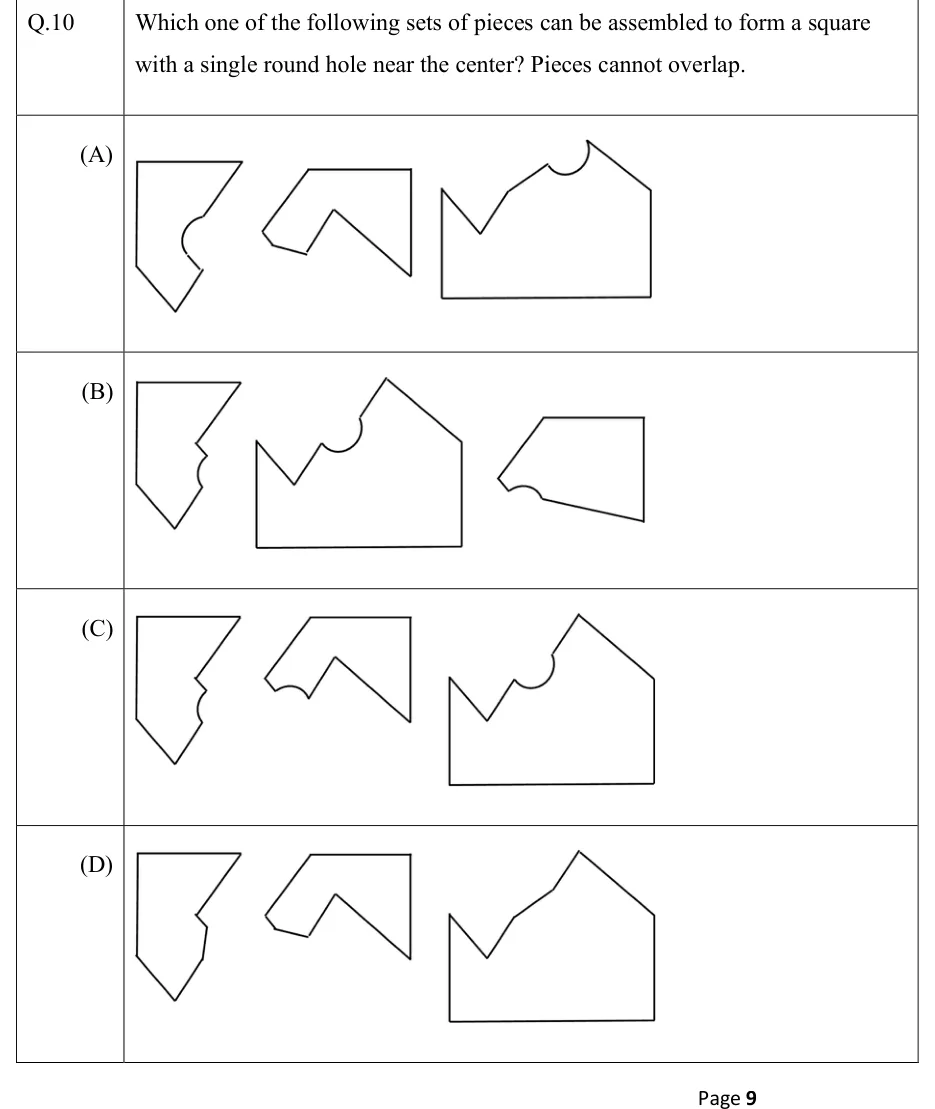
Which one of the following sets of pieces can be assembled to form a square with a single round hole near the center? Pieces cannot overlap.

GATE 2022 IN GA question 10: Four options.Tap to open full size
Figure from the GATE 2022 IN paper. It is part of the question.
Figure description

Four options. Each is a row of three flat outline drawings with no shading. Three basic pieces recur. (P) Left piece: a horizontal top edge and a vertical left edge meet at a right angle at the top-left. From the right end of the top edge, a long edge slants down-left to a small vertex. From there a short edge (the kink) steps down-right, followed by a short, nearly vertical lower-right edge. At the bottom, one slant runs down-right from the foot of the left edge and another runs down-left from the foot of the lower-right edge; they meet in a downward point. (Q) Chevron piece: a horizontal top edge and a vertical right edge meet at a right angle at the top-right. From the bottom of the right edge, a long edge slants up-left to an inner (concave) corner, then an edge runs down-left to a lower tip. From the tip a short edge runs left (slightly upward) to a small corner, a short edge slants up-left, and a long edge slants up-right back to the left end of the top edge. (R) Large piece: a horizontal bottom edge and vertical left and right edges of about equal height, with right angles at both bottom corners. Its top profile, left to right: from the top of the left edge down-right to the bottom of a V-shaped notch; up-right to a vertex; a gentler edge up-right to a bend; a steeper edge up-right to the peak (the highest point, right of centre); then down-right to the top of the right edge. Order: in options A, C and D the pieces appear left to right as P, Q, R. In option B the order is P, R, then the modified Q. Variations: (A) P has no kink. Its long slant runs straight into a large semicircular notch cut into its right side. Below the notch a short edge steps down-right, and the lower-right slant then runs down-left to the bottom point. Q has only straight edges. In R the gentler edge after the V is straight, and a semicircular notch replaces the steeper edge, with the notch's right end at the peak. (B) P has the kink plus a small circular-arc notch in its lower-right edge. R (middle) has a large, nearly semicircular notch in place of the gentler edge; the steeper edge up to the peak is straight. The right-hand piece is Q without its V-cut: a horizontal top, a vertical right side, and a straight bottom edge from the bottom-right corner up-left to a small circular-arc notch, then the short up-left slant and the long up-right slant back to the top-left. It is a four-sided shape with one arc. (C) P has the kink plus a small circular-arc notch in its lower-right edge. Q has a small circular-arc notch in place of its short edge next to the lower tip. R has a large, nearly semicircular notch in place of the gentler edge; the steeper edge up to the peak is straight. (D) All edges are straight and there are no notches: P has the kink and a straight lower-right edge, Q has a straight short edge by the tip, and R has both the gentler and the steeper edge straight.

  1. (A)

    Figure — P with no kink and a large semicircular notch on its right side, with a short step below the notch; Q with all straight edges; R with a semicircular notch on the steep edge that ends at its peak

  2. (B)

    Figure — P with kink and a small arc notch; R (middle) with a large near-semicircular notch between its V and its steep edge; right-hand piece a four-sided shape (Q without its V-cut) with a small arc notch at its lower left

  3. (C)

    Figure — P with kink and a small arc notch on its lower-right edge; Q with a small arc notch on its short edge next to the tip; R with a large near-semicircular notch between its V and its steep edge

  4. (D)

    Figure — P, Q and R with all edges straight, no notches

Official answer

Official answer: CSource: Official answer key, GATE 2022 IN (IIT Kharagpur)

GATE 2022 IN GA Q.10: official answer

PRACTICE

5 questions to test yourself

PRACTICE 11 mark · MCQ

An L-shaped figure on a card is made of two straight arms meeting at a right-angled corner. A long arm runs from the corner towards the top of the card (north), and a short arm runs from the corner towards the right-hand edge (east). The card is (i) rotated clockwise in its own plane, then (ii) reflected in a vertical mirror line, which swaps east and west, and then (iii) rotated . In which directions do the two arms now point from the corner?

  1. (A)

    Long arm east, short arm north

  2. (B)

    Long arm east, short arm south

  3. (C)

    Long arm west, short arm north

  4. (D)

    Long arm south, short arm west

Answer and solution

Answer: (A)

  1. Follow the direction of each arm. Start: long arm north, short arm east.

  2. (i) clockwise sends north to east and east to south: long arm east, short arm south.

  3. (ii) The vertical mirror swaps east and west and leaves north and south unchanged: long arm west, short arm south.

  4. (iii) reverses every direction: long arm east, short arm north.

  5. Check: the sequence contains one reflection, so the result must be a mirror image of the start. It is: north and east have swapped, which is a reflection in the line running from north-east to south-west.

PRACTICE 22 marks · NAT

A solid wooden block measuring 5 cm (length) × 4 cm (width) × 3 cm (height) stands on its 5 cm × 4 cm face. Its top face and its four vertical faces are painted; the bottom face is not painted. The block is then cut into cubes of edge 1 cm. The number of these small cubes that have no paint on any face is ______.

Answer and solution

Answer:

  1. Label each small cube by its position: length 1 to 5, width 1 to 4, height 1 (bottom) to 3 (top).

  2. To have no paint, a cube must not touch a painted vertical face. So its length position is 2, 3 or 4 (3 choices) and its width position is 2 or 3 (2 choices).

  3. It must not be in the painted top layer. The bottom layer is allowed because the bottom face is unpainted. So its height is 1 or 2 (2 choices).

  4. Unpainted cubes .

  5. For comparison, with all six faces painted the answer would be . The unpainted bottom adds a second layer of 6.

PRACTICE 32 marks · MSQ

A net of a cube is made of six squares. Four of them, labelled P, Q, R and S from left to right, lie in one horizontal row, each sharing an edge with the next. Square T is attached to the top edge of Q, and square U is attached to the bottom edge of R. The net is folded into a cube with the labels on the outside. Which of the following statements is/are correct?

  1. (A)

    P and R are on opposite faces.

  2. (B)

    T and U are on opposite faces.

  3. (C)

    Q and T are on opposite faces.

  4. (D)

    S and U share an edge of the cube.

Answer and solution

Answer: (A), (B), (D)

  1. In a row of four squares, alternate squares are opposite: P is opposite R, and Q is opposite S. So A is correct.

  2. The row P, Q, R, S folds into a ring of four side faces, open at the top and at the bottom. T, hinged on the top edge of Q, closes the top opening. U, hinged on the bottom edge of R, closes the bottom opening. So T and U are opposite, and B is correct.

  3. Q and T share an edge in the net, so they are adjacent on the cube, not opposite. C is wrong.

  4. Every face of the ring shares an edge with both end faces, so S and U share an edge. D is correct.

PRACTICE 42 marks · MCQ

A square sheet of paper ABCD has corner A at the top left, B at the top right, C at the bottom right and D at the bottom left. It is folded along the diagonal AC so that corner B lies exactly on corner D. The resulting triangle is then folded in half so that corner A lies exactly on corner C. A single small hole is punched through all the layers, close to the corner of the folded triangle where A and C now lie together, and away from both fold lines. When the sheet is completely unfolded, where are the holes?

  1. (A)

    One hole near each of the four corners A, B, C and D

  2. (B)

    Two holes near corner A and two holes near corner C

  3. (C)

    Two holes near corner B and two holes near corner D

  4. (D)

    Four holes, all near corner C

Answer and solution

Answer: (B)

  1. Place D at (0, 0), C at (1, 0), B at (1, 1) and A at (0, 1).

  2. Fold 1 is along AC, the line . The sheet now covers triangle ACD in 2 layers. Fold 2 brings A onto C, so its fold line is the perpendicular bisector of AC, the line , which passes through D. The packet is now triangle D, C, O with O = (0.5, 0.5), 4 layers thick, and A lies on C.

  3. Take the punch at (0.8, 0.1), near C. Undo fold 2 by reflecting in : holes at (0.8, 0.1) and (0.1, 0.8). The second one is near A.

  4. Undo fold 1 by reflecting in , that is . (0.8, 0.1) gives (0.9, 0.2), near C, and (0.1, 0.8) gives (0.2, 0.9), near A.

  5. Result: four holes, two near C and two near A, and none near B or D. B and D ended up at the other corner of the folded triangle, which was not punched.

PRACTICE 51 mark · NAT

Triangle PQR is drawn with P at the top and QR as its horizontal base. Three straight lines are drawn from P to three different points lying strictly between Q and R. Two straight lines parallel to QR are also drawn, at two different heights, each running from side PQ to side PR. The total number of triangles of all sizes in the figure is ______.

Answer and solution

Answer:

  1. Lines through P: PQ, PR and the three new lines, 5 in all. Lines parallel to the base: QR and the two new lines, 3 in all.

  2. Two parallel lines cannot both be sides of one triangle, and three lines through P all meet at P. So every triangle uses exactly two lines through P and one line parallel to QR.

  3. Every such choice does give a triangle, because each parallel line crosses all five lines through P.

  4. Number of triangles . This is the formula with and .

OFFICIAL GATE 2027 SYLLABUS WORDING

Copied from the GATE 2027 syllabus; see all 2027 syllabi.

EVERY GATE PAPER

Transformation of shapes: translation, rotation, scaling, mirroring, assembling, and grouping paper folding, cutting, and patterns in 2 and 3 dimensions

Preparing in Kolkata? See IAE Academy’s GATE courses.