
IAE Academy

GATE 2023 IN GA Q.10: solution and answer

GATE 2023 · INGA Q.10 · 2 marks · MCQ

An opaque cylinder (shown below) is suspended in the path of a parallel beam of light, such that its shadow is cast on a screen oriented perpendicular to the direction of the light beam. The cylinder can be reoriented in any direction within the light beam. Under these conditions, which one of the shadows P, Q, R, and S is NOT possible?
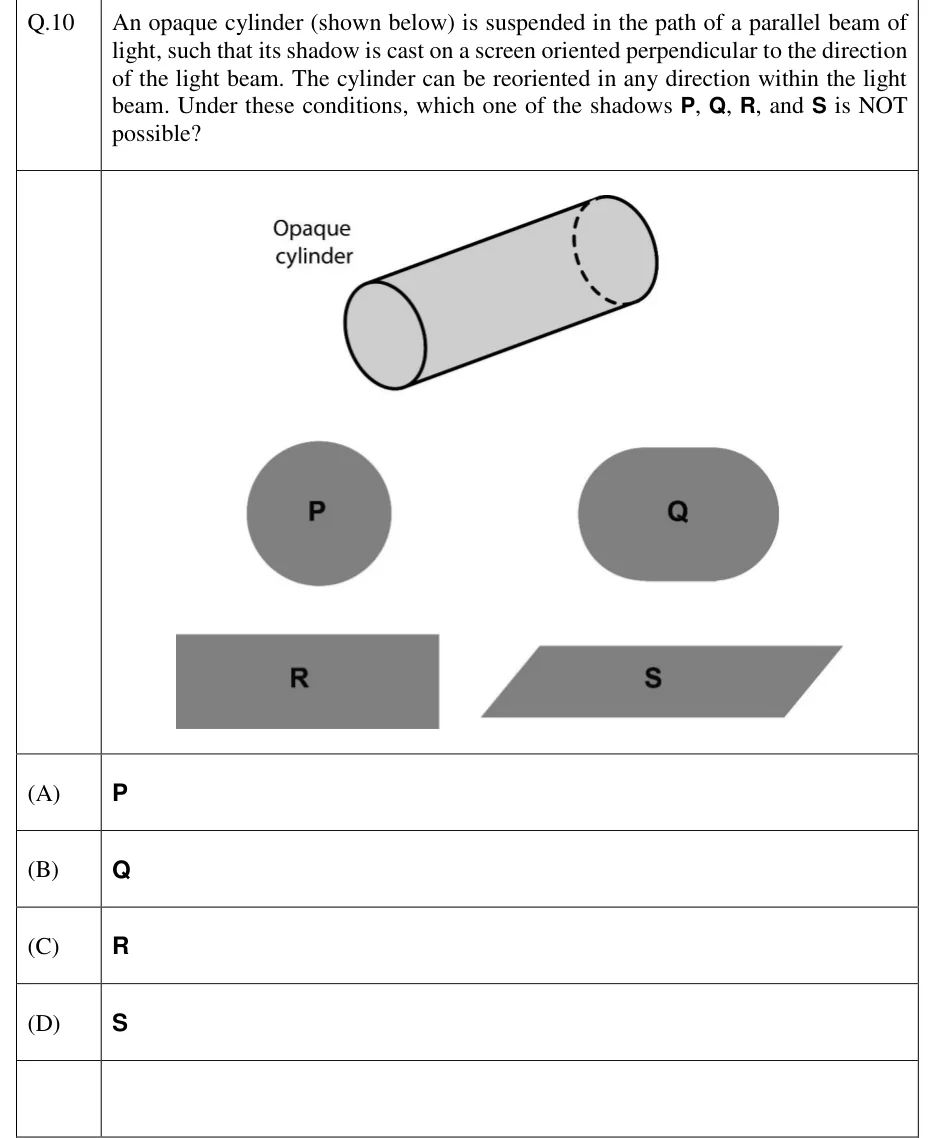
GATE 2023 IN GA question 10: Top: a 3D sketch of a solid circular cylinder, shaded light grey.Tap to open full size
Figure from the GATE 2023 IN paper. It is part of the question.
Figure description

Top: a 3D sketch of a solid circular cylinder, shaded light grey. Its axis rises from lower left to upper right. The near end face (lower left) is drawn as a full ellipse with a solid outline. At the far end (upper right), the visible half of the ellipse is solid and the hidden half is dashed. Two straight solid lines, tangent to both end ellipses, form the top and bottom edges. The label "Opaque cylinder" sits above and to the left of the cylinder. Below it are four candidate shadows, each a flat dark-grey filled shape with its bold letter at the centre. P (upper left): a circle. Q (upper right): a stadium or capsule shape, wider than it is tall, with straight horizontal top and bottom edges and rounded left and right ends. R (lower left): an axis-aligned rectangle, wider than it is tall. S (lower right): a parallelogram with horizontal top and bottom edges and both sides slanting the same way (bottom-left corner further left than top-left, bottom-right corner further left than top-right), so it leans to the right.

  1. (A)

    P

  2. (B)

    Q

  3. (C)

    R

  4. (D)

    S

Answer and solution

ANSWER

(D) S. A parallel beam can only produce a circle, a capsule or a rectangle as the cylinder's shadow. It can never produce a slanted parallelogram.

Official answer: DSource: Official answer key, GATE 2023 IN (IIT Kanpur)

  1. A parallel beam gives an orthographic projection onto a screen perpendicular to the beam: every point of the cylinder moves straight along the beam onto the screen. Let be the cylinder's diameter, its length and the angle between its axis and the beam.

  2. Take one end face first. It is a circle of diameter , and its normal is the cylinder's axis, which makes angle with the beam. Orthographically, this circle projects to an ellipse. The major axis is always and lies perpendicular to the projected axis. The minor axis is and lies along the projected axis.

  3. The cylinder is the end disc slid a distance along its axis. On the screen, that slide becomes a slide of along the projected axis. So the shadow is one end-ellipse swept along the projected axis, which is its minor-axis direction. The sweep is bounded by two straight lines parallel to the projected axis, each from it and touching the ellipses at the ends of their major axes, and it is capped by the outer halves of the two end-ellipses.

  4. (axis along the beam): and , so the two end faces project to the same circle of diameter . The shadow is a circle, so P is possible.

  5. (axis tilted): two parallel straight edges are capped by two rounded half-ellipse ends, giving a capsule shape. Q is possible.

  6. (axis across the beam): , so each end face flattens into a straight segment of length perpendicular to the projected axis, and the sweep length is . The shadow is a rectangle, so R is possible.

  7. For every , the shadow is symmetric about the projected axis, which is parallel to its long edges. Its ends are straight only when , and then they meet the long edges at . A slanted parallelogram has straight ends that are not perpendicular to its long edges, and it has no line of symmetry parallel to them. No orientation produces that, so S is NOT possible.

KEY IDEA

Under a parallel beam, the shadow is an orthographic projection. For a cylinder, that is always one end-ellipse (minor axis along the projected axis, major axis across it) swept a distance along the projected axis. The result is a circle (), a capsule () or a rectangle (). Every one of them is symmetric about a line parallel to its long edges, and any straight end meets those edges at a right angle.

WATCH OUT FOR

Picturing a tilted cylinder the way it looks in a perspective or oblique drawing, and assuming the tilt skews the rectangle into a parallelogram. Under parallel light, tilting the axis only curves the ends into half-ellipses; it never slants them. The opposite slip is to reject Q because the ends of a cylinder are flat. Those flat ends are circles seen at an angle, so they cast rounded shadows.

From the GATE 2023 IN paper. Every question of this paper · Download the full paper · All 23 Spatial questions, with notes

More Spatial questions