
IAE Academy

GATE 2023 IN GA Q.5: solution and answer

GATE 2023 · INGA Q.5 · 1 mark · MCQ

In the given diagram, ovals are marked at different heights () of a hill. Which one of the following options P, Q, R, and S depicts the top view of the hill?
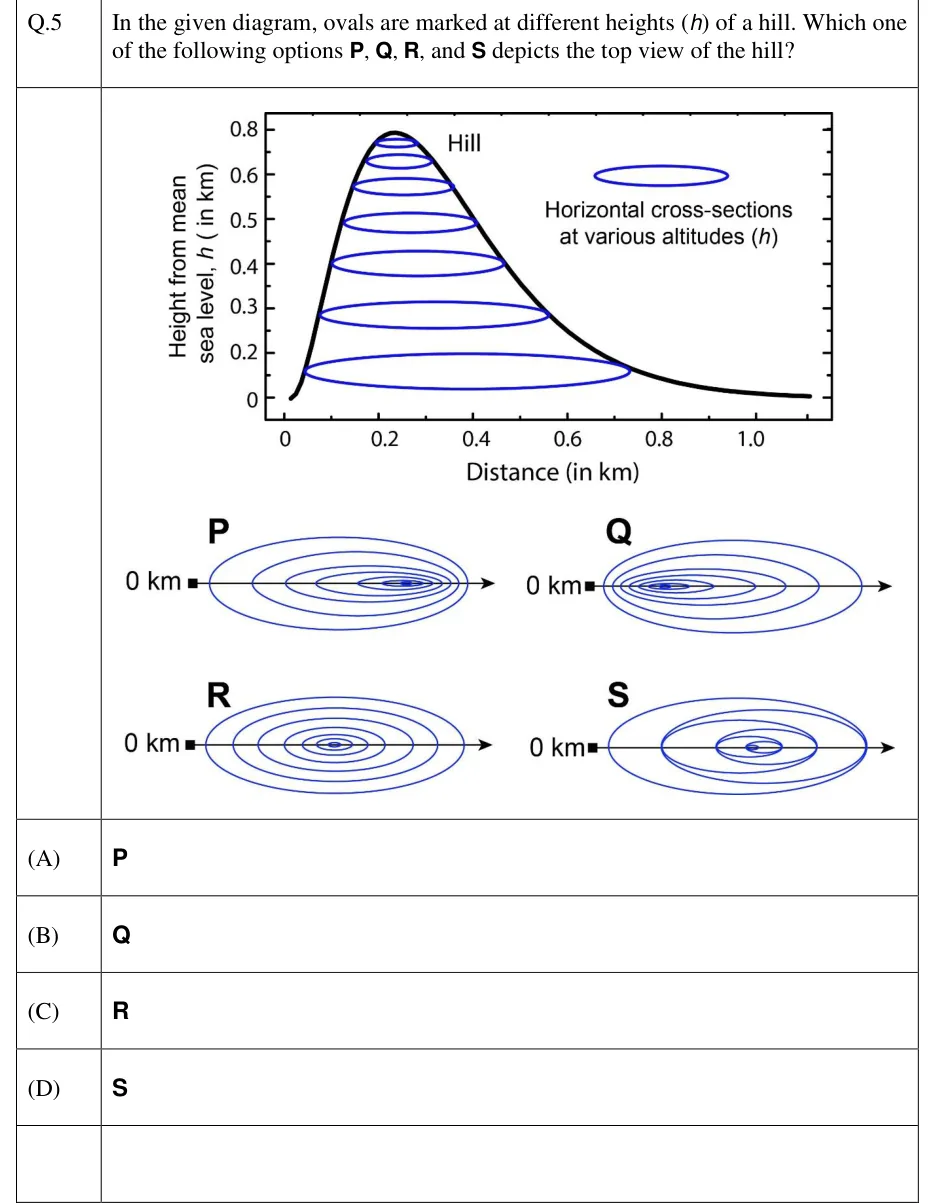
GATE 2023 IN GA question 5: Main figure: a graph.Tap to open full size
Figure from the GATE 2023 IN paper. It is part of the question.
Figure description

Main figure: a graph. The vertical axis is labelled "Height from mean sea level, h (in km)". Its tick labels, from bottom to top, are 0, 0.2, 0.3, 0.4, 0.5, 0.6, 0.8. They are equally spaced on the page, so the printed scale skips 0.1 and 0.7. The horizontal axis is labelled "Distance (in km)", with labelled ticks at 0, 0.2, 0.4, 0.6, 0.8, 1.0 and unlabelled minor ticks between them. The frame runs to about 1.15 km. A thick black curve labelled "Hill" starts at about (0.01, 0) and rises very steeply to a single peak at about 0.23 km, level with the 0.8 tick. It then falls more gently and flattens into a long tail that almost reaches zero height at about 1.1 km. So the hill is steep on the left, near 0 km, and gentle on the right. Seven blue horizontal ovals (cross-sections) sit inside the curve at different heights. Each runs from the left side of the curve to the right side at its height. From top to bottom, their approximate horizontal extents are 0.19-0.28 km (just below the peak), 0.17-0.31, 0.14-0.36, 0.12-0.41, 0.09-0.47, 0.07-0.57 and 0.04-0.74 km. The lowest one lies between the 0 and 0.2 ticks. The left ends of the ovals are close together and the right ends are far apart. Legend at the upper right: a blue oval above the text "Horizontal cross-sections at various altitudes (h)". Below the graph are four option figures. Each is drawn on a horizontal arrow that starts at a small black square labelled "0 km" and points right. Each shows seven nested closed curves: six ellipses and a tiny filled innermost oval (a dot). In every option the outer ellipse's left edge is just to the right of the 0 km square. P: the inner ellipses shift further to the RIGHT the smaller they are. Their right edges are bunched together near the right end of the outer ellipse, their left edges are far apart, and the dot is about three-quarters of the way across. Q: the inner ellipses shift further to the LEFT the smaller they are. Their left edges are bunched together near the 0 km end, their right edges are far apart, and the dot is about a quarter of the way across. Q is the mirror image of P. R: the ellipses share one centre, and the dot is in the middle of the outer ellipse. The gap between neighbouring ellipses is the same on the left as on the right, and the gaps get smaller towards the centre. S: an outer ellipse with the other ellipses inside it. Each ellipse touches the next one inside it, alternating between right end and left end. The outer ellipse and the next one almost meet at the right end. That one and the next share a leftmost point about a fifth of the way across. The next pair meet at the right, and so on inwards. The dot is slightly right of the middle. The spacing is irregular.

  1. (A)

    P

  2. (B)

    Q

  3. (C)

    R

  4. (D)

    S

Answer and solution

ANSWER

Q depicts the top view of the hill. The answer is (B).

Official answer: BSource: Official answer key, GATE 2023 IN (IIT Kanpur)

  1. Top view = the cross-sections seen from above. Looking straight down, each horizontal cross-section at height appears as a closed curve. It covers exactly the same stretch of the distance axis as its oval does in the side view. Higher sections are smaller and lie inside lower ones, so the top view is a set of nested closed curves (a contour map). In every option the arrow is the distance axis, with at the left, the same direction as in the graph.

  2. Read the left ends of the ovals. From the lowest oval to the highest they are at about . Consecutive gaps are only to , and all seven left ends fit within . The left ends are crowded.

  3. Read the right ends. From the lowest oval to the highest they are at about . The gaps are , and together they spread over , about three times the left-side spread. The right ends are widely spaced.

  4. Compare the two sides between the same pair of ovals. Two consecutive ovals differ by the same height on the left side as on the right side. So for each pair, the side with the smaller horizontal gap is the steeper side. Every left gap is smaller than the matching right gap (for the lowest pair it is against ). So the hill is steeper on the side at every level, which matches the profile's steep rise and long gentle tail. The ovals are not at equal height steps, so compare left and right between the same two ovals, not one level against another. In the top view this means the contours are bunched on the left and spread out on the right.

  5. Where the summit sits. The centre of the top oval is at and the centre of the lowest is at . The centres move right as falls, so the innermost contour is off-centre towards the left. The peak is at about , which is of the way across the outermost contour, counting from its left edge. That is roughly a quarter of the way across.

  6. Check each option. R has ellipses with one common centre and equal gaps on the left and right. That is a symmetric hill, but here the centres shift from to , so R is wrong. P bunches the contours on the right, with the summit about three-quarters of the way across. That is the mirror image of this hill, so P is wrong. In S each ellipse touches the next one, alternately at the left and the right. Two contours at different heights meeting at a point would mean a vertical cliff there. In the profile, every oval has its own left end and its own right end, and no two coincide, so S is wrong.

  7. Q has its left edges bunched near the mark and its right edges widely spaced. Its innermost oval is about a quarter of the way across from the left. That matches the profile, so the answer is Q, option (B).

KEY IDEA

The top view of a hill is its horizontal cross-sections seen from above, which is a contour map. Each oval in the side view becomes a closed curve covering the same distances. Where the hill is steep, one cross-section ends close to the next, so the contours bunch together. Where it is gentle, they spread out. This hill is steep on the 0 km side and has a long gentle tail to the right. So its contours must be bunched on the left and spread on the right, with the summit contour off-centre towards 0 km.

WATCH OUT FOR

Choosing P, the mirror image, by ignoring the 0 km mark that fixes left and right in every option. Other traps: picking R because a hill 'should' give concentric rings, which is true only for a symmetric hill. Reading crowded contours as a gentle slope instead of a steep one. Not noticing that the touching contours in S would mean vertical cliffs, which this hill does not have.

From the GATE 2023 IN paper. Every question of this paper · Download the full paper · All 23 Spatial questions, with notes

More Spatial questions