
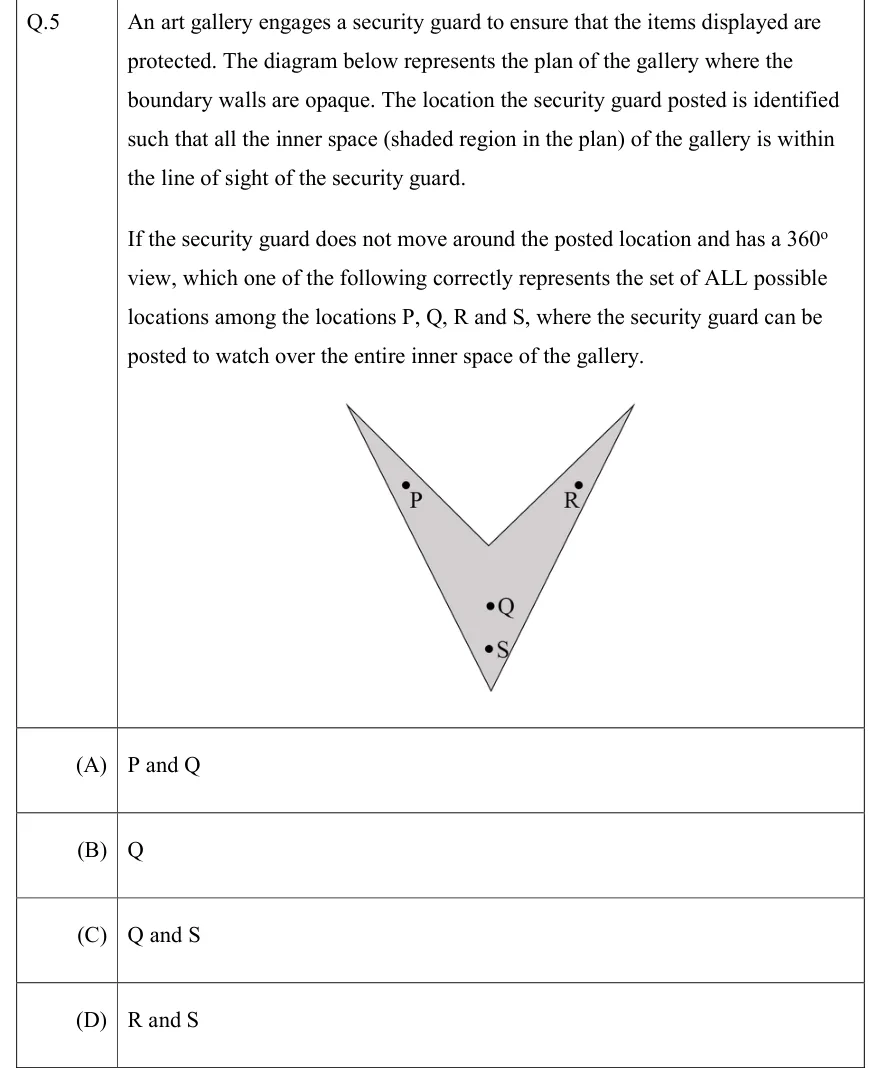
An art gallery engages a security guard to ensure that the items displayed are protected. The diagram below represents the plan of the gallery where the boundary walls are opaque. The location the security guard posted is identified such that all the inner space (shaded region in the plan) of the gallery is within the line of sight of the security guard.
If the security guard does not move around the posted location and has a 360 view, which one of the following correctly represents the set of ALL possible locations among the locations P, Q, R and S, where the security guard can be posted to watch over the entire inner space of the gallery.
 Tap to open full size
Figure description
A grey-shaded V-shaped (chevron) floor plan drawn as a concave quadrilateral with four vertices. There is a sharp top-left tip and a sharp top-right tip at the same height, and a sharp bottom tip directly below the middle. The fourth vertex is an inward (reflex) notch on the vertical centre line, about halfway down from the top tips to the bottom tip. The walls run: top-left tip to notch (inner edge of the left arm), notch to top-right tip (inner edge of the right arm), top-right tip to bottom tip (outer edge of the right arm), and bottom tip to top-left tip (outer edge of the left arm). The two arms are roughly mirror images, and the unshaded V-shaped gap between them lies above the notch. Four dots are marked inside the shaded region. P is in the upper part of the left arm, about a quarter of the way down, near that arm's inner wall. R is in the upper part of the right arm at about the same height, near that arm's inner wall. Q is on the vertical centre line, below the notch. S is on the same centre line below Q, close to the bottom tip, and its label touches the right outer wall. Q and S are in the single stem where the two arms merge; P and R are above the notch, one in each arm.
- (A)
P and Q
- (B)
Q
- (C)
Q and S
- (D)
R and S