
IAE Academy

GATE 2022 EC GA Q.10: solution and answer

GATE 2022 · ECGA Q.10 · 2 marks · MCQ

Consider the following square with the four corners and the center marked as P, Q, R, S and T respectively.

Let X, Y and Z represent the following operations:

X: rotation of the square by 180 degree with respect to the S-Q axis.

Y: rotation of the square by 180 degree with respect to the P-R axis.

Z: rotation of the square by 90 degree clockwise with respect to the axis perpendicular, going into the screen and passing through the point T.

Consider the following three distinct sequences of operation (which are applied in the left to right order).

(1) XYZZ
(2) XY
(3) ZZZZ

Which one of the following statements is correct as per the information provided above?
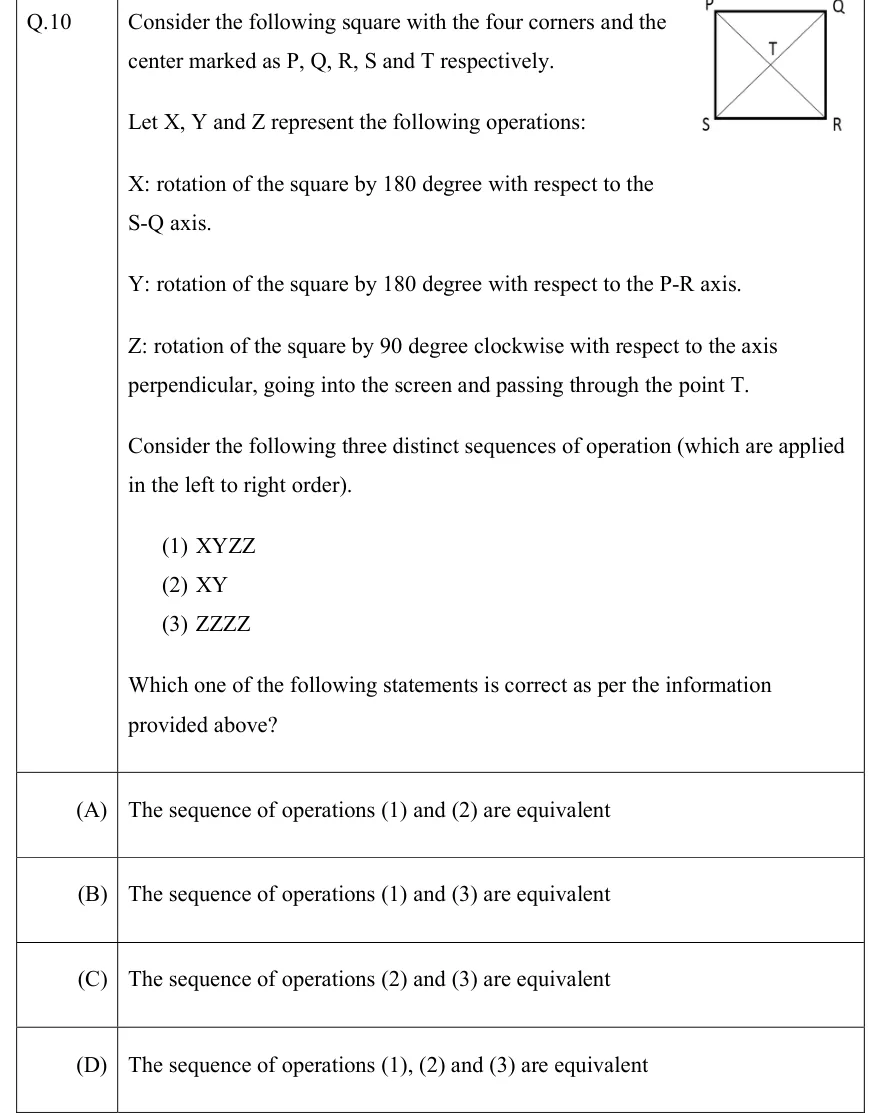
GATE 2022 EC GA question 10: A square drawn upright (sides horizontal and vertical) with both diagonals drawn as thin lines.Tap to open full size
Figure from the GATE 2022 EC paper. It is part of the question.
Figure description

A square drawn upright (sides horizontal and vertical) with both diagonals drawn as thin lines. Corner labels sit just outside the corners: P at the top-left, Q at the top-right, R at the bottom-right, S at the bottom-left. The two diagonals (P to R and Q to S) cross at the centre, which is labelled T just above the crossing point. The figure has no shading and no other marks.

  1. (A)

    The sequence of operations (1) and (2) are equivalent

  2. (B)

    The sequence of operations (1) and (3) are equivalent

  3. (C)

    The sequence of operations (2) and (3) are equivalent

  4. (D)

    The sequence of operations (1), (2) and (3) are equivalent

Answer and solution

ANSWER

(B) The sequence of operations (1) and (3) are equivalent. XY is a half-turn about T, so XYZZ is two half-turns (the identity), the same as ZZZZ. XY on its own is only a half-turn.

Official answer: BSource: Official answer key, GATE 2022 EC (IIT Kharagpur)

  1. Fix the starting layout, reading clockwise from the top-left: P (top-left), Q (top-right), R (bottom-right), S (bottom-left), with T at the centre.

  2. X is a turn about the diagonal S-Q. A half-turn about a line in the plane of the square is a flip over that line: points on the axis stay put and the other two corners swap. So S and Q stay, and P and R swap. Layout after X (top-left, top-right, bottom-right, bottom-left): R, Q, P, S.

  3. Y is a turn about the P-R diagonal. After X, R is at the top-left and P at the bottom-right, so P-R is still the top-left to bottom-right diagonal: the axis is the same line whether you take it as fixed in space or carried along with the labels. The flip keeps the top-left and bottom-right corners and swaps the top-right and bottom-left ones. Layout after XY: R, S, P, Q.

  4. Compare with the start (P, Q, R, S). Every corner has moved to the opposite corner: P from top-left to bottom-right, Q from top-right to bottom-left, and so on. So XY is a rotation about T. X alone turns the square face-down and Y turns it face-up again, so XY is an ordinary in-plane half-turn. (Rule: two half-turns about perpendicular lines crossing at T add up to a half-turn about the axis through T perpendicular to the square.)

  5. Z is a clockwise turn about the axis through T, so ZZ is a turn and ZZZZ is a turn, which leaves every corner where it started (the identity).

  6. Sequence (1): XYZZ is , the identity. Check: starting from R, S, P, Q, one Z (clockwise, so each label moves one corner to the right along the top) gives Q, R, S, P, and a second Z gives P, Q, R, S, the original.

  7. Sequence (2): XY is a turn, so the layout ends as R, S, P, Q, not the original.

  8. Sequence (3): ZZZZ is , the identity.

  9. So (1) and (3) both return the square to where it started and are equivalent. (2) matches neither of them, which rules out (A), (C) and (D). The answer is option (B).

KEY IDEA

A rotation about a line lying in the square is a flip over that line. Two flips over perpendicular diagonals make a rotation about the centre. So XY equals ZZ, which makes XYZZ equal ZZZZ (a full turn, the identity).

WATCH OUT FOR

Treating X and Y as turns about the centre T instead of flips over the diagonals. Then XY looks like a turn and (D) seems right. Another slip is to think XY undoes itself and leaves the square unchanged, which gives (C). Track the four corner labels step by step: XY sends each corner to the opposite one.

From the GATE 2022 EC paper. Every question of this paper · Download the full paper · All 23 Spatial questions, with notes

More Spatial questions