
IAE Academy

GATE 2024 EC GA Q.9: solution and answer

GATE 2024 · ECGA Q.9 · 2 marks · MCQ

Examples of mirror and water reflections are shown in the figures below:

[Figure: MIRROR REFLECTION and WATER REFLECTION examples]

An object appears as the following image after first reflecting in a mirror and then reflecting on water.

[Figure: seven-segment characters reading 5·24]

The original object is
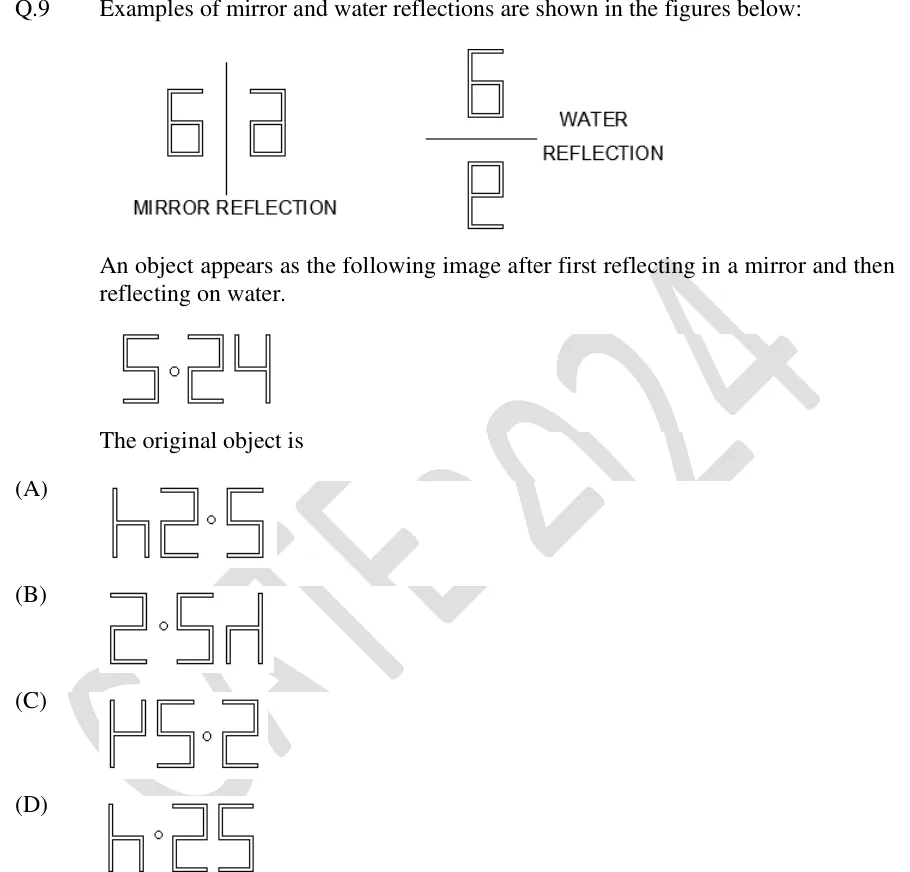
GATE 2024 EC GA question 9: Every character is a seven-segment-display glyph drawn with double (outlined) strokes.Tap to open full size
Figure from the GATE 2024 EC paper. It is part of the question.
Figure description

Every character is a seven-segment-display glyph drawn with double (outlined) strokes. Example 1, labelled MIRROR REFLECTION underneath: a seven-segment 6 (top, upper-left, middle, lower-left, bottom and lower-right segments lit) to the left of a vertical mirror line. To the right of the line is its left-right mirror image (top, upper-right, middle, lower-right, bottom and lower-left segments lit), which is a reversed 6. Example 2, labelled WATER REFLECTION to the right of a horizontal line: a seven-segment 6 above the line and, below it, its upside-down image (top, upper-left, upper-right, middle, lower-left and bottom segments lit). The observed image, after a mirror reflection followed by a water reflection, is four glyphs in a row. They are a seven-segment 5 (top, upper-left, middle, lower-right, bottom), a small circle (dot) very slightly below mid-height, a seven-segment 2 (top, upper-right, middle, lower-left, bottom) and a seven-segment 4 (upper-left, middle, upper-right, lower-right). The image reads 5·24. The options are figures in the same style. (A): h, 2, dot, 5, reading h2·5, with the dot slightly above mid-height. (B): 2, dot (slightly above mid-height), 5, then a glyph with a full right vertical, a middle bar and a lower-left vertical, which is a mirror-image h and also an upside-down 4. (C): a left-right mirror image of 4 (full left vertical, middle bar, upper-right vertical), then 5, dot (slightly below mid-height), 2. (D): h, dot, 2, 5, reading h·25.

  1. (A)

    Figure: seven-segment glyphs reading h2·5. They are h (full left vertical, middle bar, lower-right vertical), 2, a dot slightly above mid-height, and 5.

  2. (B)

    Figure: seven-segment glyphs reading 2·5 (dot slightly above mid-height), then a mirror-image h (full right vertical, middle bar, lower-left vertical).

  3. (C)

    Figure: seven-segment glyphs. They are a left-right mirror image of 4 (full left vertical, middle bar, upper-right vertical), 5, a dot slightly below mid-height, and 2.

  4. (D)

    Figure: seven-segment glyphs reading h·25. They are h, dot, 2, 5.

Answer and solution

ANSWER

The original object is (A), which reads h2·5. It is the observed image 5·24 rotated by 180 degrees: the order reverses, 5 and 2 stay the same, 4 becomes h, and the dot ends up between the 2 and the 5, just above centre.

Official answer: ASource: Official answer key, GATE 2024 EC (IISc Bengaluru)

  1. A mirror reflection (vertical mirror) swaps left and right. The order of the characters reverses, each character is flipped left to right, and the dot stays at the same height. A water reflection (horizontal surface) swaps top and bottom. The order of the characters stays the same, each character turns upside down, and a dot just below centre moves to just above centre. The printed examples agree: in the mirror the 6 becomes a reversed 6, and in the water it becomes an upside-down 6.

  2. A left-right flip followed by a top-bottom flip is a rotation in the plane. So the image is the original with the order of the characters reversed and each character rotated by . Two rotations make a full turn, so rotating the observed image by gives back the original object.

  3. The observed image, left to right, is , dot, , . Reversing the order gives , , dot, .

  4. Rotate each seven-segment glyph by . Upper-left and lower-right swap, upper-right and lower-left swap, top and bottom swap, and the middle bar stays. The (top, upper-left, middle, lower-right, bottom) maps onto itself, and so does the (top, upper-right, middle, lower-left, bottom).

  5. The (upper-left, middle, upper-right, lower-right) becomes lower-right, middle, lower-left, upper-left. That is a full left vertical, a middle bar and a lower-right vertical, which is the glyph .

  6. So the original reads , with the dot between the and the . In the image the dot is just below centre, so in the original it is just above centre, exactly as drawn in (A).

  7. Check the other options. (B) is what you get by undoing only the water reflection. It keeps the order and flips each glyph top to bottom, so the becomes a , the becomes a , and the becomes a mirror-image h. (C) is what you get by undoing only the mirror reflection. It reverses the order and flips each glyph left to right, so the becomes a mirror-image 4, the becomes a , and the becomes a . (D) has the right glyphs in the right order, but it puts the dot between the h and the . In the image the dot sits between the and the , so after the rotation it must sit between the and the . The answer is (A).

KEY IDEA

A mirror reflection followed by a water reflection is the same as rotating the object by 180 degrees in its own plane. A 180-degree rotation undoes itself, so the original is the image rotated by 180 degrees. Reverse the order of the characters and turn each one upside down in the rotational sense: in a seven-segment glyph, upper-left and lower-right swap, upper-right and lower-left swap, and top and bottom swap. Under this rotation 5 and 2 map onto themselves and 4 becomes h.

WATCH OUT FOR

Undoing only one of the two reflections. Undoing just the water reflection gives option (B), and undoing just the mirror reflection gives option (C). Both are traps. The other slip is to rotate each glyph but forget to reverse the order of the characters, or to reverse the characters but leave the dot where it was. That puts the dot between the h and the 2 and gives option (D).

From the GATE 2024 EC paper. Every question of this paper · Download the full paper · All 23 Spatial questions, with notes

More Spatial questions