
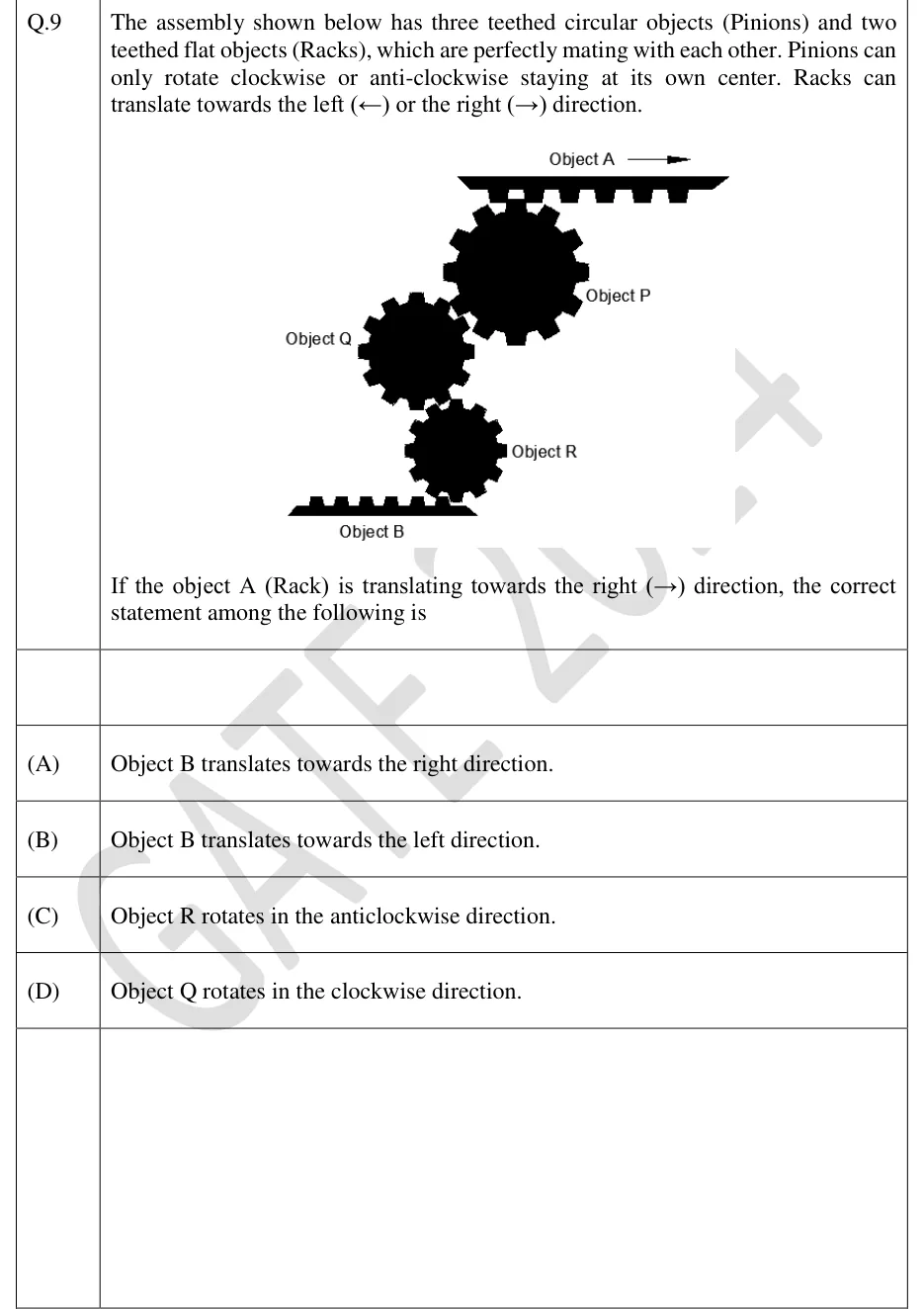
The assembly shown below has three teethed circular objects (Pinions) and two teethed flat objects (Racks), which are perfectly mating with each other. Pinions can only rotate clockwise or anti-clockwise staying at its own center. Racks can translate towards the left (←) or the right (→) direction.
[Figure]
If the object A (Rack) is translating towards the right (→) direction, the correct statement among the following is
 Tap to open full size
Figure description
Black silhouette drawing of a gear train. At the top is a horizontal rack labelled "Object A", with its teeth pointing downward and an arrow beside the label pointing to the right (→). Directly below Object A, meshing with its teeth, is the largest gear, "Object P" (label to its right). Down and to the left of P, meshing with P, is a medium gear, "Object Q" (label to its left). Below Q and slightly to the right, meshing with Q, is a smaller gear, "Object R" (label to its right). P and R do not touch. At the bottom is a horizontal rack labelled "Object B" (label below it), with its teeth pointing upward, meshing with R from underneath. So the order of contact is A (rack, on top of P) → P → Q → R → B (rack, under R).
- (A)
Object B translates towards the right direction.
- (B)
Object B translates towards the left direction.
- (C)
Object R rotates in the anticlockwise direction.
- (D)
Object Q rotates in the clockwise direction.