GATE 2026 EC GA Q.4
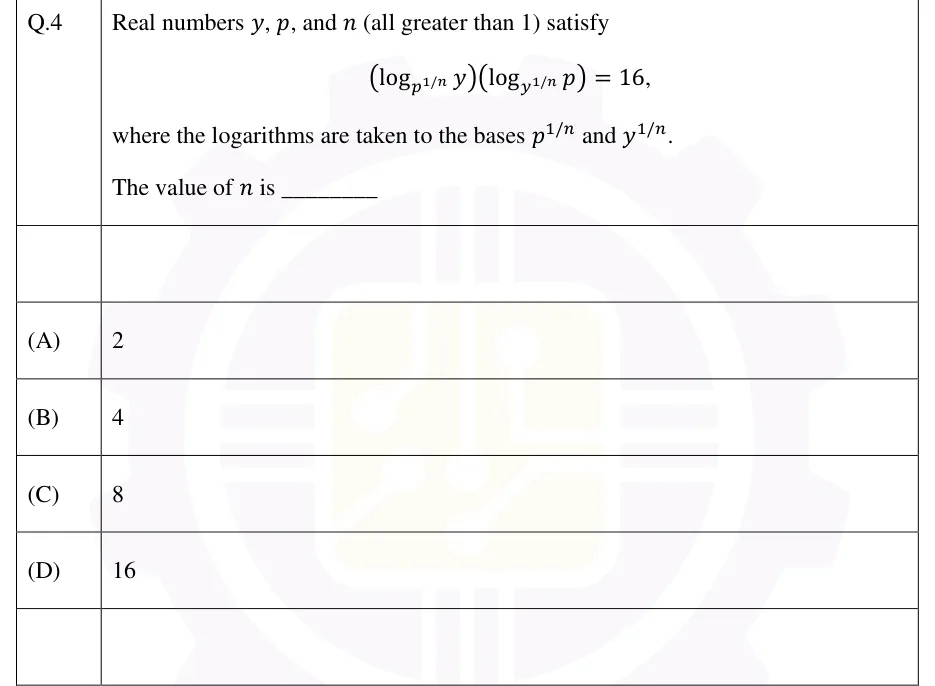
Real numbers , , and (all greater than 1) satisfy
where the logarithms are taken to the bases and .
The value of is ______
- (A)
2
- (B)
4
- (C)
8
- (D)
16

EVERY GATE PAPER
Ratios, percentages, powers, logarithms, counting and series
Numerical computation is the arithmetic toolkit of General Aptitude: ratios and percentages, rates (averages, mixtures, speed, work and interest), powers and logarithms, properties of whole numbers, progressions and series, and counting by permutations and combinations. Almost every quantitative aptitude question reduces to one of these tools applied cleanly, so what pays is knowing each standard result together with its conditions, reading the question's convention correctly (what the percentage is taken of, whether order matters), and estimating fast enough to check an answer before it is entered.
58 previous-year questions · 58 solved · 6 practice questions
Conventions used in these notes. A percentage change is taken of the ORIGINAL (base) value unless the question says otherwise, so 'A is 25% more than B' means . Profit and loss percentages are on the cost price (CP) and a discount is on the marked price (MP), unless stated otherwise. Ratios are written in lowest terms. Money is written in Rs. For counting, is the number of arrangements (order matters) and the number of selections (order does not matter), with . 'At least ' means or more and 'at most ' means or fewer; both include .
A ratio compares two quantities of the same kind and is unchanged when both terms are multiplied by the same non-zero number. The quickest way into any ratio problem is to write the quantities as multiples of one unknown: if , put and , then find from the one extra fact the question gives.
COMBINING TWO RATIOS THROUGH A COMMON TERM
Scale both ratios so that the common term has the same value () in each.
DIVIDING N IN THE RATIO A : B : C
The shares add back to . If only the difference between two shares is given, divide it by the difference of their ratio terms to get the value of one ratio unit.
PROPORTION; COMPONENDO AND DIVIDENDO
Needs , and for the second form. The mean proportional of two positive numbers and is ; for , the third proportional to and is and the fourth proportional to , and is (so that ).
PARTNERSHIP (SHARING PROFIT)
Profit is shared in the ratio of capital × time when no partner draws a salary or a fixed share first. If a partner's capital changes midway, add capital × months over each period.
PERCENTAGE CHANGE
Positive for an increase, negative for a decrease. 'A is less than B' uses B as the base; the matching statement 'B is more than A' uses A, so for , which is larger than .
TWO SUCCESSIVE PERCENTAGE CHANGES
Each change is taken on the value left by the previous step; write an increase as positive and a decrease as negative. For three or more changes multiply the factors: .
KEEPING EXPENDITURE CONSTANT
Expenditure = price × consumption. If instead the price falls by (), consumption can rise by for the same expenditure. The same algebra covers any product held fixed (speed × time for a fixed distance).
PROFIT, LOSS AND DISCOUNT
is the profit percentage on CP (negative for a loss); is the discount percentage on MP. Successive discounts combine like successive changes, so 20% and 10% make a single discount of , not .
SIMPLE INTEREST
principal, rate in per cent per annum, time in years. Interest is earned on the principal only, so the amount grows by the same sum every year (an AP).
COMPOUND INTEREST
Interest is added to the principal at the end of each period, so the amount grows by a constant factor (a GP). . For different rates in successive years multiply the factors . The same formula gives population growth at a year, and a value that depreciates by a year becomes .
DIFFERENCE BETWEEN COMPOUND AND SIMPLE INTEREST
Same and , compounded annually.
Fractions worth knowing as percentages
Fraction | Percentage | Fraction | Percentage |
|---|---|---|---|
50% | 14.29% (approx.) | ||
33.33% (approx.) | 12.5% | ||
25% | 11.11% (approx.) | ||
20% | 9.09% (approx.) | ||
16.67% (approx.) | 8.33% (approx.) |
WORKED EXAMPLE · SUCCESSIVE DISCOUNTS
An article is marked 40% above its cost price. The seller then allows two successive discounts of 10% and 5% on the marked price. Find the profit percentage.
Take . Then .
After the 10% discount: . The 5% discount is on this reduced price: .
Profit on a cost of 100, so the profit is of CP.
Check with the factor method: .
Answer: Profit of 19.7%
WORKED EXAMPLE · CI MINUS SI
The difference between the compound interest (compounded annually) and the simple interest on a sum of money for 2 years at 8% per annum is Rs. 96. Find the sum.
For 2 years, .
, so .
Check: . The amount at compound interest is , so , and .
Answer: Rs. 15000
EXAM TRAP
Per cent is not percentage point. A rate that goes from 10% to 12% rises by 2 percentage points, which is a rise of 20%. Read which one the question asks for.
EXAM TRAP
An equal rise and fall is a net loss. A rise of followed by a fall of , in either order, gives a net change of , never zero: up 20% then down 20% is down 4%.
Averages, mixtures, motion and work are all rate problems, and three ideas carry every one of them. A total is rate × quantity (sum = average × count, distance = speed × time, work = rate × time). Rates of things acting together add, with a minus sign for anything working against the others. A weighted average with positive weights always lies between the smallest and the largest of the values being averaged.
AVERAGE AND WEIGHTED AVERAGE
Adding to every value adds to the average. Replacing one value changes the sum by (new − old), so the average changes by . Work with sums, not averages, when items join or leave a group.
ALLIGATION (RULE OF MIXTURE)
Quantity at price (or concentration) mixed with at gives the mean . It is the weighted-average formula rearranged, so it works for prices, percentages of a component and marks. It also works for average speeds, provided the quantities are the TIMES spent at each speed, not the distances. Water counts as price 0.
REPEATED REMOVAL AND REPLACEMENT
A container is full with litres of pure liquid A. litres are drawn off and replaced by liquid B, and this is done times, with complete mixing each time. Each operation multiplies the amount of A by , so if the container instead starts with litres of A in a mixture of total volume , the amount left is .
SPEED, DISTANCE AND TIME
Put every quantity in one unit system before calculating. For a fixed distance, time is inversely proportional to speed.
AVERAGE SPEED
Over equal distances at speeds and the average speed is their harmonic mean, which is less than the arithmetic mean unless .
RELATIVE SPEED AND TRAINS
Time to close a gap or to pass = (length to be covered) ÷ (relative speed). A train of length passes a pole or a standing person in and a platform of length in ; two trains pass each other in .
TWO BODIES STARTING TOWARDS EACH OTHER
A starts from P towards Q and B starts from Q towards P at the same moment, each at a constant speed. After they meet, A takes time to reach Q and B takes time to reach P. Why: both travel for the same time before meeting, so and , and dividing gives .
BOATS AND STREAMS
is the speed in still water, the speed of the stream, the downstream and the upstream speed ( for the boat to make headway upstream).
TIME AND WORK; PIPES AND CISTERNS
Rates add when workers act together; an outlet pipe, or anyone undoing the job, has a negative rate. Taking the total work as the LCM of the given times keeps every rate a whole number of units per day (or hour).
MEN, DAYS, HOURS AND WORK
Assumes every worker has the same efficiency, so the work done is proportional to men × days × hours per day.
WORKED EXAMPLE · TRAIN PASSING A WALKER
A train 240 m long passes a man walking at 6 km/h in the same direction as the train in 18 seconds. Find the speed of the train in km/h.
Relative to the man, the train covers its own length: relative speed m/s.
Convert: km/h.
Same direction, so relative speed . Hence km/h.
Answer: 54 km/h
WORKED EXAMPLE · A WORKER LEAVES EARLY
A can finish a job in 12 days and B in 18 days. They start together, but A leaves 3 days before the job is finished. In how many days is the whole job finished?
Take the total work as units. A does 3 units per day and B does 2 units per day.
In the last 3 days only B works: units.
The remaining units were done by both together at units per day, taking days.
Total time days.
Answer: 9 days
EXAM TRAP
Average speed is not the average of the speeds. Going at 40 km/h and returning over the same road at 60 km/h gives km/h, not 50 km/h.
EXAM TRAP
Add rates, never times. Two pipes that fill a tank in 6 h and 3 h take h together, not 4.5 h. With alligation, first check that the mean lies between the two ingredients; if it does not, the mixture is impossible or the data has been misread.
Exponent laws turn products of powers into sums of exponents, and logarithms turn products of numbers into sums. Questions here ask you to simplify an expression, solve an equation with the unknown in an exponent, compare two large powers, or count the digits of a large number. In these notes means and means .
LAWS OF EXPONENTS
Valid for all real exponents when ; for integer exponents any non-zero will do. A tower is read from the top: , which is not .
ZERO, NEGATIVE AND FRACTIONAL EXPONENTS
For , is the positive -th root.
EQUATING EXPONENTS OR BASES
Solve an exponential equation by writing both sides as powers of the same base, e.g. gives , so .
SURDS AND RATIONALISING
For , with in the second. Multiply by the conjugate to clear a root from the denominator. .
SQUARE ROOT OF A SURD EXPRESSION
Find two positive numbers with sum and product . For the result is with . Example: .
DEFINITION OF A LOGARITHM
The logarithm exists only for a positive argument and a positive base other than 1. and for every valid base. For , increases as increases; for it decreases, so taking logarithms to such a base reverses an inequality.
LAWS OF LOGARITHMS
For . There is no law for .
CHANGE OF BASE
Any valid base may be used; choose 10, , or whichever base makes the numbers simplest. The last form needs .
TWO IDENTITIES
For . To verify the second, take of both sides: each becomes .
DIGITS OF A LARGE NUMBER
is the greatest integer not exceeding the value. For a non-integer the same expression counts the digits before the decimal point. For , the number of zeros between the decimal point and the first non-zero digit is .
Values worth remembering (logarithms, e and square roots to four decimal places; powers exact)
Quantity | Value | Quantity | Value |
|---|---|---|---|
0.3010 | 1024 | ||
0.4771 | 243 | ||
0.6990 | 625 | ||
0.8451 | 343 | ||
0.6931 | 2.7183 | ||
2.3026 | , | 1.4142, 1.7321 |
WORKED EXAMPLE · COUNTING DIGITS
Given , how many digits does have?
.
So , and the number of digits is .
Answer: 16 digits
WORKED EXAMPLE · MIXED BASES
Solve .
Change every term to base 2: and .
, so .
, which is positive, so it is admissible.
Check: .
Answer:
SHORTCUT
Compare powers by matching exponents. and , so . When the exponents share no convenient factor, compare logarithms instead: and , so .
EXAM TRAP
Check the domain after solving. Reject any root of a logarithmic equation that makes an argument zero or negative, or a base non-positive or equal to 1. Squaring or combining logs can create such roots.
Natural numbers are ; whole numbers include 0 as well. A prime has exactly two positive factors, 1 and itself, so 1 is neither prime nor composite and 2 is the only even prime. Every integer greater than 1 has a prime factorisation that is unique apart from the order of the factors, and almost every question on factors, HCF and LCM starts by writing it down.
Divisibility tests
2, 5, 10: the last digit is even; is 0 or 5; is 0.
4 and 8: the number formed by the last two digits is divisible by 4; by the last three digits, divisible by 8.
3 and 9: the sum of the digits is divisible by 3 (respectively 9).
11: (sum of the digits in odd places) − (sum of the digits in even places) is 0 or a multiple of 11.
7, 11, 13: since , split the number into groups of three digits from the right and take the alternating sum of the groups; the number is divisible by 7, 11 or 13 exactly when that sum is. Example: gives , so it is divisible by all three.
Composite divisors: test coprime factors separately. Divisible by 12 means divisible by 3 and by 4 (not by 2 and 6, which share a factor).
DIVISION ALGORITHM
For an integer and a positive integer , the quotient and remainder are unique. A reported remainder is never negative: a 'remainder of ' on division by 7 is only a working shortcut and means 6.
REMAINDERS OF SUMS AND PRODUCTS
Replace each number by its remainder before adding or multiplying; remainders of powers follow by repeated multiplication. means and leave the same remainder on division by .
FERMAT'S LITTLE THEOREM
For a prime that does not divide . For the remainder of a large power on division by , reduce the exponent modulo .
DIVISIBILITY OF A^N − B^N AND A^N + B^N
reads ' divides '. Here are integers with a non-zero divisor and is a positive integer. Example: is divisible by both 16 and 18.
HCF AND LCM OF TWO NUMBERS
True for exactly two positive integers, not for three or more. The HCF takes the lowest power of each common prime; the LCM takes the highest power of every prime present.
HCF AND LCM OF FRACTIONS
Write each fraction in lowest terms first.
NUMBER AND SUM OF FACTORS
are distinct primes. counts all positive factors including 1 and ; is their sum. is a perfect square exactly when is odd. can be written as a product of two positive factors (order ignored) in ways, or ways when is a perfect square. Example: has factors, so it is a product of two factors in 15 ways.
HOW MANY NUMBERS UP TO N ARE COPRIME TO N
counts the integers from 1 to whose only common factor with is 1; are the distinct primes dividing . Example: . Euler's theorem extends Fermat's to any modulus: if and have no common factor other than 1, then ; for instance leaves remainder 1 on division by 36.
HIGHEST POWER OF A PRIME IN A FACTORIAL
Stop when . The number of trailing zeros of is this sum with , since there are always at least as many 2s as 5s. Example: ends in zeros.
Cycles of the last digit of successive powers
Last digit of the base | Last digits of the 1st, 2nd, 3rd, ... powers | Cycle length |
|---|---|---|
0, 1, 5, 6 | the same digit every time | 1 |
4 | 4, 6 | 2 |
9 | 9, 1 | 2 |
2 | 2, 4, 8, 6 | 4 |
3 | 3, 9, 7, 1 | 4 |
7 | 7, 9, 3, 1 | 4 |
8 | 8, 4, 2, 6 | 4 |
Unit digit of a^n (n a positive integer)
Keep only the last digit of .
Find the remainder of on division by 4; if the remainder is 0, use 4 instead.
Raise the last digit to that small exponent; its last digit is the answer. (Every cycle length above divides 4, so this works for every base.)
WORKED EXAMPLE · LCM WITH A CONDITION
Find the smallest positive integer that leaves a remainder of 3 when divided by each of 4, 6 and 9, and is itself divisible by 7.
, so every number leaving remainder 3 on division by 4, 6 and 9 has the form with .
, so .
For we need , that is . The smallest such is 4, giving .
Check: , and where is divisible by 4, 6 and 9.
Answer: 147
WORKED EXAMPLE · REMAINDER AND UNIT DIGIT OF LARGE POWERS
(a) Find the remainder when is divided by 7. (b) Find the unit digit of .
(a) and , so .
(b) , so ends like , in 3.
, so ends like , in 9.
The product ends like , in 7.
Answer: (a) 2; (b) 7
EXAM TRAP
HCF × LCM = product holds for two numbers only. For 4, 6 and 9 the HCF is 1 and the LCM is 36, but the product is 216. And an exponent that leaves remainder 0 on division by 4 points to the FOURTH term of the cycle: ends in 1, like .
SHORTCUT
Same remainder from several numbers. The largest number that divides , and leaving the same remainder in each case is . The numbers that leave remainder on division by each of (with less than every ) are exactly for , so the smallest one greater than is .
A sequence is a list of numbers in a definite order and a series is the sum of its terms. Two patterns carry most of the algebra: an arithmetic progression (AP) adds a fixed common difference at each step, and a geometric progression (GP) multiplies by a fixed common ratio . Number-series questions (find the next term, the missing term or the wrong term) are pattern recognition built on these and on squares, cubes and primes.
ARITHMETIC PROGRESSION
first term, common difference, last term. The number of terms from to is . Take three terms in AP as so that their sum is simply . For any sequence, not only an AP, and for .
GEOMETRIC PROGRESSION
If , . An infinite GP has a finite sum only when . Take three terms in GP as so that their product is .
ARITHMETICO-GEOMETRIC SERIES
Each term is an AP term times a GP term. If the formula slips from memory, write , subtract term by term and sum the GP that remains.
MEANS OF TWO POSITIVE NUMBERS
Equality holds only when . A harmonic progression is a sequence whose reciprocals form an AP. AM ≥ GM also holds for positive numbers: with the sum fixed, the product is greatest when the numbers are equal, and with the product fixed, the sum is least when they are equal.
SUMS OF POWERS OF THE FIRST N NATURAL NUMBERS
Also: the sum of the first odd numbers is and the sum of the first even numbers is .
TELESCOPING BY PARTIAL FRACTIONS
Split each term into a difference so that neighbouring pieces cancel; only the first and last pieces survive.
Patterns to test, in this order, for a missing or wrong term
Constant first differences (an AP), or constant second differences (the terms follow a quadratic in the position ).
A constant ratio (a GP), or a ratio that itself changes steadily, such as
Squares, cubes or primes, possibly with a constant or the position added or subtracted, such as or .
Two separate series interleaved in alternate positions.
Each term built from the previous two (their sum, difference or product).
Mixed operations repeating in a cycle, such as
WORKED EXAMPLE · SUM OF AN AP
Find the sum of all three-digit numbers that are divisible by 7.
The smallest is and the largest is .
Number of terms: .
.
Answer: 70336
WORKED EXAMPLE · TELESCOPING SERIES
Evaluate .
The general term is for ; here the two factors differ by .
So .
Adding, the inner pieces cancel: .
.
Answer:
EXAM TRAP
Count terms with the +1. From 105 to 994 in steps of 7 there are terms, not 127. An infinite GP needs : has no finite sum, even though would return .
SHORTCUT
Recurring decimals are infinite GPs. . When the repetition starts right after the decimal point, a block of repeating digits is that block divided by nines. When digits come before the repeating block, take (all the digits up to the end of the first block) minus (the digits before the block), over nines followed by zeros: and .
Counting rests on two principles. If one task can be done in ways and a second, independent task in ways, doing both (task 1 AND task 2) can be done in ways. If the tasks are alternatives that cannot both happen (task 1 OR task 2), the count is . Every formula below is one of these principles applied to a standard situation. Before choosing a formula, answer three questions: does order matter, is repetition allowed, and are the objects distinct or identical?
ARRANGEMENTS AND SELECTIONS OF DISTINCT OBJECTS
, no repetition. , and .
PROPERTIES OF NCR
If then or . The number of ways to select at least one item from distinct items is .
BINOMIAL THEOREM
For a positive integer . There are terms and is the general term. Putting gives .
INCLUSION AND EXCLUSION
Anything counted twice is subtracted once, and so on. Among exactly numbers are multiples of . Example: from 1 to 100, the numbers divisible by 2 or 3 number (16 being the multiples of 6).
REPETITION ALLOWED
positions each filled from distinct kinds in unlimited supply give ordered arrangements. When only how many of each kind are chosen matters, the number of selections of items from kinds is .
ARRANGEMENTS WITH IDENTICAL OBJECTS
objects of which are alike of one kind, alike of another, and so on (; an object with no duplicate counts as a kind with ). Selecting at least one item from identical items of one kind, of a second kind and of a third can be done in ways.
CIRCULAR ARRANGEMENTS
For distinct objects only the relative order counts. The halved count () applies to necklaces, garlands and rings of beads that can be turned over, never to people seated round a table. If the seats are numbered, or one position is otherwise marked, the arrangement is linear: .
DISTRIBUTING N OBJECTS INTO R DISTINCT BOXES
Equivalently, has solutions in non-negative integers and in positive integers (needs ). The count for distinct objects allows empty boxes; with no box empty it is , by inclusion and exclusion. Example: 4 distinct objects into 3 boxes with none empty: .
DIVISION INTO EQUAL GROUPS
Ways to split distinct objects into unlabelled groups of each. Drop the when the groups are labelled (named teams, rooms, or people receiving them). Example: 4 players into two pairs: . For groups of different sizes , and no division by the number of groups is needed: , so 9 objects split into groups of 2, 3 and 4 in ways.
DERANGEMENTS
Arrangements of distinct items in which none is in its own original place (letters in wrong envelopes). , , , , .
COUNTING IN GEOMETRY AND ON GRIDS
Lines and triangles are for points with no three collinear. If of them () lie on one line and no other three are collinear, subtract lines and triangles. Grid paths counts the shortest routes made of unit steps right and unit steps up in any order.
Choosing the formula
Situation | Order matters? | Repetition? | Count |
|---|---|---|---|
Arrange of distinct objects in a row | Yes | No | |
Choose of distinct objects | No | No | |
Fill positions from symbols (codes, strings) | Yes | Yes | |
Choose items from kinds in unlimited supply | No | Yes | |
Arrange objects: alike of one kind, alike of another, the rest all different | Yes | Identical objects | |
Seat distinct people round a table | Relative order only | No |
WORKED EXAMPLE · LETTERS WITH REPEATS
How many distinct arrangements of the letters of the word PARALLEL are there? In how many of them do the three vowels come together?
PARALLEL has 8 letters: P, R and E once each, A twice and L three times.
All arrangements: .
Vowels together: tie A, A, E into one block. The units to arrange are the block, P, R, L, L, L: six units with L three times, giving .
Inside the block, A, A, E can be ordered in ways.
Vowels together: .
Answer: 3360 arrangements in all; 360 with the vowels together
WORKED EXAMPLE · AT LEAST, BY THE COMPLEMENT
A committee of 5 is to be chosen from 6 men and 5 women so that it contains at least 2 women. In how many ways can this be done?
'At least 2 women' is quicker through the complement: all committees minus those with 0 or 1 woman.
All committees: .
No woman: . Exactly one woman: .
Required number .
Check by cases (2, 3, 4, 5 women): .
Answer: 381
EXAM TRAP
Do not fix a 'first pick' and then choose the rest freely. Counting 'at least one woman' as counts a committee with two women twice (once for each woman picked 'first'). Use the complement or split into exact cases.
EXAM TRAP
Distinct or identical changes everything. Five identical sweets can be given to 3 children in ways; five different sweets in ways. And people round a table give , not : the clockwise and anticlockwise orders give each person a different neighbour on the left, so they are different seatings.
A numerical answer question states how the answer is to be rounded, and a multiple-choice question offers only four values, so a rounded calculation done first tells you what size of answer to expect or which option to aim for, and it catches slips in the exact working. Round to two or three significant figures, keep track of whether each rounding pushed the result up or down, and let errors cancel where you can (round one factor up and another down).
FIRST-ORDER APPROXIMATION
Good when is a few per cent; the neglected term is about . Example: (exact value ).
SQUARE ROOT NEAR A PERFECT SQUARE
Example: ; indeed .
RELATIVE CHANGE OF A PRODUCT, QUOTIENT OR POWER
For small relative changes. A 2% rise in length and a 3% rise in width raise the area by about 5% (exactly ).
DOUBLING TIME AT COMPOUND INTEREST (ESTIMATE)
An approximation for annual compounding at a moderate rate of per year; the exact time is . At 8%: estimate 9 years, exact about 9.01 years.
WORKED EXAMPLE · ESTIMATE, THEN REFINE
Estimate without a calculator, and decide whether the exact value is above or below your first estimate.
Round: .
Direction of each rounding: raises the result by about ; lowers it by about ; enlarges the denominator by about and so lowers the result by about .
Net: the estimate is low by about , so the exact value is about 102.
Exact: and (to two decimal places).
Answer: First estimate 100; the exact value, 102.12, is above it
EXAM TRAP
Check the size of a NAT answer before entering it. A misplaced decimal point, km/h entered where m/s was asked, or a percentage entered as a fraction (0.2 for 20%) all give an answer off by a factor of 10, 3.6 or 100. A one-line estimate catches each of them.
SHORTCUT
Let the options decide the precision. If the options differ by more than your rounding error, the estimate alone picks the answer; only when two options are close do you need the exact calculation.
PREVIOUS-YEAR QUESTIONS
Try each question first, then open the answer. We placed each question under a topic ourselves; the exam paper does not label topics.
See these papers in full: GATE ECE 2026 · GATE ECE 2025 · GATE ECE 2024 · GATE ECE 2023 · GATE ECE 2022 · GATE ECE 2020 · GATE ECE 2018 · GATE EE 2026 · GATE EE 2025 · GATE EE 2024 · GATE EE 2023 · GATE EE 2022 · GATE EE 2020 · GATE EE 2018 · GATE IN 2026 · GATE IN 2025 · GATE IN 2024 · GATE IN 2023 · GATE IN 2022 · GATE IN 2020 · GATE IN 2018
Real numbers , , and (all greater than 1) satisfy
where the logarithms are taken to the bases and .
The value of is ______
2
4
8
16
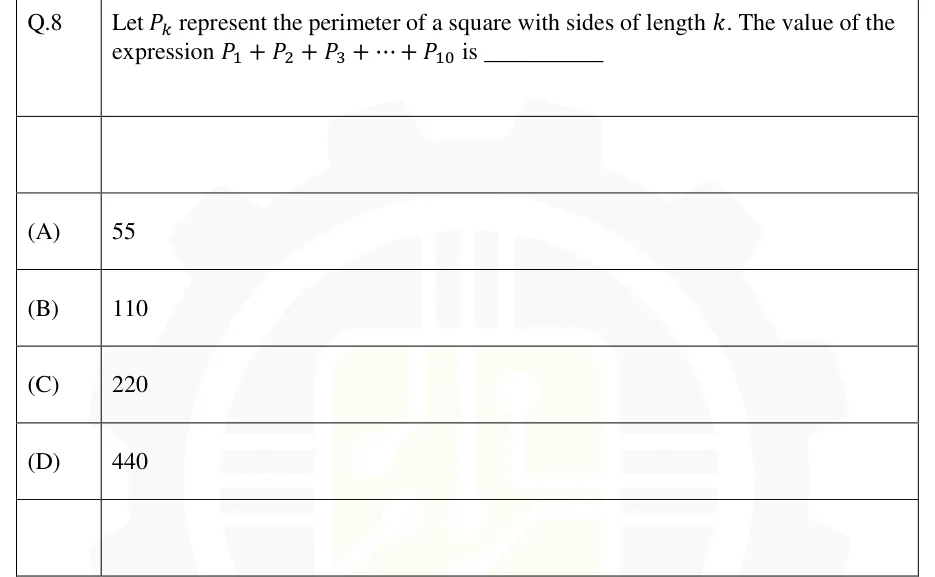
Let represent the perimeter of a square with sides of length . The value of the expression is ______
55
110
220
440
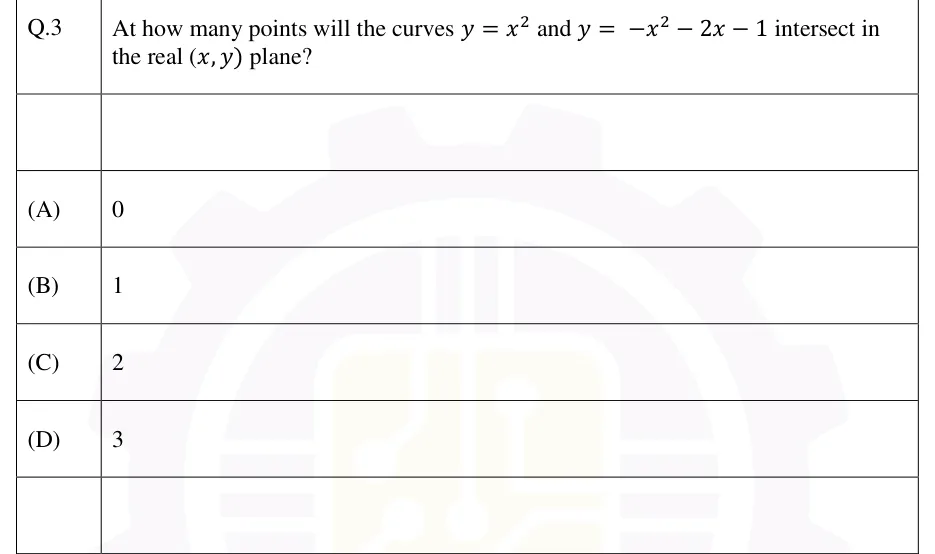
At how many points will the curves and intersect in the real plane?
0
1
2
3
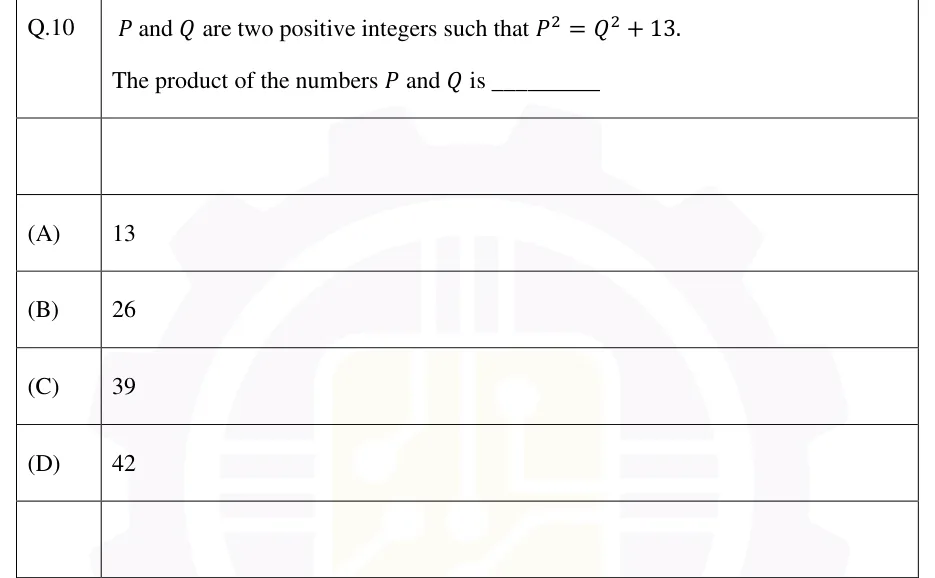
and are two positive integers such that .
The product of the numbers and is ______
13
26
39
42
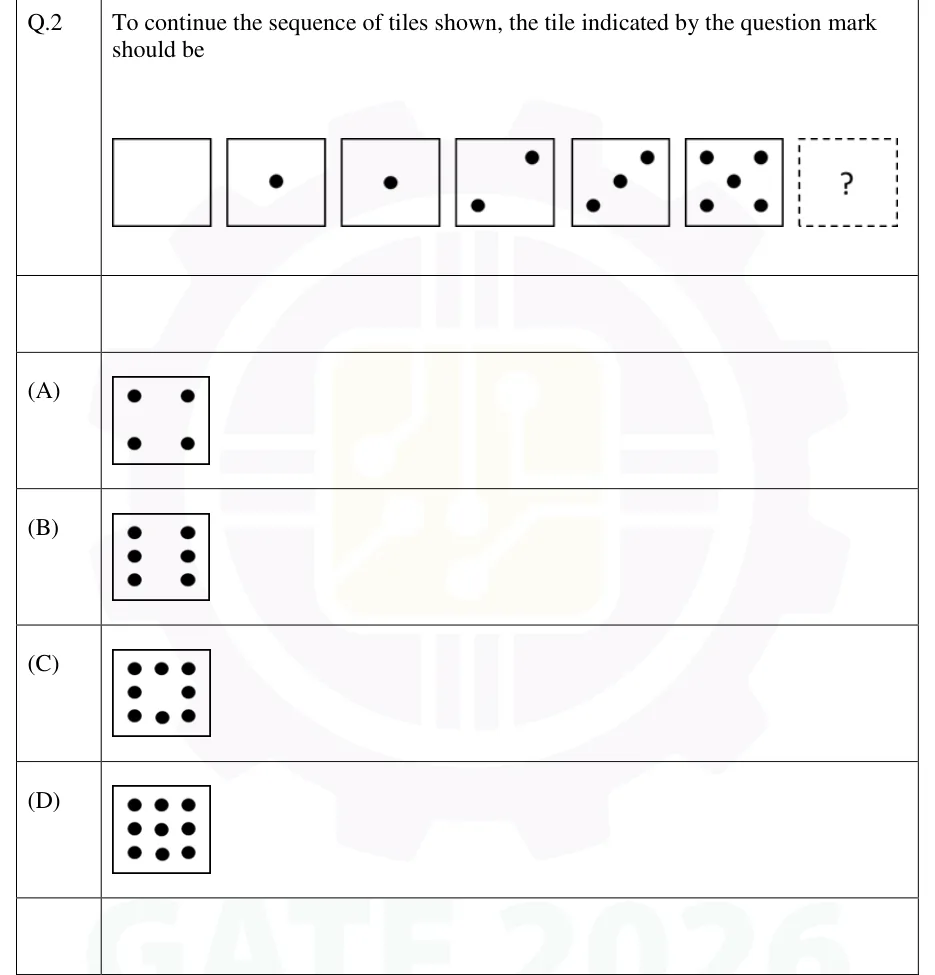
To continue the sequence of tiles shown, the tile indicated by the question mark should be
Figure — a row of seven square tiles, left to right. Tile 1: empty. Tile 2: one dot at the centre. Tile 3: one dot at the centre. Tile 4: two dots, one at the top-right corner and one at the bottom-left corner. Tile 5: three dots along the diagonal (bottom-left corner, centre, top-right corner). Tile 6: five dots (all four corners and the centre). Tile 7: a dashed-outline square containing a question mark.
 Tap to open full size
A horizontal row of seven equal square tiles with solid black outlines, except the seventh, which has a dashed outline and holds a "?" at its centre. Filled black dots sit inside the tiles as follows. Tile 1: no dots. Tile 2: 1 dot at the centre. Tile 3: 1 dot at the centre. Tile 4: 2 dots, one at the top-right and one at the bottom-left. Tile 5: 3 dots along the rising diagonal: bottom-left, centre and top-right. Tile 6: 5 dots, one in each of the four corners and one at the centre (the five on a die). The four options are also tiles. (A) 4 dots, one in each corner. (B) 6 dots in two vertical columns of 3, left and right (the six on a die). (C) 8 dots around the edge: a row of 3 along the top, one dot at the middle of the left side, one at the middle of the right side, and a row of 3 along the bottom; the centre is empty. (D) 9 dots in a full 3 x 3 grid.
Figure — a tile with 4 dots, one in each corner
Figure — a tile with 6 dots in two vertical columns of three (left and right)
Figure — a tile with 8 dots around the edge: three along the top, one at the middle of each side and three along the bottom; the centre is empty
Figure — a tile with 9 dots in a full 3 x 3 grid
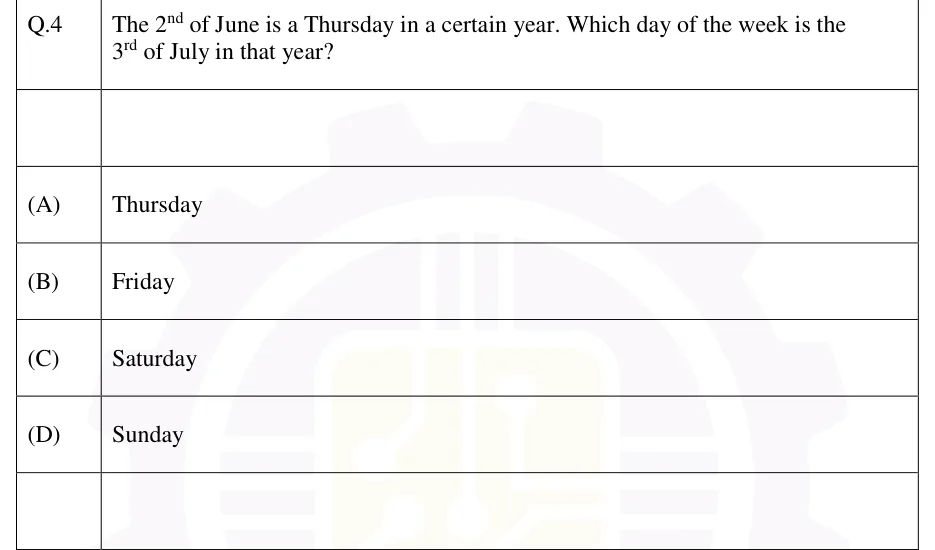
The 2<sup>nd</sup> of June is a Thursday in a certain year. Which day of the week is the 3<sup>rd</sup> of July in that year?
Thursday
Friday
Saturday
Sunday
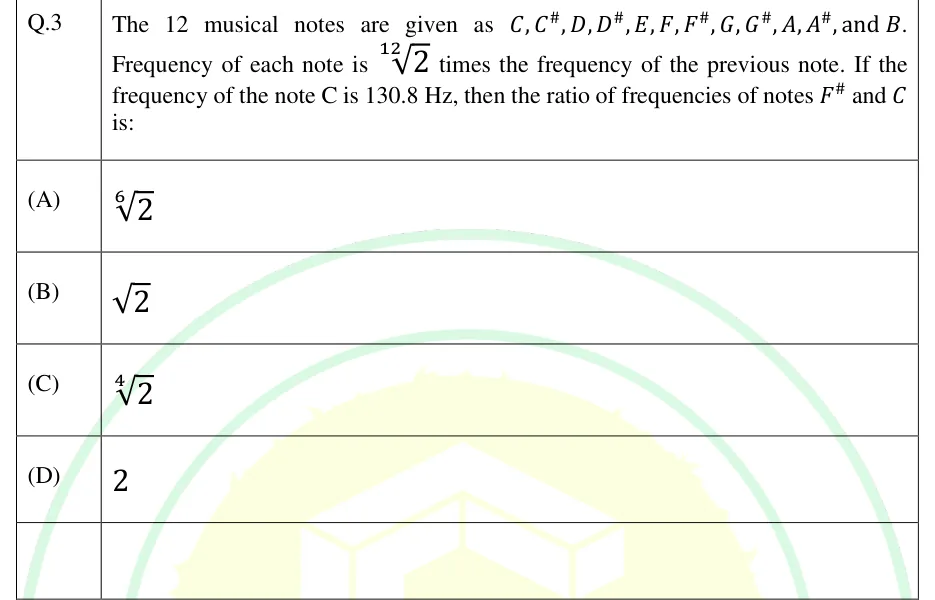
The 12 musical notes are given as and . Frequency of each note is times the frequency of the previous note. If the frequency of the note C is 130.8 Hz, then the ratio of frequencies of notes and is:
The following figures show three curves generated using an iterative algorithm. The total length of the curve generated after 'Iteration ' is:
Note: The figures shown are representative.
Iteration 0: [a straight segment of length 1]
Iteration 1: [curve made of segments] Length of each segment:
Iteration 2: [curve made of segments] Length of each segment:
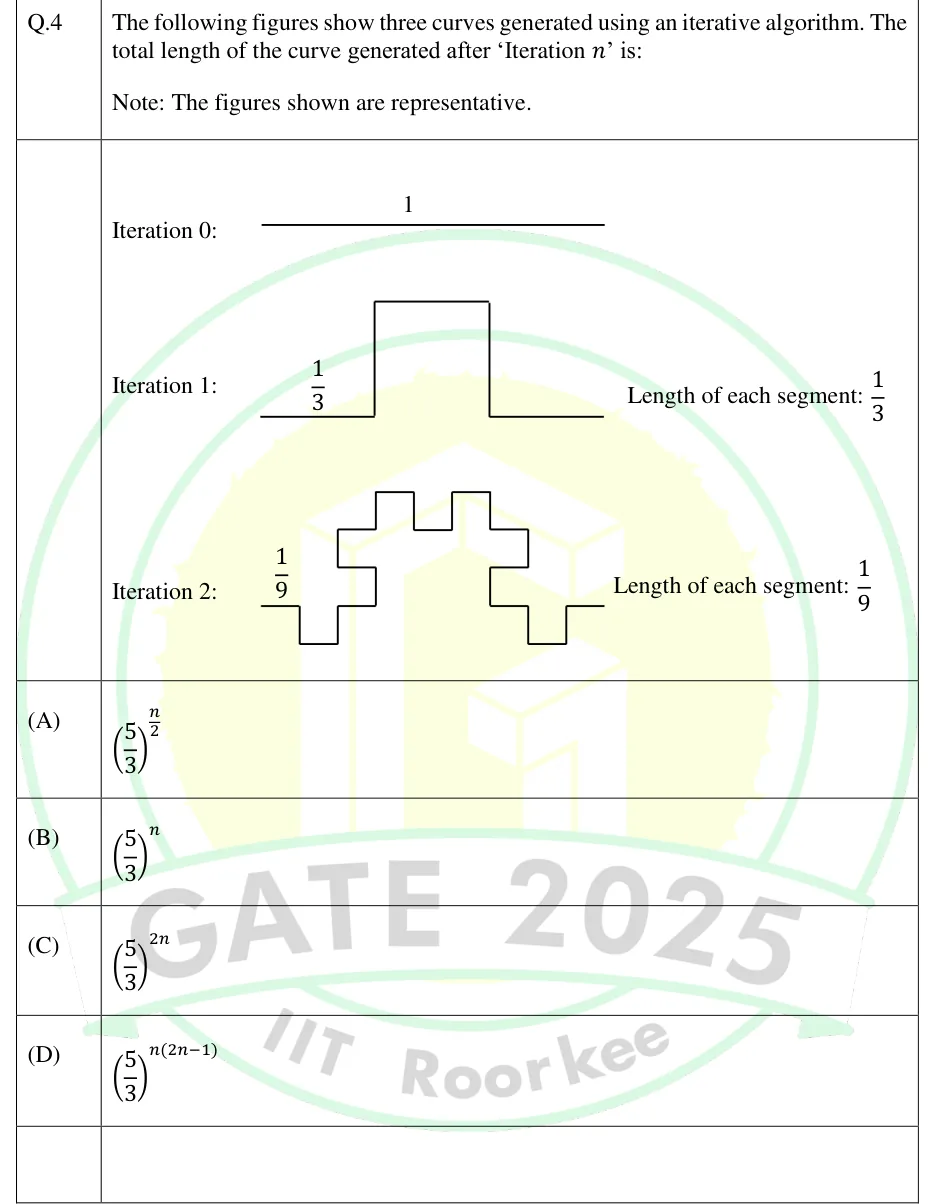 Tap to open full size
Three curves stacked vertically, each labelled on the left. Iteration 0: a single horizontal line segment labelled '1' above its middle. Iteration 1: the same overall horizontal span, split into thirds. The left third and right third stay horizontal on the baseline (the left one is labelled 1/3 above it). The middle third is replaced by an open square bump pointing up: a vertical line up, a horizontal line across the top, and a vertical line down, each 1/3 long. That makes 5 equal segments. The text on the right reads 'Length of each segment: 1/3'. Iteration 2: each of the 5 segments of Iteration 1 is replaced by a copy of the same motif at one-third scale (square bumps with side 1/9). The result is a stepped, cross-like outline. The left and right baseline pieces each carry a small square notch that dips below the baseline, the two vertical sides carry small square steps, and the top has small square bumps and a dip. The leftmost small segment is labelled 1/9, and the text on the right reads 'Length of each segment: 1/9'.
Which one of the following plots represents , where is a non-zero real number?
Note: The figures shown are representative.
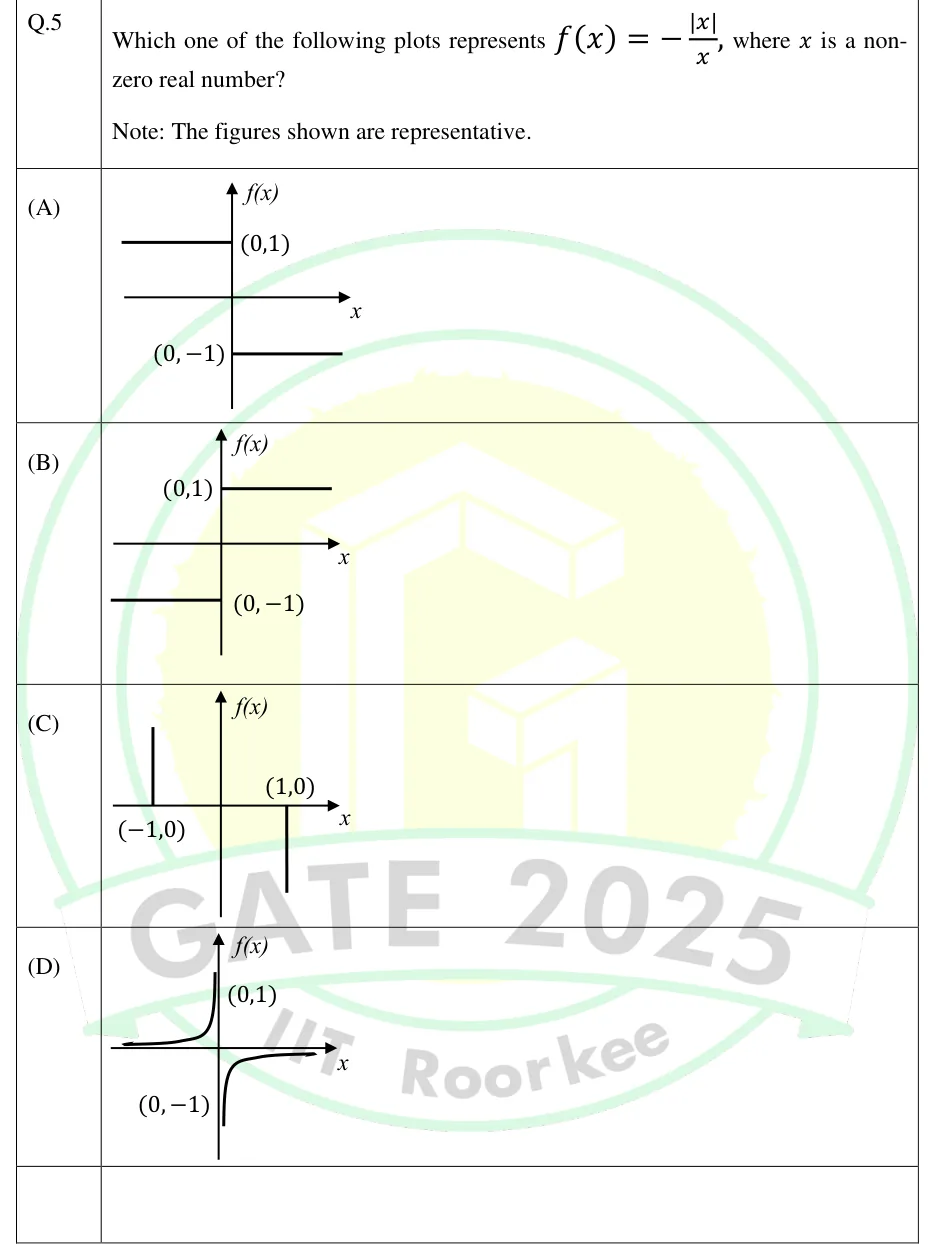 Tap to open full size
Each option is a graph on axes with a horizontal x-axis (arrow to the right, labelled x) and a vertical f(x)-axis (arrow upward, labelled f(x)), crossing at the origin. (A) Two horizontal line segments: one to the LEFT of the vertical axis at height +1, ending at the axis at the point labelled (0,1); one to the RIGHT of the vertical axis at height -1, starting at the axis at the point labelled (0,-1). (B) The mirror image of (A): a horizontal segment to the RIGHT of the vertical axis at height +1, starting at the point labelled (0,1); a horizontal segment to the LEFT of the vertical axis at height -1, ending at the point labelled (0,-1). (C) Two vertical line segments: one at x = -1, labelled (-1,0) at its foot on the x-axis, rising upward from the x-axis; one at x = +1, labelled (1,0) at its top on the x-axis, going downward from the x-axis. (D) Two curved branches like a hyperbola-type graph: for x < 0 the curve starts close to the x-axis far left, stays just above it and shoots steeply up near the vertical axis towards the point labelled (0,1); for x > 0 the curve starts steeply from far below near the vertical axis at the point labelled (0,-1) and bends to approach the x-axis from below as x increases.
Figure — horizontal segment at height 1 for x < 0 (ending at (0,1)), horizontal segment at height -1 for x > 0 (starting at (0,-1)).
Figure — horizontal segment at height 1 for x > 0 (starting at (0,1)), horizontal segment at height -1 for x < 0 (ending at (0,-1)).
Figure — vertical segment rising from the x-axis at (-1,0), and vertical segment falling from the x-axis at (1,0).
Figure — two curved branches: for x < 0 the curve hugs the x-axis from above and rises steeply near the vertical axis towards (0,1); for x > 0 the curve rises from far below near (0,-1) and flattens towards the x-axis from below.
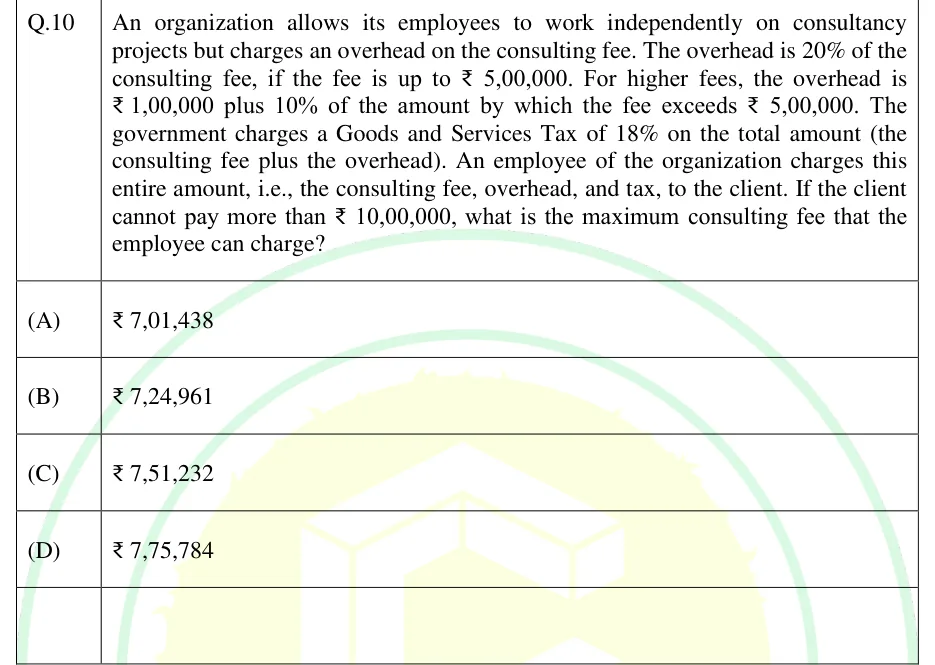
An organization allows its employees to work independently on consultancy projects but charges an overhead on the consulting fee. The overhead is 20% of the consulting fee, if the fee is up to Rs. 5,00,000. For higher fees, the overhead is Rs. 1,00,000 plus 10% of the amount by which the fee exceeds Rs. 5,00,000. The government charges a Goods and Services Tax of 18% on the total amount (the consulting fee plus the overhead). An employee of the organization charges this entire amount, i.e., the consulting fee, overhead, and tax, to the client. If the client cannot pay more than Rs. 10,00,000, what is the maximum consulting fee that the employee can charge?
Rs. 7,01,438
Rs. 7,24,961
Rs. 7,51,232
Rs. 7,75,784
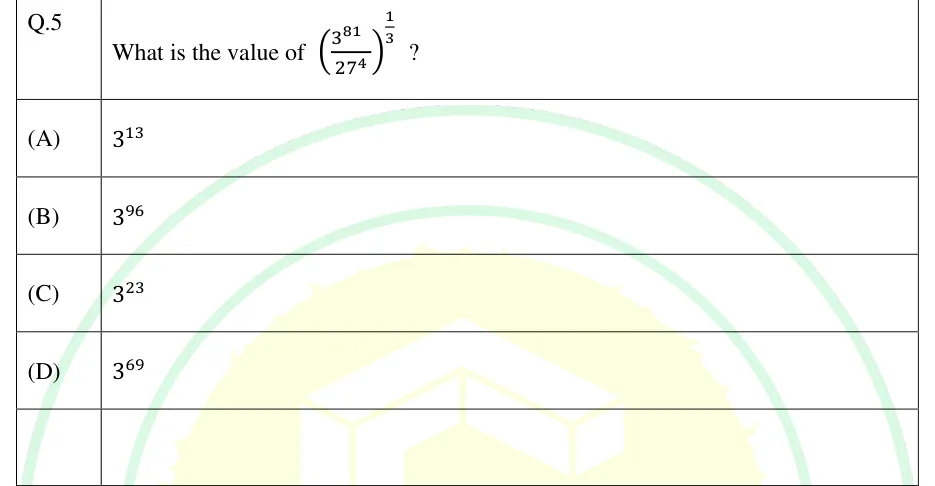
What is the value of ?
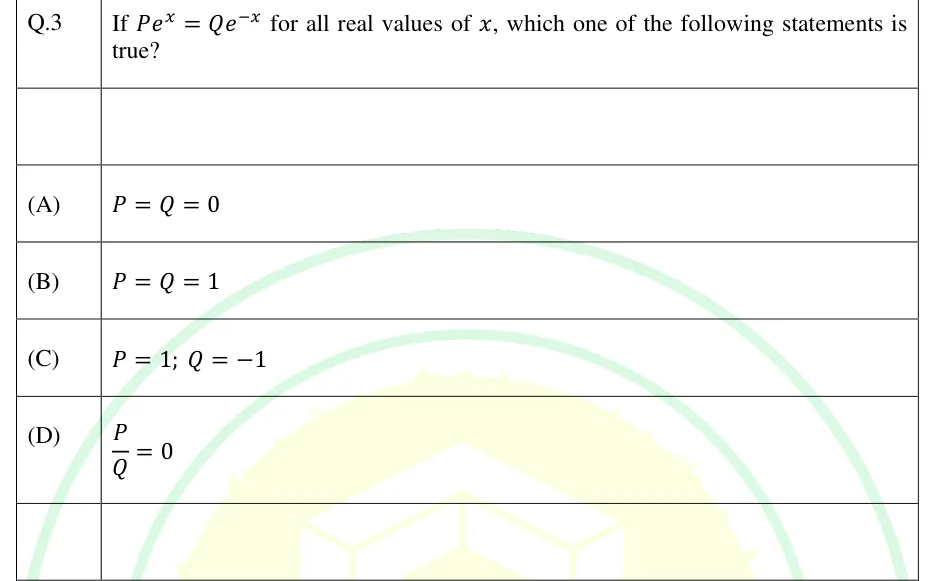
If for all real values of , which one of the following statements is true?
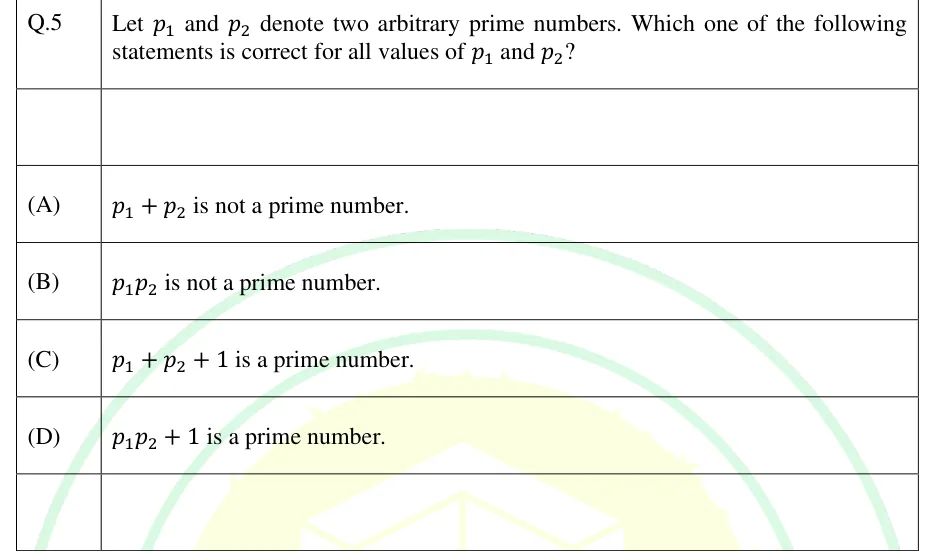
Let and denote two arbitrary prime numbers. Which one of the following statements is correct for all values of and ?
is not a prime number.
is not a prime number.
is a prime number.
is a prime number.
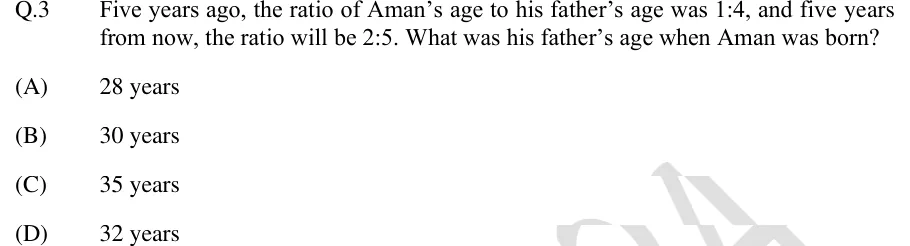
Five years ago, the ratio of Aman's age to his father's age was 1:4, and five years from now, the ratio will be 2:5. What was his father's age when Aman was born?
28 years
30 years
35 years
32 years
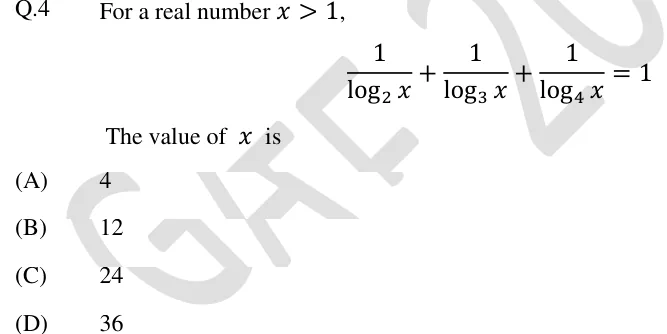
For a real number ,
The value of is
4
12
24
36
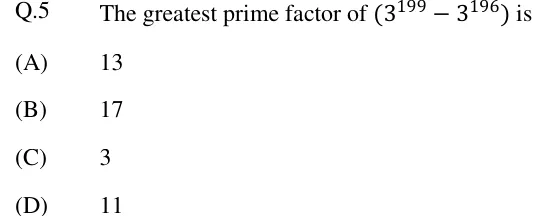
The greatest prime factor of is
13
17
3
11
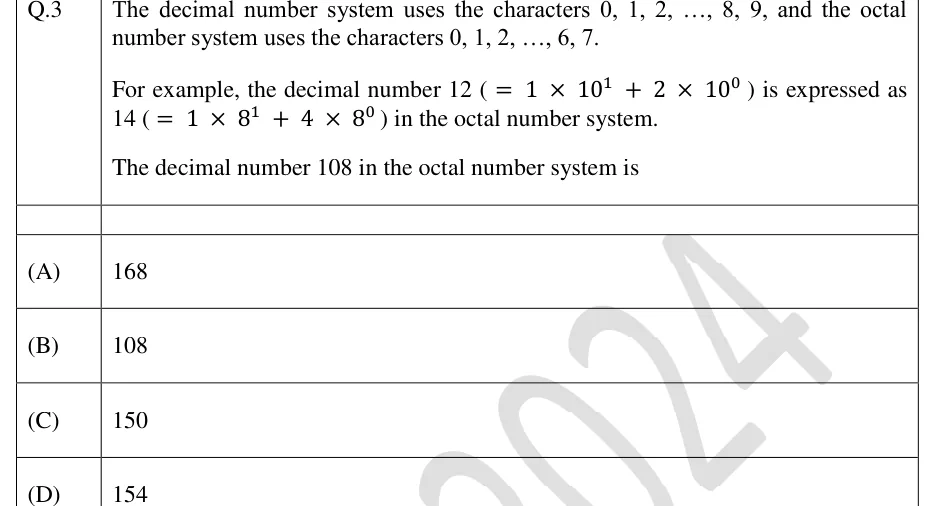
The decimal number system uses the characters 0, 1, 2, …, 8, 9, and the octal number system uses the characters 0, 1, 2, …, 6, 7.
For example, the decimal number 12 ( ) is expressed as 14 ( ) in the octal number system.
The decimal number 108 in the octal number system is
168
108
150
154
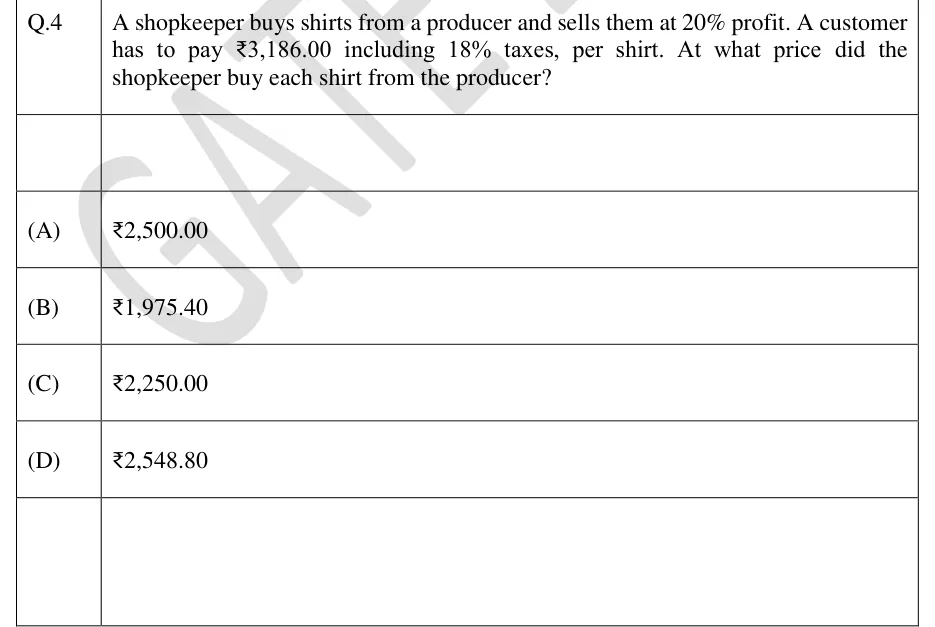
A shopkeeper buys shirts from a producer and sells them at 20% profit. A customer has to pay Rs. 3,186.00 including 18% taxes, per shirt. At what price did the shopkeeper buy each shirt from the producer?
Rs. 2,500.00
Rs. 1,975.40
Rs. 2,250.00
Rs. 2,548.80
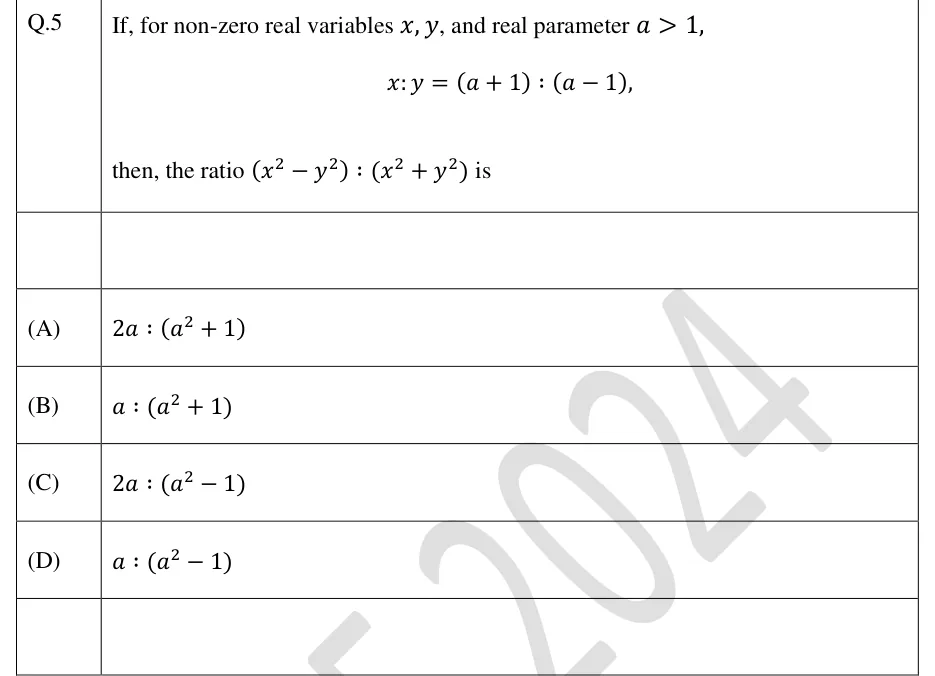
If, for non-zero real variables , and real parameter ,
then, the ratio is
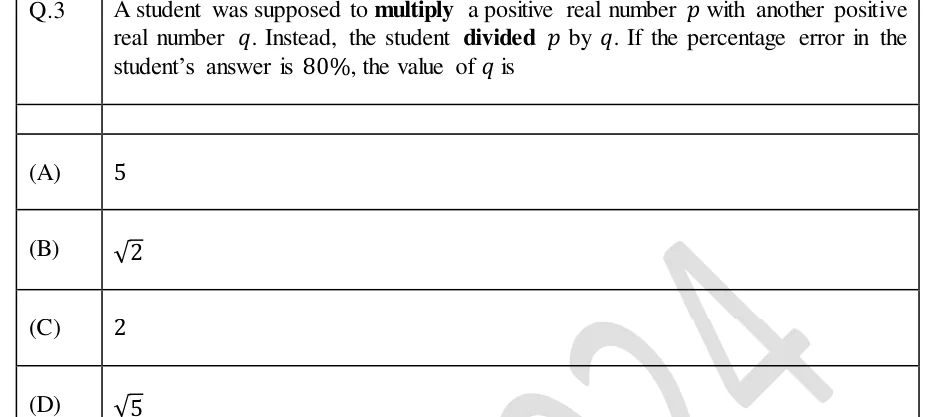
A student was supposed to multiply a positive real number with another positive real number . Instead, the student divided by . If the percentage error in the student's answer is 80%, the value of is
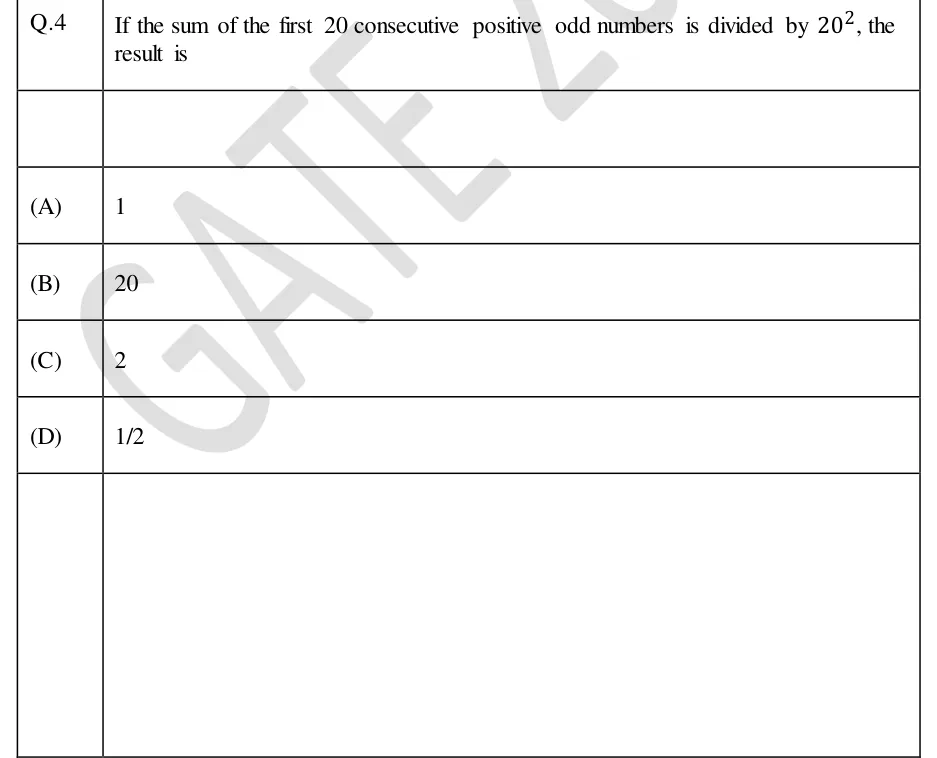
If the sum of the first 20 consecutive positive odd numbers is divided by , the result is
1
20
2
1/2
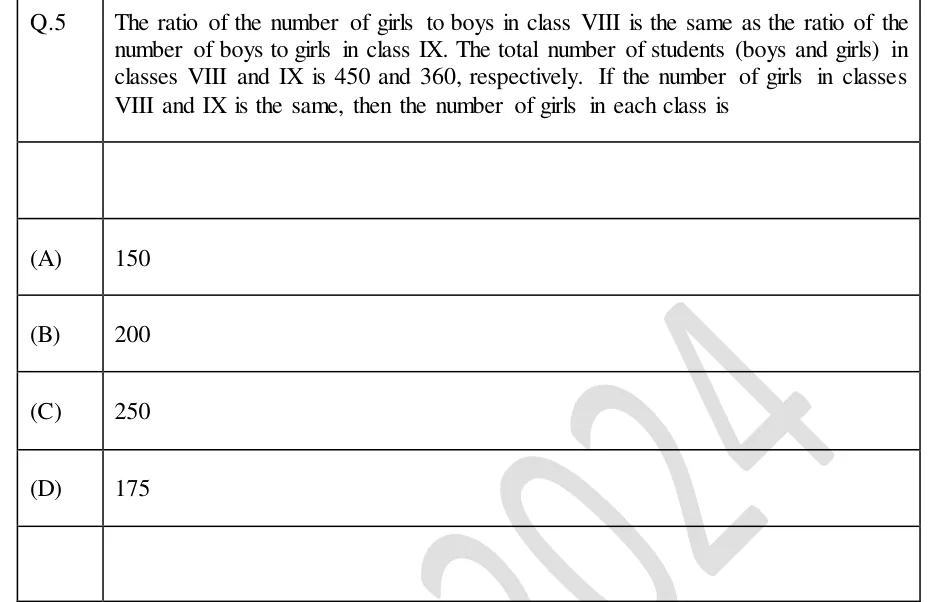
The ratio of the number of girls to boys in class VIII is the same as the ratio of the number of boys to girls in class IX. The total number of students (boys and girls) in classes VIII and IX is 450 and 360, respectively. If the number of girls in classes VIII and IX is the same, then the number of girls in each class is
150
200
250
175
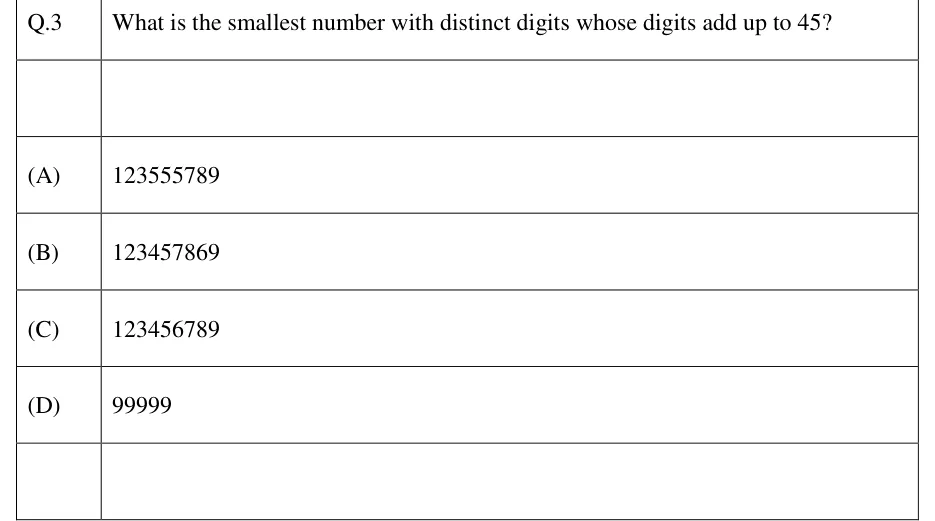
What is the smallest number with distinct digits whose digits add up to 45?
123555789
123457869
123456789
99999
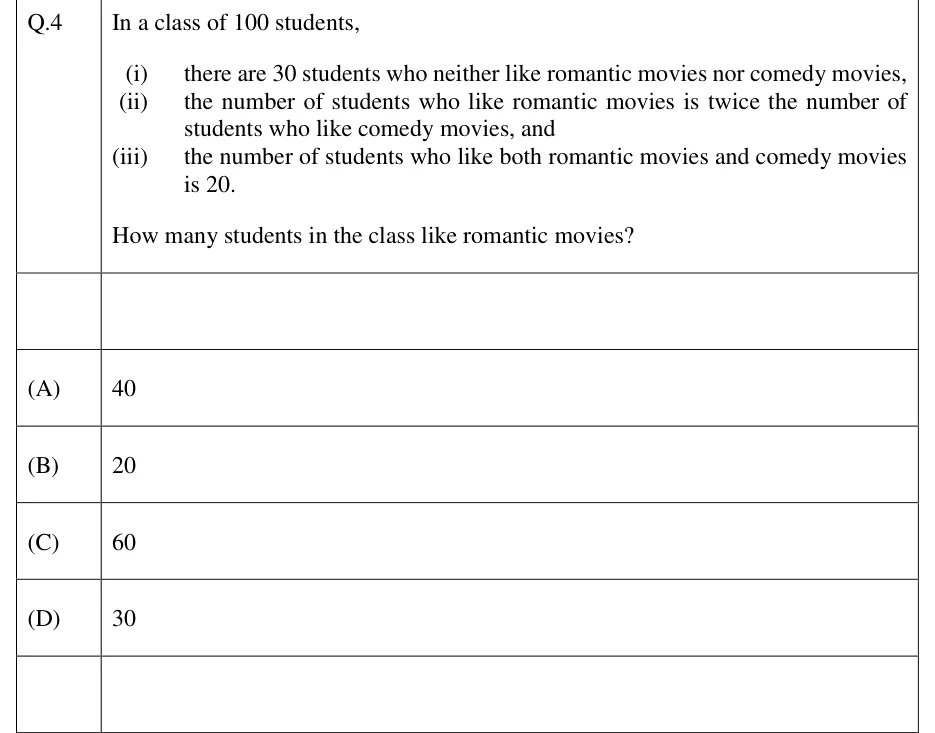
In a class of 100 students,
(i) there are 30 students who neither like romantic movies nor comedy movies,
(ii) the number of students who like romantic movies is twice the number of students who like comedy movies, and
(iii) the number of students who like both romantic movies and comedy movies is 20.
How many students in the class like romantic movies?
40
20
60
30
Which one of the following options represents the given graph?
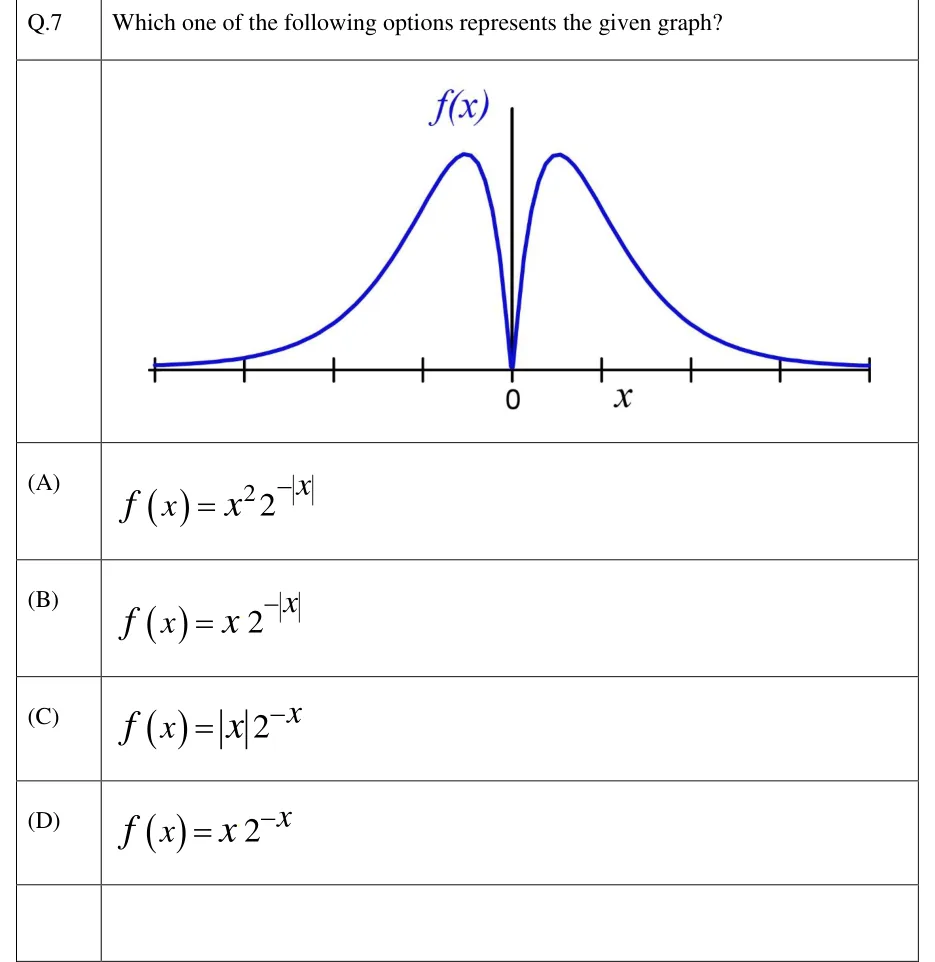 Tap to open full size
A graph of f(x) against x. A horizontal x-axis runs across the figure, with 9 equally spaced unlabelled tick marks: the centre tick is labelled 0, with 4 ticks to its left and 4 to its right. The label x sits just below the axis to the right of 0. A vertical axis labelled f(x) passes up through 0. A single solid blue curve is drawn, symmetric about the vertical axis. It touches the x-axis only at the origin, where it comes to a sharp V-shaped minimum of value 0. From the origin it rises steeply on each side to a maximum at about half a tick-spacing from the vertical axis (one peak left of it, one right of it, at equal height). Beyond each peak it falls away smoothly, in a bell-shaped tail, towards the x-axis, and is almost touching the axis at the outermost ticks on both ends. The curve is never below the x-axis.
Which one of the following options represents the given graph?
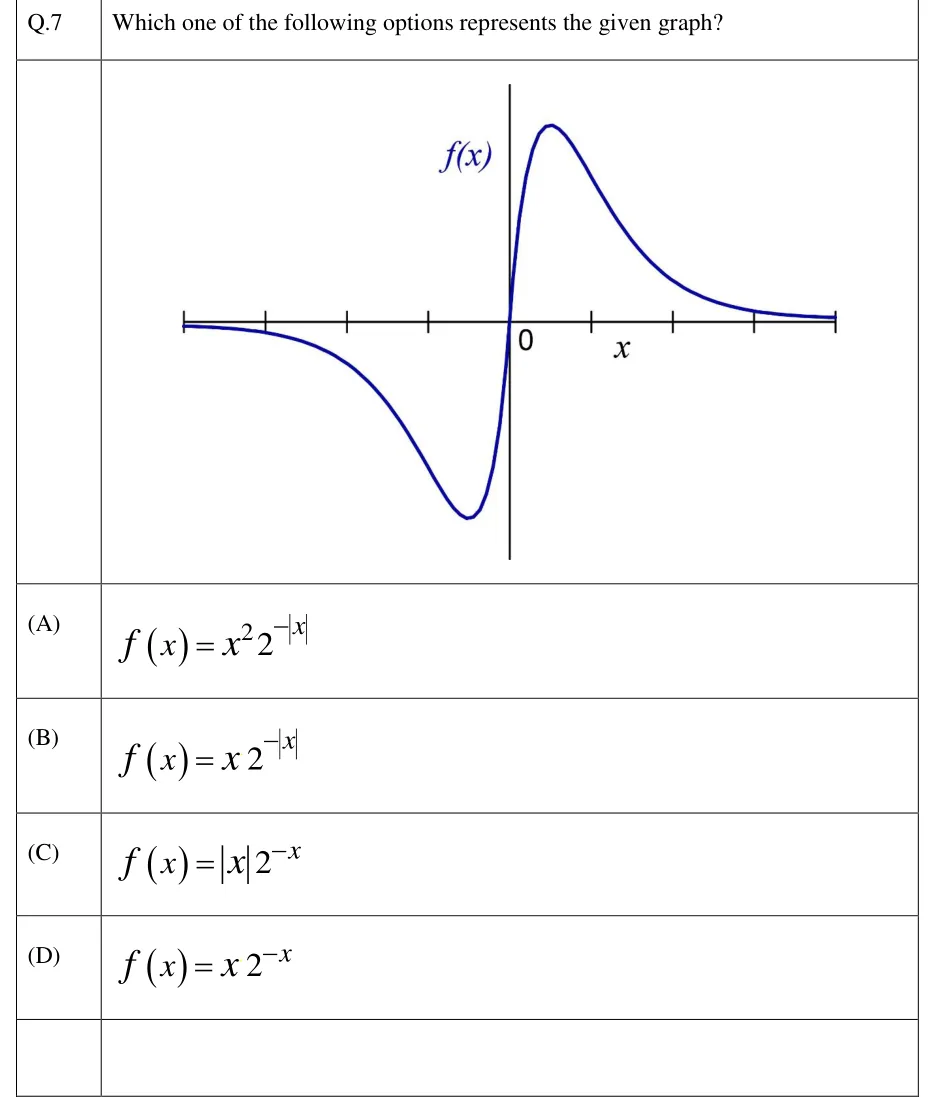 Tap to open full size
A plot of f(x) against x. A horizontal x-axis runs across the figure with equally spaced tick marks: four ticks to the left of the origin and four to the right (the outermost tick on each side is drawn as a small end bar). The origin is labelled 0 just below and to the right of where the axes cross, and the axis is labelled x below it, to the right of the origin. A vertical axis through the origin is labelled f(x) at its upper left. No numerical values are printed on either axis. The curve (dark blue) is antisymmetric about the origin. At the far left it starts just below the x-axis, very close to zero. Moving right it bends further below the axis and reaches a sharp minimum a short distance left of the origin (about half a tick spacing). It then rises steeply, crosses the axis at the origin, and reaches a sharp maximum a short distance right of the origin (about half a tick spacing) at a height equal to the depth of the minimum. After that it decays smoothly and stays above the x-axis, approaching zero at the far right. The curve is negative for every x < 0, zero at x = 0, positive for every x > 0, and tends to 0 as x goes to plus or minus infinity.
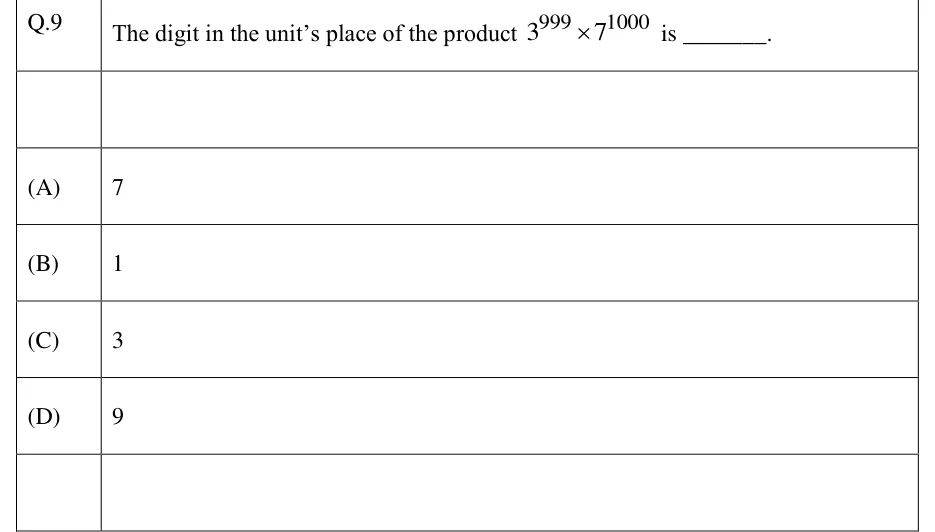
The digit in the unit's place of the product is ______.
7
1
3
9
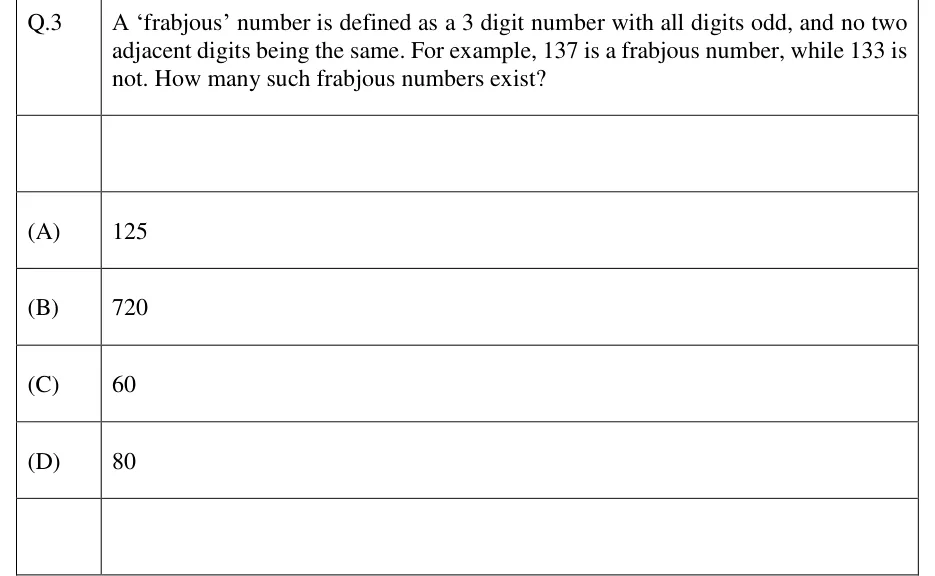
A ‘frabjous’ number is defined as a 3 digit number with all digits odd, and no two adjacent digits being the same. For example, 137 is a frabjous number, while 133 is not. How many such frabjous numbers exist?
125
720
60
80
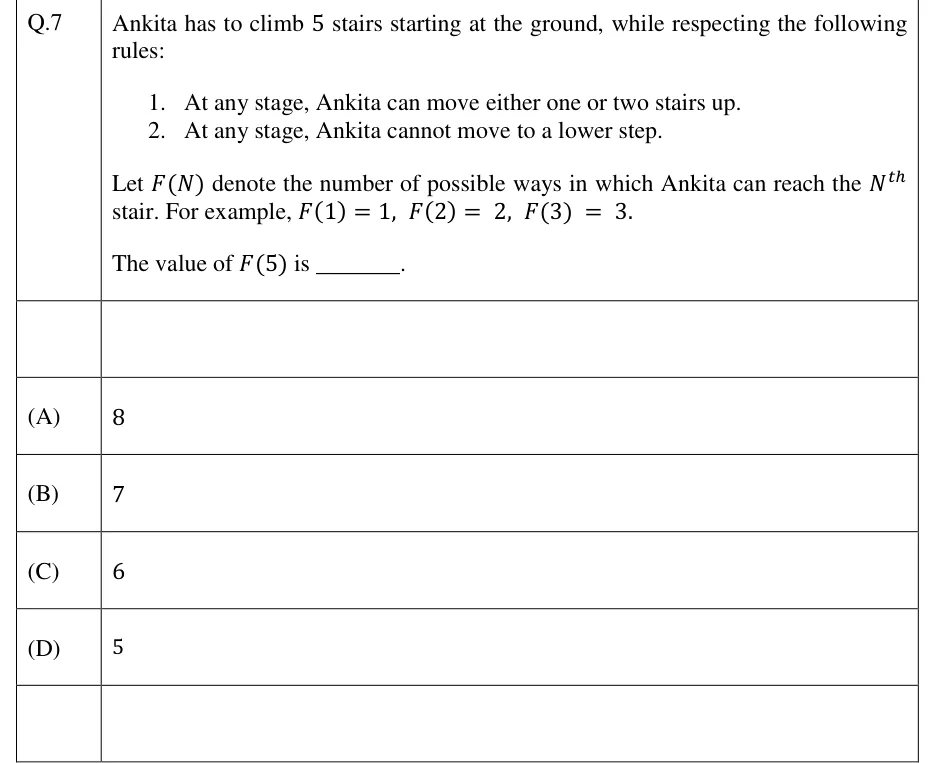
Ankita has to climb 5 stairs starting at the ground, while respecting the following rules:
1. At any stage, Ankita can move either one or two stairs up.
2. At any stage, Ankita cannot move to a lower step.
Let denote the number of possible ways in which Ankita can reach the stair. For example, .
The value of is ______.
8
7
6
5
Which one of the given figures P, Q, R and S represents the graph of the following function?
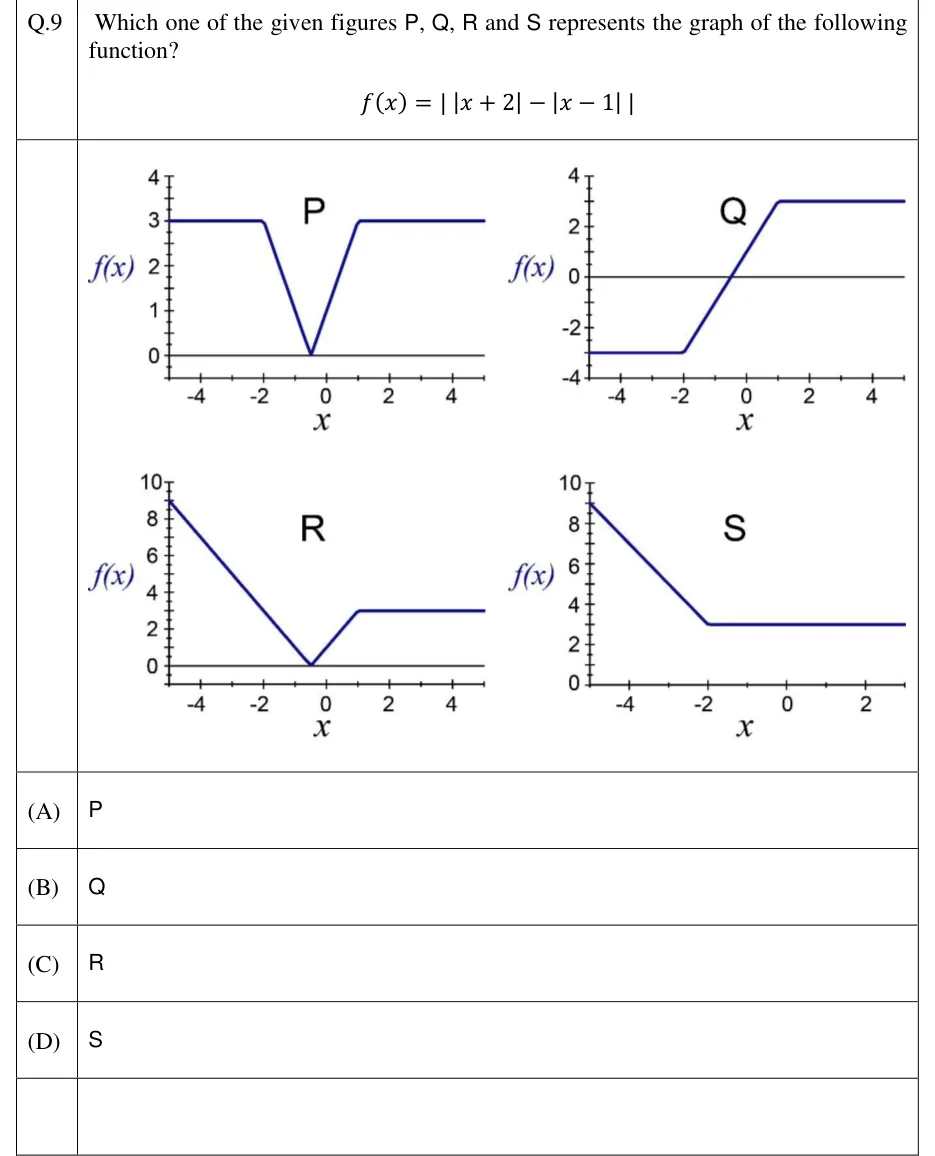 Tap to open full size
Four graphs arranged in a 2 x 2 grid, each a thick blue piecewise-linear curve on axes labelled f(x) (vertical) and x (horizontal), with the letter of the figure printed near the top. Top left, P: vertical axis from 0 to 4 with labels 0, 1, 2, 3, 4; horizontal axis from about -5 to 5 with labels -4, -2, 0, 2, 4; a thin horizontal line at f(x) = 0. The curve is flat at f(x) = 3 from the left edge to x = -2, falls in a straight line to f(x) = 0 at x = -0.5, rises in a straight line to f(x) = 3 at x = 1, then stays flat at 3 to the right edge (a V-shaped notch between two level arms at height 3). Top right, Q: vertical axis from -4 to 4 with labels -4, -2, 0, 2, 4; horizontal axis from about -5 to 5 with labels -4, -2, 0, 2, 4; a thin horizontal line at f(x) = 0. The curve is flat at f(x) = -3 from the left edge to x = -2, rises in a straight line through f(x) = 0 at x = -0.5 to f(x) = 3 at x = 1, then stays flat at 3 to the right edge (a ramp between two level arms at -3 and 3). Bottom left, R: vertical axis from 0 to 10 with labels 0, 2, 4, 6, 8, 10; horizontal axis from about -5 to 5 with labels -4, -2, 0, 2, 4; a thin horizontal line at f(x) = 0. The curve starts at about (-5, 9), falls in a straight line to f(x) = 0 at x = -0.5, rises in a straight line to f(x) = 3 at x = 1, then stays flat at 3 to the right edge. Bottom right, S: vertical axis from 0 to 10 with labels 0, 2, 4, 6, 8, 10; horizontal axis from about -5 to 3 with labels -4, -2, 0, 2. The curve starts at about (-5, 9), falls in a straight line to f(x) = 3 at x = -2, then stays flat at 3 to the right edge; it never touches zero.
P
Q
R
S
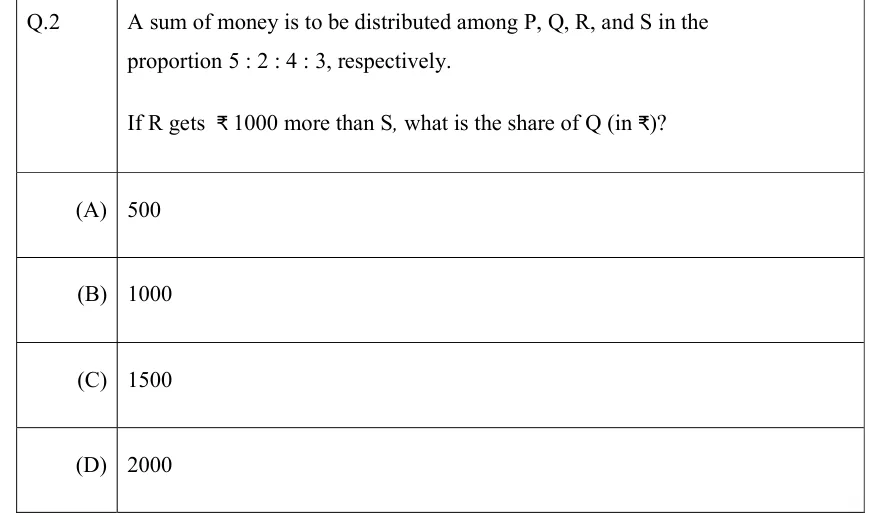
A sum of money is to be distributed among P, Q, R, and S in the proportion 5 : 2 : 4 : 3, respectively.
If R gets Rs. 1000 more than S, what is the share of Q (in Rs.)?
500
1000
1500
2000
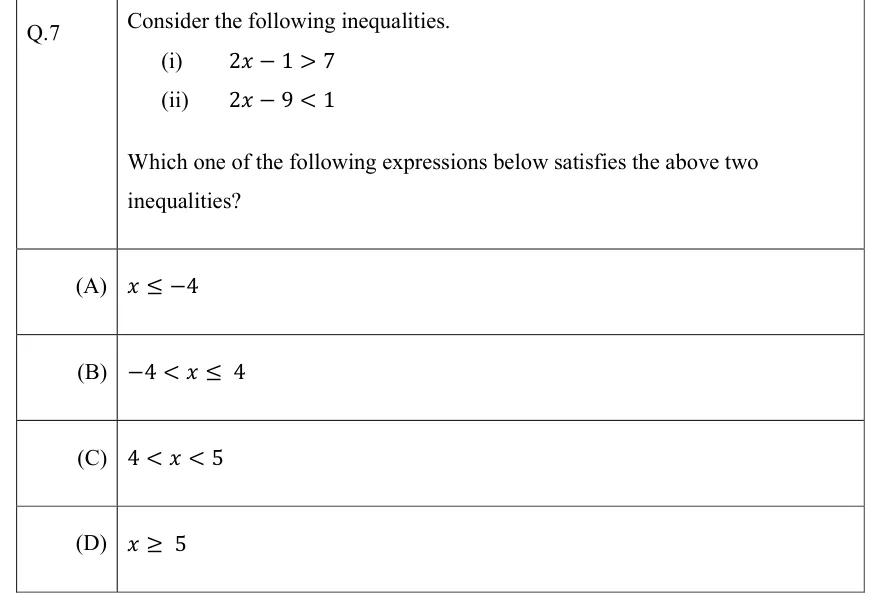
Consider the following inequalities.
(i)
(ii)
Which one of the following expressions below satisfies the above two inequalities?
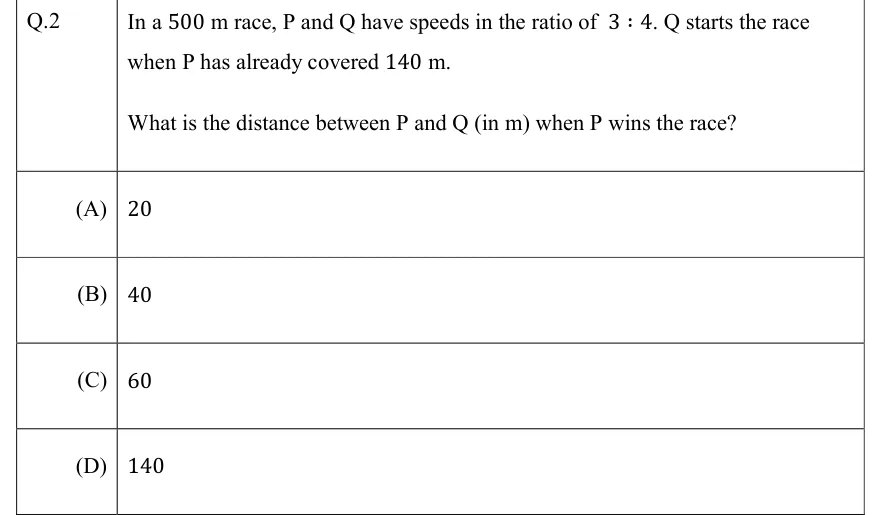
In a 500 m race, P and Q have speeds in the ratio of . Q starts the race when P has already covered 140 m.
What is the distance between P and Q (in m) when P wins the race?
20
40
60
140
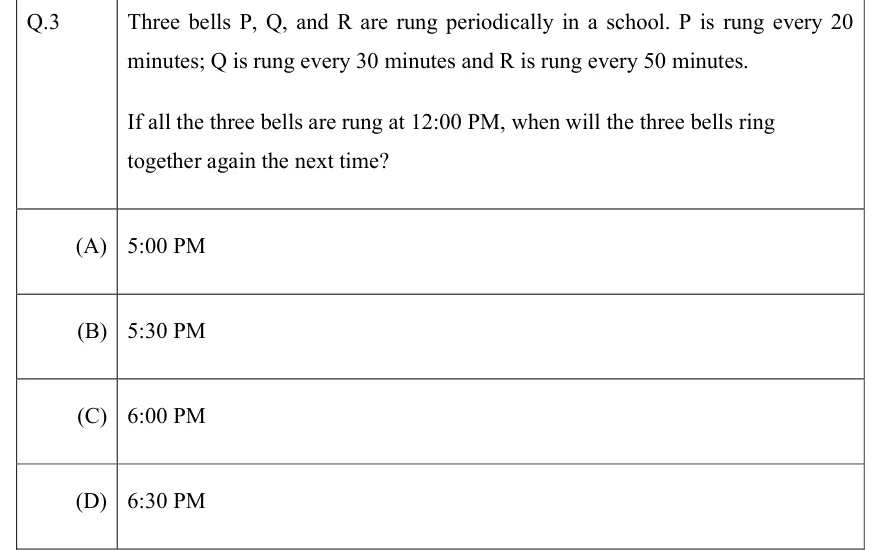
Three bells P, Q, and R are rung periodically in a school. P is rung every 20 minutes; Q is rung every 30 minutes and R is rung every 50 minutes.
If all the three bells are rung at 12:00 PM, when will the three bells ring together again the next time?
5:00 PM
5:30 PM
6:00 PM
6:30 PM
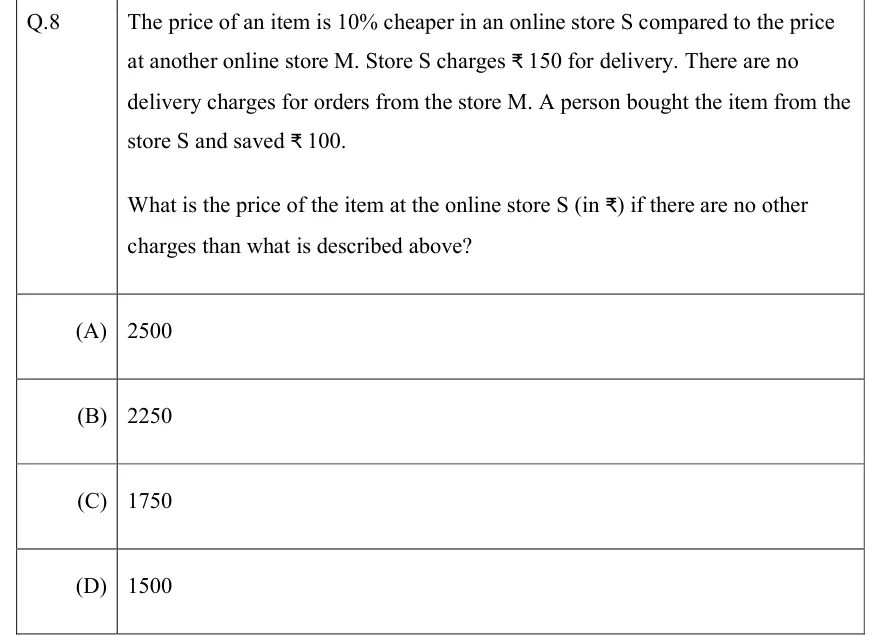
The price of an item is 10% cheaper in an online store S compared to the price at another online store M. Store S charges Rs. 150 for delivery. There are no delivery charges for orders from the store M. A person bought the item from the store S and saved Rs. 100.
What is the price of the item at the online store S (in Rs.) if there are no other charges than what is described above?
2500
2250
1750
1500
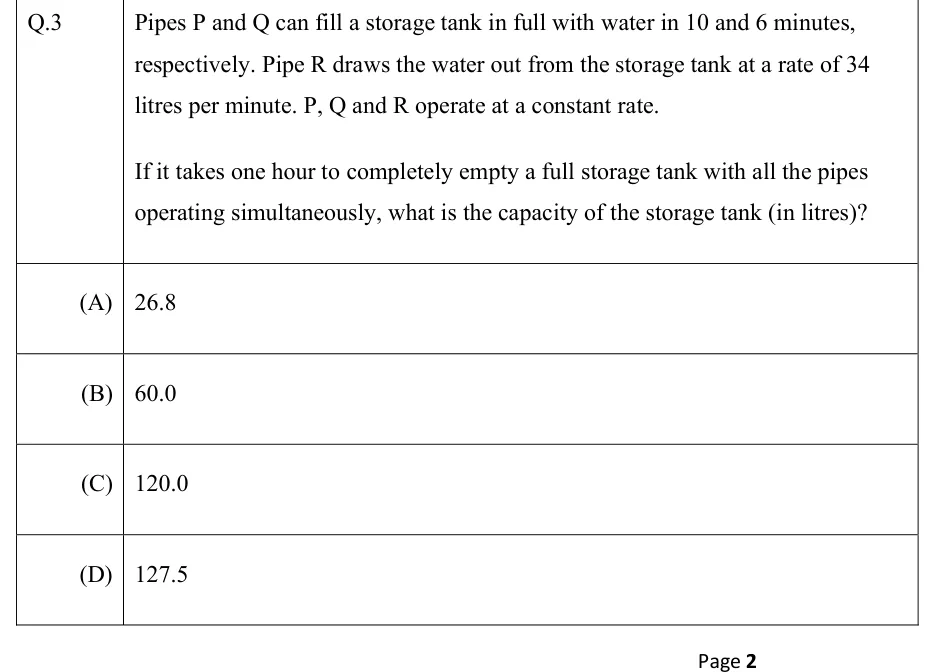
Pipes P and Q can fill a storage tank in full with water in 10 and 6 minutes, respectively. Pipe R draws the water out from the storage tank at a rate of 34 litres per minute. P, Q and R operate at a constant rate.
If it takes one hour to completely empty a full storage tank with all the pipes operating simultaneously, what is the capacity of the storage tank (in litres)?
26.8
60.0
120.0
127.5
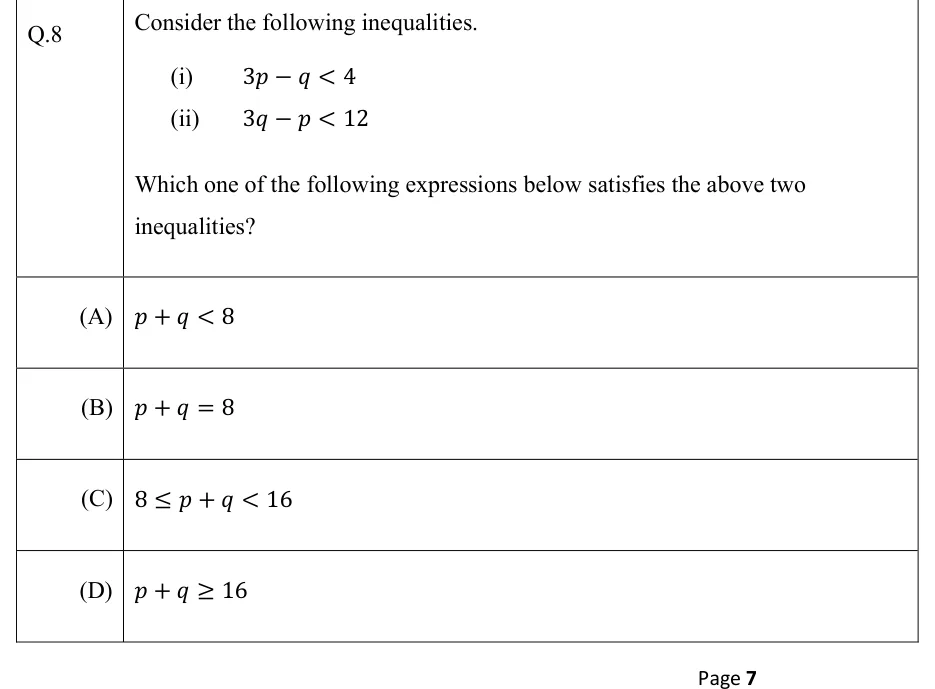
Consider the following inequalities.
(i)
(ii)
Which one of the following expressions below satisfies the above two inequalities?
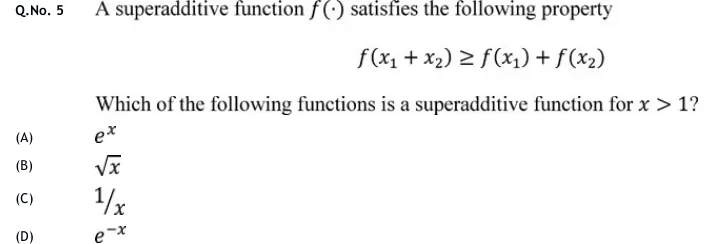
A superadditive function satisfies the following property
Which of the following functions is a superadditive function for ?
It is quarter past three in your watch. The angle between the hour hand and the minute hand is ______.
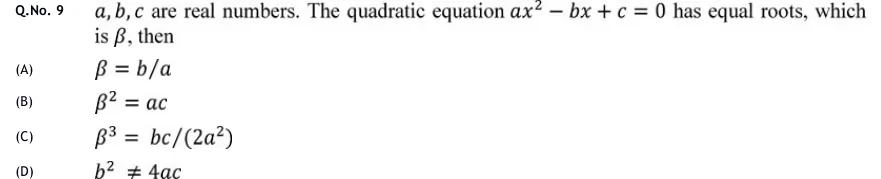
are real numbers. The quadratic equation has equal roots, which is , then
If are four individuals, how many teams of size exceeding one can be formed, with as a member?
5
6
7
8
In four-digit integer numbers from 1001 to 9999, the digit group “37” (in the same sequence) appears ______ times.
270
279
280
299
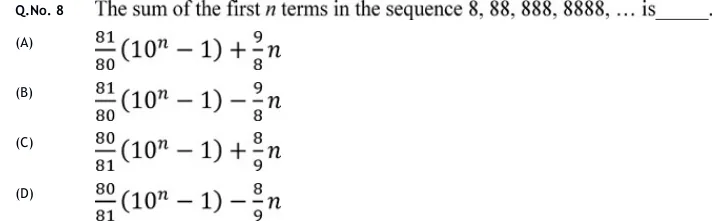
The sum of the first terms in the sequence 8, 88, 888, 8888, ... is______.
Select the graph that schematically represents BOTH and properly in the interval , for integer values of , where .
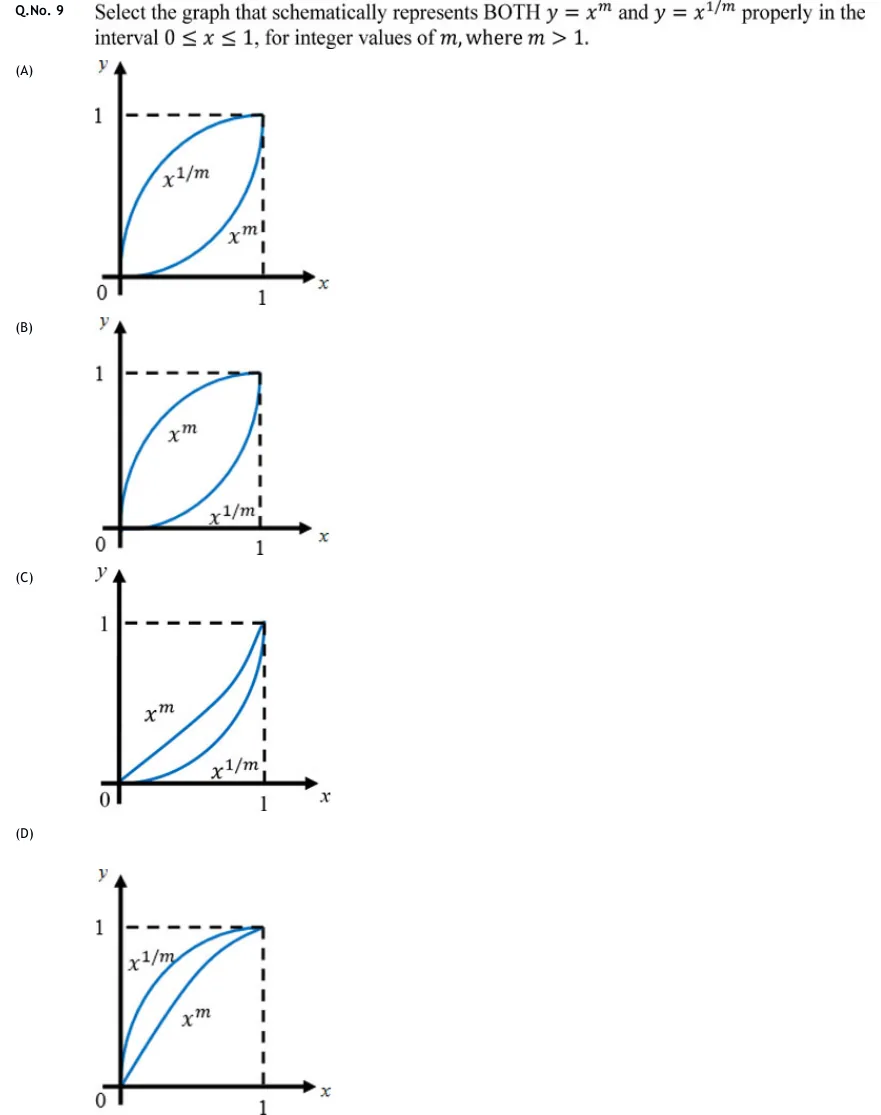 Tap to open full size
Every option is a graph drawn the same way. The vertical axis is labelled y and the horizontal axis x. The origin is labelled 0 and each axis has a tick marked 1. A dashed horizontal line runs from y = 1 across to x = 1, and a dashed vertical line runs from there down to x = 1 on the x-axis, so together with the axes they outline the unit square. Two solid blue curves join (0,0) to (1,1). (A): the upper curve is concave: it leaves the origin almost vertically and levels off as it reaches (1,1). It is labelled x^1/m. The lower curve is convex: it leaves the origin almost flat along the x-axis and rises steeply into (1,1). It is labelled x^m. The two curves are mirror images about the diagonal. (B): the same two curves as in (A), concave on top and convex below, but with the labels swapped: the upper concave curve is labelled x^m and the lower convex curve x^1/m. (C): the upper curve is almost a straight line from the origin, close to the diagonal, and bends upward steeply just before (1,1). It is labelled x^m. The lower curve is convex: it starts flat near the origin and rises steeply into (1,1). It is labelled x^1/m. Both curves lie on or below the diagonal. (D): both curves are concave and lie above the diagonal. The upper curve rises very steeply from the origin and levels off at (1,1). It is labelled x^1/m. The lower curve bows up less and is closer to the diagonal. It is labelled x^m.
Figure — upper concave curve labelled (steep at the origin, levelling off at ); lower convex curve labelled (flat at the origin, steep at ); the two are mirror images about
Figure — the same pair of curves as (A), with the labels swapped: upper concave curve labelled , lower convex curve labelled
Figure — upper curve, nearly straight and turning up sharply near , labelled ; lower convex curve labelled ; both on or below the diagonal
Figure — two concave curves above the diagonal: the steeper upper one labelled , the flatter lower one labelled
If the number 715■423 is divisible by 3 (■ denotes the missing digit in the thousandths place), then the smallest whole number in the place of ■ is ______.
0
2
5
6
What is the value of ?
Leila aspires to buy a car worth Rs. 10,00,000 after 5 years. What is the minimum amount in Rupees that she should deposit now in a bank which offers 10% annual rate of interest, if the interest was compounded annually?
5,00,000
6,21,000
6,66,667
7,50,000
Two alloys A and B contain gold and copper in the ratios of 2:3 and 3:7 by mass, respectively. Equal masses of alloys A and B are melted to make an alloy C. The ratio of gold to copper in alloy C is ______.
5:10
7:13
6:11
9:13
The three roots of the equation are . What are the three values of for which ?
For what values of given below is an integer?
4, 8, 18
4, 10, 16
4, 8, 28
8, 26, 28
Functions and are defined as follows:
and , where represents the absolute value of .
What would be the value of ?
2
4
6
36
An e-mail password must contain three characters. The password has to contain one numeral from 0 to 9, one upper case and one lower case character from the English alphabet. How many distinct passwords are possible?
6,760
13,520
40,560
1,05,456
A designer uses marbles of four different colours for his designs. The cost of each marble is the same, irrespective of the colour. The table below shows the percentage of marbles of each colour used in the current design. The cost of each marble increased by 25%. Therefore, the designer decided to reduce equal numbers of marbles of each colour to keep the total cost unchanged. What is the percentage of blue marbles in the new design?
| Blue | Black | Red | Yellow |
|---|---|---|---|
| 40% | 25% | 20% | 15% |
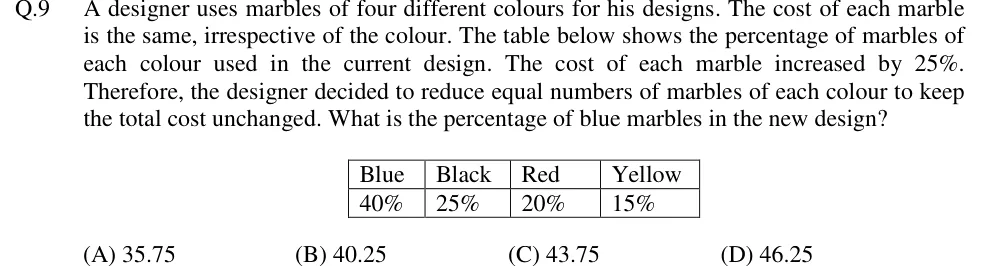 Tap to open full size
A one-row data table with four columns headed Blue, Black, Red, Yellow; the values below the headings are 40%, 25%, 20%, 15% respectively.
35.75
40.25
43.75
46.25
For , and are both decreasing functions in the interval ______.
An automobile travels from city A to city B and returns to city A by the same route. The speed of the vehicle during the onward and return journeys were constant at 60 km/h and 90 km/h, respectively. What is the average speed in km/h for the entire journey?
72
73
74
75
A set of 4 parallel lines intersect with another set of 5 parallel lines. How many parallelograms are formed?
20
48
60
72
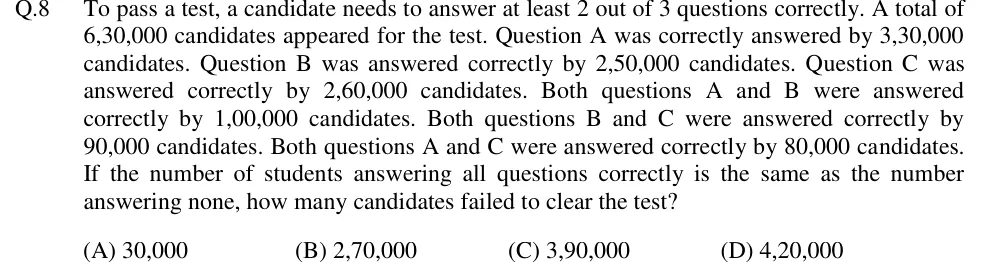
To pass a test, a candidate needs to answer at least 2 out of 3 questions correctly. A total of 6,30,000 candidates appeared for the test. Question A was correctly answered by 3,30,000 candidates. Question B was answered correctly by 2,50,000 candidates. Question C was answered correctly by 2,60,000 candidates. Both questions A and B were answered correctly by 1,00,000 candidates. Both questions B and C were answered correctly by 90,000 candidates. Both questions A and C were answered correctly by 80,000 candidates. If the number of students answering all questions correctly is the same as the number answering none, how many candidates failed to clear the test?
30,000
2,70,000
3,90,000
4,20,000
If what is the value of ?
1
5
7
9
PRACTICE
Given and , the number of digits in is
15
16
17
20
Answer: (B)
.
.
Number of digits .
A sum of money is invested at compound interest, compounded annually at a fixed rate. It amounts to Rs. 8820 at the end of 2 years and to Rs. 9261 at the end of 3 years. The annual rate of interest, in per cent, is ________.
Answer:
During the third year the amount is multiplied by , so .
Hence .
Check: the principal is , and .
The price of a commodity rises by 25%. A household wants to spend exactly the same amount on the commodity as before. The percentage by which it must reduce its consumption is ________.
Answer:
Expenditure = price × consumption. With the price multiplied by 1.25, the consumption must be multiplied by to keep the product unchanged.
A factor of 0.8 is a reduction of .
Same result from the formula: .
Check: price 100 and consumption 10 cost 1000; price 125 and consumption 8 also cost 1000.
P and Q together can complete a piece of work in 12 days, Q and R together in 15 days, and R and P together in 20 days. Each person works at a constant rate. Working alone, P would complete the work in
24 days
30 days
40 days
60 days
Answer: (B)
Take the total work as units. Then , and units per day.
Adding the three: , so units per day.
units per day (and , , which satisfy all three conditions).
P alone takes days.
Consider all distinct arrangements of the six letters of the word LETTER (the letters L, E, T, T, E, R), where arrangements that differ only by swapping identical letters are counted once. Which of the following statements is/are correct?
There are 180 distinct arrangements in all.
There are 60 arrangements in which the two T's are next to each other.
There are 60 arrangements that begin with L.
There are 120 arrangements in which the two E's are not next to each other.
Answer: (A), (B), (D)
All arrangements: , so (A) is correct.
T's together: treat TT as one unit. The units TT, L, E, E, R give , so (B) is correct.
Beginning with L: arrange E, T, T, E, R in the other five places in ways, not 60, so (C) is incorrect.
E's together: the units EE, L, T, T, R give . E's not together: , so (D) is correct.
The sum of all integers from 1 to 200 (both inclusive) that are divisible by neither 2 nor 5 is ________.
Answer:
Sum of all integers from 1 to 200: .
Multiples of 2: . Multiples of 5: . Multiples of 10, counted in both: .
By inclusion and exclusion, the numbers divisible by 2 or 5 add to .
Required sum .
Check: in the block the numbers ending in 1, 3, 7, 9 add to ; over the total is .
OFFICIAL GATE 2027 SYLLABUS WORDING
Copied from the GATE 2027 syllabus; see all 2027 syllabi.
EVERY GATE PAPER
Numerical computation and estimation: ratios, percentages, powers, exponents and logarithms, permutations and combinations, and series
Preparing in Kolkata? See IAE Academy’s GATE courses.