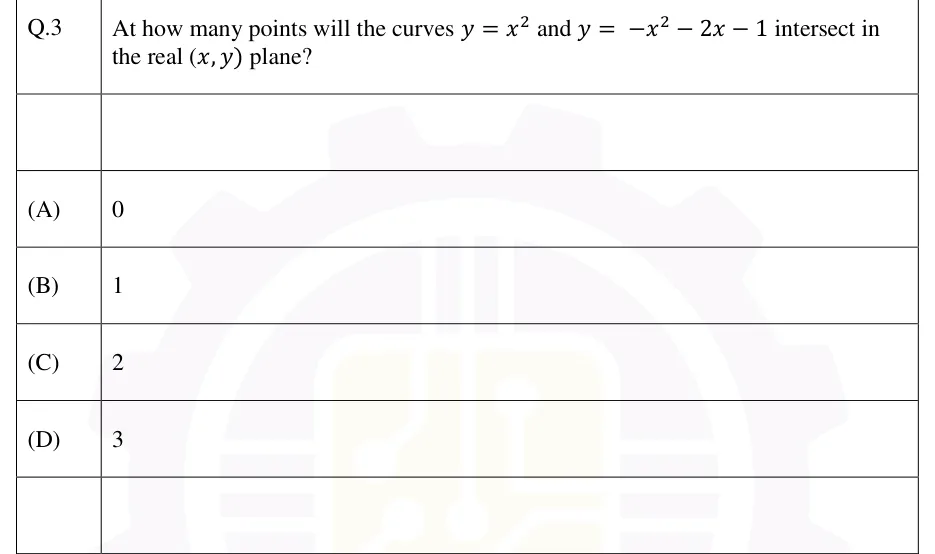
At how many points will the curves and intersect in the real plane?
- (A)
0
- (B)
1
- (C)
2
- (D)
3

At how many points will the curves and intersect in the real plane?
0
1
2
3
ANSWER
The curves do not intersect at all, so the number of intersection points is 0. Option (A).
Official answer: ASource: Official answer key, GATE 2026 EE (IIT Guwahati)
At a point of intersection, both equations hold, so the two expressions for must be equal: .
Move every term to one side: .
A quadratic has real roots only if its discriminant . Here , , , so
Because , no real satisfies both equations. The curves therefore have no common point in the real plane.
Check by completing the square: , and it equals zero only at . Also , and it equals zero only at . Any common point would need , but the two curves reach at different values of ( and ), so they never meet.
Number of intersection points , which is option (A).
KEY IDEA
Set the two expressions for equal to each other. The number of real roots of the resulting quadratic, read from its discriminant, is the number of intersection points. Here has , so there are none. Another way to see it: opens upward with its vertex at , and opens downward with its vertex at . One curve lies on or above the -axis and the other on or below it, and they touch the axis at different points.
WATCH OUT FOR
Making a sign error while moving terms across. For example, writing gives and the wrong answer (C) 2. The other trap is noticing that both parabolas touch the -axis, assuming they touch each other there, and choosing (B) 1. They touch the axis at and , which are different points.
From the GATE 2026 EE paper. Every question of this paper · Download the full paper · All 58 Numerical questions, with notes