
IAE Academy

GATE 2025 EC GA Q.4: solution and answer

GATE 2025 · ECGA Q.4 · 1 mark · MCQ

The following figures show three curves generated using an iterative algorithm. The total length of the curve generated after 'Iteration ' is:

Note: The figures shown are representative.

Iteration 0: [a straight segment of length 1]

Iteration 1: [curve made of segments] Length of each segment:

Iteration 2: [curve made of segments] Length of each segment:
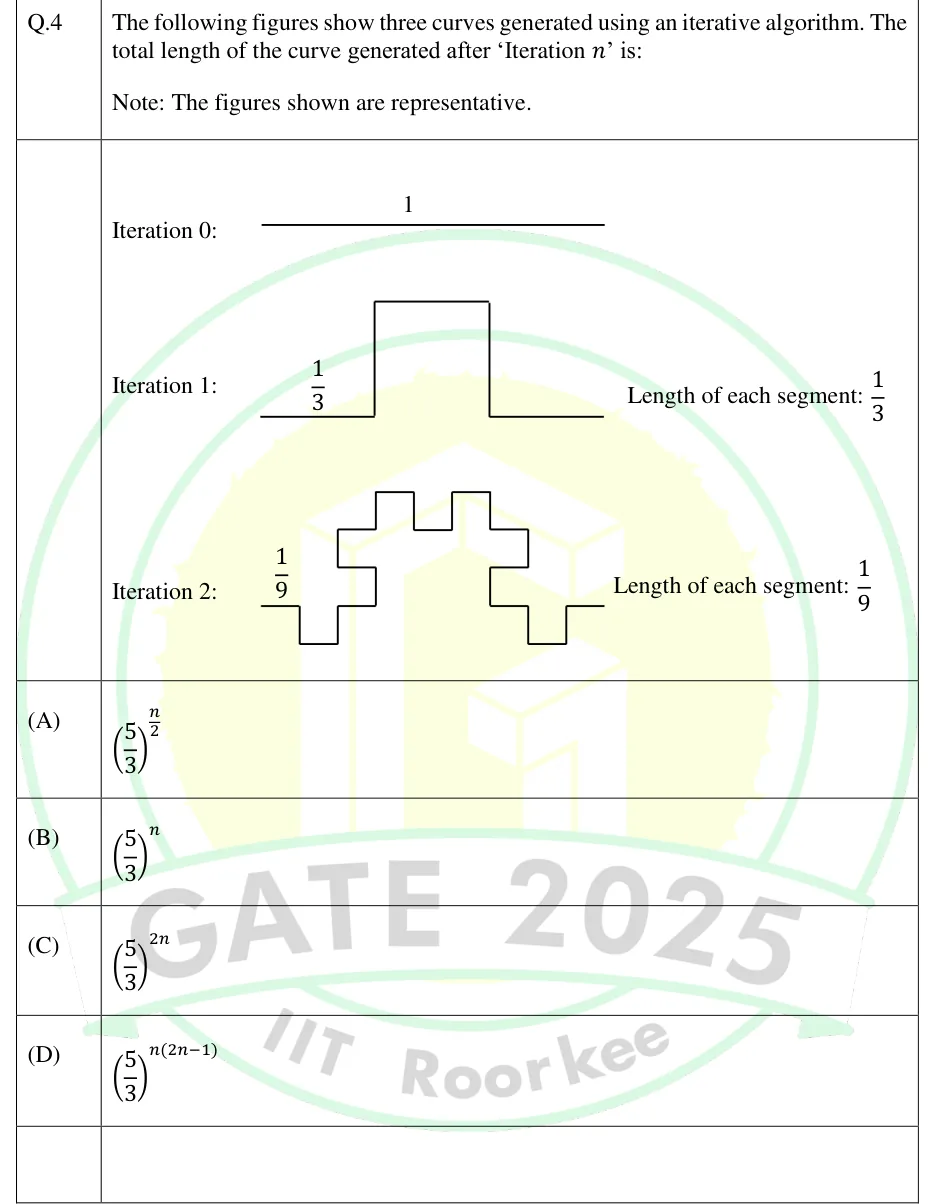
GATE 2025 EC GA question 4: Three curves stacked vertically, each labelled on the left.Tap to open full size
Figure from the GATE 2025 EC paper. It is part of the question.
Figure description

Three curves stacked vertically, each labelled on the left. Iteration 0: a single horizontal line segment labelled '1' above its middle. Iteration 1: the same overall horizontal span, split into thirds. The left third and right third stay horizontal on the baseline (the left one is labelled 1/3 above it). The middle third is replaced by an open square bump pointing up: a vertical line up, a horizontal line across the top, and a vertical line down, each 1/3 long. That makes 5 equal segments. The text on the right reads 'Length of each segment: 1/3'. Iteration 2: each of the 5 segments of Iteration 1 is replaced by a copy of the same motif at one-third scale (square bumps with side 1/9). The result is a stepped, cross-like outline. The left and right baseline pieces each carry a small square notch that dips below the baseline, the two vertical sides carry small square steps, and the top has small square bumps and a dip. The leftmost small segment is labelled 1/9, and the text on the right reads 'Length of each segment: 1/9'.

  1. (A)

  2. (B)

  3. (C)

  4. (D)

Answer and solution

ANSWER

Each iteration turns every segment into 5 segments, each one-third as long, so the length is multiplied by 5/3 each time and L_n = (5/3)^n. The answer is option (B).

Official answer: BSource: Official answer key, GATE 2025 EC (IIT Roorkee)

  1. Read the rule from Iteration 1. The straight segment is cut into thirds, and the middle third is replaced by three sides of a square (up, across, down), each side long. So one segment becomes 5 segments, each as long.

  2. Iteration 0: 1 segment of length 1, so .

  3. Iteration 1: segments of length , so .

  4. Iteration 2: each of those 5 segments is replaced by the same motif at one-third scale. That gives segments of length , which you can count in the figure: 5 on each baseline piece, 5 on each vertical side and 5 on the top. So . The direction each small bump points in does not change the length. This is why the paper says the figures are representative.

  5. General term: each iteration multiplies the number of segments by 5 and divides the length of each segment by 3. So the total length is multiplied by every time:

  6. Check the options against , and . Option (B) gives , and , so all three match. Option (A) gives at and option (C) gives at , so both fail. Option (D) gives at , which matches, but at it gives , which does not. Only (B) fits every iteration shown.

  7. Answer: (B)

KEY IDEA

When every segment is replaced by k copies, each scaled by a factor r, the total length is multiplied by k times r at every iteration. The length therefore grows geometrically, L_n = (kr)^n × L_0. Here k = 5 and r = 1/3, so L_n = (5/3)^n.

WATCH OUT FOR

Checking only n = 1. Option (D) also gives 5/3 at n = 1, because n(2n-1) = 1 there. Only n = 2 (25/9, against (5/3)^6 for D) separates it from (B). A second mistake is counting the segments of Iteration 2 as 5 × 3 = 15 instead of 5 × 5 = 25, or being put off by bumps that point in different directions. Orientation does not change length.

From the GATE 2025 EC paper. Every question of this paper · Download the full paper · All 58 Numerical questions, with notes

More Numerical questions