
IAE Academy

GATE 2026 IN GA Q.2: solution and answer

GATE 2026 · INGA Q.2 · 1 mark · MCQ

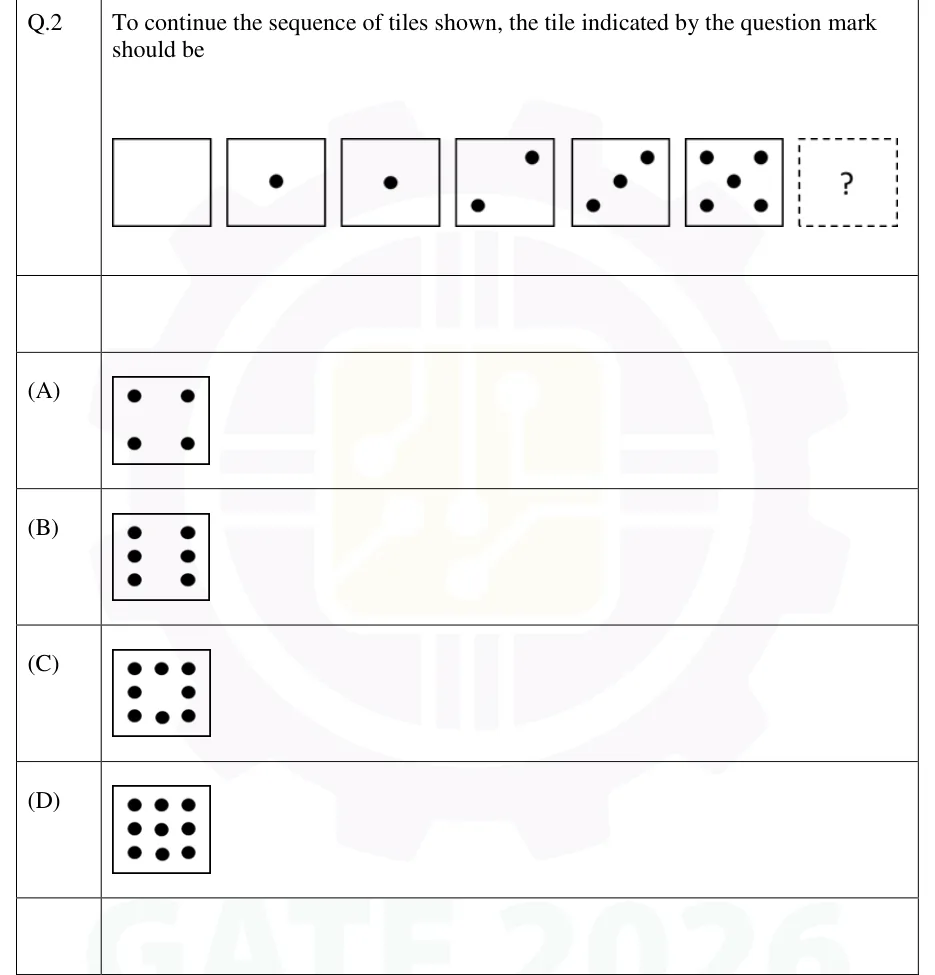
To continue the sequence of tiles shown, the tile indicated by the question mark should be

Figure — a row of seven square tiles, left to right. Tile 1: empty. Tile 2: one dot at the centre. Tile 3: one dot at the centre. Tile 4: two dots, one at the top-right corner and one at the bottom-left corner. Tile 5: three dots along the diagonal (bottom-left corner, centre, top-right corner). Tile 6: five dots (all four corners and the centre). Tile 7: a dashed-outline square containing a question mark.
GATE 2026 IN GA question 2: A horizontal row of seven equal square tiles with solid black outlines, except the seventh, which has a dashed outline…Tap to open full size
Figure from the GATE 2026 IN paper. It is part of the question.
Figure description

A horizontal row of seven equal square tiles with solid black outlines, except the seventh, which has a dashed outline and holds a "?" at its centre. Filled black dots sit inside the tiles as follows. Tile 1: no dots. Tile 2: 1 dot at the centre. Tile 3: 1 dot at the centre. Tile 4: 2 dots, one at the top-right and one at the bottom-left. Tile 5: 3 dots along the rising diagonal: bottom-left, centre and top-right. Tile 6: 5 dots, one in each of the four corners and one at the centre (the five on a die). The four options are also tiles. (A) 4 dots, one in each corner. (B) 6 dots in two vertical columns of 3, left and right (the six on a die). (C) 8 dots around the edge: a row of 3 along the top, one dot at the middle of the left side, one at the middle of the right side, and a row of 3 along the bottom; the centre is empty. (D) 9 dots in a full 3 x 3 grid.

  1. (A)

    Figure — a tile with 4 dots, one in each corner

  2. (B)

    Figure — a tile with 6 dots in two vertical columns of three (left and right)

  3. (C)

    Figure — a tile with 8 dots around the edge: three along the top, one at the middle of each side and three along the bottom; the centre is empty

  4. (D)

    Figure — a tile with 9 dots in a full 3 x 3 grid

Answer and solution

ANSWER

The tile at the question mark is (C), the one with 8 dots. The dot counts 0, 1, 1, 2, 3, 5 follow the Fibonacci rule, so the next count is 3 + 5 = 8.

Official answer: CSource: Official answer key, GATE 2026 IN (IIT Guwahati)

  1. Count the dots on each tile from left to right:

  2. Check the differences first: . They are not constant, so the sequence is not arithmetic.

  3. Test the Fibonacci rule, in which each term is the sum of the two terms before it: , , , . All four checks hold, so this rule produces every term shown.

  4. So the next tile must have dots.

  5. Count the dots on each option: (A) has , (B) has , (C) has and (D) has .

  6. Only option (C) has dots, so the missing tile is (C).

KEY IDEA

In a tile series, ignore the pictures at first and just count what is on each tile. Here the counts 0, 1, 1, 2, 3, 5 form the Fibonacci sequence, where each term is the sum of the two before it. So the next term is 3 + 5 = 8, and only one option has 8 dots.

WATCH OUT FOR

Tile 6 looks like the five on a die, so it is easy to assume the tiles are die faces counting up and pick (B), the six. That rule breaks at the start: the tiles begin 0, 1, 1, so a count does repeat. The other mistake is picking (D), the full 3 x 3 grid, because it looks like the natural way to finish the pattern. It has 9 dots, not 8.

From the GATE 2026 IN paper. Every question of this paper · Download the full paper · All 58 Numerical questions, with notes

More Numerical questions