
IAE Academy

GATE 2020 IN GA Q.9: solution and answer

GATE 2020 · INGA Q.9 · 2 marks · MCQ

Select the graph that schematically represents BOTH and properly in the interval , for integer values of , where .
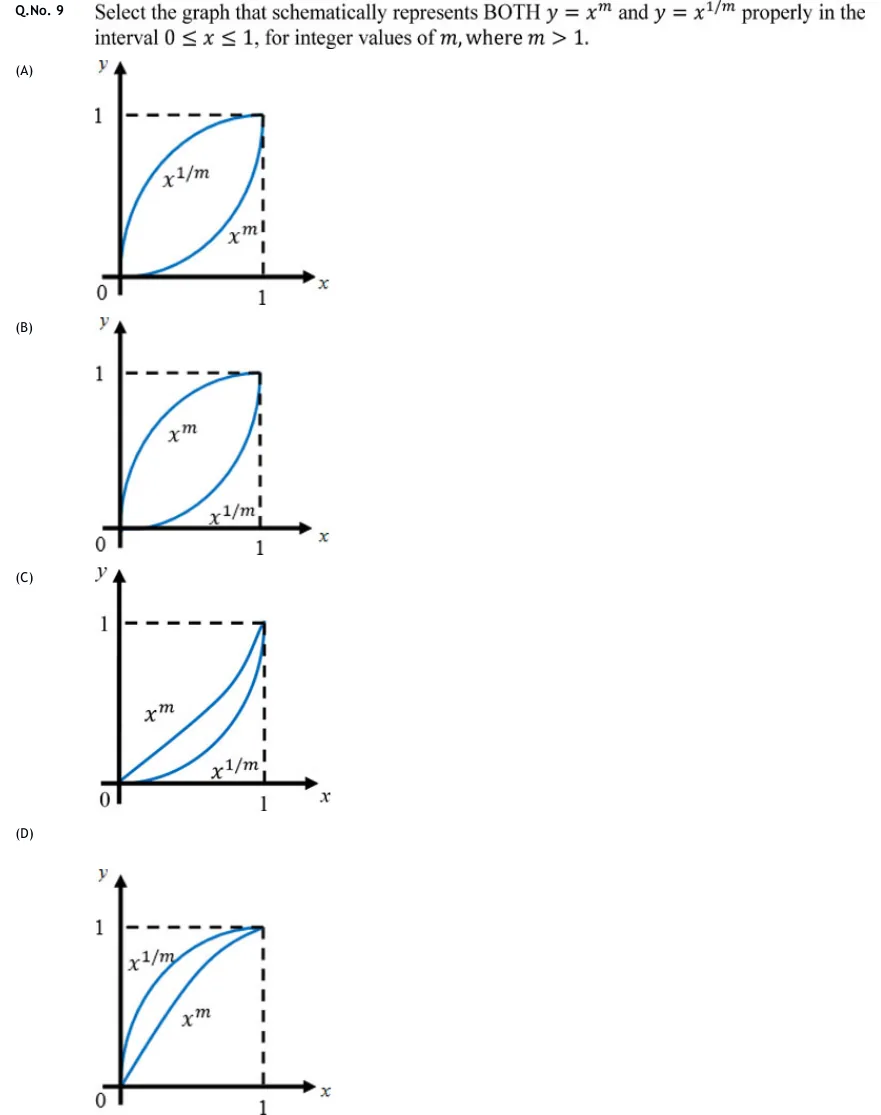
GATE 2020 IN GA question 9: Every option is a graph drawn the same way.Tap to open full size
Figure from the GATE 2020 IN paper. It is part of the question.
Figure description

Every option is a graph drawn the same way. The vertical axis is labelled y and the horizontal axis x. The origin is labelled 0 and each axis has a tick marked 1. A dashed horizontal line runs from y = 1 across to x = 1, and a dashed vertical line runs from there down to x = 1 on the x-axis, so together with the axes they outline the unit square. Two solid blue curves join (0,0) to (1,1). (A): the upper curve is concave: it leaves the origin almost vertically and levels off as it reaches (1,1). It is labelled x^1/m. The lower curve is convex: it leaves the origin almost flat along the x-axis and rises steeply into (1,1). It is labelled x^m. The two curves are mirror images about the diagonal. (B): the same two curves as in (A), concave on top and convex below, but with the labels swapped: the upper concave curve is labelled x^m and the lower convex curve x^1/m. (C): the upper curve is almost a straight line from the origin, close to the diagonal, and bends upward steeply just before (1,1). It is labelled x^m. The lower curve is convex: it starts flat near the origin and rises steeply into (1,1). It is labelled x^1/m. Both curves lie on or below the diagonal. (D): both curves are concave and lie above the diagonal. The upper curve rises very steeply from the origin and levels off at (1,1). It is labelled x^1/m. The lower curve bows up less and is closer to the diagonal. It is labelled x^m.

  1. (A)

    Figure — upper concave curve labelled (steep at the origin, levelling off at ); lower convex curve labelled (flat at the origin, steep at ); the two are mirror images about

  2. (B)

    Figure — the same pair of curves as (A), with the labels swapped: upper concave curve labelled , lower convex curve labelled

  3. (C)

    Figure — upper curve, nearly straight and turning up sharply near , labelled ; lower convex curve labelled ; both on or below the diagonal

  4. (D)

    Figure — two concave curves above the diagonal: the steeper upper one labelled , the flatter lower one labelled

Answer and solution

ANSWER

(A): the curve labelled is concave and lies above , the curve labelled is convex and lies below it, and both join to .

Official answer: ASource: Official answer key, GATE 2020 IN (IIT Delhi)

  1. Endpoints: and , so both curves join to . All four options do this, so the endpoints alone cannot decide the answer.

  2. Order between the endpoints: take . Since , , so . Now put , so . By the same argument , which means . Together, Check with and : .

  3. So the curve labelled must lie above the line and the curve labelled must lie below it. That rules out (B), where the labels are reversed, and (C), where is drawn below .

  4. Shape of : and for , so the curve is convex (it bends upward). Because , the slope is at and at : flat at the start, steep at the end.

  5. Shape of : and for , so the curve is concave. Since , the slope grows without bound as , and it equals at : steep at the start, levelling off at the end.

  6. The two functions are inverses of each other on (), so their graphs are mirror images in the line . In (D) the curve labelled is drawn concave and above the diagonal, which contradicts steps 2 and 4. So (D) is wrong.

  7. (A) draws concave and above the diagonal, steep at the origin, and convex and below it, flat at the origin, as mirror images of each other. This matches every property found above. The answer is (A).

KEY IDEA

On , raising a fraction to a power greater than 1 makes it smaller and raising it to a power less than 1 makes it larger, so . is convex with slope 0 at the origin, is concave with a vertical tangent there, and as inverse functions their graphs are mirror images in .

WATCH OUT FOR

Carrying over the intuition from , where is the larger of the two, and so choosing (B), which has the right shapes but swapped labels. Another mistake is to check only the endpoints and , which every option satisfies, and never test a point in between such as .

From the GATE 2020 IN paper. Every question of this paper · Download the full paper · All 58 Numerical questions, with notes

More Numerical questions