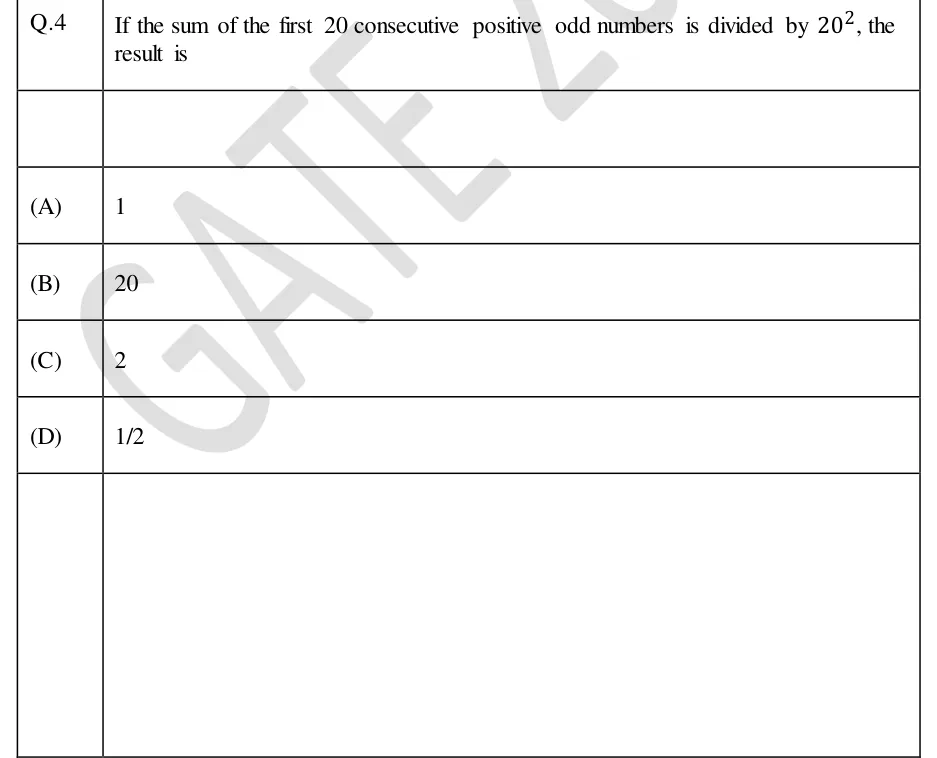
If the sum of the first 20 consecutive positive odd numbers is divided by , the result is
- (A)
1
- (B)
20
- (C)
2
- (D)
1/2

If the sum of the first 20 consecutive positive odd numbers is divided by , the result is
1
20
2
1/2
ANSWER
The sum of the first 20 positive odd numbers is , so dividing by gives 1. The answer is option (A).
Official answer: ASource: Official answer key, GATE 2024 IN (IISc Bengaluru)
The first 20 consecutive positive odd numbers are . The -th positive odd number is , so the 20th is .
These numbers form an arithmetic progression with common difference 2. Sum of an arithmetic progression = (number of terms) (first term + last term) / 2:
This agrees with the standard result that the sum of the first positive odd numbers is : .
Divide by :
The result is 1, which is option (A).
KEY IDEA
The sum of the first positive odd numbers is always , because . Here , so the sum is exactly and the ratio is 1.
WATCH OUT FOR
Taking the 20th odd number to be 41 (confusing with ) or including 0, which gives a wrong sum. Another slip is using the formula for the sum of the first natural numbers, , in place of the sum of odd numbers. Both lead to a ratio that is not 1.
From the GATE 2024 IN paper. Every question of this paper · Download the full paper · All 58 Numerical questions, with notes